Paying Respects in #FFFFFF
Why is this WebDev meme funny?
Level 1: The Loudest Silence
Imagine the person who invented the recipe for mixing paint passes away, and to honor them, the whole world holds up... a perfectly blank white canvas. At first it looks like nobody bothered to make anything — but white is a color from their recipe book, maybe the most-used one of all. It's like honoring the inventor of the alphabet with a moment of silence: the silence only means something because of what they invented. The joke is that the tribute looks like nothing, until you realize it's secretly the biggest something on the page.
Level 2: What #FFFFFF Actually Says
A hex color code is a six-character recipe for a color, written in hexadecimal (base-16, digits 0-9 then A-F). The six characters split into three pairs — #RRGGBB — telling the screen how much red, green, and blue light to mix, each from 00 (none, 0) to FF (maximum, 255). So #FF0000 is pure red, #000000 is black (all lights off), and #FFFFFF is white: every channel cranked to full. That's the decoding step the meme demands — the white rectangle isn't empty, it's the value "all 255s" filling the frame.
body {
background-color: #FFFFFF; /* the joke, in production */
}
If you're early in your career, this meme doubles as a rite-of-passage check. The first time someone hands you a design and says "make the border #E5E7EB," hex looks like keyboard noise. A few weeks of building UIs later, you're the person who glances at a blank page and thinks "ah, FFFFFF" — at which point the original poster's warning, "Complex meme. Hope you will got it," stops applying to you. Three pairs, three light channels, 256 levels each: that's the whole system, and it's been quietly painting every webpage you've ever seen.
Level 3: A Eulogy in Sixteen Million Colors, Delivered in One
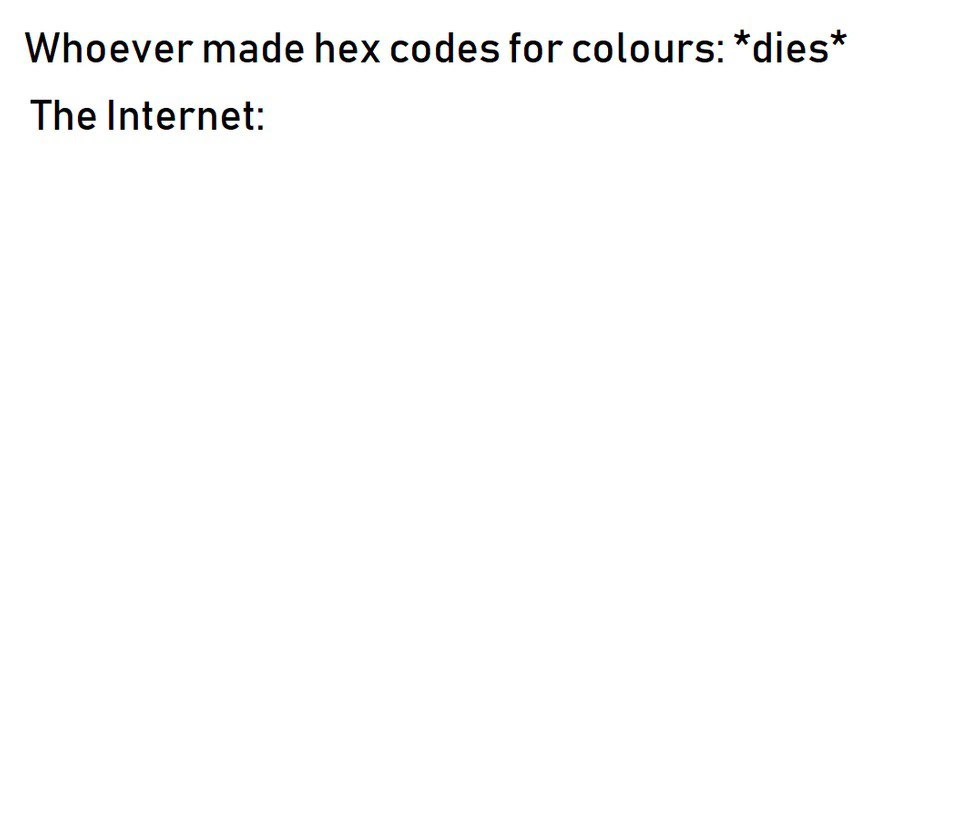
The entire meme is two lines of black text — "Whoever made hex codes for colours: *dies*" and "The Internet:" — followed by nothing. A vast, deliberate field of pure white. That emptiness is the punchline, and it only fires if your brain has been rewired by frontend work to read blank white space not as "no content" but as a value: #FFFFFF. The tribute to the inventor of hex color codes is expressed in hex color codes. The medium is the memorial.
What makes this land with working developers is how precisely it captures a professional deformation. After enough years of CSS, you stop seeing colors and start seeing encodings. A sunset is a gradient stop. "Slightly warmer gray" is the difference between #CCCCCC and #D3CFC9. The meme weaponizes that reflex: it gives you an image that is, by any normal standard, broken — it looks like a screenshot of a page that failed to load, the dreaded white screen of death — and trusts the audience to decode absence as data. There's a quietly clever inversion, too: human mourning conventions say black, but the web's resting state, its default canvas before any stylesheet loads, is white. The Internet doesn't wear black to a funeral; it reverts to background-color: #FFFFFF, the most-shipped color in history. A moment of silence, rendered as a moment of blankness.
There's also a wry historical wink buried here. Nobody single-handedly "made hex codes for colours" — the convention emerged from 24-bit RGB hardware representation and was popularized when early HTML adopted #RRGGBB notation in the 1990s. The meme's fictional lone inventor getting a planet-wide tribute is itself part of the joke structure: the "X: *dies* / The Internet:" template usually cuts to an elaborate outpouring of grief. Here the outpouring is maximal and minimal at once — all 16,777,216 expressible colors honored by displaying exactly one of them.
Description
A minimalist and clever meme presented on a completely white background. The text at the top reads, 'Whoever made hex codes for colours: *dies*' followed by 'The Internet:'. The rest of the image is a vast, empty white space. The joke is a visual pun for web developers and designers. The blank white area itself is the punchline, as the hexadecimal code for the color white is #FFFFFF. This is a creative evolution of the 'Press F to pay respects' meme, where 'F' is part of the hex code for white. The internet is visually paying its respects by displaying the color associated with the ultimate hex value
Comments
8Comment deleted
Of course they used #FFFFFF. Displaying #000000 would have just been too dark for the occasion
We posted the obituary in #FFFFFF on #FFFFFF - nothing honors the inventor of hex codes like a final PR that flunks every WCAG contrast check
The Internet: *responds entirely in #F0F0F0 on a #FFFFFF background to express their grief*
A fitting memorial: 16,777,215 colors to choose from and the Internet ships the default background anyway
The Internet's silence speaks volumes - we're all too busy arguing whether #000000 is 'true black' or if we should use #0a0a0a for 'accessibility,' while simultaneously copy-pasting hex codes from Stack Overflow because nobody actually memorizes that #7FFFD4 is 'aquamarine.' The real tragedy? We've collectively spent more time debugging why #FFF isn't rendering than mourning the person who decided base-16 was the perfect way to represent millions of colors
The perfect frontend paradox: cursing hex codes in a meme that's only legible with a color picker - self-inflicted dev masochism at its finest
Only the web would turn “press F to pay respects” into body { color: #FFFFFF } on a white background - an elegant tribute and a WCAG violation in one commit
Internet tribute to the hex-color inventor: body { background: #000 !important; } - instant audit of which legacy apps still hardcode #000 text and call it “dark mode.”