The Hard Truth of the Tech Interview Circuit
Why is this Interviews meme funny?
Level 1: Tiny Task, Big Surprise
This joke is funny because it’s about expecting something really hard and then finding out it’s super easy. Imagine you studied for a big math test, practicing all these tough problems, and then the teacher only asks, “What’s 1 + 1?” You’d be shocked and probably a little confused. In the meme, the person was bracing for a difficult challenge (like a really tricky puzzle), but the “big question” turned out to be a very simple task. It’s the surprise and contrast that make it humorous: they prepared for a dragon, and got a harmless little lizard instead. The truth was so easy that it left them speechless!
Level 2: Left, Right, Swap!
Let’s break down the joke in simpler terms. In programming, a binary tree is a structure where each node can have up to two children (think of them as two sub-nodes branching off). We label one child the left child and the other the right child. The top node is called the root. Now, inverting a binary tree means making a mirror image of it. In other words, every left child and right child get swapped at every level. (Don't worry, we’re not talking about turning a real tree upside-down! We just mean swapping pointers in a data structure, not flipping an actual plant in a pot.)
For example, imagine a simple tree where node 1 has 2 as its left child and 3 as its right child. If we invert this tree, 1 will now have 3 as the left child and 2 as the right child. We apply that swap for every node. So if node 2 originally had children 4 (left) and 5 (right), after inversion node 2’s left child would be 5 and its right child would be 4. Visually, it’s like holding the tree diagram in front of a mirror: everything on the left side appears on the right, and vice versa.
How do you actually invert a binary tree in code? One of the easiest ways is using recursion – which means a function calls itself to solve smaller parts of the problem. You would write a function that, given a node, swaps that node’s left and right children, and then calls itself on each of those children to perform the same swap down the line. Eventually, this will flip the entire structure. It’s a short and sweet algorithm. In fact, many coding practice websites (like LeetCode, a popular site for preparing for technical interviews) tag this problem as an Easy level exercise. It usually doesn’t stump people who have seen binary trees before. The key steps are just:
- Visit each node.
- Swap its left and right child pointers.
- Repeat for its children (using recursion or a loop).
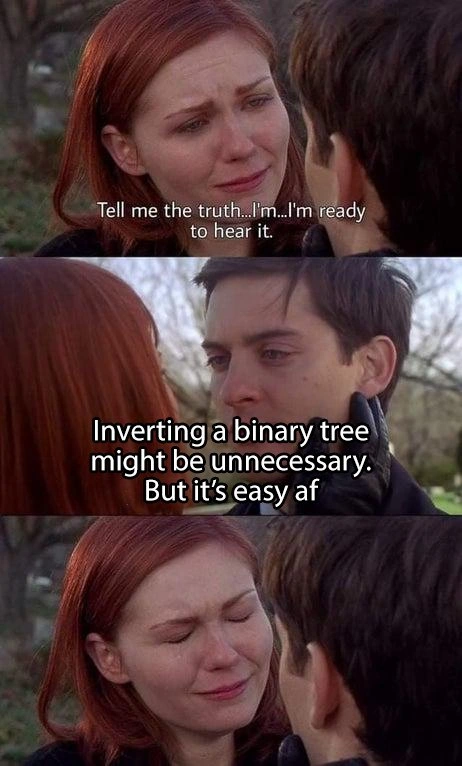
That’s why the meme calls it “easy af” – which is informal slang for “extremely easy.” The joke is that interviewers sometimes present this question like a big challenge or a “bombshell,” but if you’ve practiced basic CS fundamentals, it’s straightforward. In the meme’s three panels (taken from a Spider-Man movie scene), the red-haired woman (Mary Jane) says, “Tell me the truth, I’m ready to hear it.” She’s bracing herself, much like a nervous interview candidate expecting a difficult question or an important revelation. In the next panel, the interviewer (Peter Parker) drops the truth: “Inverting a binary tree might be unnecessary. But it’s easy af.” In plain terms, he’s saying, “Alright, here’s the truth: this famous interview question is actually not that useful in real life, but it is super easy.” The final panel shows Mary Jane’s stunned, speechless face.
(By the way, this Spider-Man scene is a popular meme template for dramatic revelations – often captioned with “Tell me the truth.” It’s used here to humorously deliver an underwhelming tech revelation.)
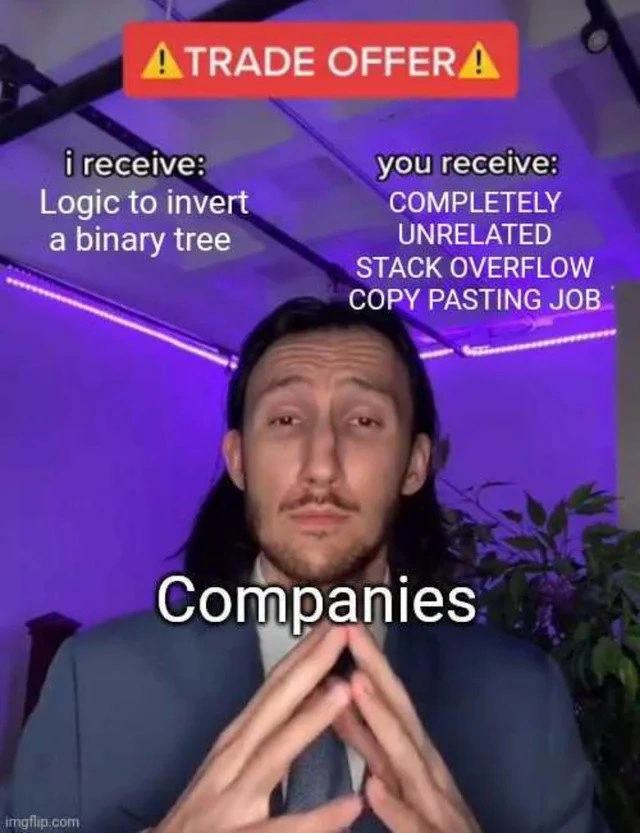
So why the shock on her face? It’s a bit absurd to realize that a problem hyped up in interviews is, in reality, pretty trivial and arguably pointless outside of interview practice. Many aspiring developers train hard for coding interviews, grinding through lots of algorithm problems. Hearing that one of the canonical questions you spent time preparing is admittedly unnecessary (even though you had to study it to get the job) can be both funny and frustrating. It highlights a gap between what interviews ask for and what programmers actually do on the job. The meme pokes fun at that disconnect in a way that’s very relatable for anyone who has gone through a coding interview. The humor comes from the dramatic setup versus the silly truth: the “big secret” is that an interview favorite is easier and less important than everyone pretends.
Level 3: Mirror Mirror on the Tree
To a seasoned developer, the “invert a binary tree” question is practically interview folklore. It's a classic whiteboard exercise that every candidate with a week of LeetCode practice has seen. Technically, inverting a binary tree (also called mirroring a binary tree) means swapping each node’s left and right children. That’s it. No exotic data structures, no tricky edge cases – just a simple recursive traversal flipping pointers as it goes. The entire algorithm often fits in just a few lines of code:
def invert_tree(node):
if node is None:
return None
# recursively invert the subtrees
node.left, node.right = invert_tree(node.right), invert_tree(node.left)
return node
In this implementation, we visit every node (hitting both left and right subtrees) exactly once, giving a time complexity of O(n) for a tree with n nodes. It’s about as straightforward as an algorithm can get – essentially a depth-first search that swaps pointers. Many developers could write this in their sleep, and indeed, it's rated “Easy” on coding practice sites like LeetCode. In interviews, solving it correctly is almost a rite of passage, on par with reversing a linked list or the infamous FizzBuzz problem.
The humor of this meme comes from a shared realization: technical interviews often drill CS fundamentals that have little bearing on day-to-day engineering. Inverting a binary tree is a textbook example of an algorithmic trivia question – something you memorize for the interview, then rarely (if ever) implement in a real job. It’s telling that one famous developer joked about failing a big tech interview because he “couldn’t invert a binary tree on a whiteboard,” despite having created software used by millions. That anecdote turned this humble algorithm into the poster child for interview absurdity. After all, how often do we actually need to produce the mirror image of an entire tree structure in production? Virtually never. If you wanted a sorted tree’s data in reverse order, you could just traverse it backward – you wouldn’t physically flip the tree unless you were doing something very specialized (or just showing off).
Yet, here we are. Interviewers keep this question in their rotation because it’s quick to ask, easy to evaluate, and a handy way to see if a candidate understands recursion and basic data structures. The meme nails the irony: the unnecessary algorithm everyone stresses about is, in truth, “easy af.” In the second panel, our straight-faced interviewer (played by Peter Parker) drops that truth bomb. He's essentially admitting, “Yeah, we know inverting a binary tree isn’t actually useful in the real world – but come on, it’s so simple!” Meanwhile, the candidate (Mary Jane in the first and third panels) is left speechless. Her expression screams a mix of “Wait... seriously?!” and “All that anxiety for this?!” It’s the face of someone who prepared for a brain-bending challenge only to be hit with a trivial task.
This resonates with any developer who has prepped intensely for coding interviews. We drill complex algorithms and puzzle problems, worrying about corner cases, only to encounter a softball question like this. It’s almost insulting and relieving at the same time. The meme captures that relatable experience: the tension of anticipating a dreaded interview bombshell, followed by the awkward relief (and slight exasperation) when the “bombshell” turns out to be a basic question you mastered ages ago. Binary trees and their inversion have basically become an inside joke in the programmer community – a tongue-in-cheek symbol of how disconnected interview testing can be from actual software engineering.
Even the choice of meme format – the dramatic “Tell me the truth” scene from Spider-Man – adds a layer of irony. In the movie, this scene is charged with emotion and serious revelations. Here, it's used to reveal an almost comically mundane truth about coding interviews. The over-the-top seriousness of Mary Jane’s “I’m ready to hear it” setup versus the underwhelming answer highlights the absurdity perfectly. For experienced devs, it’s a nod and a wink: we’ve all been Mary Jane, bracing ourselves for some deep algorithmic ordeal, only to find out the challenge is as straightforward as swapping left and right nodes. (At least they didn’t ask you to manually rebalance a red-black tree – now that would be a real nightmare.)
Description
A three-panel meme using the 'Tell Me the Truth' format from the Sam Raimi 'Spider-Man' movie, featuring Mary Jane Watson and Peter Parker. In the first panel, a tearful Mary Jane says, 'Tell me the truth...I'm...I'm ready to hear it.' In the second panel, Peter Parker solemnly replies, 'Inverting a binary tree might be unnecessary. But it’s easy af'. The final panel shows Mary Jane crying. The meme satirizes the heated debate around a classic tech interview question that became infamous after the creator of Homebrew was rejected by Google for failing to solve it. The humor for senior developers lies in the dual 'truth': the algorithm is often irrelevant to real-world jobs, yet for anyone with a formal CS background, it's considered a trivial problem. The punchline captures the frustrating disconnect between academic gatekeeping and practical engineering skills
Comments
8Comment deleted
We spend years arguing if inverting a binary tree is a valid interview question, while the real hard truth is that most of our careers will just be inverting the order of divs with CSS
Sure, I can invert a binary tree on a whiteboard - just don’t expect the same turnaround when you ask me to invert the 200-service call graph your “simple” micro-monolith grew last quarter
We've spent 20 years optimizing our hiring pipeline to select for people who can solve problems they'll never encounter using techniques they'll never apply, and we're genuinely surprised when they can't debug a distributed cache coherency issue in production
After years of FAANG interviews, we've collectively realized that inverting a binary tree is the technical equivalent of being asked 'where do you see yourself in five years?' - everyone knows it's coming, everyone has a prepared answer, and it tells you absolutely nothing about whether the candidate can actually architect a distributed system that won't fall over at 3 AM on Black Friday
Inverting a binary tree is trivial; inverting ten years of Conway's Law baked into your microservices is the real NP-hard problem
Amazing how many companies think flipping pointers in O(n) predicts whether you can unwind a multi‑region outage at 3 a.m
Unnecessary in prod, but skip it in interviews and watch your offer invert itself
Are all gifs in english? They have to be english Comment deleted