Brain As A Virtual Machine
Why is this Virtualization meme funny?
Level 1: Pretend Brain
It is like trying to play yourself and another person in a board game at the same time. You keep guessing what the other player would do, but all the guessing still happens inside your own head. The funny part is that developers describe this ordinary overthinking as if the brain has opened another computer inside itself.
Level 2: Virtual Worry Machines
A virtual machine is a software computer running inside a real computer. Developers use VMs to test different operating systems, isolate risky software, reproduce environments, or run workloads without giving them full control of the host machine. The "host" is the real computer, and the "guest" is the simulated computer.
The meme says that thinking about what others are thinking is like running a VM. The visual joke is that the text treats a normal human habit as if it were infrastructure. Instead of "I wonder what they meant," the developer-brain version is "I have provisioned a temporary simulation of another person's brain."
The "leaks" caption refers to memory leaks, where software forgets to release memory. In everyday learning terms, that means the thought keeps taking up space even after it should be done. This connects to cognitive load: your mind has limited attention, and simulating other people can use a lot of it.
Level 3: Nested Brainware
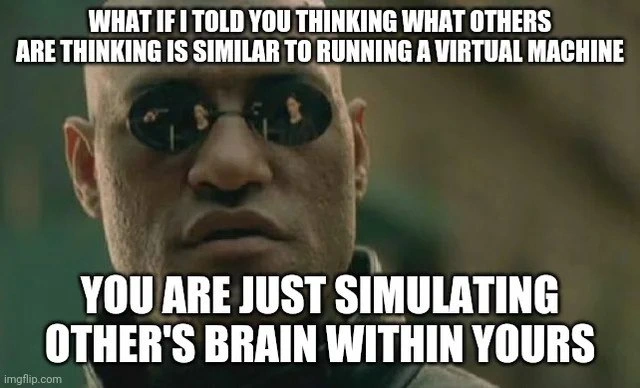
The meme uses a Morpheus-style image and asks:
WHAT IF I TOLD YOU THINKING WHAT OTHERS ARE THINKING IS SIMILAR TO RUNNING A VIRTUAL MACHINE
Then it lands the technical analogy:
YOU ARE JUST SIMULATING OTHER'S BRAIN WITHIN YOURS
That is a surprisingly good developer joke because virtualization is about running one computing environment inside another. A virtual machine has its own operating system, processes, memory, disk, and network assumptions, but all of that is ultimately hosted by a real machine underneath. The meme maps that to social overthinking: when you imagine what another person believes, wants, fears, or might say next, you are effectively spinning up a mental model of their internal runtime inside your own.
The caption, "Be careful with leaks!", sharpens it from philosophical humor into systems humor. A memory leak happens when a program keeps holding resources it no longer needs. In this meme, worrying about someone else's thoughts becomes a leaky guest VM: it keeps allocating attention, replaying conversations, consuming emotional RAM, and refusing to shut down cleanly. Anyone who has debugged both software and their own brain at 2 AM knows which one has worse observability.
The senior-level pain here is resource isolation. Real virtual machines need limits: CPU quotas, memory caps, storage boundaries, network controls, and a way to terminate the instance when it misbehaves. Human empathy and anxiety rarely come with clean hypervisor settings. You can try to model another person's mind, but the model is speculative, lossy, and expensive. Worse, the guest workload may start influencing the host: your own decisions get shaped by an imagined process that may not match the real person at all.
So the joke sits between CS fundamentals and Mental Health. It is funny because the analogy is nerdy, but also because it describes a real cognitive overload pattern with suspicious accuracy. The brain is doing nested virtualization without documentation, billing alerts, or a stop button.
Description
A Morpheus-style Matrix meme image shows a close-up of a man in dark sunglasses against a blurred green background. The top text reads "WHAT IF I TOLD YOU THINKING WHAT OTHERS ARE THINKING IS SIMILAR TO RUNNING A VIRTUAL MACHINE" and the bottom text reads "YOU ARE JUST SIMULATING OTHER'S BRAIN WITHIN YOURS," with an imgflip watermark in the lower left. The post caption says "Be careful with leaks!" extending the analogy into memory/resource-leak humor: empathy or overthinking is framed as hosting another process inside your own mental runtime.
Comments
6Comment deleted
Overthinking is just nested virtualization with no resource limits and suspiciously bad garbage collection.
That's deep Comment deleted
What if I told you that we live in a simulation within another simulation which is in another simulation etc... What if we simulation created by highly developed AI like that from the future used by scientists of that future to remodel history from the very beginning of the universe Comment deleted
How to simulate neuronetwork degradation inside other degraded neuronerwork? Comment deleted
Modify its environment Comment deleted
Exactly, you sir got everything right Comment deleted