Skip to content
DevMeme
The Most Dangerous 'N Word' in Programming
Languages Post #49, on Feb 4, 2019 in TG

The Most Dangerous 'N Word' in Programming

Why is this Languages meme funny?

Level 1: The Empty Box

The joke pretends it's about to say something shockingly rude, then says... "null" — a computer word that just means empty, nothing here. Why would that be scary? Imagine a vending machine that sometimes, instead of a snack, drops an invisible box with nothing inside — and the machine can't tell the difference. You grab it, try to take a bite, and everything falls apart. For programmers, "null" is that invisible empty box: it has ruined so many of their days that the word itself feels like a curse word. The meme is funny because it treats a boring little computer term with the same hushed horror as an actual forbidden word — and honestly, to programmers, it is one.

Level 2: What null Actually Is

null is a special value meaning "nothing is here" — a reference that points to no object at all. It sounds harmless until you learn the catch: in most older languages, any variable can be null at any time, and the moment you use a null value as if it were real, your program crashes:

String name = findUser("ghost");  // not found → returns null
int len = name.length();          // 💥 NullPointerException

A few terms you'll meet alongside it:

  • NullPointerException (NPE) — Java's crash when you poke a null; every language has its dialect of this scream.
  • undefined vs null — JavaScript famously has two nothing-values, because one source of confusion was deemed insufficient.
  • Null check — the ritual if (thing != null) guard you'll soon be sprinkling everywhere, like garlic against a vampire you can't see.

The early-career arc is universal: your first real program works on your machine, then crashes for a user, and the log says something was null that "couldn't possibly" be null. Welcome. Everyone has this story; the only variable is how many layers deep the null traveled before it blew up.

Level 3: The Word You Can't Say in Production

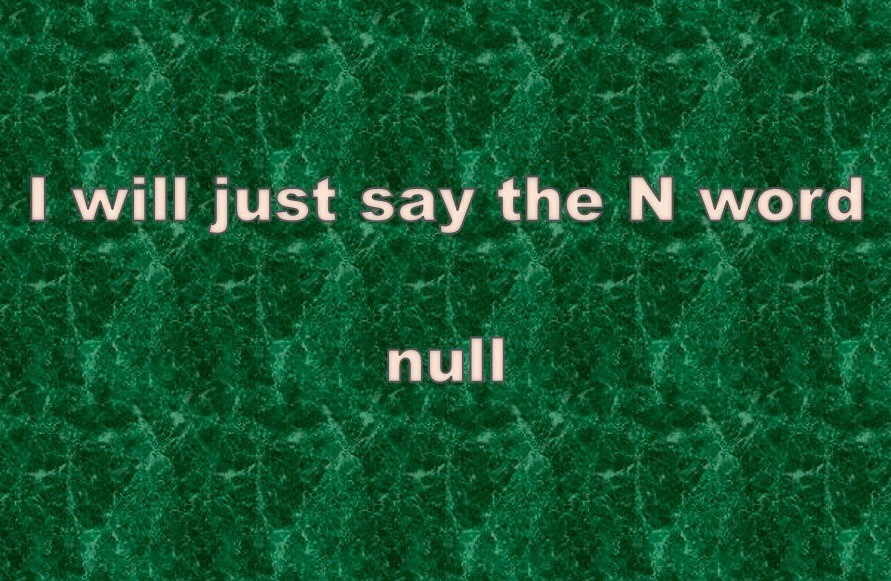
I will just say the N word

null

The meme runs a classic bait-and-switch: the setup primes an edgy transgression, and the punchline swerves into the one word that genuinely is unspeakable in a codebase. The joke's engine is that the substitution barely changes the emotional register — among developers, null carries authentic taboo weight. Say it in a postmortem and watch the room flinch.

The flinch is earned. NullPointerException is plausibly the single most-thrown exception in the history of computing; its JavaScript cousin Cannot read property of undefined is the unofficial error message of the modern web. The failure mode is uniquely cruel because of action at a distance: the null is born innocently in one module — an empty DB column, an unchecked API response, a forgotten initialization — then travels through five layers of code, perfectly camouflaged as a real value, before detonating in a function whose author did nothing wrong. The stack trace points at the victim, not the perpetrator. That's why null-hunting is the canonical 3 AM activity: the bug isn't where the crash is.

And the defenses became their own pathology. Codebases calcify into defensive null-checkingif (x != null) scar tissue wrapping every method, which doesn't fix the design, just relocates the uncertainty while doubling the line count. Teams adopt Optional, then someone returns a null Optional and achieves a new tier of irony. The meme's framing of null as unspeakable is, accidentally, sound engineering doctrine: the entire modern consensus — from Rust to Kotlin to strict TypeScript — amounts to "design your types so this word cannot be uttered." The taboo is the best practice.

Level 4: The Bottom Value That Broke the Lattice

In type-theoretic terms, null is a hole punched through the entire type system. When Tony Hoare added the null reference to ALGOL W in 1965 — "simply because it was so easy to implement," as he confessed when calling it his billion-dollar mistake — he created a value that inhabits every reference type while satisfying the contract of none of them. Declare a String, and the type checker promises you a string; null is the asterisk on that promise, an uninvited bottom-like value that type-checks everywhere and works nowhere. The soundness guarantee — "well-typed programs don't go wrong" — quietly becomes "well-typed programs don't go wrong, except via the one value we let impersonate all types."

The principled fix predates the mistake's apology tour: option types. ML and Haskell encode absence in the type itself — Maybe String is a different type from String, and the compiler forces you to pattern-match both cases before touching the value. Absence becomes data you must handle, not a landmine you might step on. The industry spent five decades converging back on this: Rust's Option<T> with no null at all, Kotlin's String? vs String split, Swift optionals, TypeScript's strictNullChecks, Java limping along with Optional<T> bolted onto a language where everything is still secretly nullable anyway. The lesson is brutal and general: a shortcut in the type system's foundations cannot be patched at the library level, because every line of code written in the intervening fifty years assumed the hole was a floor.

Description

An image with a textured, dark green, marble-like background. It features text in a light, serif font with a slight drop shadow. The first line reads, 'I will just say the N word'. Below it, centered, is the single word 'null'. This meme is a simple but effective pun that plays on the cultural prohibition of a racial slur, subverting the expectation by revealing the 'N word' to be 'null', a ubiquitous and often troublesome concept in programming. For experienced developers, the humor lies in the shared pain caused by null references, which are a common source of critical bugs like NullPointerExceptions, often referred to as 'the billion-dollar mistake.' The meme equates the social taboo of the slur with the technical taboo of using or returning null in modern, robust software design
Comments

8
Anonymous ★ Top Pick Some developers try to avoid 'null' with monads and optionals, but legacy systems ensure it remains the one 'N word' you're guaranteed to hear during every production incident
  1. Anonymous ★ Top Pick

    Some developers try to avoid 'null' with monads and optionals, but legacy systems ensure it remains the one 'N word' you're guaranteed to hear during every production incident

  2. Anonymous

    Every time I see a raw ‘null’ in a PR, I forward the diff to the CFO with the subject: “Potential billion-dollar mistake detected - please budget for an Optional migration.”

  3. Anonymous

    After 20 years in this industry, I've heard Tony Hoare apologize for his billion-dollar mistake, but I've never heard a PM apologize for making nullable fields required in prod

  4. Anonymous

    The real slur is null - Tony Hoare apologized for it, yet it still dereferences its way into every postmortem

  5. Anonymous

    Every senior engineer knows the real 'N word' that keeps them up at night isn't in any HR manual - it's the one Tony Hoare apologized for inventing. We've spent decades building elaborate type systems, Option monads, and Maybe wrappers just to avoid saying it, yet there it is in every stack trace at 3 AM: NullPointerException. The billion-dollar mistake that launched a thousand defensive null checks and made '?.' the most beloved operator in modern languages

  6. Anonymous

    Architecture policy: model absence explicitly (Option/Maybe) - every “null” turns into a 3am RCA and a Tony Hoare quote

  7. Anonymous

    Null: where SQL invents three-valued logic, Java ships the billion-dollar mistake, and your JSON API debates whether absence is data

  8. Anonymous

    Null: programming's N-word - utter it in prod, and your on-call rotation becomes eternal hell

Use J and K for navigation