Skip to content
DevMeme
714 of 7435
Stonks of Overfitting
AI ML Post #810, on Nov 12, 2019 in TG

Stonks of Overfitting

Why is this AI ML meme funny?

Level 1: Cheating on the Exam

Imagine you have a big list of questions and answers that you need to study for a test. On the day of the test, instead of getting new questions, the teacher accidentally gives you the exact same questions with the exact same answers that you already memorized from the study guide. Of course, you’re going to get every question right – you knew all the answers beforehand! You score 100% and feel like a genius. But does that score really prove you’re good at the subject? Not really. It just proves you knew those particular answers by heart.

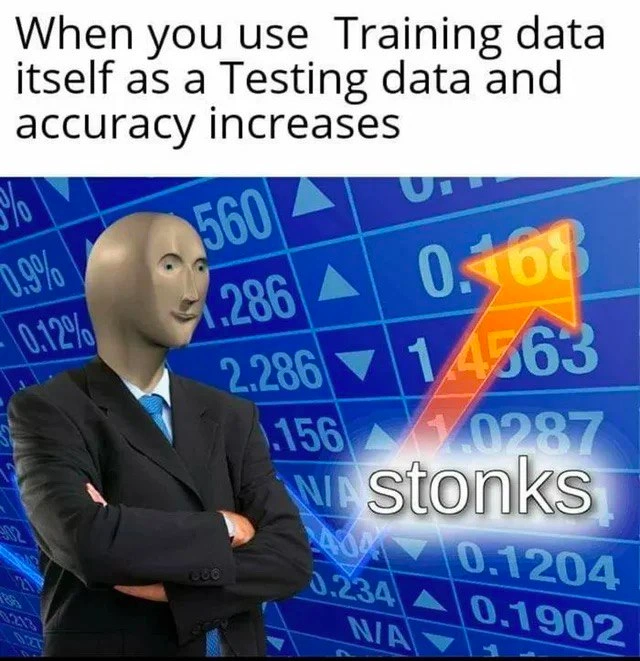
This meme is joking about a similar situation, but with a computer program. The program “learned” from a bunch of examples (that’s the studying part). Then, instead of being tested on new examples, it was tested on the same ones it already saw. Not surprisingly, it did extremely well – just like you aced the test with the questions you already knew. The picture with the silly businessman and the upward arrow is like someone celebrating a huge success, saying “Stonks!” (which is a goofy way of saying “profits!” or “success!” in meme language). The joke is that the success is fake. The program’s accuracy (its score) went way up, but only because it effectively cheated.

So the funny part is like watching someone brag about getting a perfect score on a test when you know they had all the answers in advance. It’s that mix of “Ha, well of course you did well – you peeked!” and a little bit of “Oops, you don’t actually know anything new, do you?” Everyone can laugh because we understand that doing only what you practiced is not a real achievement. In simple terms: the meme is comparing a machine learning model to a student who cheated on the exam, and it’s using a popular silly stock-market image to make the point in a lighthearted way. The message: if you already had the answers, getting a high score isn’t real success – and that’s why this “skyrocketing accuracy” is more funny than impressive.

Level 2: Testing on Training

Let’s break down what’s happening in simpler terms. In machine learning, we typically split our data into at least two parts: a training set and a testing set. The training data is what we feed to the model to learn from – kind of like the material you study. The testing data (also called a test set) is meant to be like an exam or quiz; it’s a separate batch of examples that the model has never seen during training. We evaluate the model on this test set to see how well it learned – in other words, to check if it can make correct predictions on new, unseen data.

Now, accuracy is one common way to measure how well a model is doing. Accuracy is defined as the proportion of correct predictions out of all predictions. It’s usually given as a percentage. For example, 90% accuracy means the model got 9 out of 10 predictions right. In the context of the meme, accuracy is the metric that is “increasing” and making the graph (and the stonks figure) look happy. Normally, when you train a model, you expect the accuracy on the training data to be high (since the model adjusts itself to get those training examples right). However, the accuracy on the testing data is usually lower than on training data. This is because the test data is new to the model – it can’t just recall answers, it has to genuinely predict them. The difference between training accuracy and testing accuracy tells us if the model is overfitting or not. Overfitting means the model is too tightly tuned to the training data details and isn’t generalizing well. A little drop in accuracy from train to test is normal, but if your training accuracy is 100% and test accuracy is, say, 60%, that’s a red flag that the model memorized the training data and failed to learn the true patterns.

What the meme jokes about is someone doing something you should never do: using the training data itself as the testing data. In other words, they skipped the whole idea of a separate test set. They trained the model on data and then evaluated it on the exact same data. Of course the model’s going to do extremely well in that case! It’s like teaching a student answers to 100 trivia questions and then immediately quizzing them with those exact same questions. The student will likely get 100/100 – a perfect score – but it doesn’t prove they’re good at trivia in general, only that they memorized those specific answers. Similarly, a model tested on its training set will often report an amazing accuracy, but that number is bogus as an indicator of real performance. It’s artificially inflated. In data science, we call this kind of mistake a form of data leakage or an evaluation mistake. More specifically, this scenario is often referred to as train/test leakage because information from the training phase “leaks” into the test phase (in fact, here they’re one and the same!). This leakage ruins the experiment, because the model isn’t being truly tested on new information at all.

Let’s illustrate with a tiny pseudo-code example in Python-like syntax to see the difference:

from sklearn.model_selection import train_test_split
from sklearn.linear_model import LogisticRegression

# Suppose we have some dataset X, y
X_train, X_test, y_train, y_test = train_test_split(X, y, test_size=0.2)

model = LogisticRegression()
model.fit(X_train, y_train)              # Train the model on training data

train_accuracy = model.score(X_train, y_train)   # Accuracy on training data
test_accuracy  = model.score(X_test, y_test)     # Accuracy on a true test set

print("Training Accuracy:", train_accuracy)
print("Testing Accuracy:", test_accuracy)

In a proper setup, train_accuracy might be high (say 95%), and test_accuracy will usually be a bit lower (maybe 85%, for example). That gap is expected. The test accuracy (~85%) is the meaningful one – it tells us how well the model might do on new data. Now, what if someone ignores the whole train_test_split part and just does this:

model.fit(X, y)                        # Train on ALL the data (no separate test set)
accuracy = model.score(X, y)           # Test on the same data it was trained on
print("Accuracy:", accuracy)

Here, because the model was tested on the exact data it learned, accuracy will likely come out very high, maybe even 1.0 (which means 100%). That looks fantastic, but it’s basically cheating. We have no idea how the model would do on new data, because we never actually checked! We only measured how well it remembered the training examples. This is what the meme is highlighting. It’s as if the code above is making the orange arrow in the meme shoot up to a glowing “Accuracy: 100%”. And the suited “stonks” character is standing there with arms folded, looking proud of this number – while any experienced person knows that number is suspect.

In plain terms, using training data as testing data is a bad practice. It gives you overly optimistic results. Beginners in AI/ML sometimes accidentally do this when they’re first learning, especially if they’re not aware of how important it is to keep test data separate. It’s a very common MachineLearningHumor trope because once you learn the right way, you look back and realize how silly it was to think the model was “genius” for scoring itself on the material it already saw. It’s basically an accuracy metrics abuse: you’re abusing the metric by not using it in the proper way. The key terms to know here are:

  • Training set: the data used to train (fit) the model. The model adjusts its internal parameters to get these examples right.
  • Test set: a separate set of data used to test the model after training. The model has never seen these examples during training.
  • Accuracy: a metric that tells us what fraction of predictions the model got correct. Needs to be measured on test data to mean anything for real-world performance.
  • Overfitting: when a model learns the training data too well (including noise or quirks), and as a result, performs poorly on new data. High training accuracy with much lower test accuracy is a sign of overfitting.
  • Data leakage: any situation where information from the test data ends up in the training process. Using the same data for training and testing is an extreme case of leakage.

All these concepts come together in this meme. The meme basically says: if you evaluate your model on the training set, of course your accuracy will look stonkingly high! (Pun intended with stonks.) But that’s not a valid result. It’s a mistake that provides a false sense of accomplishment. The proper approach is to always evaluate on data that wasn’t used in training, so you get an honest assessment of your model’s performance.

Visually, the meme’s blue background with numbers and an upward arrow parodies a stock market chart. It implies some value (accuracy, in this case) is dramatically increasing. The word “stonks” in big letters is an internet joke – it intentionally spells “stocks” wrong and is paired with that weird mannequin-like businessman figure. It’s often used to mock scenarios where someone thinks they’re doing something financially savvy or clever, but it’s actually foolish in a real sense. Here, the foolish “strategy” is testing on the training data to bump up accuracy. The meme is essentially saying “Look, my model’s accuracy kept going up – stonks!” in a tongue-in-cheek way. Everyone who knows about proper model evaluation will get the joke: the person celebrating has misunderstood how to measure success in machine learning.

So, to recap in simple terms: the meme jokes that if you cheat by checking your work on the same examples you used to learn, you can make your performance look unbelievably good. But that’s just fooling yourself. Real AI/ML success is measured by how well you do on new problems, not the ones you already know. Always keep training and testing separate – that’s one of the first lessons in Data Science 101, and this meme humorously reminds us why!

Level 3: Overfitting to the Moon

Every experienced data scientist immediately recognizes this situation: a model’s accuracy shoots up “to the moon” 🚀 when you evaluate it on the same data it was trained on. The meme shows the famous faceless “stonks” guy with an upward arrow, gleefully celebrating a metric going up. But in the context of machine learning, that giant upward orange arrow is pure irony. We expect accuracy to be near-perfect on the training set – after all, the model has seen (and likely memorized) every example there. So when someone treats that as a legit test result, it’s as nonsensical (and darkly funny) as cheering a stock’s rise based on fake profits. The caption spells it out: using Training data as Testing data makes accuracy increase. No kidding! It’s essentially saying, “Hey, I found a hack to get amazing accuracy: just cheat!” In data science circles, that’s a classic rookie mistake. The meme is poking fun at that naïveté with the exaggerated stock-market success image.

Practitioners share a collective facepalm at this because many of us remember making this mistake exactly once early in our careers. It usually goes like this: Newbie Developer trains their shiny new model and then evaluates it on the training set (perhaps not realizing they need separate test data). They excitedly report, “Guys, I got 98% accuracy!” For a brief moment, they think they’ve struck gold – their model is a genius! But a nearby senior engineer smirks and asks, “That’s on unseen test data, right?” The newbie replies, “Test data? I just checked against the training set.” Cue the sighs and gentle chuckles. The high accuracy is literally true but utterly misleading – the model aced an exam for which it had the answer key in advance. It’s the quintessential example of AI hype vs reality: the hype is “astonishing accuracy achieved!” while the reality is “the evaluation was flawed, so the result means nothing.” The meme distills this scenario with the satirical “stonks” framework: number go up, therefore success (sarcasm implied).

The technical issue at play is overfitting. Overfitting means the model isn’t actually intelligent or generally applicable – it has simply learned the training data by heart. Imagine a student who memorizes the textbook examples verbatim. They’ll get those specific questions right (100% on the practice problems), but throw a new question at them and they blank out. A model that’s evaluated on its training set is just like that student being tested on the exact same practice problems. Naturally, it aces them, and the reported accuracy is through the roof. But if you gave this model fresh, unseen data, its performance would likely plummet. Experienced ML engineers have a rule: always test on data the model hasn’t seen. This is why we do a train-test split (or use cross-validation). If you don’t, you’re basically leaking information from the test into training. That’s called train/test leakage or data leakage, and it renders your evaluation invalid. It’s one of those things every DataScience mentor warns about early on: “Don’t test on training data, or you’re just fooling yourself.”

The meme’s humor also comes from the absurdity of the metrics abuse. Accuracy is a key metric for model performance, but it only has meaning when measured on fresh data. By reusing the training set for testing, you’re abusing the accuracy metric – it’s no longer an indicator of real performance, just a measure of how completely the model fit the training examples. It’s like bragging that your code has 0 bugs after you ran all the unit tests – except you wrote those tests using the code’s expected output. Of course it passes with flying colors, but that doesn’t mean it won’t fail on new input. In software terms, this is akin to the infamous “Works on my machine!” – here the model “works on its training data!” The senior folks laugh (or cringe) because they’ve seen this story play out: a model shows near-perfect accuracy in development, then utterly fails in production. Nine times out of ten, someone mixed up the evaluation procedure.

The stonks meme format amplifies the joke by suggesting a goofy “profit” from a bad practice. In investing, making number go up by cheating the system would be fraud; in ML, making accuracy go up by evaluating on training data is, if not fraudulent, at least completely invalid. The faceless suited figure with arms confidently crossed embodies a kind of clueless confidence. He’s proud of the skyrocketing accuracy line, just as an amateur investor might be proud of obviously unsustainable stock gains. The word “stonks” itself is an intentional misspelling of “stocks”, used in memes to indicate a silly or absurd financial decision that somehow looks profitable. Here, the decision is evaluating on the wrong dataset, and the profit is the inflated accuracy. The whole scene screams, “Look, my numbers are amazing – what could possibly be wrong?”, while every ML engineer in the room is laughing because they see exactly what’s wrong.

In practice, this meme highlights an evaluation mistake that everyone must learn to avoid. It’s funny because it’s true: using the training set as test will give you a higher accuracy than you deserve. It’s basically free performance points — or as one might jokingly call it, “accuracy stonks!” 📈. But that performance is fake. Seasoned developers know that a model’s true worth is proved on data it hasn’t seen yet. So when we see someone celebrating a huge accuracy without mentioning a proper test, we get suspicious. The meme captures that scenario in one image. It’s a gentle jab at those who might unknowingly (or even knowingly) inflate their metrics. It says, in effect, “Sure, you got great results… because you cheated. Good job, buddy.” And as MachineLearningHumor often does, it turns an important lesson into a laugh. After we’re done chuckling, we all remember the takeaway: Always separate your training and testing data!.

Dev: “Our model’s 99% accurate, this is amazing!”
Senior: “Impressive! Did you test on a hold-out set (unseen data)?”
Dev: “Uh… I used the training data for testing.”
Senior: [facepalm] “That accuracy… it’s not what you think it is.”

Level 4: The Generalization Mirage

At the cutting edge of machine learning theory, this meme spotlights a fundamental evaluation blunder: testing a model on the training data itself. In theoretical terms, it collapses the distinction between a model’s training performance and its generalization performance. Normally, we denote the model’s error on the training set as $E_{\text{train}}$ and on an independent test set as $E_{\text{test}}$. The entire goal of model evaluation is to estimate $E_{\text{test}}$ – how well the model generalizes to new, unseen data drawn from the same distribution. By evaluating on the training set, one essentially forces $E_{\text{test}} = E_{\text{train}}$ by definition. This creates a generalization mirage: the accuracy appears sky-high, but it’s a meaningless artifact of testing the model on the very examples it memorized. It’s akin to proving a theorem using the theorem itself as evidence – logically circular and invalid. The meme’s humor stems from this violation of fundamental ML validation principles masquerading as a triumphant success (the goofy stonks arrow shooting upward).

From a learning theory perspective, if a model is sufficiently powerful (has a large hypothesis space or many parameters), it can achieve arbitrarily low training error by simply memorizing the training examples. This is the essence of overfitting: the model fits noise and details of the training data that do not generalize. Formally, given $N$ data points, one can always find a model (for example, a polynomial of degree $N-1$ or a deep neural network with enough neurons) that perfectly interpolates all those points. The training accuracy $A_{\text{train}}$ can reach 100%, while the true underlying performance $A_{\text{test}}$ (on unseen data) remains unboundedly worse. In fact, researchers have shown that large neural networks can even memorize completely random labels – achieving ~100% accuracy on training noise with zero actual predictive power. This underscores a crucial point: a model’s capacity to memorize can produce a perfect score on the training set without learning any real pattern. The meme is poking fun at exactly this phenomenon: it’s trivially easy to get astonishing accuracy when you evaluate on the same data you trained on, but that accuracy is an illusion.

Mathematically, using training data for testing induces an optimistically biased estimate of performance. It violates the assumption of independent evaluation. It’s a textbook case of data leakage: information from the test set (in this case all the information) has leaked into model training. The result is an evaluation metric that is overly optimistic – essentially measuring how well the model remembers the training samples, not how well it predicts new outcomes. In statistical terms, you’re not actually testing a hypothesis on fresh data; you’re reusing the sample, so standard generalization bounds (like those based on VC dimension or PAC-learning) do not hold. All the beautiful theory around train/test splits, cross-validation, and regularization is meant to prevent this exact scenario. The community developed those practices because, without them, any model could achieve near-perfect performance by brute-force memorization, yielding zero insight into real-world effectiveness.

To a seasoned ML researcher, the situation depicted is almost comically absurd because it’s guaranteed that accuracy will “skyrocket” under these conditions. It’s like dividing by zero in model evaluation – the result is undefined but someone is treating it as infinity (stonks!). In summary, the meme humorously illustrates a fundamental truth: evaluating on training data conflates learning with mere memorization, producing a high accuracy mirage. It’s a reminder of why we hold out test sets and why generalization is the true north star of model performance, no matter how tempting that 100% training accuracy number may be.

Description

This image uses the popular 'Stonks' meme format. It features the surreal, poorly-rendered 3D character 'Meme Man' standing in a business suit with his arms crossed, looking smugly at the viewer. In the background is a blue digital stock market ticker display with a large orange arrow pointing upwards, indicating growth. The word 'stonks' is written over the arrow. The text at the top of the image reads, 'When you use Training data itself as a Testing data and accuracy increases'. The joke is a sarcastic jab at a fundamental mistake in machine learning. Testing a model on the same data it was trained on will naturally produce a high accuracy score, but this result is meaningless as it doesn't measure the model's ability to generalize to new, unseen data. This is the definition of overfitting, and presenting it as a success ('stonks') is a classic example of beginner's folly or willful misrepresentation of results

Comments

7
Anonymous ★ Top Pick I've developed a revolutionary new ML validation strategy: it's called 'train-train validation'. My models now have a 100% success rate at predicting the past
  1. Anonymous ★ Top Pick

    I've developed a revolutionary new ML validation strategy: it's called 'train-train validation'. My models now have a 100% success rate at predicting the past

  2. Anonymous

    If this counts as validation, then shipping to prod on Friday counts as chaos engineering

  3. Anonymous

    It's like watching a junior data scientist discover 100% accuracy and immediately updating their LinkedIn to "Senior ML Engineer" before the production deployment crashes harder than crypto in May

  4. Anonymous

    Ah yes, the classic 100% accuracy on your test set - the machine learning equivalent of grading your own homework. When your model memorizes the answers instead of learning the concepts, you get perfect scores in development and a production disaster that makes your stakeholders question whether you understand the difference between fitting and overfitting. It's like training for a marathon by only running the exact route once, then being shocked when race day presents a slightly different path and you collapse at mile two. Your confusion matrix becomes a confusion reality, and suddenly that 99.9% accuracy metric in your slide deck looks less like achievement and more like evidence of fundamental misunderstanding of statistical validation

  5. Anonymous

    Data leakage: ML's insider trading, where train==test pumps accuracy to stonks, but prod deploys the rug pull

  6. Anonymous

    Using the training set for testing is the MLOps equivalent of unit tests that assert 2 == 2 - great for OKRs, worthless for generalization

  7. Anonymous

    Calling the training set 'test' is metric laundering - ROC-AUC hits 1.0 while generalization quietly 500s in production

Use J and K for navigation