Skip to content
DevMeme
4548 of 7435
The Ancient Ruins of Project Documentation
Documentation Post #4990, on Nov 9, 2022 in TG

The Ancient Ruins of Project Documentation

Why is this Documentation meme funny?

Level 1: Forever Temporary

Imagine you’re helping to fix a big wooden bridge in your backyard that kids use to play. One day, you notice the bridge is a bit wobbly, so you slide a temporary wooden plank under one of the slats just to keep it steady for now. You even label that plank "temp" in your mind, because you plan to replace it later with a proper piece of wood. But then you get busy and forget about it. Years go by, and that little temporary plank just stays there, holding things up. Other people even start walking on the bridge, not knowing that one random plank is acting as a secret support. Over time, the bridge’s design kind of unintentionally starts depending on that flimsy piece of wood. Then one day, the bridge starts creaking badly, and everyone’s puzzled. You investigate and finally discover, “Aha! The troublemaker is this plank named 'temp'!” At first you’re relieved to find the cause of the problem – it’s just that old temporary plank. But then you realize this plank has been there for four years, and the whole bridge has been relying on it the entire time. 😮 Now you’re shocked: that plank was never meant to be permanent! To make matters worse, imagine there was no note in the toolbox or no instruction manual saying, “Oh by the way, there’s a quick-fix plank under the bridge.” Nobody told the new handyman about it. So you’ve got a bridge that was unknowingly built on a “temporary” fix, and no one ever documented it. It’s both funny and frustrating – funny because the plank named "temp" became a hero piece of the bridge without anyone realizing it, and frustrating because now it’s a huge pain to finally replace it properly. The meme is poking fun at exactly this kind of situation in coding: sometimes a quick patch you threw in “just for now” ends up sticking around forever, and discovering it years later can be quite a facepalm moment.

Level 2: Permanent Placeholder

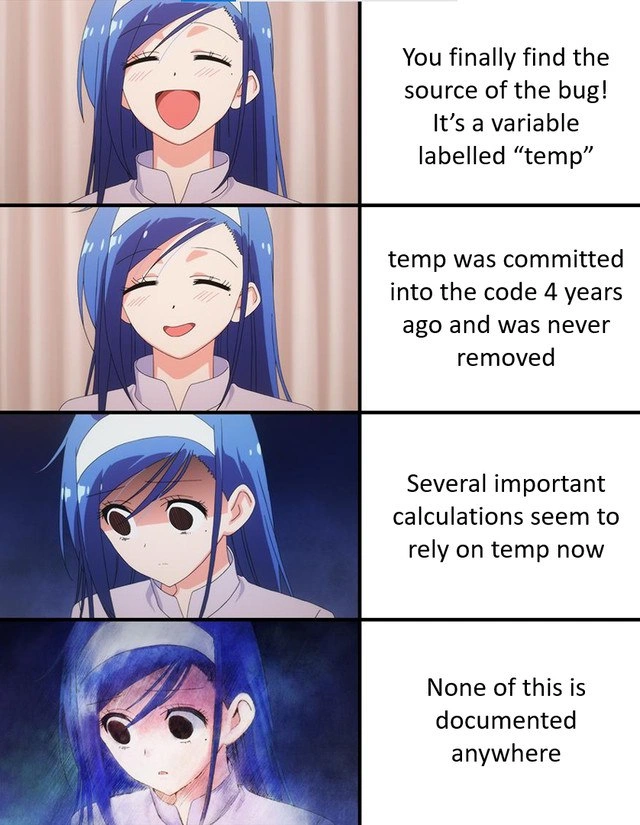
This meme highlights a classic software engineering fiasco in a way that even newer developers can understand. Let’s unpack what’s happening in simpler terms. We have a variable literally named temp (short for "temporary") that ended up sticking around in a program for four years. It was likely introduced as a placeholder – maybe to hold some data just for a moment or as a quick fix. However, despite its name, this temp variable was never removed. Over time, more and more code came to rely on temp until it turned into a crucial part of the system’s calculations. The punchline? No one ever documented any of this. It’s a bit like finding a random gear in a machine that everyone is using, and then realizing that gear was actually a makeshift part someone jammed in years ago, and now the whole machine depends on it.

Let’s go through each part of the scenario:

  • The bug hunt: A developer is debugging a problem in the code. After some effort, she finally finds the cause of the bug – hooray! It turns out to be a variable called temp. Now, in programming, a variable is just a name for a storage spot that holds some value. Typically, you give variables meaningful names (like userAge or totalPrice) so that their purpose is clear. A name like temp is a red flag. It usually means "this is temporary data or a throwaway placeholder." So, initially our developer is happy because she found the bug and it seems to be tied to this obviously-not-important temp thing. She’s probably thinking, "Alright, I’ll just remove or change this temp variable and be done."

  • Age of the code: Then she discovers temp was introduced 4 years ago. In a codebase, committing something means adding or changing code in the source control (like using Git to save your changes along with a timestamp and author). So a commit from 4 years back means this code is old. It’s been sitting there for a long time, which hints that it might be part of the legacy code now. Legacy code is a fancy term for old code that has been inherited by the current team of developers. It’s often code that nobody on the current team wrote (or remembers writing) and can be scary to work with because it might not follow current best practices or have proper tests. Realizing a bug traces back to such an old piece of code makes our developer a bit nervous – it’s like stumbling on a four-year-old to-do note that was never addressed.

  • Supposed to be temporary: The fact that the variable is named temp and never got removed is a classic example of technical debt. Technical debt refers to the concept of doing something in a quick, messy way now, instead of the right way, so you can ship faster – but at the cost of more work later. Just like financial debt, if you don’t "pay it back" (by refactoring or cleaning up the code), interest accumulates – the problem gets bigger and harder to fix over time. Here, someone took a shortcut by using a quick temp variable, probably thinking "I’ll clean this up eventually." But apparently, eventually never came. Four years later, that little shortcut has grown into a significant problem. In other words, a temporary workaround turned into a permanent part of the code because no one paid off that debt.

  • Unexpected dependency: By the third panel, she notices that “several important calculations seem to rely on temp now.” This is where things get really shaky. It means that over the years, other code was written that uses this temp variable. Perhaps temp was originally meant just for one function or one module, but since it wasn’t removed, other developers (or even the same developer at a later time) might have seen it was there and thought, "Oh, temp already holds this intermediate result I need; I’ll just use it." This is how a hidden dependency forms. A dependency means one part of the code relies on another. A hidden dependency is when that reliance isn’t obvious or intended. Now temp has become a globally shared state or a common piece that multiple parts of the program use. This is dangerous because if temp changes in one place, it can impact calculations in another place unexpectedly. It’s a bit like having a single spare key that multiple family members copied and used; if one person misplaces or changes it, everyone is locked out or affected.

  • No documentation: Finally, we hit the big facepalm moment: none of this behavior is documented. In software, documentation can mean comments in code, external documents, README files, or any written notes that explain how things work or why certain decisions were made. Good documentation would have something like:

    • A comment in the code: // TEMP is a quick fix for issue #45, to be removed when we refactor the data flow
    • Or a developer note in a wiki: "Using a temporary variable as a workaround in module X. Replace in next version."

    But here, there’s nothing. Documentation gap is when there’s a big difference between how the system actually works and what’s recorded about it. So new developers, or even the same developer years later, have no clue that temp was a hack. Our poor bug-hunting developer is realizing that she’s on her own to figure out why temp exists and how to deal with it. No guide, no comments, no commit message even (sometimes commit messages can offer clues like "added temp for quick fix"). It’s like getting a second-hand gadget with wires duct-taped inside, and no manual – you’re left scratching your head asking "Is this supposed to be like this?"

For a junior developer or anyone who’s early in their career, this meme is a cautionary tale and a shared joke about what not to do:

  • Don’t name things ambiguously: Naming a variable temp is asking for trouble if it sticks around. Always try to give variables clear, descriptive names. If you ever catch yourself calling something temp, ask if there’s a better name – or make sure it's truly short-lived.
  • Clean up your TODOs: If you put in a quick fix (especially under pressure), make a plan to replace it properly. Set a reminder, create a task in your issue tracker, write a big obvious comment. Otherwise, that to-do item might linger until it becomes a big bug years later. There’s a common saying that temporary code becomes permanent more often than you'd expect. This meme is basically illustrating that.
  • Write documentation or comments for hacks: If you absolutely must leave a temporary thing in the code, at least leave a note. A future you (or someone else) will be very grateful. A simple comment like // TODO: remove temp when issue #123 is resolved can be a beacon for whoever is spelunking through the code later. In the story of this meme, if there had been documentation, the developer might not be so shocked. She might think, "Ah, there’s that known hack, time to finally fix it properly," instead of "What on earth is this temp doing?"
  • Be careful with global state: Having a variable that many parts of the program use (especially if it wasn’t planned that way) can lead to unpredictable bugs. It’s usually better to pass needed values directly to functions or use well-structured modules, rather than sneakily relying on some outside temp. Global variables like this can make debugging a nightmare, because you change something in one place and something else entirely breaks.

So, in a nutshell, this meme resonates with developers because it’s a funny dramatisation of a real scenario: a temporary coding solution that lived far beyond its expiration date and became a skeleton in the closet of the codebase. It highlights key concepts like technical debt (quick fixes that accumulate cost), the importance of good naming and documentation, and the perils of legacy code where you often encounter mystifying things with no one around to explain them. For a newcomer to the field, it’s both humorous and educational: a reminder that even a single poorly handled variable can spiral into a big headache down the line. And if you ever encounter a weird temp in your code, now you know to treat it with caution – it might be hiding an entire untold story!

Level 3: The Immortal temp

In the depths of a legacy codebase, a variable named temp has achieved unintended immortality. It was likely introduced as a quick-and-dirty workaround — a supposedly temporary patch to fix an urgent issue. Ironically, that placeholder became a permanent resident of production, surviving four years of commits and deployments. The humor (and horror) here comes from how a throwaway variable labeled "temp" silently evolved into a mission-critical dependency. Seasoned engineers have witnessed this pattern again and again: "Nothing lasts longer than a temporary fix." This meme captures that bitter truth with each panel, as the blue-haired developer’s expressions shift from relief to pure despair when she realizes the scope of this blunder.

Let's break down the saga unfolding across those anime panels, which any experienced debugger can relate to:

  • Eureka! – In the first panel, our dev is jubilant: she finally found the source of the bug and it's just some variable called temp. Easy fix, right? At this moment, she's all smiles because spotting a clearly named variable that might be misbehaving feels like a win. (A variable literally named "temp" practically screams "I don’t really belong here, please delete me!" – how hard could it be to remove or adjust it?)
  • Uh-oh... – The second panel’s text reveals temp was committed 4 years ago and never removed. The dev’s smile fades. Four years is an eternity in software; that means this line of code has survived code reviews, refactors, and maybe even company re-orgs. Our hero’s starting to realize she’s dealing with technical debt older than some junior devs. A temp that old raises questions: Who put it there? Did they intend to clean it up later? Are they even still around? It’s dawning on her that this isn’t a simple one-line fix – it’s archaeology. She’s essentially unearthing a forgotten artifact in the codebase, left by a developer ancestor.
  • It’s Everywhere! – By the third panel, the text says "Several important calculations seem to rely on temp now." The developer’s eyes widen in horror. This is the classic moment in debugging legacy code when you tug on what you think is a loose thread, and an entire section of the system starts unraveling. That trivial-sounding temp variable isn’t trivial at all – it’s tied into critical logic. Perhaps other developers saw temp lying around and, not knowing its flimsy origins, assumed it was a legitimate part of the design. Over time, new features or quick patches might have latched onto this temp variable. Now it’s a full-blown spaghetti dependency, intertwining parts of the code that should never have been directly connected. This is a textbook code smell: a simple placeholder variable has morphed into a linchpin for computations, suggesting a deeper design flaw. It’s like finding out the "temporary" braces holding up a bridge were quietly incorporated into the final structure — yikes.
  • No Clues, No Docs – Finally, panel four reveals the bleak kicker: "None of this is documented anywhere." The background turns dark blue, and so does our protagonist’s mood. There are zero comments, no README notes, no ticket referencing why temp exists. It’s as if temp is a ghost that haunts the code—everyone sees its effects, but no one recorded its origin story. For a weary debugger at 3 AM (and trust me, such bugs usually surface at the worst times), this is the ultimate nightmare. Not only has she discovered a fragile piece of architecture by accident, but she also has no documentation to guide her on how to fix it safely. It’s now her job to perform delicate surgery on the code, trying to untangle temp from those “important calculations” without bringing the whole system down. This is where a senior engineer might let out a groan and mutter something about "classic technical debt" or "why we can’t have nice things."

The meme is funny because it’s painfully true. Every seasoned developer has a war story about a "temporary" something that outlived its creator’s intentions. temp is basically the poster-child of accidental global state or unintended permanent logic. It highlights poor variable naming (naming a core variable temp is like naming a main power switch “do not touch” and then wiring it into essential systems). It also spotlights failures in process: how did a four-year-old workaround evade all cleanup efforts? Why weren’t there tests catching this? Was there no code review to question a temp left in production?

The answers often boil down to the messy reality of software development. Here are a few likely reasons this immortal temp survived so long:

  • Last-Minute Hotfix – It probably began during a crunch time. Perhaps a production bug was discovered late Friday evening, and some dev threw in temp as a quick fix. The intent was to remove or refactor it on Monday, but Monday brought new fires to fight. That "temporary" fix then shipped to production because it solved the immediate problem and nobody dared touch it afterward (why fix what isn’t apparently broken?).
  • Forgotten Cleanup – Over the years, the team either forgot that temp ever was a band-aid or assumed someone else would clean it up. This is classic technical debt interest accumulating: the cost to remove temp grew as more code started depending on it. With each passing sprint, refactoring temp became riskier and easier to postpone. It slipped through the cracks, especially if the original author left or moved teams (taking the context with them).
  • Hidden Dependency – As new features were added, developers unknowingly treated temp as a normal part of the system. Maybe a function needed an intermediate value, saw temp was conveniently holding something relevant, and used it. Before long, temp turned into a piece of accidental architecture. A whole flock of calculations now perch on this flimsy branch. Removing it is non-trivial because you’d have to rewire those parts of the program to work differently. It’s the definition of a house of cards: pull out the temp card, and who knows what collapses.
  • No Documentation – Without any comments or documentation, temp remained a mysterious black box. New engineers joining the project wouldn’t know temp was a makeshift placeholder. They’d read the code and shrug, “I guess temp is needed for something.” No one wrote down “This variable is a temporary workaround for issue #123” or “Replace this when refactoring X”. The documentation gap meant the knowledge lived only in someone’s memory (or nowhere at all). In the end, the codebase ended up with a critically important variable that everyone assumes is harmless, because there’s no documentation flagging it as a liability.

So what’s the result? A bug surfaces years later, and the investigation leads to this ghost of codebase past. The developer’s journey in the meme – from triumph to terror – is a condensed version of a real debugging session. First comes the joy of locating the bug’s origin, quickly replaced by dread upon realizing that origin is a can of worms. By the end, she’s confronting the weight of accumulated tech debt and cursing that innocuous name temp that promised “I’m just a quick fix” but delivered a long-term headache. It’s equal parts comedy and tragedy: comedy for those watching from the outside, tragedy for the poor soul who has to clean up the mess. In true cynical veteran fashion, we laugh at the meme because if we didn’t, we might just cry. After all, who among us hasn’t deleted a “temporary” comment or variable, thinking "surely no one will depend on this…" only to find out years later just how wrong we were?

Description

This meme features a picture of a skeleton sitting at a computer on the ocean floor, covered in dust and cobwebs. The caption reads: 'Me waiting for the documentation to be updated.' The image humorously captures the perpetual state of outdated or non-existent documentation in many software projects. It's a deeply relatable pain point for developers who have to reverse-engineer code or rely on tribal knowledge because the written guides are hopelessly obsolete. The skeleton represents the developer's hope dying a slow death while waiting for a Confluence page to be updated

Comments

14
Anonymous ★ Top Pick Our project has two sources of truth: the source code and the legend whispered by the ancient one who wrote it
  1. Anonymous ★ Top Pick

    Our project has two sources of truth: the source code and the legend whispered by the ancient one who wrote it

  2. Anonymous

    That moment when git blame reveals ‘temp’ predates Kubernetes and half the P&L hangs off it - you’re not refactoring code, you’re defusing a four-year-old landmine labeled “temporary.”

  3. Anonymous

    The only thing more permanent than a temporary fix is a variable named 'temp' that somehow became load-bearing infrastructure - and the senior who wrote it left three companies ago with all the context in their head

  4. Anonymous

    Ah yes, the classic 'temp' variable - named with the optimism of someone who thought they'd refactor it 'tomorrow,' now serving as the load-bearing pillar of your entire calculation engine. It's like discovering your company's revenue model depends on a bash script someone wrote during a hackathon in 2019, except this time it's a variable that probably started as `int temp = 0;` and somehow evolved into the Rosetta Stone of your business logic. The real kicker? You can't rename it without a full regression test suite that doesn't exist, and you can't document it because understanding what it actually does would require archaeological carbon dating of git blame across three acquired companies and two database migrations

  5. Anonymous

    Nothing is more permanent than a temporary variable that survives one release - four years later it’s the monolith’s single source of truth

  6. Anonymous

    Nothing is more permanent than a “temp” variable: four years later it’s an undocumented cross‑module singleton encoding critical business rules, and the only spec is git blame saying “quick hack.”

  7. Anonymous

    'temp': short for 'temporarily essential forever' - the silent killer of refactors everywhere

  8. @Daler_XYZ 3y

    True

  9. @dosboxd 3y

    and the author has relocated to another country

  10. @brbrmensch 3y

    comment it out and compiler will politely tell you all the places it's used in

    1. D Y 3y

      In case it is compiled language and not traspiled like js for example...

  11. @abstract_factory 3y

    man dont use non final vars

  12. @FunnyGuyU 3y

    Refactor: rename temp variable

    1. @sylfn 3y

      into "tmp"

Use J and K for navigation