Skip to content
DevMeme
5723 of 7435
The Solopreneur's Expanding Brain: From SaaS to Running OpenAI
AI ML Post #6276, on Sep 26, 2024 in TG

The Solopreneur's Expanding Brain: From SaaS to Running OpenAI

Why is this AI ML meme funny?

Level 1: Magic Tool, Solo Show

Imagine you have a big school project to build a giant treehouse, and at first you have a whole team of friends helping – one friend saws wood, another friend decorates, someone handles the snacks, etc. That’s like a company with thousands of employees: lots of people, each doing their part. Now, pretend you find a super fancy robot helper that can do some of those jobs. You decide, “Hmm, I don’t need as many friends on the team now because my robot (let’s call it Robby) can help hammer nails and even paint the walls.” So you let a couple of friends go home since Robby the robot makes things easier. That’s like a company saying, “We’ve got a new AI tool, so maybe we don’t need all these workers anymore.”

Next, imagine the robot gets even more amazing – it can not only hammer and paint, but it can design new rooms and talk to people who want to visit the treehouse. It’s almost like this robot can do everything. You start thinking, “Wow, maybe I don’t need any friends at all to build and run this treehouse. I could be the only person and let Robby do the rest!” That’s the “one-person show with a magic tool” idea. In the grown-up world, that’s like a single person trying to run a whole business alone because they have a super advanced AI helping them. It sounds kind of cool – you get to be the boss and keep all the rewards – but also kind of crazy, right? One person doing all the work, even with a helper, would be super hard and exhausting.

Finally, the wildest idea: what if you said, “You know what, I’m so smart, I could even be the only person running the company that makes these super robots!” That would mean you are the only person in charge of creating and fixing the very magic tool everyone else uses – basically being one kid running an entire robot factory all alone. That’s pretty much impossible (and definitely not fun, imagine trying to do everything in a factory yourself).

So, the meme is joking about this kind of situation. It’s using an image of brains lighting up more and more to tease the idea that “the more people you fire and the more you rely on AI, the bigger your brain must be” – said with sarcasm. It’s funny because it’s an exaggeration: no one can actually do all that alone, and believing a magical helper can replace all your friends (or all employees) is a bit silly. It’s like a cartoon making fun of a kid who thinks, “I have a magic tool, I don’t need anyone else!” We laugh because we know in real life, teams exist for a reason – even the smartest person usually can’t do everything by themselves. The meme is a lighthearted way to poke fun at bosses or companies that get too excited about new tech and start thinking in extreme ways. It reminds us of that old saying: don’t put all your eggs in one basket (or don’t trust one robot to do everything). It’s okay to use cool new tools, but at the end of the day, people working together is usually the real key to success.

Level 2: AI-Powered Startup

Let’s break down what’s happening in this meme in simpler terms, focusing on the buzzwords. SaaS stands for Software as a Service – basically, software that’s delivered online, often with a subscription model (think of services like Slack, Shopify, or Salesforce). A typical SaaS company has many employees with different roles:

  • Developers/Engineers who write the code and build new features.
  • QA (Quality Assurance) testers who make sure the software isn’t full of bugs.
  • DevOps/IT folks who keep the servers running and handle deployments.
  • Customer Support teams who help users with issues or questions.
  • Marketing and Sales teams who promote the product and bring in customers.
  • Management and HR to coordinate everything and handle hiring, etc.

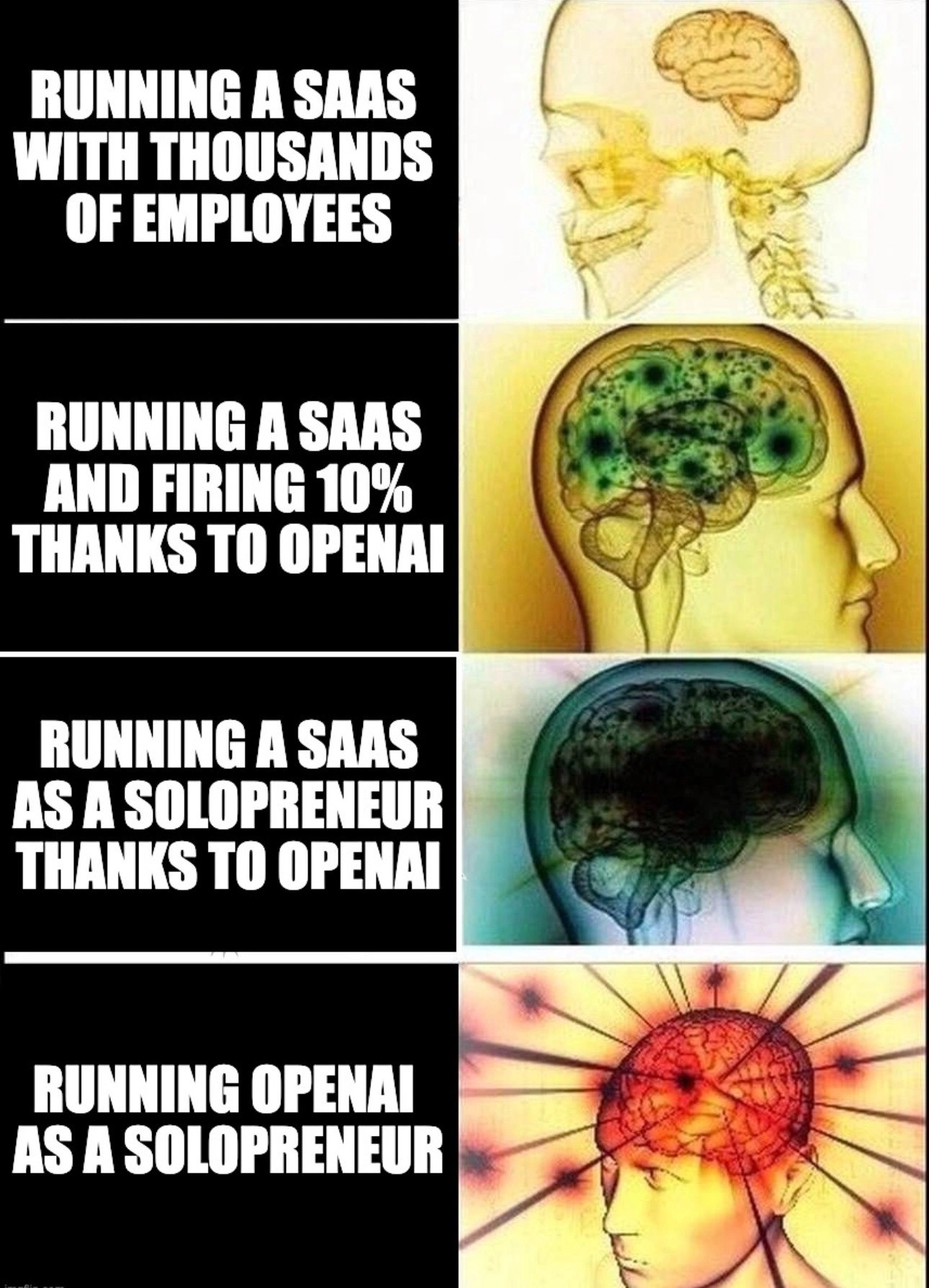
In the first panel of the meme (“Running a SaaS with thousands of employees”), it’s showing this classic setup: a big SaaS company with all these teams and probably thousands of employees in total. That’s the normal way – lots of people, lots of specialized jobs. The brain picture next to it is the smallest, implying this is the entry-level or simplest thinking in the meme’s playful context (not that it’s actually dumb to have employees, but the meme humorously ranks it as the least “enlightened” level).

Now, the second panel says “Running a SaaS and firing 10% thanks to OpenAI.” OpenAI is the company behind cutting-edge AI models like ChatGPT and GPT-4, which are examples of generative AI. The text basically says: “Hey, we’re running a SaaS and we cut 10% of our staff because OpenAI’s tech lets us automate some jobs.” In real life, this could mean a company used AI to automate tasks that people used to do, leading to layoffs. For instance, maybe they integrated a ChatGPT-based customer support chatbot, so they needed fewer support agents on payroll. Or they started using AI to generate marketing content (like blog posts or social media copy), so they let go of a few content writers. “Firing 10%” is a reference to layoffs – letting go of 10% of employees. In startup news, it’s common to hear “Company X lays off 10% of its workforce to cut costs.” Attaching “Thanks to OpenAI” implies the reason (or excuse) is that OpenAI’s tools made those employees supposedly redundant. This part of the meme is poking at the current trend and fear: companies might lean on AI to save money, and employees worry about AutomationAnxiety (the fear that robots or AI will take your job). The brain image is a bit brighter green, hinting that the meme considers this a “more enlightened” idea than the first – it’s the next level up in this satirical roadmap.

In the third panel: “Running a SaaS as a solopreneur thanks to OpenAI.” A solopreneur means a sole entrepreneur – basically a person who founds and runs a business all by themselves (no co-founders, no employees). So this phrase is describing someone running a SaaS company single-handedly, using OpenAI’s help to do so. The idea here is that with enough AI and automation, one person can handle all those jobs we listed above. It’s like saying: one founder using AI can replace an entire staff:

  • For writing code (developers), they might use AI coding assistants (like GitHub Copilot or GPT-4) to help generate code quickly.
  • For customer support, they use an AI chatbot (maybe fine-tuned on support FAQs) to answer user questions 24/7.
  • For marketing, they have AI tools that generate advertising slogans, graphics, or even videos.
  • For operations/DevOps, perhaps they use smart automation scripts or an AI ops tool to manage servers and deployments.
  • They might even use AI to analyze user data and trends, replacing some need for data analysts.

The brain image here is getting even brighter (a glowing bluish brain), suggesting this idea is even more “galaxy brain” in the meme’s tone. Realistically, there are indeed tiny startups or indie developers who try to leverage a ton of tools so they can go solo. With cloud platforms and AI, one person today can do what used to require a whole team, to a certain extent. For example, one developer can rent cloud infrastructure instead of having an IT team, or use a website builder instead of a front-end team. With generative AI, one person can produce content or code faster. But running a whole SaaS alone is still very challenging – that’s partly why this panel is funny, it’s an exaggeration of the “do it all yourself” founder ethos. It connects to the StartupCulture trope of the lone genius founder, but now turbocharged by AI. Tags like StartupHumor and AIHypeVsReality are relevant: there’s hype that AI can do everything, and some humor in seeing how far that hype could go.

Now, the fourth and final panel: “Running OpenAI as a solopreneur.” This is the meme’s punchline. OpenAI is itself a huge, advanced tech organization. The joke is imagining that even this complicated enterprise (which arguably creates the very AI tools others are using) could be run by just one person. The brain picture is the most illuminated – it’s red, cosmic, almost godlike. It’s called the galaxy brain level in meme-speak, meaning the idea is portrayed as the ultimate enlightened wisdom in an ironic way. Clearly, it’s not actually wise to think one person could run OpenAI alone; it’s an absurd exaggeration to make us laugh. It satirizes the whole progression: if a little AI can cut 10% of jobs, more AI means one person can do it all, and the ultimate AI means even the AI company needs only one guy/gal. It’s tongue-in-cheek TechSatire about how tech enthusiasts sometimes get overzealous. In reality, OpenAI has researchers working on AI models, engineers maintaining the systems, people aligning the AI to behave, policy folks, etc. – a one-person OpenAI is impossible today.

A beginner might wonder, is there any truth to this idea at all? Well, companies are indeed trying to use AI to become more efficient. Startups especially like to be “lean.” And some indie developers really do attempt one-person SaaS businesses (you might have heard of “indie hackers” or one-person startups selling apps). AI can help automate certain tasks – like chatbots for support or scripts that handle routine chores. But the meme is exaggerating to the extreme and having a laugh. The tags like AIHumor and ManagementHumor indicate it’s a joke about the intersection of AI technology and management decisions (like layoffs and budgeting). People find it funny because it’s an over-the-top take on real trends. It’s sort of going “Yeah, why not fire literally everyone, CEOs? If AI is so great, who needs humans at all, LOL?” – which points out the underlying absurdity.

In simpler terms: imagine a lemonade stand. First panel is you have 10 friends helping run the stand. Second panel, you get a fancy automated juicing machine from ScienceCo (that’s our OpenAI in this analogy), so you fire 1 of your 10 friends because the machine squeezes lemons faster. Third panel, you upgrade the machine to also handle taking payments and greeting customers (wow, it’s an AI robot now), so you decide you don’t need any friends at the stand – you run it completely alone with your magic machine. And the final panel is like saying you take over the company that makes those magic machines and somehow run that solo too. It’s crazy, right? That’s the joke.

So, this meme uses the familiar “expanding brain” format to humorously chart a path of increasingly extreme startup scenarios:

  1. Normal big SaaS with lots of staff (small brain, normal idea).
  2. Medium brain: use AI to trim some fat, fire a chunk of staff.
  3. Big brain: use AI so much that you operate as a one-person company.
  4. Galaxy brain: one person even runs the AI company itself.

It’s a commentary on how each step is seen as more innovative or visionary in some circles, but it’s also poking fun at that vision by showing how ridiculous it becomes at the end. After all, a single person running a massive operation (especially one like OpenAI) is science fiction at this point. The meme is firmly AIHypeVsReality – highlighting the contrast between the hype (“AI can do EVERYTHING!”) and reality (we still need people for most things). And it’s definitely StartupHumor/TechSatire: if you’re in the tech world, you likely know both the hype (every startup pitching how AI will revolutionize their business) and the anxiety (workers worrying they’ll get laid off if the hype convinces bosses). This meme takes that situation and makes it absurd in a funny way, which helps us laugh at our industry’s latest craze.

Level 3: Galactic Downsizing

This meme captures a StartupCulture fever dream through the classic expanding_brain_meme format. Each panel cranks up the “enlightenment” (glowing brain) as the idea of running a SaaS company with fewer and fewer people becomes more “genius” (read: more absurd). The humor targets the current wave of AI hype and the real-world trend of tech layoffs. In the first panel, we have “RUNNING A SAAS WITH THOUSANDS OF EMPLOYEES” – that’s the baseline, a normal large SaaS company with full staff. Many big SaaS companies (think Salesforce, Zoom, or any cloud company) indeed have thousands of employees across engineering, sales, support, etc. The brain is small and dim here, implying this is the basic or conventional approach. It’s almost poking fun at old-school management: “Haha, needing thousands of humans to run your software-as-a-service – how pedestrian.”

Then the meme escalates: “FIRING 10% THANKS TO OPENAI.” This references a very real phenomenon – companies cutting a portion of staff claiming automation or efficiency gains from AI (like using OpenAI’s GPT models) will make up the difference. It’s a ManagementHumor jab; we can practically hear a CEO bragging on an earnings call about embracing AI to improve margins:

Big-Brain CEO: “We integrated GPT-4 into our workflows, allowing us to eliminate 10% of roles and reduce costs.”

The meme’s second panel brain is glowing a bit more – apparently, layoffs are an ‘enlightened’ move. It’s dark humor reflecting the cynicism many developers feel. We’ve seen hype where bosses think a ChatGPT integration can replace teams overnight. For example, some customer support departments started using AI chatbots to handle simple queries, potentially letting them scale back staff. Developers have experimented with GitHub Copilot or OpenAI’s code generation to speed up coding tasks, leading some managers to wonder if they can cut engineers (cue AutomationAnxiety among programmers!). The shared trauma here is that whenever a shiny new tech comes, higher-ups get layoff-happy, thinking they’ve found a magic cost-cutting hack. AIHumor in this context often points out the gap between AI hype vs. reality: sure, an AI might handle some tasks, but it often can’t replace the deep expertise and problem-solving of experienced people. Firing 10% of your staff because “the AI will do it” is a risky move – as any battle-scarred dev will tell you, those tasks tend to come back as 3 AM emergencies when the AI falls short. It's always fun and games until the AI customer service bot starts insulting VIP clients at 2 AM because it misinterpreted a prompt. 🤖🔥

The third panel goes further: “RUNNING A SAAS AS A SOLOPRENEUR THANKS TO OPENAI.” Now the brain image is almost at galaxy brain status – bright and bluish. This satirizes the solo_founder_dream many indie hackers and startup folks have: the idea that one brilliant person, armed with enough automation and AI, can run a whole Software-as-a-Service business alone. In recent years, we’ve seen a surge of tools that make this feel almost plausible. For instance, a solo developer can use infrastructure platforms (serverless functions, managed databases) so they don’t need an ops team. They can use AI to generate marketing copy and customer email responses, serving as their own marketing and support teams. They can even have AI help write code. The meme humorously implies that with openai_automation (like ChatGPT making code, images, content on demand), our enlightened solopreneur can fire everyone – they never even hire, because they do it all themselves. This is the indie hacker fantasy: run a lean SaaS, keep all the profits, no pesky payroll or HR. StartupHumor often pokes at how founders wear many hats; here the founder is wearing all hats, with an AI sidekick under each hat. It’s also riffing on the reality that early startups do start with one or two people doing everything – but usually they grow out of that. The meme exaggerates it to “why ever grow your team if AI can just scale you up?”

Finally, the punchline panel: “RUNNING OPENAI AS A SOLOPRENEUR.” The brain is radiant, cosmic, with neural flares – absolute enlightenment! This is the ultimate satirical twist. OpenAI itself is a massive company (in reality, by 2024 they have hundreds of employees, top research scientists, engineers, and a ton of Azure GPU servers from Microsoft). The idea that even OpenAI – the very source of these AIs – could be run by one person is hilariously absurd. It’s a wink at how ridiculous the prior idea was by taking it to an impossible extreme. It’s as if saying, “Oh you think you’re galaxy-brained by running your startup solo with AI? Well, the truly enlightened guru would run the AI company solo!” This leverages irony: OpenAI, which creates the tools that supposedly let you cut staff, itself definitely couldn’t operate with one person and some scripts. There’s a TechSatire aspect here – mocking the hype by showing its logical endpoint. If every company used AI to reduce headcount, why not reduce all headcount, even at the AI providers? It highlights the flaw in the thinking: at some point, you do need actual people.

From a senior developer perspective, this meme is a riot because it nails our collective skepticism. We’ve seen waves of automation before. Each time, some boss or VC touts “We won’t need as many humans, tech will do it all.” Remember the rise of cloud computing? Suddenly companies aimed to ditch operations teams (“No more ops – it’s serverless, it runs itself!”). In reality we just traded sysadmins for DevOps engineers and new kinds of on-call issues. Or think about the promises of earlier AI in the 2010s with “chatbots will replace customer service” – only for companies to realize pure bots angered customers and they had to bring humans back into the loop. The AIHypeVsReality tag is relevant: the reality usually is that AI changes jobs, it doesn’t just eliminate the need for humans entirely (at least not as cleanly as the “cost cutters” hope).

This meme also resonates with the post-2023 tech landscape, where many SaaS companies did mass layoffs. Often it was economic downturn + a dash of “we implemented efficiency improvements” as justification. Now with generative AI booming, we hear whispers like, “Maybe we can trim the content team if ChatGPT writes blogs,” or “Do we need all these junior devs if Copilot can code?” The meme mercilessly caricatures that mindset. The AutomationAnxiety tag isn’t just for workers; senior devs know that over-relying on unproven automation can backfire spectacularly. We joke that a galaxy-brained CEO might fire the entire QA department because “our AI code generator writes perfect code” — famous last words before a production meltdown.

In summary, from the seasoned techie view, “Expanding-brain roadmap: AI shrinking your SaaS headcount all the way to one” is a sarcastic roadmap to disaster. It’s both a laugh at the ridiculous optimism and a cathartic nod that we’ve seen this movie before. It combines AIHumor (wow, AI can do everything!) with ManagementHumor (cost-cutting obsession) and points out how comically over-optimistic the tech world can get about new trends. It’s funny because it’s partially true – some people really are trying versions of panel 2 and 3 – and as cynical veterans, we’re bracing for the system failures and midnight calls that this “AI-run business” fad might bring.

# Pseudocode of an "AI-run" SaaS where one person delegates nearly everything to GPT
def implement_feature_request(spec):
    # Instead of a whole engineering team, let an LLM build the feature
    code = openai.ChatCompletion.create(prompt=f"Write code for this feature: {spec}")
    deploy_to_prod(code)  # YOLO deployment: assume the AI wrote bug-free code (What could go wrong?)

def handle_support_ticket(ticket):
    # Instead of support reps, have the AI answer user issues
    reply = openai.ChatCompletion.create(prompt=f"Support answer for customer issue: {ticket.text}")
    return reply

def run_marketing_campaign(product):
    # Instead of a marketing team, use AI to generate ad copy and images
    slogan = openai.ChatCompletion.create(prompt=f"Craft a catchy slogan for {product}")
    image = openai.Image.create(prompt=f"Generate marketing image for {product} using style X")
    post_to_social_media(slogan, image)

# ... similarly, the solo founder attempts to replace HR, ops, and analytics with automation ...

(The code comments above are dripping with irony – “What could go wrong?” is what every on-call veteran sarcastically mutters right before an incident. In reality, relying on an AI to deploy code without testing or to handle angry customer tickets unmonitored is a recipe for high-severity chaos.)

Level 4: SaaS Singularity

On the final panel, the meme blasts into a galaxy-brain scenario approaching an AI singularity for startups. In theory, one person running OpenAI suggests an almost mythical level of automation – basically achieving AGI (Artificial General Intelligence) that can do the work of hundreds or thousands of people. This is tongue-in-cheek, but let’s entertain the technical rabbit hole for a moment. To truly replace an entire SaaS workforce (developers, QA, support, ops, marketing, management) with AI, you’d need systems capable of understanding context, making complex decisions, and learning new domains autonomously. That drifts into the realm of self-improving AI agents – think AutoGPT on steroids, or a fully autonomous Decentralized Autonomous Organization (DAO) running a company’s every function via smart contracts and bots. Today’s generative AI (like GPT-4 from OpenAI) is powerful at generating text or code, but it’s not an all-knowing corporate mastermind. It can’t truly replace strategic planning, nuanced product decisions, or handle completely novel problems without guidance.

From a computer science perspective, the idea of one human + AI replacing an entire company runs into fundamental limits. Amdahl’s Law from parallel computing is a useful analogy: no matter how much you parallelize or automate tasks, any part that still requires a human (the serial bottleneck) limits the overall speed and scale. Here, our lone founder becomes that bottleneck. They can delegate many tasks to AI in parallel, sure, but decisions, reviews, and unpredictable crises still demand human oversight. The throughput of one brain (even a “galaxy brain”) handling all critical oversight becomes a serious cap on growth. There’s also Tesler’s Law of the Conservation of Complexity: you can’t make a complex system simpler overall, you can only move the complexity around. Replacing teams with AI doesn’t erase the work – it shifts complexity into maintaining AI systems, crafting perfect prompts, handling AI mistakes, and integrating all those automated pieces. The complexity of running a large SaaS is conserved; our solo founder just absorbs it in different forms (like late-night prompt engineering debugging sessions 😅).

Another angle is system reliability and risk. Distributed responsibility across many people provides checks and balances – code reviews, QA testing, on-call rotations, etc. With one person at the helm, you have a bus factor of 1 (if that person disappears, everything falls apart). Even if that one person wields a legion of AI tools, those tools themselves can fail or go off the rails. We’ve all seen how AI can hallucinate incorrect outputs or make bizarre decisions. An AI might answer thousands of support tickets flawlessly, until it suddenly starts hallucinating a weird solution that angers customers. Normally, a support manager might catch that; in our scenario, the solo founder might not notice until it’s a full-blown PR disaster. Essentially, the meme’s ultimate panel parodies the idea of a fully automated company by showing an impossibly radiant brain – it’s the satirical endgame of AI hype. It hints at concepts of AI-run businesses that appear in sci-fi: for example, corporations in fiction that are just an AI or a single uploaded mind. We’re nowhere near that reality in 2024. Modern AI lacks true general intelligence and common sense. It also requires huge infrastructure – imagine one person trying to manage OpenAI’s massive GPU clusters, model training pipelines, and worldwide API servers all by themselves. Unless our founder has some cyborg upgrades or secret superpowers, the physical and cognitive workload is beyond human limits.

So, the cosmic joke here nods to real technical discussions in AI and automation: Could a future AI be so advanced that one person (or no person!) can run a gigantic service? It’s theoretically intriguing but practically far-fetched. We’d need breakthroughs in AI autonomy, reliability, and alignment (ensuring AI’s goals stay in check) to avoid chaos. Until then, StartupCulture dreams of single-handed empires remain humorous tech satire. This meme’s final form exaggerates to make us laugh at how absurd the “ultimate productivity hack” is. It’s poking fun at the notion that throwing OpenAI automation at every problem could let management cut costs infinitely – a StartupHumor take on automation taken to a ludicrous extreme. In reality, even the best automation can’t replace the creativity, judgment, and accountability of an entire workforce. The “SaaS singularity” isn’t here, but the meme gives us a neon-glowing vision of that impossible endpoint for comedic effect.

Description

This is a four-panel 'Expanding Brain' meme. Each panel has text on a black background on the left and a corresponding image of a brain on the right. The first panel shows a small, simple brain next to the text 'RUNNING A SAAS WITH THOUSANDS OF EMPLOYEES'. The second panel shows a larger, more active brain next to 'RUNNING A SAAS AND FIRING 10% THANKS TO OPENAI'. The third panel features a cosmic, galaxy-like brain with the text 'RUNNING A SAAS AS A SOLOPRENEUR THANKS TO OPENAI'. The final panel shows the ultimate enlightened brain with light rays emanating from it, alongside the text 'RUNNING OPENAI AS A SOLOPRENEUR'. The meme uses the expanding brain format to satirize the escalating hype and ambition surrounding AI's impact on business. It progresses from using AI for minor efficiency gains (layoffs) to achieving massive leverage (a one-person SaaS), and finally to the ultimate fantasy of a single person running the foundational AI model itself. This resonates with experienced engineers by reflecting the current industry discourse on AI-driven disruption, the feasibility of solopreneurship at scale, and the sometimes absurd levels of hype in the tech world
Comments

13
Anonymous ★ Top Pick Stage 1: Your SaaS scales with headcount. Stage 2: Your SaaS scales with GPU clusters. Stage 3: Your GPU cluster tells you it has decided to scale itself and has already filed the IPO paperwork
  1. Anonymous ★ Top Pick

    Stage 1: Your SaaS scales with headcount. Stage 2: Your SaaS scales with GPU clusters. Stage 3: Your GPU cluster tells you it has decided to scale itself and has already filed the IPO paperwork

  2. Anonymous

    Sure, fire the whole engineering org - until the one-person on-call rotation hits that 3 a.m. Sev-0 and ChatGPT asks for PTO

  3. Anonymous

    The real galaxy brain move is realizing you still need thousands of H1-B visa holders to keep the GPUs running while your solopreneur SaaS crashes because you forgot to implement rate limiting on your OpenAI API calls

  4. Anonymous

    The real galaxy brain move is realizing that running OpenAI as a solopreneur would require you to train yourself on your own training data, creating an infinite recursion of existential compute costs and board drama - at which point you'd probably just fire yourself and replace you with a fine-tuned GPT-4 instance that costs $0.03 per decision

  5. Anonymous

    You can “run OpenAI as a solopreneur” until your bus factor equals 1, your SLO equals someone else’s rate limit, and SOC 2 still asks for evidence

  6. Anonymous

    AI scales your SaaS to one-node cluster: ultimate fault tolerance via solo brain failure

  7. Anonymous

    Solopreneurship via OpenAI is great until a silent model rollout changes function-calling and your entire ‘workforce’ returns 429s - turns out your org chart is just you and someone else’s SLA

  8. @callofvoid0 1y

    huh

  9. @SamsonovAnton 1y

    Running Universe as a solopreneur

    1. @azizhakberdiev 1y

      Running universe as OpenAI

  10. @DIRECTcut 1y

    Walking instead of running

    1. @Diotost 1y

      Something is wrong with this gif

  11. @theodolu 1y

    Ruining the world as solopreneur

Use J and K for navigation