Skip to content
DevMeme
3875 of 7435
The Buzzword-Salad Request That Finally Broke the Engineer
Management PMs Post #4219, on Feb 17, 2022 in TG

The Buzzword-Salad Request That Finally Broke the Engineer

Why is this Management PMs meme funny?

Level 1: You Can’t Print a Cake

Imagine someone says: “I’m not a chef, so this might be a dumb question, but why can’t we 3-D print a cookbook and microwave it into a cake?” 🤔 Sounds pretty silly, right? You can picture the baffled look on the chefs’ faces. We all know that printing out a recipe from the internet doesn’t give you a real cake, and sticking that printed recipe in the microwave won’t magically bake anything delicious. A recipe is just instructions on paper, and a cake is a real baked dessert – two very different things! The question mixes up the idea of making physical stuff with the idea of cooking and expects a magical result. In the real world, that’s obviously not how it works: you have to actually follow the recipe and use ingredients to bake a cake.

The meme is funny for the same reason. The manager in the comic basically asked the tech equivalent of the cookbook-and-microwave question. She mixed up a bunch of tech ideas that don’t go together – kind of like mixing up printing and cooking and expecting instant cake. The engineers know it’s an impossible, nonsensical request, so they react with shock. One of them even gives up (quits) out of frustration, which is an exaggerated, jokey way to show just how crazy the question sounds to an expert. It’s like a teacher hearing a student insist that 2 + 2 should equal 5 – it’s so wrong it’s funny (and a bit exasperating). In simple terms, the meme is poking fun at how people who don’t understand a subject might ask for something that just doesn’t make sense, without realizing it. And the extreme reaction (the engineer quitting) makes us laugh because it’s a comedic way to say, “That request was beyond ridiculous!”

Level 2: Breaking Down the Buzzwords

Let’s break down the tech jargon in that manager’s question to see why it doesn’t make sense. The manager tossed out four big terms: 3-D printing, blockchain, HTML, and Bitcoin. These are all real things in technology, but they belong to totally different areas. Here’s what each one actually means:

  • 3-D Printing: A fancy kind of printer that creates physical objects instead of flat paper prints. It works by laying down material (like plastic) layer by layer to form a 3D shape. For example, engineers use 3D printers to make prototypes of gadgets or replacement parts. It’s basically manufacturing. Importantly, 3D printing deals with things you can touch – it’s about the physical world. You can 3D print a phone case or a miniature model of a building. But you cannot 3D print data or software – you can’t print a Word document into a physical letter that updates itself, and you can’t print a list of transactions (a ledger) into something that magically continues to operate. It’s strictly for making tangible items, not digital concepts.

  • Blockchain: In simplest terms, a blockchain is a type of database or ledger that’s distributed across many computers. Imagine a record book that everyone on a network has a copy of, and when new transactions or entries happen, they get added to this book in a chain of blocks. Each block holds a bunch of records (like transactions), and it securely links to the block before it using cryptography (kind of like a digital fingerprint that connects them in order). Because every block is linked and distributed, it’s very hard to alter past records – that’s why blockchains are praised for being tamper-resistant. Blockchains are completely digital – they live in computer memory and storage across the internet. There’s nothing physical to touch; it’s all entries in computers. So asking to 3D print a blockchain is like asking to print out an entire ever-changing Google spreadsheet that millions of people update in real time. The moment you print it, it’s out of date and no longer interactive. A blockchain isn’t a object you can hold; it’s more like an ongoing process or agreement among many machines.

  • HTML: This stands for HyperText Markup Language. It’s the code (or rather, markup) used to create web pages. When you visit a website, your browser is reading HTML (often along with CSS and JavaScript) to know how to display the text, images, and layout. HTML is great for structuring documents and content on the internet – headings, paragraphs, links, tables, etc. But HTML by itself is not a programming language that can perform logic or interact with a blockchain or anything complex; it’s static instructions for layout. Think of HTML as the skeleton or blueprint of a webpage, telling the browser “this is a header, this is a paragraph, here’s an image here.” It can’t do calculations like a spreadsheet nor create digital coins. So the idea of “HTML it into a Bitcoin” doesn’t align with what HTML does. That phrase doesn’t even really make grammatical sense in tech – it sounds like someone took a tech word and tried to use it as a verb incorrectly. It would be like saying “Can we PowerPoint it into a database?” – mixing unrelated tools and expecting a result.

  • Bitcoin: Bitcoin is a cryptocurrency, which is a form of digital money. It’s called a cryptocurrency because it uses cryptography for security. Bitcoin was actually the first widely successful use of a blockchain. In Bitcoin’s system, the blockchain is the public ledger that records all Bitcoin transactions. People “mine” new bitcoins by using powerful computers to solve hard math puzzles (that’s the Proof-of-Work we mentioned above), and as a reward, they might earn some bitcoin. Important: a bitcoin (the coin itself) is not physical – it’s not a coin you can hold in your hand. It exists only as a record on the blockchain (basically as balances associated with cryptographic addresses). You can think of it like digital cash. If you want to actually get a bitcoin, you either mine it (expensive, computationally heavy) or someone sends it to your digital wallet. You definitely can’t make one with a 3D printer or by writing HTML. Bitcoin isn’t created by sculpting something or printing something; it’s created by running algorithms on computers and adhering to the network’s rules. Some people do make novelty physical coins that represent bitcoin (for fun), but those are just memorabilia – the real value is in the digital token, which only exists on the network.

Now, looking at these definitions, you can see why the manager’s question is jumbled up. She basically mixed up completely different realms of tech:

  • 3D printing is about making physical stuff (imagine printing a small plastic toy).
  • A blockchain is an invisible digital ledger that lives on the internet (imagine a shared Google doc of transactions that everyone trusts).
  • HTML is just a way to make things look right on a web page (imagine the code behind a website you visit).
  • Bitcoin is a form of money but digital, living on its blockchain (imagine numbers in an online ledger that people treat as valuable currency).

The manager’s question, “Why can’t we 3-D print a blockchain and HTML it into a Bitcoin?”, is essentially asking: “Why can’t we make a physical copy of this digital ledger and then somehow convert that copy into digital money using a website language?” When phrased like that, the confusion becomes clear. These things don’t line up at all. It’s like asking, “Why can’t we photocopy the internet and paint it into gold?” – the terms just don’t belong together in that way.

For a junior developer or someone new to tech, it’s important to understand that each tech buzzword usually refers to a specific technology or concept with its own purpose. Mixing them up can lead to nonsense. And that’s exactly the point of the joke: the manager is using tech words without knowing what they really mean, so she ends up suggesting something impossible. It’s a lesson in disguise – if you’re not sure what a term means, it’s okay to ask or look it up (preferably before proposing a big idea in a meeting!). Every developer has to learn these concepts over time. At some point, we all had to learn that HTML isn’t a programming superpower, that you can’t hold a Bitcoin in your hand, and that a blockchain isn’t literally a chain you can see. The humor here comes from someone skipping that learning and making a wild, naive suggestion. It’s funny to those who know, and a learning moment for those who don’t.

So, to recap in simple terms: The question in the meme mixes up four things that don’t mix. 3D printing makes physical objects. Blockchain manages digital records. HTML builds web pages. Bitcoin is digital money. If you can see why using those in one sentence feels wrong, you’ve got the essence of the joke. It’s the ultimate tech buzzword mix-up, and the engineers’ shocked reaction (and Alice quitting) is there to underscore just how off-base it is. Don’t worry if you’re new – even non-engineer managers get confused by tech sometimes, as this meme shows. The key takeaway is that understanding what each technology actually does prevents this kind of hilarious misunderstanding.

Level 3: Buzzword Bingo Breakdown

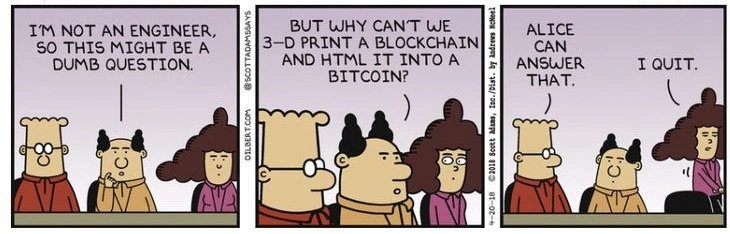
This meme nails a scenario that seasoned developers know all too well: the dreaded buzzword salad meeting. We have a non-engineer stakeholder – likely a well-meaning but tech clueless manager – confidently stringing together every hot tech term they’ve heard: “Why can’t we 3-D print a blockchain and HTML it into a Bitcoin?” In one breath, she hits Buzzword Bingo: BlockchainHype, Bitcoin, 3D printing, HTML – none of which actually fit together. The result is comic absurdity, but it’s also painfully familiar as a caricature of real corporate meetings. Stakeholder expectations can get wildly unrealistic when fueled by hype. In the comic’s first panel, she even prefaces with “I’m not an engineer, so this might be a dumb question.” That’s a classic red flag for engineers in the room – we’ve learned that what follows is usually indeed a dumb question. And oh boy, this one doesn’t disappoint. It’s the kind of request that leaves a room of developers stunned into silence, exchanging looks that say, “Did they really just say that?”

Why is this funny (and cringy) to experienced devs? Because it perfectly satirizes MisunderstandingTechnology at the management level. We’ve sat through meetings where higher-ups or clients suggest things that make us want to pull the fire alarm and escape. For example: a VP excitedly asking, “Can’t we just put our database on the blockchain to automatically get AI insights and drive crypto revenue?” – mixing unrelated TechBuzzwords in hopes of a miracle. Here, the manager likely heard about Bitcoin being worth a lot of money and knows “blockchain” is involved. She’s also heard of fancy tech like 3D printing and some vague notion of coding (“HTML it” as if HTML is a magic verb). In her mind, why not just combine them all and innovate? To an engineer, though, this request is pure nonsense. It’s like someone grabbed random jargon from Wired magazine and Mad Libbed them into a sentence. We call this buzzword-driven development (not a compliment). The humor comes from just how incomprehensible and impossible the ask is – it’s a word soup that pretends to be tech-savvy but has no actual meaning.

The comic’s reaction beats are spot-on: the two engineers sit there slack-jawed in panel 2, too shocked to even begin answering. (If you look at their faces, they’re drawn with that 1,000-yard stare of “did I really just hear that?”) In many real meetings, there’s that moment of awkward silence after a higher-up drops a question that doesn’t make sense. Everyone glances around, silently debating who’s going to tackle this. In the strip, one engineer quickly says, “Alice can answer that.” That’s a slick move – he basically throws Alice under the bus (or perhaps he knows Alice has a low tolerance for BS and will handle it bluntly). Alice is the other engineer at the table, and she represents every seasoned developer who’s been dealing with one too many absurd requests. Her response isn’t a polite explanation or a gentle correction. She simply stands up, says “I quit,” and walks away. It’s an exaggerated punchline, but it resonates because it captures the exasperation engineers feel when faced with repeated stakeholder ignorance. Alice literally nopes out of there on the spot.

This speaks to a deeper truth in CorporateCulture: when non-technical management insists on chasing IndustryTrends_Hype without understanding them, it’s often the engineers who suffer the fallout. They’re asked to “just make it happen.” Imagine being told to implement a blockchain (a complex distributed system) into a project with no justification, or to somehow “add Bitcoin” because someone thinks it’ll instantly add value. It’s frustrating and demoralizing. Over time, a steady diet of such requests can lead to real burnout – the joke of “I quit” has an edge to it. Many developers have fantasized about walking out of a meeting where the ideas are this detached from reality. It’s funny in the comic, but in real life it’s a coping mechanism to laugh, while inside you might actually be a bit worried about the direction from leadership.

The buzzword bingo aspect is also a jab at how corporate stakeholders often try to sound informed. There’s a long tradition of humor around this: playing Buzzword Bingo in meetings (secretly marking off words like “synergy,” “leveraging the cloud,” “disruptive blockchain solution” on a bingo card) because you just know someone will say them. Here our non-engineer hit the jackpot by using four hot terms in one ridiculous sentence. It highlights the disconnect between techies and non-techies. She thought she was proposing something cutting-edge, not realizing she basically said, “Why can’t we do an impossible and meaningless thing?” This misunderstanding can arise from the hype cycle: articles and consultants might’ve convinced management that blockchain and Bitcoin are magical solutions to any problem, while buzzwords like 3-D printing and HTML5 were also trending. (Remember, around the time this comic was written, blockchain and crypto were all the rage, and even 3D printing had been hyped as “the future of manufacturing.” Every exec wanted to show they’re on top of these trends.)

From a senior engineer’s perspective, the scenario is too real: you have to manage StakeholderExpectations tactfully. If someone truly asked this, you’d have to explain gently that these technologies don’t work that way – basically a buzzword reality check. But in many companies, there’s pressure to indulge the boss’s ideas, however outlandish. So developers often find themselves diplomatically translating buzzwords into real terms or pushing back without insulting the person’s intelligence. The comic cuts through all that nicety with Alice’s comedic “I’m outta here,” which is satisfying because it’s what we wish we could do sometimes. It’s the ultimate mic-drop exit when faced with irredeemable nonsense.

In summary, this panel is hilarious to those in tech because it spotlights a common workplace comedy of errors: a stakeholder/client who doesn’t get tech proposing a magical solution by throwing buzzwords together. It captures the collective groan and facepalm of developers everywhere, along with that little daydream of escaping the madness. The humor lives at the intersection of BlockchainHype and CorporateHumor – it’s both a send-up of trending tech jargon and a cathartic laugh at corporate absurdity. Every engineer who’s had to explain for the tenth time that “No, you can’t just blockchain that, and HTML isn’t a programming superpower” feels a kinship with Alice in that final panel. As exaggerated as “I quit” is, it underscores the very real frustration that can come from trying to meet impossible stakeholder requests. And through our laughter, there’s a bit of a lesson: tech buzzwords aren’t lego bricks you can snap together arbitrarily – and anyone who tries will likely end up as a punchline in a comic strip or, worse, driving their best talent out the door.

Level 4: Proof-of-Work vs Proof-of-Print

At a fundamental level, the manager’s question is a category error of epic proportions – it’s like trying to solve a cryptography problem with a glue gun. A blockchain isn’t a physical chain of blocks you can pick up or 3-D print; it’s an append-only distributed ledger existing as data across many computers. Each “block” in a blockchain contains encrypted transaction records and a link (via a cryptographic hash) to the previous block. The whole system maintains integrity through a consensus algorithm (like Bitcoin’s famous Proof-of-Work, which involves intense number-crunching to add new blocks). None of this process is physical – it’s pure computation and network communication. If you attempted to 3-D print a blockchain, you’d just get a frozen snapshot of data (probably stacks of paper or plastic with lots of numbers) that cannot update or achieve consensus. The real-time, distributed nature of blockchain data is lost the moment you turn it into something static. In short, you can’t extrude cryptographic trust out of a 3D printer nozzle – reality doesn’t compile that way.

Meanwhile, trying to “HTML it into a Bitcoin” mashes up entirely unrelated layers of technology. HTML (HyperText Markup Language) is a presentation language for structuring web pages – it tells browsers how to display content. It has zero capability to perform computations, interact with a blockchain, or generate cryptocurrency. Bitcoin, on the other hand, is a cryptocurrency that emerges from solving complex math puzzles and consensus across a network; you “mine” it through algorithms and cryptographic hashing, not by writing markup. The manager’s phrase is essentially suggesting using a web page description to somehow create money from a printed ledger. This is a triple-layer type mismatch. In programming terms, it’s like calling a function with completely wrong argument types: a PhysicalObject instead of a DigitalKey, or a markup string where a cryptographic proof is needed. The request simply doesn’t type-check with how these systems work:

# Pseudo-code illustrating the type mismatch in the manager's request:
blockchain_data = network.get_blockchain()         # Digital distributed ledger data
physical_copy  = printer3D.print(blockchain_data)  # ❌ Cannot turn dynamic data into a static physical object and keep its function
bitcoin_coin   = html_engine.convert(physical_copy) # ❌ HTML can't create cryptocurrency from a physical thing
# Result: TypeError – incompatible types and processes at every step

In essence, the manager dreams of materializing a complex digital system into physical form and then magically coding it into valuable currency. But blockchains derive their value and security from mathematics and distributed consensus, not from any tangible object. You can’t “HTML” a plastic model into a valid Bitcoin because a Bitcoin isn’t a physical coin at all – it’s an entry on that distributed ledger, secured by private keys and consensus rules. Even if you printed the entire Bitcoin blockchain on paper (which would be millions of pages long by now), those printouts wouldn’t let you spend or create Bitcoins. The network wouldn’t accept a stack of paper or a 3D-printed object as proof of work or ownership. To an engineer, the question “Why can’t we 3-D print a blockchain and HTML it into a Bitcoin?” sounds about as feasible as “Why can’t we solve the Byzantine Generals Problem with a paper shredder?” – it’s a complete misunderstanding of what these technologies are and how they operate on a theoretical level. The laws of computer science (and a fair bit of physics and math) simply don’t allow such a magical conversion of matter and code. It’s a hilarious collision of disparate domains: trying to treat bits like atoms and expecting the cryptographic alchemy to just happen. The idea fundamentally fails reality’s type checking, so to speak. No amount of trendy tech jargon can overcome the fact that digital distributed consensus can’t be forged in a physical printer, and markup code can’t mint money by itself. Reality throws a compiler error on this one.

Description

A classic three-panel Dilbert comic strip by Scott Adams. In the first panel, the pointy-haired boss prefaces a question with, 'I'M NOT AN ENGINEER, SO THIS MIGHT BE A DUMB QUESTION.' In the second panel, he delivers the nonsensical query: 'BUT WHY CAN'T WE 3-D PRINT A BLOCKCHAIN AND HTML IT INTO A BITCOIN?' His question is a jumble of unrelated tech buzzwords, showcasing a profound lack of understanding. In the final panel, Dilbert deflects the question by saying, 'ALICE CAN ANSWER THAT.' Alice, the female engineer, is shown getting up from her seat and succinctly replies, 'I QUIT.' The humor resonates deeply with experienced developers who have often endured meetings with non-technical stakeholders or managers attempting to use trendy terms they don't comprehend, leading to absurd requests and immense frustration. Alice's resignation is the ultimate punchline, representing the breaking point for a competent engineer faced with weapons-grade ignorance
Comments

18
Anonymous ★ Top Pick My PM asked if we could refactor the mainframe in TypeScript to make the cloud run faster. I didn't quit, but my soul now requires a hotfix
  1. Anonymous ★ Top Pick

    My PM asked if we could refactor the mainframe in TypeScript to make the cloud run faster. I didn't quit, but my soul now requires a hotfix

  2. Anonymous

    Sure - right after we upgrade the 3-D printer’s firmware to support Byzantine-fault-tolerant extrusion so it can commit each layer to the ledger before the filament hard forks

  3. Anonymous

    This is exactly what happens when your PM returns from a conference with a notebook full of buzzwords and a mandate to 'leverage synergies' - suddenly you're in a meeting discussing how to containerize machine learning into a serverless blockchain using agile quantum computing

  4. Anonymous

    Every architect has fielded this exact question - the only correct architecture decision record here is Alice's: status: accepted, decision: quit

  5. Anonymous

    This perfectly captures the moment when a stakeholder achieves buzzword singularity - combining blockchain, 3D printing, HTML-as-a-verb, and Bitcoin into a request so technically incoherent it creates a resignation event horizon. It's the enterprise equivalent of asking why we can't just download more RAM into the cloud and REST it into a microservice. Alice's immediate 'I quit' is the only architecturally sound response to a requirements gathering session that violates the laws of computer science

  6. Anonymous

    Can we 3D-print the blockchain and HTML it into a Bitcoin? The kind of type error that only compiles in PowerPoint and ships as a roadmap

  7. Anonymous

    Stakeholders 3D-printing blockchains to HTML into Bitcoin? That's just one SHA-256 away from forking the entire company into oblivion

  8. Anonymous

    When leadership says we should “HTML a blockchain into a Bitcoin,” you realize Byzantine consensus is easier than stakeholder consensus

  9. @mnik01 4y

    типо смешно?

    1. @sylfn 4y

      use English please or add a translation

    2. @sylfn 4y

      tr: (approx) you think it's fun?

  10. @cptnBoku 4y

    Yeah this dude's right

  11. @cptnBoku 4y

    WHY DONT WE DO THAT

  12. @mpolovnev 4y

    There should be another picture. In this picture, he says: "But I've already confirmed this in the Q2 OKRs"

    1. @YaroST12 4y

      This is too real

  13. @QutePoet 4y

    Let's try to print one small segment of a Blockchain to understand if it's fairly possible. But I don't understand the reason of HTMLing a Blockchain somewhere.

  14. @ro_man_m 4y

    slozhna

    1. @sylfn 4y

      хард

Use J and K for navigation