Sole Dev Takes Highway Exit to Bikeshed Instead of Building First Version
Why is this DeveloperProductivity meme funny?
Level 1: Lost in the Details
Imagine you’re cleaning your room, and you have one simple goal: put all your toys back on the shelf. That’s like the MVP – the one thing you really need to do to have a cleaner room. But as you start, you think, “Hmm, maybe I should also color-coordinate my books… and maybe reorganize my closet… oh, and let me sort all my LEGO pieces by size while I’m at it!” Now you’ve stopped putting toys on the shelf and are doing five other things. Hours later, your room is still a mess, you’re surrounded by piles of stuff from your closet and books from your bookcase, and you feel tired and frustrated. You got distracted by extra tasks and never finished cleaning the main mess.
That’s exactly what this meme is joking about, but in the world of coding. The car in the picture is like a person suddenly deciding to do something else instead of the main job. It’s funny because we know the driver (the developer) is being a bit silly – they swerved off the road of getting the main thing done and went towards a bunch of other unnecessary stuff. Just like cleaning, in programming it’s easy to get lost in the details. The meme is a playful reminder: focus on your main task first! Don’t be the driver who can’t resist taking the exit to “Feature Creep City” – that place where you keep adding so many extra things that you never arrive at your destination (a finished project). In simple terms, it’s saying: too much extra work can stop you from finishing the important work.
Level 2: Feature Creep 101
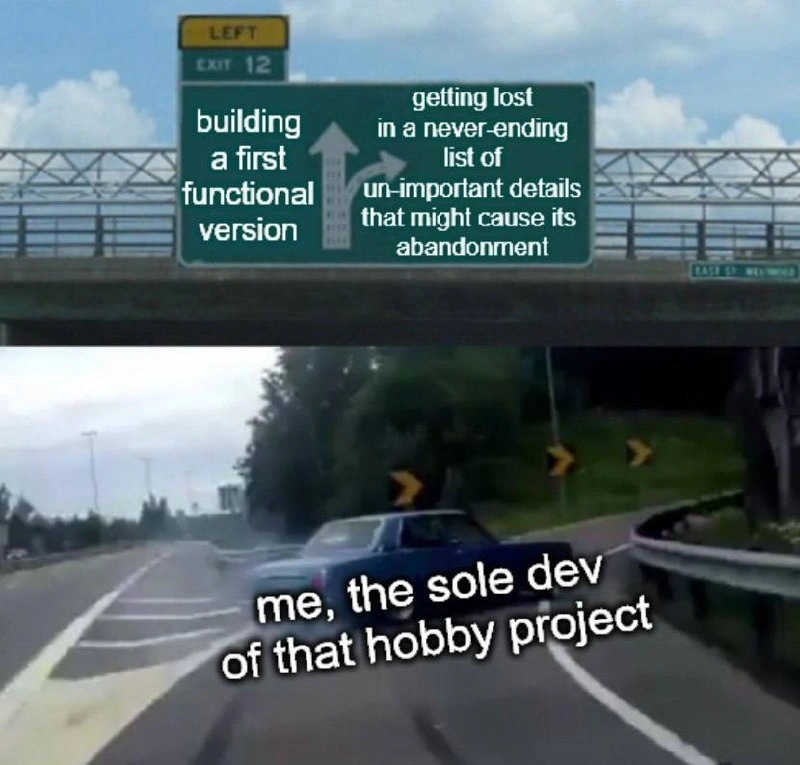
Let’s break down the technical terms and scenario for less experienced developers. The meme uses a popular format (the “car exit ramp” meme) to illustrate a software development lesson. In the image, the straight path (the highway) is labeled “building a first functional version.” That refers to creating a MVP (Minimum Viable Product) – the simplest, core implementation of your idea that actually works. It’s what developers are supposed to aim for initially: get something working, even if it’s basic, so you can test it, get feedback, or at least prove the concept.
The exit ramp sign reads “getting lost in a never-ending list of un-important details that might cause its abandonment.” This describes feature creep, sometimes also called scope creep. Feature creep means continuously adding extra features or refinements beyond the original plan. These add-ons are often low-priority or “nice-to-have” improvements that aren’t necessary for the project’s main goal. In a hobby project (a project you’re doing on the side, by yourself), it’s easy to keep thinking of new bells and whistles to add, because there’s no client or boss to say “No, stick to the plan.”
In real terms, imagine you set out to code a simple weather app for fun. The core goal is to display today’s weather for your city – that’s your MVP. Feature creep would be if you start saying: “Actually, I should include a five-day forecast… and also a radar map… oh, and what if users want to save multiple locations? Let me add user accounts with login… and notifications for weather alerts… and maybe I’ll integrate a Machine Learning algorithm to predict weather trends…” You can see how you’ve drifted far from the original “show today’s weather” goal. Each of those ideas might be cool, but they aren’t necessary at the beginning. If you try to do everything, you risk finishing nothing.
Now, the bottom panel of the meme shows a car labeled “me, the sole dev of that hobby project” violently turning onto the exit. This is saying the developer (me) consciously or subconsciously chose to pursue the extra features and trivial enhancements over completing the basic version. The car could have kept going straight to complete the first functional release, but instead it “takes the exit” to Feature Creep City. In plainer language, the developer got distracted by unimportant details. Maybe they started obsessing over finding the “perfect” folder structure, or rewriting the code in a new programming language halfway through, or adding a complex settings menu nobody asked for.
Let’s define a few key concepts and tags mentioned:
- SideProjects: A side project is any project you work on outside of your main job or obligations, usually for learning or fun. Because it’s yours alone, you have complete freedom – which is great, but also means no external guidance or deadlines. In a side project, it’s easy to keep tinkering indefinitely.
- FeatureCreep / Scope Creep: As described, this is the tendency to keep broadening the scope of a project by adding features, often without a clear necessity. It “creeps” in – one small idea at a time – until the project becomes much larger and more complex than originally intended.
- OverEngineering: This means designing a solution that is more complicated or fancy than needed for the problem at hand. For example, using five different microservices and a message queue for an app that could be a single simple script is overengineering. In our context, overengineering happens when the sole dev starts implementing industrial-scale features (like a plugin architecture, super optimization, etc.) for a simple hobby app.
- YAGNI Principle: “You Aren’t Gonna Need It.” This is a software principle reminding developers not to build functionality until it’s actually needed. It’s a direct antidote to feature creep. If you catch yourself saying, “I’ll add this now because I might need it later,” YAGNI suggests not doing it. Build only what the project needs right now to meet its goal. In the meme, the exit ramp of unimportant details is precisely all the stuff YAGNI warns against.
- Developer Procrastination / Perfectionism in Coding: Sometimes writing code that feels productive can actually be a form of procrastination. For instance, instead of tackling a hard but essential part of the project (maybe writing a tricky algorithm), a developer might procrastinate by doing something easier but non-essential, like beautifying the UI or refactoring code that already works. It feels like work, but it might be avoiding the real work. Perfectionism ties in: the desire to make everything flawless can lead to spending hours on details that users may never notice. There’s a saying, “Perfect is the enemy of done,” meaning if you seek perfection, you might never finish. In a one-person side project, it’s easy to fall into this trap because nobody is there to tell you that “good enough” is good enough!
- Analysis Paralysis: This is when you overthink choices so much that you fail to make progress. A solo dev might spend days deciding “what’s the absolute best framework or architecture for this project,” endlessly researching and debating with themselves, instead of just picking a reasonable option and coding. It’s another form of getting lost on a tangent (another exit ramp) and stalling the project.
All these concepts show why the car (developer) might skid off the road: the developer is essentially distracting themselves with secondary objectives. The meme humorously warns against this. ProjectManagement wisdom would say: define the scope (what you’re going to build) and stick to it, especially for a first version. Teams usually have project managers or mentors to rein in feature creep, but on a personal project, you have to be your own manager. The image of the car dramatically cutting across the highway divider to take the exit emphasizes just how sudden and reckless this decision can be. It’s like the developer couldn’t resist the temptation of “one more neat feature,” even though it’s clearly a wild move that jeopardizes reaching the original destination (a completed MVP).
In summary, the meme is a lighthearted lesson: if you’re a developer on a side project, try not to lose sight of your original goal. It’s okay to be excited about features, but don’t let endless enhancements prevent you from finishing something. After all, a simple app that is completed is more valuable (and satisfying) than an ambitious super-app that never gets done.
Level 3: Off-Ramp to Overengineering
In this meme’s top panel, a highway sign presents two choices: keep going straight towards building a first functional version (the intended path to a MVP – Minimum Viable Product), or veer off the exit toward “a never-ending list of un-important details.” The bottom panel shows a car (labeled “me, the sole dev of that hobby project”) dramatically swerving onto the exit ramp, tires smoking. This visual humorously depicts a scenario every seasoned developer recognizes: a solo side project getting derailed by feature creep and overengineering.
From a senior engineer’s perspective, the joke hits close to home. We’ve learned (often the hard way) that a MVP should be just that – the simplest working version of your idea. Yet there’s a strong temptation to add “just one more cool feature” or perfect every tiny aspect. That’s the off-ramp to overengineering: instead of finishing the core functionality, the developer chooses to chase endless enhancements. The result? The “hobby MVP” stalls out in development hell, possibly never seeing the light of day. 😅
Why is this so funny (and painfully true)? Because it satirizes a common developer pitfall: premature optimization and adding features you YAGNI (“You Aren’t Gonna Need It”). The meme sign literally spells out that the exit leads to “un-important details that might cause its abandonment.” It’s calling out how obsessing over low-priority polish can doom a project. For example, imagine a dev building a simple to-do list app for fun. Instead of finishing the basic “add and display tasks” functionality (the straight path), they veer off to implement a custom theme engine, a plugin system, or an AI-based task sorter – none of which are necessary for a first version. They might spend days setting up a complex microservice architecture or tweaking the color palette to perfection, all while the key feature (adding a task to a list) remains incomplete. This behavior is often jokingly referred to as “yak shaving.”
Yak shaving: a term engineers use for getting sidetracked by a chain of related tasks that are only tangentially important to your original goal. (As in, you wanted to fix one thing, but ended up needing to “shave a yak” in a far-off field before you can even start on the real task!)
The highway exit meme format perfectly captures that moment of decision where the developer’s rational mind says “stay on target – finish the MVP,” but their excited brain yells “Ooh, wouldn’t it be cool if...?!” and violently jerks the wheel. The car’s aggressive swerve implies this isn’t a gentle detour; it’s a reckless change of plans driven by enthusiasm and perfectionism outrunning practicality. Every experienced programmer has witnessed or lived this: a weekend project meant to solve a small problem balloons into a grand undertaking with too many moving parts. There’s a shared dark humor in how predictable this is. It highlights the gap between best practices (deliver something functional, use the KISS principle – Keep It Simple, Stupid) and the messy reality of developer psychology (“I’ll add all these cool features, I have no boss to stop me!”).
Seasoned devs laugh (and wince) because they’ve been that swerving car at 2 AM, suddenly deciding to refactor the entire codebase or integrate a new framework “because why not?”. We know the ending: burnout or boredom sets in, and the side project gets abandoned with no usable product to show. The humor comes from recognition – it’s a form of commiseration. By exaggerating the scenario (tires screeching toward “feature creep city”), the meme pokes fun at our tendency to be our own worst project managers. The truth is, without external deadlines or a team to enforce scope, developers often become the biggest obstacle to their own productivity. This meme is basically a cheeky PSA from the programming community: “Don’t be this car. Resist the shiny detour; finish the MVP first!”
Description
The classic 'Left Exit 12 Off Ramp' meme showing a highway with two options. The straight path is labeled 'building a first functional version'. The exit ramp (LEFT EXIT 12) is labeled 'getting lost in a never-ending list of un-important details that might cause its abandonment'. A car is shown dramatically swerving off the highway onto the exit ramp. The bottom panel shows the driver with text: 'me, the sole dev of that hobby project'. The meme captures the solo developer's tendency to obsess over inconsequential details instead of shipping a working product -- quintessential bikeshedding behavior that kills side projects
Comments
11Comment deleted
My GitHub is a graveyard of repos where I spent 3 weeks choosing between Tailwind and CSS Modules before writing a single line of business logic
My hobby project's CI pipeline can deploy a flawlessly linted, containerized 'Hello World' to a geo-redundant Kubernetes cluster in under 30 seconds. The actual application logic is still a TODO
Why ship an MVP today when you can spend six weekends perfecting a settings modal nobody asked for?
After 15 years in the industry, I've learned that the only difference between a senior engineer's side project and a junior's is the sophistication of the over-engineering before abandonment
Every side project has two possible exits: ship the MVP or spend six months bikeshedding the logging framework. Most of us miss that first exit every single time
Ship v0.1 behind a feature flag; everything else is a backlog sink
Classic second-system syndrome: over-engineering v0.1 before the first functional commit
go forward. in 3 months, turn right. turn right. turn right. Comment deleted
Okay okay, I'll finish it! You don't have to call me out like that! Comment deleted
Took me a long time to realize first I gotta build an MVP then add the rest of the features Comment deleted
YAGNI, YAGNI, YAGNI! It helps when you keep repeating it over and over again. Comment deleted