Skip to content
DevMeme
6691 of 7435
Grandma Remembers Deploying Applications Without Containers
Containerization Post #7335, on Oct 26, 2025 in TG

Grandma Remembers Deploying Applications Without Containers

Why is this Containerization meme funny?

Level 1: Grandma’s Tall Tech Tale

Imagine your grandma tells you, “When I was your age, I had to wash all our clothes by hand in a river.” You, who have only ever known washing machines, might giggle and say, “Sure, Grandma, let’s get you home.” You’re not really believing her or you think it’s a funny old story because nowadays nobody would do laundry that way.

This meme is doing the same thing, but with computers. The “grandma” here is an old engineer saying, “I used to put new software on computers without using those special containers (like doing it the hard way).” The young person is basically the modern engineer who finds that statement crazy or outdated, gently responding, “Okay, sure thing, let’s get you to bed,” as if humoring a senile claim. The joke is that technology has advanced so much that the old way of doing things sounds like a wild fairy tale to those who grew up with the new way. It’s funny because it shows a generation gap: the older generation is proud of how they did things in the past, and the younger generation can’t even imagine living without today’s conveniences. In simple terms, it’s poking fun at how grandpa or grandma talks about “back in my day, we did X by hand,” and the kids today respond with an affectionate eye-roll, since times have clearly changed. Here, “X” happens to be deploying software, but you don’t need to know the tech details to get the feeling – it’s just like marveling that someone used to do something the long, hard way when now there’s an easy way.

Level 2: Containers vs. Bare Metal for Newbies

Let’s break down the terms and ideas for those new to this whole Containerization and deployment thing:

  • Deploying without containers: This means running an application directly on a server (physical machine or VM) without using a container like Docker. Think of a server as a computer that sits in a data center. “Bare-metal” means a physical machine’s OS, and “deploying to bare metal” means you’re putting your app on that machine’s operating system directly. In the past (and still in some legacy setups), developers would update and run apps by copying files to these servers and launching processes on the host OS itself. For example, you might upload your web application files via scp (secure copy) or FTP, then maybe start it by running a command over SSH.

    • For instance, an old-school deployment could be:
      # Copy the new version of the app to the server
      scp myapp.tar.gz prod-server:/opt/myapp/
      
      # Log into the server and deploy
      ssh prod-server
      cd /opt/myapp/
      tar -xzf myapp.tar.gz   # extract files
      sudo systemctl restart myapp.service   # restart the app's service
      
      This is a manual deploy – you physically move the files and then restart the app on the server. The server might be lovingly named something like apollo or grandma-prod (naming servers was common, hence “pet” servers with unique names and personalities).
  • Containers (Docker): A container is like a lightweight virtual mini-computer for your app. Tools like Docker package an application along with everything it needs (libraries, runtime, etc.) into an image. When you run that image, it becomes a container: an isolated environment on the host machine. Containers share the host machine’s kernel (core of the OS) but keep everything else separate. This means you can have two containers each with different versions of libraries without clashing, even though they’re on the same host.

    • Example: You write a Python app that needs Flask 1.0 and an older Java app that needs a specific JDK. In the old days, installing both on one server could cause conflicts. With containers, you wrap the Python app in its own Docker image (with Flask inside) and the Java app in another image. Running them as containers on one host is fine; each container thinks it has the machine to itself.

    A typical modern deploy goes something like:

    # Build a Docker image for version 2.0 of our app
    docker build -t myapp:2.0 .
    
    # Push the image to a registry so others (like your cluster) can fetch it
    docker push myregistry.example.com/myapp:2.0
    
    # In Kubernetes, update the deployment to use the new image
    kubectl set image deployment/myapp myapp=myregistry.example.com/myapp:2.0
    

    Instead of copying files to a server, you’re shipping a Docker image to a registry and telling Kubernetes or another platform to run that image. Kubernetes will start new containers (with the new version) and stop the old ones, often without any downtime if configured right.

  • Kubernetes (K8s): This is a system to manage containers at scale. If Docker is the tool that creates containers, Kubernetes is the big brain that decides when and where to run those containers, how to network them, and what to do if one fails. It treats dozens or hundreds of servers as one big pool of resources on which it places containers. You don’t care which exact machine runs your container – Kubernetes (often just called K8s because eight characters come between K and s) handles that. It’s the poster child of modern DevOps/SRE because it automates much of the ops grunt work (starting/stopping containers, scaling up/down, rolling updates, etc.).

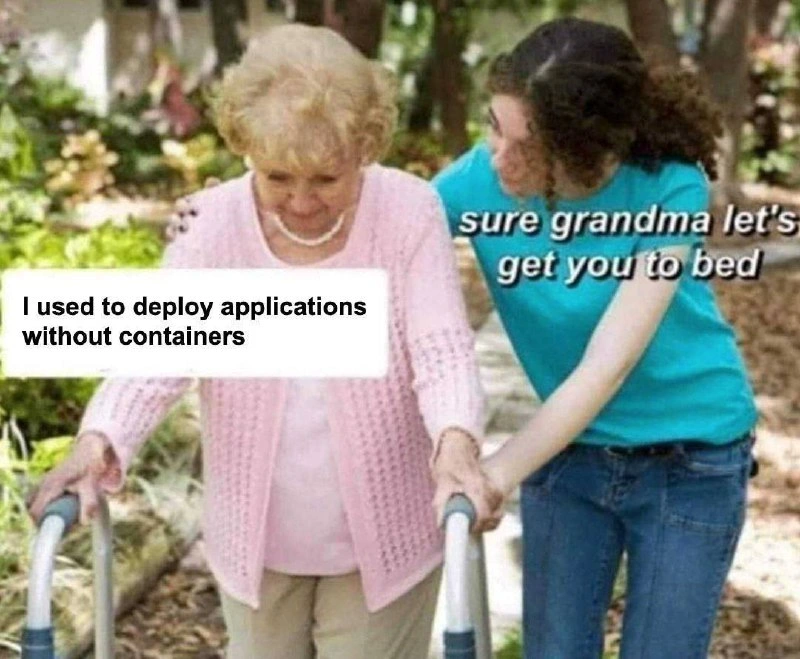
  • “Sure, Grandma” meme format: In internet/meme culture, the “sure grandma, let’s get you to bed” image is used when someone says something that sounds crazy or out-of-touch, and we respond in a gentle, patronizing way. In this case, Grandma says, “I used to deploy applications without containers,” which a modern dev (the young woman) finds hard to believe or just antiquated. It’s like someone saying “I used to write letters by hand and send them via postal mail,” and a kid today replying, “Sure, Grandma, let’s get you back to your chair.” It’s a jokey way to say “that was then, this is now – and now is totally different.”

  • “Pets vs cattle”: This is a popular analogy in DevOps. Pets (old style) are servers you care for individually: if a pet server gets sick (has an issue), you fix it and bring it back to health. You might even name it (e.g., WebServer01 with personality). Cattle (modern style) are servers or containers that are replaceable and identical. If one gets sick, you don’t nurse it, you replace it with another from the herd. Kubernetes treats servers and container instances like cattle – no single container is special. If one dies, a new one (with the same image) is created to take its place, automatically. This approach leads to more reliable systems because things self-recover and nothing depends on any single unique machine staying alive. Grandma’s statement “without containers” hearkens to the pets era, and the meme jokes that today’s engineers only know the cattle approach and see anything else as primitive.

In essence, what the meme is conveying in simple terms: Legacy systems used to run directly on hardware or VMs with manual deployments, which is like doing things the “hard way” by today’s standards. Modern systems use containerization (Docker) and orchestration (Kubernetes) to automate and simplify deployments, treating servers more uniformly. So when Grandma says she deployed without containers, the younger DevOps crowd finds it adorably antiquated – hence the humorous, patronizing response. It’s a clash of Modern vs Legacy approaches in deployment, packaged in a single image. Even if you’re new to these terms, you can understand it as “Old manual way vs New automated way,” with the meme joking about how the new generation can hardly imagine the old way was real.

Level 3: scp to Prod, What Could Go Wrong?

This meme hits home for every senior engineer who’s lived through the bare-metal deployment era and then witnessed the rise of containerized DevOps. The humor comes from the stark contrast in deployment mindsets:

On the left, “Grandma” reminisces about the good old days of deploying without containers. Translation: she’s talking about manual deployments on pet servers. This was the age of:

  • scp-ing or rsync-ing files to production: Literally copying the application files or binaries directly onto a live server. Maybe you had a trusty deploy.sh script that zipped up your code and FTP’d it to the server. There was a proud (and slightly terrifying) sense of ownership – that server was your baby. You knew its hostname, its quirks (like that one time a rogue cron job nearly wiped /var/log), and you often SSH’d in to tweak configs by hand. These servers earned the nickname “pets” – each one lovingly maintained and unique (and when one got “sick,” you nursed it back to health with manual fixes).

  • Hand-crafted startup scripts: Before modern init systems and container orchestration, you might write custom scripts to start your app when the server booted. Editing /etc/init.d/myapp or later a systemd service file by hand was normal. Deploying a new version often meant updating these scripts or running something like sudo service myapp restart over SSH. A lot of deployment tribal knowledge lived in people’s heads and shell scripts.

  • Downtime and late-night deploys: Deploying without containers often meant pushing changes directly onto a live system. You’d carefully schedule a late-night maintenance window, cross your fingers, and deploy straight to prod. If something misbehaved, it could bring down the whole machine. Rolling back? Ha – hope you kept a backup of the previous version’s files, or you’re re-running last week’s installer at 3 AM. The war stories from this era involve outages caused by one wrong command (like accidentally rm -rf-ing the wrong directory on a live server… yes, it happened).

Now on the right, we have the young “Sure, grandma” character – representing today’s DevOps/SRE generation raised on containers and Kubernetes. They’re gently patting the old-timer on the back with an indulgent smile: “Sure, grandma, let’s get you to bed.” Why? Because to them, deploying without Docker or K8s sounds as absurd as using punch cards. Modern deployment practices assume you package your app into a Docker container image and run it in an orchestrated environment. No one is SSH’ing into prod to tweak configs on the fly (in fact, immutable infrastructure and GitOps practices practically forbid that). Instead:

  • Cattle, not pets: Today’s servers (whether VMs or nodes in a cluster) are treated as replaceable instances (“cattle”). You don’t lovingly hand-configure a cattle server; you automate everything. If a node dies, Kubernetes just replaces it; if a container crashes, it gets rescheduled. The system is designed to self-heal and scale without individual attention. This resiliency is a world apart from the fragile “one server = one precious service” setup of the past.

  • Infrastructure as Code: Tools like Terraform, Kubernetes YAML manifests, and Helm charts mean your entire deployment configuration lives in code repositories. A change in how an app is deployed means pushing a git commit, not logging into a server. This ensures consistency across environments – no more “well, it worked on Server A, not sure why Server B is acting weird.” In grandma’s day, that weirdness was often due to config drift (slightly different settings on each “pet” server).

  • CI/CD Pipelines and Container Registries: Modern workflows automatically build and test container images and deploy them. For example, a developer merges code to main, a CI pipeline builds a new Docker image (say myapp:v2.3), pushes it to a registry, and then a deployment tool updates the cluster to run that image. Contrast that with the old manual process: someone (maybe grandma herself) manually compiling the code and copying artifacts to the server. The new generation finds the old way error-prone and scary – and it was, frankly.

The meme’s comedy comes from the generational tech gap. The older engineers wear their bare-metal deployment experiences like badges of honor (“I once brought up a production webserver with nothing but a Bash script and raw determination”). Meanwhile, the younger engineers might roll their eyes, because in their world, such tales sound like Grandpa Simpson rambling about the days before the internet. It’s affectionate ribbing: veterans sometimes recount these war stories to highlight how much tougher deployments used to be (walking uphill both ways in the snow, technologically speaking), and juniors respond with an amused “Sure thing, Grandpa, you’re so old-school.”

But under the humor, there’s a real acknowledgment of Legacy Systems still running without containers. A veteran DevOps engineer might actually have to maintain an old stack where deployments are done via shell script, even as newer services in the same company are on Kubernetes. That scenario can feel exactly like the meme: you explain a manual deployment quirk to a fresh engineer, and they look at you like you’re speaking ancient Greek. The “let’s get you to bed” line playfully suggests “you’re talking crazy,” reflecting how modern practice views those legacy methods as nearly unbelievable.

From an industry perspective, this meme pokes fun at how containerization has become the default expectation. Terms like “cloud-native,” “Dockerfile,” “pods,” and “K8s” dominate today’s deployment conversations. Hearing someone talk about deploying straight onto a server without any of that is jarring – it’s analogous to hearing, “I hand-wrote assembly to build websites” – technically possible, but why would you now? The meme captures that sentiment: Sure, Grandma, those were the days, but let’s move on with our Kubernetes-managed life.

One could also sense a bit of DevOps humor here in how each generation views the other: the seasoned engineers sometimes feel a bit dismissed, while the new generation can’t imagine life without the safety nets of modern tools. Yet, behind the scenes, every seasoned SRE knows that many core concepts haven’t changed – we still worry about processes, resources, uptime – we just have shinier tools. And every new engineer eventually encounters a scenario where the abstraction leaks (e.g., debugging a weird container networking issue) and gains newfound respect for the complexities the older folks handled manually.

In summary, Level 3 exposes why the meme is painfully funny to industry veterans and newcomers alike: it’s exaggerating the modern vs legacy divide. It highlights the almost incredulous reaction a Kubernetes-native DevOps engineer might have to the idea of pre-Docker deployments (“you mean you just… ran it on the server?!”). The shared laugh comes from realizing how fast tech norms change — what was standard 10-15 years ago now sounds like a fairy tale to engineers who grew up with containers.

Level 4: Dark Ages of DevOps

Before containers revolutionized DevOps, deploying software was an arcane sysadmin art. In these dark ages, applications ran directly on a server’s OS without any virtual sandbox. This meant dealing with all the gritty OS-level internals ourselves:

  • Dependency Hell: All apps shared the same base system. If one app required libSSL 1.0 and another needed libSSL 1.1, guess what – you were in for a dependency deathmatch. No isolated containers to give each app its own version; you manually juggled library versions or resorted to hacks like static linking.
  • No Namespace Isolation: Modern containers use Linux namespaces (PID, network, mount, etc.) to pretend each app has its own little machine. Back then, processes rubbed shoulders in one global namespace. A rogue process could hog all CPU or memory, and only clunky tools (nice, ulimit) stood between a misbehaving app and a crashed server. There was no cgroup-based resource isolation – if one service decided to eat 100% CPU, it was game over for everything else on that box.
  • Mutable Servers: Deploys were done on live systems, meaning the server’s state changed over time (mutable infrastructure). Each update tweaked configs, installed packages, maybe left old files around. Over months and years, servers became unique snowflakes – hard to recreate, fragile to change. Today’s container images and immutable infrastructure model didn’t exist; you couldn’t just redeploy a fresh container to reset a bad state. Instead, sysadmins performed configuration surgery on long-lived machines.

At a kernel level, what we consider a “container” is basically a fancy combination of chroot (changing the filesystem root to isolate file access), cgroups (controlling resource usage), and namespace tricks to give a process its own view of the system. In grandma’s time, if you wanted similar isolation, you either ran a full virtual machine (heavy, like running a whole extra OS), or you did without. There was no lightweight middle ground until technologies like LXC and Docker emerged. This fundamental shift – from tweaking real servers (bare metal or VMs) to orchestrating boxed-up processes – is why the meme’s claim, “I used to deploy applications without containers,” sounds so prehistoric to the Kubernetes generation. It’s as if someone said they used a rotary phone in the smartphone era – technically true and historically important, but practically unthinkable to those who grew up with cloud-native convenience.

In summary (for the hardcore): The meme highlights a time before industry-standard containerization, when deployments were constrained by OS internals and manual practices. It’s poking fun at how far infrastructure tech has come – from an era of ad-hoc scripts and hand-crafted init scripts running on unique pet servers, to today’s automated, containerized fleets managed by orchestration magic. The “grandma” in the meme is essentially referencing the bygone era of bare-metal deployments and early configuration management, which, while foundational, now feel like archaic lore in a world dominated by Docker images and Kubernetes pods.

Description

The 'Sure grandma, let's get you to bed' meme template showing an elderly woman using a walker being guided by a younger woman in a teal t-shirt, set in a garden. The grandma's text reads: 'I used to deploy applications without containers'. The younger woman responds: 'sure grandma let's get you to bed'. The meme humorously frames pre-container deployment (bare metal, VMs, manual server provisioning, 'works on my machine' syndrome) as something so ancient and absurd that only an elderly person would remember it, highlighting how deeply containerization has become the default in modern software deployment

Comments

14
Anonymous ★ Top Pick Deploying without containers? Next you'll tell me you SSH'd into production and ran 'git pull' -- oh wait, some of us still do that on Fridays at 5pm
  1. Anonymous ★ Top Pick

    Deploying without containers? Next you'll tell me you SSH'd into production and ran 'git pull' -- oh wait, some of us still do that on Fridays at 5pm

  2. Anonymous

    The year is 2050. 'I remember when we had to write our own Dockerfiles,' I'll tell my grandkids. They'll nod politely and say, 'Sure, grandpa, let's get you back to the AI that auto-codes and deploys based on your brainwaves.'

  3. Anonymous

    Back in her day, ‘deploy’ meant a cheeky ssh + rsync - now it’s 400 lines of YAML to run “hello world.”

  4. Anonymous

    Back when 'works on my machine' meant physically shipping your machine to the data center

  5. Anonymous

    Back in my day, we deployed straight to bare metal and liked it! Now get off my lawn and into your ephemeral pods

  6. Anonymous

    We replaced 'ssh + rsync + pray' with 'kubectl apply + YAML drift.' Progress, but the pager still knows my number

  7. Anonymous

    Pre-containers: artisanal snowflake servers, where 'it works on my machine' launched a thousand incidents

  8. @yevhen_k 8mo

    good old scp/ftp. just upload new html/css to the server and voila! new version is deployed

  9. @WaterCat73 8mo

    Idk, I deploy without containers (but using Python venv). Also no CI/CD, but using git pull instead of ftp

    1. @adm877 8mo

      At work a rather simple application was developed using Docker because a guy with DevOps title had to practice his skills and make his salary worth. He since left and my colleagues can't understand what tf was that for.

  10. @vialli 8mo

    i used to deploy applications in a testing stage first. but you do you.

  11. @Agent1378 8mo

    Lol still am

  12. @adm877 8mo

    Aaa yes, my precious HTTPS to HTTPS eternal redirect. After it failed to set HTTPS flag to true.

  13. @mohamed_023 8mo

    This error is some nightmare fuel

Use J and K for navigation