Skip to content
DevMeme
5293 of 7435
The Brutally Honest Guide to Improving at Coding
Learning Post #5805, on Jan 11, 2024 in TG

The Brutally Honest Guide to Improving at Coding

Why is this Learning meme funny?

Level 1: Just Code It

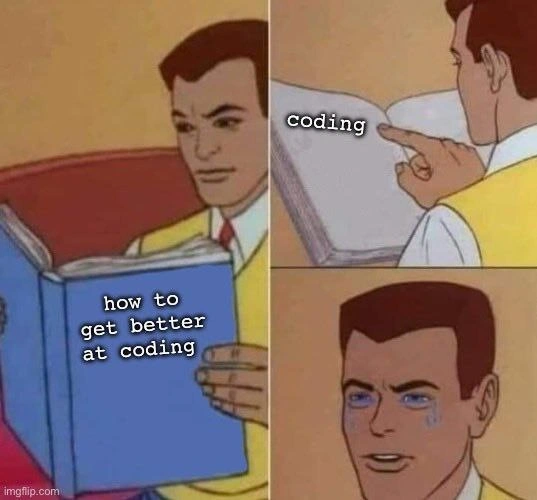
Imagine you have a big, shiny book titled "How to Get Better at Playing Piano." You’re excited to open it, thinking it will reveal a special secret. But when you look inside, it only has one sentence: "Play the piano every day." 🙃 It might make you giggle because it’s so simple and obvious! This meme is doing the same thing, but with coding. It shows a comic character (Spider-Man) reading a book about getting better at coding, and the only answer written there is "coding." In plain terms, that means if you want to become a better coder, the best thing to do is write code. It’s funny because sometimes we expect a magical shortcut or a big secret to becoming great, but the answer is really just practice. Like learning to ride a bike – you can read about balance and steering, but you only really get better by hopping on the bike and pedaling. The meme’s last panel shows Spider-Man’s face like, "Oh, of course!" We feel a bit of the same amusement because the "secret" turned out to be something we kinda knew all along. It makes us smile and remember that whether it’s coding, playing an instrument, or drawing a picture, practice is the key – the more you do it, the better you get. So the joke is basically saying: no big tricks here, just keep coding, and you'll improve!

Level 2: Hands-On Learning

For a newer developer (or someone early in their coding journey), this meme highlights the difference between theory and practice. In the images, Spider-Man (from a 1960s animated series often used in DeveloperMemes) is reading a book about improving coding skills. When he opens it, all he sees is the word "coding". This scene is a playful way to say: to get better at coding, you have to do a lot of coding! In software terms, that means actually writing programs, experimenting with code, building small projects, and solving errors yourself.

Let's break down the key idea: learning by doing. This is a fundamental concept in skill development. You can read about programming concepts or watch someone code on YouTube, which is helpful to a point, but it's a bit like reading about riding a bicycle versus actually hopping on a bike. The tag reading_vs_doing is exactly about that comparison. Reading gives you knowledge, but doing (coding) gives you experience. Experience is what really cements skills because you encounter real problems and learn to fix them. For example, you might read about how to use a web framework like Django or how to optimize an algorithm, but you won’t truly understand those things until you try to implement them in a real program. The first time you deploy a web app or debug a slow piece of code, you'll gain insights that no tutorial could fully convey. This process of trial and error is how you climb the LearningCurve in tech. The "learning curve" refers to the rate at which you progress in a new skill: at first it might feel steep (lots of challenges and slow progress), but as you practice, things click faster. Each project or coding challenge you tackle makes the next one a bit easier — that’s ContinuousLearning in action, constantly building on what you know.

The meme’s humor also comes from how obvious the answer seems. The character expected to find a detailed guide or some secret technique in that big book. Instead, the book basically says, “Just do it.” It's like asking "How can I get better at painting?" and the answer is "paint". This can feel both funny and a bit frustrating. Many of us, as beginner developers, have googled “How to become a better programmer” hoping for a clear list of steps. Often the advice lists will include things like: practice coding every day, contribute to open source, read others’ code, build projects, etc. Notice a pattern? They all involve actively coding. Sure, reading documentation and studying theory is important (for instance, reading about data structures or design patterns gives you valuable knowledge). But knowledge sitting in your head isn't useful until you apply it. This meme emphasizes DeveloperMindset too: a good developer mindset is one that accepts that DeveloperGrowth is a gradual, hands-on process. Instead of just reading about a new JavaScript framework, a developer with a growth mindset will start a small app with it to understand it firsthand.

Let’s demystify some terms from the tags:

  • Deliberate practice: This means practicing with a purpose, focusing on improving specific aspects of your coding. For example, deliberately writing a lot of algorithms to get better at problem-solving, not just copying and pasting code.
  • Practice makes perfect: A common saying (tagged as practice_makes_perfect) meaning the more you practice, the closer you get to mastery. In coding, every bug you fix and program you finish makes you a bit more skilled. (We often amend it to "practice makes progress" because there's always more to learn in coding – nobody’s truly "perfect".)
  • Skill improvement: This is just another way of saying getting better at something. Here, improving your coding skill means things like writing cleaner code, solving problems faster, and maybe using fewer Google searches over time because you remember solutions from experience!
  • Developer Productivity: This refers to how efficiently a developer can produce working code. When you practice a lot, you tend to become more productive — for instance, you might build a simple website in a day whereas it took you a week when you were just starting. Practice builds familiarity with tools and languages, which speeds you up.

So, the meme is basically a tongue-in-cheek lesson for those learning to code: reading a guide about coding can give you hints, but your ability will improve mostly by actually coding. It's an encouragement to focus more time on writing code, even if it's challenging, because that's how you'll truly get better. The blank, surprised look on Spider-Man’s face in the last panel is something many of us recognize: it's the moment you realize the only real trick is consistent practice. No superhero serum or ultra-tech gadget (or fancy book) instantly makes you a great programmer – you just have to put in the keyboard hours. And the good news is, each time you practice, you do level up a little in your coding superpowers.

Level 3: No Silver Bullet

For experienced developers, this meme elicits a knowing chuckle because it pokes fun at the eternal quest for a magic solution to become a better programmer. The thick blue book titled "how to get better at coding" represents all the blog posts, tutorials, courses, and books promising to improve your skills. As developers, especially early on, we often hope there's one weird trick or a silver bullet that will level up our abilities – maybe a new framework, a secret language feature, or that must-read software engineering tome. Panel by panel, Spider-Man (Peter Parker in that vintage cartoon) flips through this substantial guide expecting profound wisdom. Instead, he finds the single, obvious answer: "coding". The punchline lands in Panel 4 with Peter’s blank, slightly dumbfounded stare, which perfectly captures that "oh... of course" realization. It’s the same look you might have when a senior engineer tells you the unwelcome truth: there are no shortcuts.

This is classic DeveloperHumor because it highlights an almost universal experience in the developer journey. Everyone who’s been around long enough recognizes the truth of practice_makes_perfect (or more accurately, practice makes progress). The meme is essentially a sarcastic TL;DR of every DeveloperGrowth advice thread: "How do you improve at coding?""Code." It's funny in the same way it’s funny to see a huge "Expectations vs Reality" contrast compressed into one word. We spend hours Googling tips, reading about design patterns, or watching conference talks (all useful to some extent), but the LearningCurve in programming is conquered mainly by writing a lot of code, making mistakes, and learning from those mistakes. Refactoring a messy legacy module at 3 AM, wrestling with a gnarly bug, or tweaking a feature for the umpteenth time – those hands-on trials are where real growth happens.

The meme also winks at the distinction between reading_vs_doing. A lot of novices ask, "Should I read this 500-page book on C++ to get better?" Experienced devs might reply with something like, "Sure, books are great, but you also need to write actual C++ programs – build something!" The comedic exaggeration of a giant book containing just the word "coding" satirizes the fact that ultimately, doing the work is the primary way forward. It's a playful jab at any complacency we might have: maybe we thought buying that Algorithms textbook or binge-watching tutorial videos would magically transform us overnight. Nope – the book effectively throws us back into the editor: just write code. In a way, it aligns with the software engineering proverb "No Silver Bullet," coined by Fred Brooks to say there's no single tool or methodology that instantly yields tenfold improvement. Here, the "no silver bullet" message is that no amount of purely theoretical knowledge will replace deliberate_practice. Even legendary programmers like Grace Hopper or John Carmack became experts by spending endless hours coding – not by simply reading about coding.

In the workplace, this truth manifests in things like the hiring process: ever notice how many tech interviews include writing real code (on a whiteboard or laptop) rather than just theoretical questions? It's because, in practice, your value as a developer comes from your ability to produce and troubleshoot code. Senior engineers smile at this meme because they've lived it — the only way they became proficient in debugging, mastering a framework, or improving DeveloperProductivity was by diving in and coding, often through ContinuousLearning on the job. It's humor with a hint of "told you so," especially towards any mindset that there’s an easier route to expertise. Ultimately, the meme resonates as both a joke and a gentle admonition: stop overthinking and start coding, because that's how everyone gets better, even Spider-Man.

Level 4: Recursion of Mastery

At the most theoretical level, this meme humorously hints at a self-referential solution – essentially a recursive answer to the question of skill improvement. In computer science, recursion is when a function calls itself as part of its operation. Here, the book titled "how to get better at coding" contains only the word "coding", implying the advice is to do the thing itself. It's like a function defined in terms of itself:

def how_to_get_better_at_coding():
    return how_to_get_better_at_coding()  # recursion: the answer is to call itself (keep coding)

Of course, this how_to_get_better_at_coding() snippet would infinitely recurse in real code (and eventually cause a stack overflow), but as a metaphor it's spot on – you improve by continually engaging in the activity. This is reminiscent of the classic programming joke about recursion: “See recursion, see recursion.” The meme delivers a similarly tautological punchline: the algorithm for coding mastery is to code.

From a learning theory perspective, this speaks to the idea of bootstrapping. Just as a compiler might be written in the language it compiles (a compiler that compiles itself, which is a mind-bending but real concept in computer science), a developer "compiles" their skill by using coding itself to improve. Each coding session acts like an iteration in a learning algorithm – akin to how a neural network trains by adjusting weights over many epochs. You can think of your brain as running a gradient descent on coding skill: every time you write and debug a program, you're reducing the "loss" (misunderstanding) and strengthening neural connections. In essence, deliberate practice in coding is the training data that updates your mental model. No textbook formula can bypass the fundamental necessity of accumulating experience. Just as no AI model can generalize without ample data, no programmer can achieve expertise without extensive hands-on ContinuousLearning through actual coding. The humor here is that such an academically grounded truth – supported by cognitive science and the "10,000 hours rule" – is presented in the simplest, almost absurd form: one blank page with a single word. It’s a wink to seasoned engineers that behind every elegant theory (or hefty book) on skill_improvement, at the end of the day, practice is the recursive core of the solution.

Description

A three-panel cartoon meme that humorously depicts the harsh reality of skill development in programming. In the first panel on the left, a man with a serious expression is reading a blue book titled 'how to get better at coding'. The second panel, top right, shows a close-up of the book's content, where the man's finger points to a single word on the page: 'coding'. The final panel, bottom right, shows the man looking up from the book, his face now etched with despair and tears welling in his eyes. The joke lies in the contrast between the desire for a secret or shortcut to mastery and the painfully simple, yet arduous, truth: the only way to improve is through the often-frustrating process of actually doing it. This resonates deeply with developers who understand that the word 'coding' encompasses a world of debugging, problem-solving, learning, and banging one's head against the keyboard


Comments

12
Anonymous ★ Top Pick That single word 'coding' expands into a recursive dependency graph of suffering, 17 Stack Overflow tabs, and existential questions about why you didn't just become a farmer
  1. Anonymous ★ Top Pick

    That single word 'coding' expands into a recursive dependency graph of suffering, 17 Stack Overflow tabs, and existential questions about why you didn't just become a farmer

  2. Anonymous

    Finally got the principal engineer’s 500-page guide to mastering software: Page 1 - “Write code.” Page 2 - “Delete half of it.” The remaining 498 pages are just git blame output

  3. Anonymous

    After 20 years in the industry, I've discovered the secret to getting better at coding: it's exactly like achieving eventual consistency in distributed systems - you keep writing code until either you get better or the heat death of the universe occurs, whichever comes first

  4. Anonymous

    The classic developer paradox: spending 40 hours reading about clean code architecture, SOLID principles, and design patterns to avoid spending 2 hours actually refactoring that legacy monolith. It's not procrastination - it's 'strategic knowledge acquisition' and 'risk mitigation through comprehensive research.' The sweating intensifies when you realize the book's examples are in a language that went EOL three years ago

  5. Anonymous

    After 20 years, the most reliable training program is a tight loop - write code, get feedback, refactor - the book’s single-word chapter in practice

  6. Anonymous

    Coding: one Post-it note. Getting better: the GitHub archive of every deprecated library you've ever sworn by

  7. Anonymous

    That book is basically a while(true) loop to prod: write code, get reviewed, fix prod, repeat - amortized O(years) improvement

  8. 扇子 2y

    mooooods

  9. @MDSPro 2y

    All I see is PAIN

  10. @Araalith 2y

    Mindless coding solidifies bad habits and terminates any progress. True improvement requires constant learning and keeping up with modern best practices.

  11. @CcxCZ 2y

    Actual list here: http://www.norvig.com/21-days.html My personal take: Read others' code. Modify it. Collaborate.

  12. @xera86 2y

    Read documentation ☠

Use J and K for navigation