The Unspoken Truth of Pre-QA Testing
Why is this Testing meme funny?
Level 1: Did You Check Your Work?
Imagine you’re at school and you just finished a big homework assignment. You rush to say “I’m done!” without even checking your work or reviewing the answers. Your teacher looks at you and asks, “You did double-check your answers, right?” You freeze for a moment, because… uh oh… you didn’t actually check anything. Now you’re worried what mistakes might be in there. This meme is exactly that feeling, but with computer code. The developer is like the student who shouted “I’m finished!” too soon. The QA person is like the teacher asking gently, “Are you sure you’re finished? Did you review it (test it) even a little?” In the meme’s last panel, the QA’s face shows panic because it’s dawning on her that the developer didn’t verify his work at all. It’s funny in a silly way because we all know it’s not wise to hand in something important without checking – whether it’s homework or computer code – and yet people sometimes do it and hope for the best. The joke teaches a simple lesson: always check your work before saying it’s done, or someone else will worry (or find mistakes) for you!
Level 2: But Did You Test?
Let’s break down why Padmé’s question "You wrote unit tests, right?" is such a big deal in this CodingHumor scenario. First, what are unit tests? A unit test is a small piece of code that automatically checks that a specific part of your program (usually a single function or module) works correctly. For example, if you have a function divide(a, b) that is supposed to divide two numbers, a unit test would call divide(6, 2) and expect to get 3 as a result. It would also check how divide handles tricky cases, like dividing by zero (which should maybe throw an error). Integration tests go a bit further – they test how different pieces of the system work together. When Padmé asks if any tests were written, she’s basically asking if the developer made sure the code works as intended before handing it over.
Now, QA stands for Quality Assurance. A QA engineer’s job is to verify that the software meets the requirements and to find any issues a developer might have missed. But here’s the catch: in a good QAProcess, the developer is expected to do some homework upfront – namely writing unit tests and perhaps running automated test suites – to ensure CodeQuality. Saying "This code is ready for QA" means the developer believes the feature is complete and stable enough for a deeper round of testing. It’s like saying "I think I did a good job, you probably won’t find any obvious bugs." Padmé’s follow-up question is essentially "Are you sure? You did your part and tested it yourself, right?". When the developer (Anakin) has no answer, it’s a big red flag.
Why is that silence so awkward? Because not writing any tests is a sign that the developer might have skipped basic quality checks. Think of TestCoverage as a measure of how much of the code is exercised by tests. If test coverage is near 0%, it means almost no automated tests were run, and many bugs could be lurking undetected. Most teams consider it a bad practice to have missing_unit_tests for new code. Many companies even require a certain percentage of test coverage (say 80% of the code must be covered by tests) before code can move on. Skipping tests can lead to bugs that slow down the project: QA will likely find issues that send the code back to the developer for fixes, delaying releases. It’s also about trust and collaboration. In a dev team, handing off untested code is kind of dumping unfinished work on QA’s plate. That’s why Padmé’s face goes from happy to concerned in the meme – she realizes the developer might be throwing a surprise party of bugs her way.
The Padmé–Anakin meme format is popular in DeveloperMemes because it clearly shows a conversation and a sudden shift in mood. In this case, "ME" (Anakin) is the developer asserting success, and "QA" (Padmé) is the colleague double-checking. The joke plays on a common TestingHumor scenario: a developer insists "It’s all good!" and the QA immediately responds "Did you even test it?" It's funny to developers because it’s a gentle poke at our bad habits. We’ve all been a bit overconfident at times, thinking "It works on my machine, so ship it!". But in a healthy software development practice, UnitTesting isn’t optional – it’s how we verify our code before involving QA. The meme serves as a humorous PSA: next time you’re about to announce code "QA-ready", make sure you’ve done the basics like writing tests. Otherwise, expect your QA teammate to give you that Padmé look of utter disbelief. In summary, Padmé’s question and Anakin’s guilty silence illustrate the importance of testing in the QA process: code isn’t truly ready until it’s been checked, double-checked, and then checked by someone else.
Level 3: Confidence Without Coverage
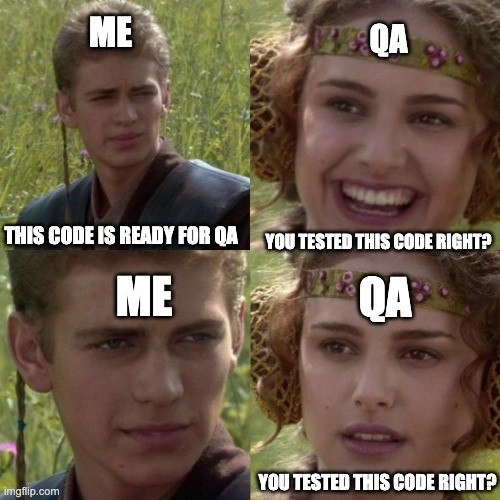
In this meme, Anakin (the developer) proudly proclaims "This code is ready for QA," essentially saying "I'm done, let's hand it off." Padmé (the QA engineer) immediately asks the pointed question: "You wrote unit tests, right?". This punchline lands because experienced developers recognize the situation all too well. It's a classic case of premature confidence without proper test coverage. The humor here stems from an unspoken industry truth: claiming a feature is done without any unit tests or integration tests is like saying a book is ready for publishing when only one chapter was proofread. Everyone in software knows they should write tests for good CodeQuality, but under tight deadlines or sheer optimism, some devs still skip this critical step. The meme’s tension comes from that shared DeveloperHumor experience – the QAProcess catching a developer in the act of effectively saying "Trust me, it's fine" with nothing to back it up. Padmé’s increasingly worried face in panels 2 and 4 embodies test_coverage_doubt: the sinking realization that the "ready" code might be a minefield of bugs because no one verified it.
This scenario highlights a disconnect in the Definition of Done. In mature teams, code isn't truly "done" until it’s tested. A senior engineer will tell you that marking code QA-ready without tests is a recipe for QA panic. Why? Because QA (Quality Assurance) expects the basics to be covered – they assume the developer at least ran automated checks or unit tests for key functions. When Padmé asks “You wrote any tests… right?” and Anakin just stares blankly, it’s the cringe moment every QA engineer dreads. His silence says, “Oops, I only did a quick manual run on my machine, no real tests.” That’s why Padmé repeats the question more urgently – she's realizing this qa_ready_claim might be hollow. The padme_anakin_meme format brilliantly captures this escalating dread: the first ask is hopeful, the second is panicked. It’s funny to us because we’ve either been Anakin (hoping nobody asks about tests) or Padmé (sensing a looming disaster) at some point.
From a senior dev perspective, there's also an element of dark comedy in how TestCoverage often gets treated. You might hear jokes like "100% 0% coverage, works on my machine!". The hard truth is that untested code is high risk. Seasoned devs know that when a feature with no tests hits QA, it frequently boomerangs back with a bunch of bug tickets. It’s practically an IT horror trope: code handed off on Friday 5 PM with zero tests, only for QA to find a show-stopping bug in the first five minutes of testing. The meme thus satirizes this TestingHumor scenario we all recognize. The subtext is: writing tests is not just bureaucratic fuss – it’s what separates confident delivery from wishful thinking. When QA asks “Did you test this code right?”, they’re really asking if the developer did their due diligence. If not, both sides know they’re in for a rough ride. In short, the meme humorously exposes the gap between a dev’s optimism and the reality of QA testing expectations. Every experienced engineer chuckles (or cringes) because they know no amount of "But it worked on my machine" will save you when there are no safety nets (unit tests) to catch the falling bugs.
// Developer's "tested on my machine" scenario:
public int divide(int a, int b) {
return a / b; // Hope b is never zero because we didn't write a test for that.
}
// Quick manual check by the developer:
System.out.println(divide(6, 2)); // Output: 3. Looks good in this one case. Ship it!
// No automated unit tests were written, but code is marked "ready for QA". Uh-oh!
In the code above, the developer only tried a simple case manually (6 divided by 2) and declared victory. But missing_unit_tests means they never tested critical edges like b = 0 – something a basic unit test would catch (division by zero will crash!). This is exactly the kind of bug that QA will discover instantly. The meme’s humor lives in that Testing gap: the developer’s proud “ready for QA” versus the QA’s "are you serious?" face. It’s a lighthearted reminder (with an anxious laugh) that skipping tests is never as harmless as we tell ourselves. In reality, confidence without coverage just transfers the burden onto QA and downstream teams, leading to tense moments exactly like the one Padmé is having. Experienced devs smile at this meme because it encapsulates a core lesson of professional software development: if you didn't test it, it's probably not as “ready” as you think.
Description
This meme uses the four-panel 'Anakin and Padmé' format from Star Wars: Episode II - Attack of the Clones to illustrate a common, tense interaction between developers and quality assurance (QA) teams. In the first panel, a confident-looking Anakin Skywalker is labeled 'ME,' with the caption 'THIS CODE IS READY FOR QA.' In the second panel, a smiling Padmé Amidala, labeled 'QA,' asks, 'YOU TESTED THIS CODE RIGHT?' The third panel shows Anakin's expression shift to a deadpan, silent stare, still labeled 'ME.' The final panel mirrors this change, showing Padmé's smile replaced with a look of serious concern as she repeats the question, 'YOU TESTED THIS CODE RIGHT?' The humor is derived from the silent admission of guilt. The developer's bravado crumbles when faced with the simple question of whether they've performed due diligence, and the QA engineer's expression perfectly captures the dawning horror of receiving untested code. It's a relatable scenario that highlights the pressure to ship quickly, sometimes at the expense of quality, and the classic 'throw it over the wall' mentality
Comments
10Comment deleted
Of course I tested it. The test was `git push` and the result was `true`
“It’s totally ready for QA, Padmé - I just dropped the coverage threshold to 0% in the pipeline. Observability is the new unit test, right?”
After 15 years in the industry, I've learned that 'ready for QA' is just developer speak for 'I've successfully compiled it once and the happy path worked on my machine with that one specific dataset I hardcoded three sprints ago.'
This is the exact moment when 'works on my machine' meets 'did it work on your machine though?' - a timeless dance where developers discover that Ctrl+S doesn't count as integration testing, and QA realizes they're about to become the world's most expensive debugger. The real test isn't in the code; it's whether you can maintain eye contact while claiming you ran the happy path at least once
Devs treat QA as outsourced unit testing: 'It compiles locally, ship it!' - until prod echoes with bug screams
Calling code Ready for QA without unit tests isn’t shift-left - it’s just routing the test pyramid through a person-shaped load balancer
“Ready for QA” is dev-speak for “the mocks are passing, the contracts are aspirational, and CI is green because the flaky tests live in quarantine.”
If i will test my crap, why we will need you. Comment deleted
Because you test that code at least works in some way and I test how it's behavior exactly meets the functional requirement Comment deleted
is it correct usage of the macro? I thought you need weaker question on the second right quarter Comment deleted