When try-catch becomes a cheesy developer pickup line about exceptions
Why is this Languages meme funny?
Level 1: I'll Catch You
Imagine your friend is learning to be a magician who catches falling plates as a trick. They practice by saying, "I'll try to catch every plate so none break." Now, switch the scene to a playground: you’re on a swing and jump off, and your friend says, "Don't worry, I'll catch you if you fall!" It's a kind and caring promise. This meme is doing the same thing, but with programmer words. In coding, we say try and catch when we handle mistakes so the computer doesn't crash. Here, a developer uses those same words to tell someone in a sweet way, "If you stumble or take a risk, I'll be there to catch you." It’s funny and cute because it's like a secret handshake for coders — mixing a everyday loving phrase with computer language. Even if you don’t code, you can feel the warm, protective vibe: someone saying they'll catch you is always nice, and hearing it in a geeky way just makes it extra charming.
Level 2: Catch Exceptions & People
In programming, exceptions are errors or unexpected events that occur during a program’s execution (at runtime). Instead of the program crashing immediately when something goes wrong, we use error handling constructs to manage these situations. One common construct is the try/catch block. The idea is simple: you try to execute some code that might be risky, and if an error (exception) happens, you catch it and handle it so the program can continue or shut down gracefully. This is a fundamental part of debugging & troubleshooting in many languages. For example, in Java you might see:
try {
// Attempt something that might throw an exception
riskyOperation();
} catch (Exception e) {
// Catch the error and handle it
System.err.println("Caught an exception: " + e.getMessage());
}
In the code above, the program will try to run riskyOperation(). If riskyOperation() throws an error (say, it couldn't find a file or divided by zero), the flow jumps to the catch block. There, we catch the exception (often storing it in a variable e) and can respond—like printing an error message or doing some cleanup—rather than letting the whole program blow up. Think of catch like a safety net or airbag: it catches the program when something falls apart, preventing a full crash. This pattern is extremely common across programming languages: C++ and C# use try/catch too, JavaScript has try/catch, and Python has a similar idea with try/except. Handling runtime errors this way makes software more robust and user-friendly. Without any catch, an exception would typically unwind the stack and potentially stop the program with a nasty error dump (stack trace). With a catch, we can recover or at least fail gracefully.
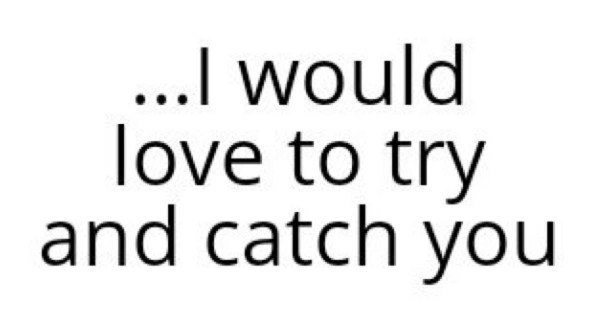
Now, the meme text "...I would love to try and catch you" is directly playing on that terminology. It reads like a line of code turned into English. The words try and catch are not accidental—they're lifted straight from the vocabulary of ExceptionHandling. Essentially, the meme is a try_catch_pun. It's taking the very serious act of catching errors and twisting it into a flirty sentence. As a normal English phrase, telling someone "I'll try and catch you" suggests “I’ll attempt to catch you (if you fall)” — which is a sweet, caring thing to say. The humor is that a developer would hear that and also visualize a try { } catch { } block. It's like the person is saying, "I'd put in the effort (try) and be there to catch you if anything goes wrong." For a coder, it's immediately recognizable as a joke because we use these words every day in a completely different context. This is classic coding humor: you need to know the code meaning to get why it's funny.
To put it plainly, the meme uses a double meaning. Here's a comparison of the terms in code versus in the flirtatious context:
| Term | In Code (literal meaning) | In the Meme (figurative meaning) |
|---|---|---|
| try | Attempt an operation that might fail (e.g., read a file) | Attempt or dare to start a romance/flirtation |
| catch | Intercept an exception/error if one is thrown, so you can handle it | Catch the person (support them, win their heart, or catch them if they stumble) |
In the world of programming, "catching an exception" means you're dealing with a problem. In the world of this meme, "catching you" playfully means being there for someone (or catching feelings for them, as the phrase goes). The meme’s text is minimalist — just black sans-serif text on white background — because the joke itself is the star. No fancy graphics are needed; the humor is entirely in that one line of text which melds a coding phrase with a romantic trope.
For a junior developer or someone just learning to code, let's clarify some terms:
- Exception: A fancy word for an error or unexpected event in a program. For example, trying to open a file that doesn’t exist might throw a
FileNotFoundexception. - Try/Catch: A pair of keywords used to handle exceptions. "Try" is where you put code that might error out. "Catch" is where you define what to do if an exception happens during the try.
- Error Handling: The practice of writing code that anticipates things going wrong (like a user entering bad input, or a network connection dropping) and handling those cases so the software remains stable.
When you first start coding, you might not realize why this is important. Then you run your first program without error checks and see it blow up with a big red error message — that’s when you learn why we need try/catch! It’s a lesson every programmer learns early: always catch the errors you can foresee. For instance, if you're making a simple calculator app and someone tries to divide by zero, you could wrap that operation in a try/catch to catch the RuntimeError (division by zero) and maybe display a friendly "Cannot divide by zero" message instead of crashing. This is what we mean by Debugging_Troubleshooting in practice: figuring out where errors might happen and handling them.
Now imagine a group of programmers hanging out. One wants to compliment or flirt with another, but in a true coder fashion. They might drop a line like this meme. It's an exception_pickup_line – basically a nerdy pickup line that only makes full sense if you know about catching exceptions in code. It’s both corny and clever. The corniness comes from it being a very cheesy developer kind of joke (the kind that makes non-coders groan), and the cleverness comes from using a technical concept in a perfectly apt way outside its domain. Developer humor often involves puns like this because we spend so much time with these terms, they inevitably creep into our jokes. Whether it's runtimeErrors or syntax, almost any part of coding can be spun into a gag. For example, other jokes might say things like "Are you an exception? Because I'd catch you." It's along the same lines. We find it funny (and a bit eye-roll inducing) because it shows how a mundane piece of coding routine can be turned into something as human as a pickup line.
In short, the meme is taking a very basic coding concept that a lot of us struggled to learn and turning it into a light-hearted phrase. It’s humorous because it's unexpected: you don't usually hear love and error handling in the same sentence! Yet here it is, and oddly, it makes sense once you get the pun. So if you’re new to coding, now you not only know what try/catch means, but you’ve also seen how it can be the butt of a joke. And if you ever hear a programmer say this out loud, you'll know they're not actually planning on tackling you or anything — they're just being playfully nerdy, saying "I'll be there for you" in coder language. 😄
Level 3: Catching Feelings at Runtime
"...I would love to try and catch you"
This meme delivers an exceptional one-liner that fuses coding syntax with flirtation. Any seasoned developer will immediately recognize try and catch as keywords for exception handling in many programming languages (Java, C#, C++, JavaScript, etc.). In a code context, a try { ... } catch { ... } block is how we attempt risky operations and gracefully handle any runtime errors that might occur. Here, the meme cheekily repurposes that technical idea as a romantic promise: the speaker wants to "try" for someone's affection and "catch" them if they fall (or perhaps catch their heart).
The humor works on multiple levels. First, it’s a classic example of developer humor where everyday language is hijacked by code terminology. The phrase "try and catch" in normal English might sound a bit odd or incomplete, but to a programmer it's a perfect mirror of a code snippet. The leading ellipsis (...) even gives the feeling of an in-progress code block or an unfinished thought, as if this line is the tail end of some pseudo-code or a conversation. That subtle detail makes the text look like a snippet pulled from a larger block of code (or perhaps a shy confession). Seasoned devs chuckle because we see the dual meaning instantly: in code we try a dangerous operation and catch an exception, while in this "pickup line" the danger is romantic rejection and catching is about being there for the other person. It's a nerdy play on the phrase "catching feelings."
For a senior developer, there's an extra sprinkle of amusement because we've all been in the trenches of debugging_troubleshooting where a well-placed try/catch saved our app from certain doom. We appreciate robust error handling in software; seeing it turned into a cheesy flirt reminds us how far our coding mindset permeates our life. The meme hints that just as we prepare for unexpected exceptions in code, the speaker is ready for the "exceptional" case where this romantic attempt might actually succeed (or at least not crash and burn!). It's funny because it acknowledges the risk—in code, you risk a crash; in love, you risk rejection—and in both cases, having a catch block (or a willing catcher) is comforting.
The categories here (Languages, Debugging/Troubleshooting) are fitting: this joke lives at the intersection of programming lingo and human interaction. It satirizes how developers often see the world through a technical lens. We spend our days thinking about catching errors and exceptions, so of course a flirty compliment gets unintentionally (or intentionally) formatted like a try/catch block. In the shared culture of coding, this kind of pun is a lighthearted relief. It’s the kind of line you might see on a sticker or hear at a programmers' meetup, eliciting groans and laughs in equal measure because of its undeniable cheesiness. In a way, the meme is also poking fun at how literal and analytical engineers can be — turning even romance into a code problem to handle. And let's be honest, it's much safer than some exceptions we've caught at 2 AM; here the worst that could happen is an eye-roll or a laugh.
Lastly, consider the unspoken subtext: In programming, failing to catch an exception can crash your program with an uncaught exception error. In relationships, failing to catch someone (not being supportive or attentive) could crash things as well. The meme playfully promises, "I'm not going to let you fall unchecked." It's a promise of reliability wrapped in a pun. For those of us who have seen one too many NullPointerException or "Unhandled exception" messages, there's a warm, fuzzy feeling imagining a world where every risky operation (even asking someone out) has a safety net. In the world of corny programmer pick-up lines (yes, that's a thing), this one is a standout exception_pickup_line — it handles the exception of flirting with nerdy charm, and no try/catch block in real life ever looked so romantic.
Description
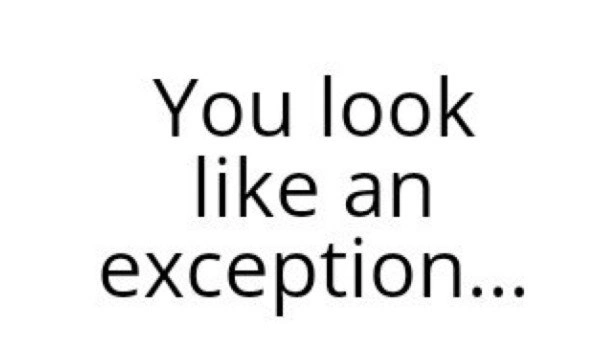
The image is a plain white rectangle with centered black sans-serif text that reads, "...I would love to try and catch you". The ellipsis at the start hints at an unfinished thought, while the phrase "try and catch" visually mirrors the keywords of a typical exception-handling block in many programming languages (try { ... } catch { ... }). There are no other graphics, logos, or colors - just the minimalist text that relies entirely on wordplay for humor. For seasoned developers, the gag is instantly recognizable as a pun on error handling: the code tries something risky and then catches the resulting exception, much like the speaker offers to "catch" the listener. It’s a one-liner that melds romantic cliché with software engineering jargon, appealing to anyone who has ever wrapped code in a try/catch block
Comments
6Comment deleted
Cute, but after two decades in prod I’ve stopped catching generic Exceptions - come back when you’re a well-typed DomainException with actionable metadata
After 20 years in the industry, I've learned that the only thing more elusive than catching all edge cases in production is catching that one intermittent race condition that only appears during the CEO's demo - at least with try-catch blocks, we can pretend we have control over the chaos
A senior engineer's approach to relationships: wrap everything in try-catch, but never actually handle the exception - just log it to /dev/null and pretend the error never happened. At least in production, we have monitoring; in dating, you're flying blind until the stack trace hits you at 3 AM
“I’d love to try and catch you,” says try/catch to the exception thrown in a fire-and-forget async task; the pager catches me instead
The rare try-catch that catches something worthwhile - unlike prod code swallowing StackOverflowErrors silently
I only say this to exceptions I intend to catch, log, and rethrow with context - empty catch is just a 3am page written in code