Skip to content
DevMeme
3673 of 7435
Book reveals the one-page secret to becoming a better programmer
Learning Post #4012, on Dec 9, 2021 in TG

Book reveals the one-page secret to becoming a better programmer

Why is this Learning meme funny?

Level 1: Practice Makes Perfect

Imagine you want to get better at playing the guitar. You have a huge book that says “How to Become a Great Guitarist.” Excitedly, you open it, thinking it will have a big secret, but the first page just says: “Start playing the guitar.” 😮 That’s a bit funny and surprising, right? You were expecting some magic tip, but it turns out the not-so-secret is that you actually have to do the thing to get better at it. This meme is saying the same, but for programming. It’s like if you asked, “How can I be a better painter?” and the answer is simply, “Start painting.” Of course, reading and learning are helpful, but the real improvement comes when you practice. We laugh at the meme because the man’s face says, “Really? That’s it?” But deep down, we know it’s true. Just like you only learn to ride a bike by actually riding and maybe falling a few times, you only get good at coding by writing code, making mistakes, and trying again. In the end, the joke reminds us in a very simple way: to get better at anything, you’ve got to start doing it. It’s obvious, it’s simple, and that’s exactly why it’s funny and true.

Level 2: Just Code It

For a junior developer or someone just starting out, this meme is a lighthearted wake-up call. The big blue book looks promising, like it contains a step-by-step master plan for becoming a great programmer. But when he opens it, all he sees is “start coding.” The humor is that the advice is so simple and obvious that it’s almost disappointing – yet it’s very true. This speaks to something many newbies experience: the search for the perfect way to learn programming. We often imagine there’s a special trick or a best-kept secret in a guide somewhere. The meme is saying: actually, the secret is to begin writing code and keep doing it.

Let’s break down some terms and ideas here. When we talk about getting better at programming, we’re really talking about practice and experience. There’s a concept called the learning curve – it describes how quickly or slowly someone can pick up a new skill. In programming, the learning curve can feel steep early on: there’s a lot of new terminology, tools, and concepts. Many beginners try to make that curve less scary by reading tons of articles, watching video tutorials, or buying big programming books. Learning theory is good, but it can turn into analysis paralysis (overthinking so much that you never actually do anything) or what some coders jokingly call “tutorial hell”. Tutorial hell means getting stuck in an endless cycle of tutorials. You feel like you’re learning, but you might notice you struggle to write your own code without following a script. It’s a comfortable trap, because as long as you’re reading or watching someone else code, you’re not making mistakes. But you’re also not creating anything new or solving problems on your own.

Continuous learning is definitely important in tech — technologies change, and good developers keep reading and updating their knowledge. However, continuous learning doesn’t mean only consuming information. It means combining learning with doing, over and over. The meme’s message “start coding” is encouraging exactly that: stop postponing the doing part. In a way, it’s comforting advice for a junior developer. You might think, “I need to know everything about JavaScript frameworks or read three books on algorithms before I start my project.” But the truth (and the joke here) is that you’ll learn a lot of those things faster by actually starting the project. Even if it’s a small project or a simple exercise, writing your own code is active learning. It forces you to face real problems and find real solutions.

Consider a common scenario: a newcomer has read about loops and variables and maybe even design patterns, but when they sit down to code a small game or an app, they suddenly realize they’re not sure how to start or what to do when things go wrong. This is normal! It’s the moment where theoretical knowledge is being tested in practice. The meme basically says: “That hurdle you’re facing? Jump into it. That’s how you get better.” The surprise on the man’s face in the last panel is like a newbie realizing, “Oh… I actually have to do this myself, huh?” It’s both funny and a bit intimidating, but ultimately motivating.

Let’s clarify “start coding” as advice. It doesn’t mean you shouldn’t read or use resources. It means that reading alone won’t make you improve until you apply it. For example, you can read about how to ride a bicycle or watch a bunch of cycling videos, but until you get on a bike, you won’t really get the hang of it. In programming terms, you might watch a tutorial on how to build a web page. That’s informative, but you solidify that knowledge by actually building a web page yourself, maybe making your own tweaks or even running into errors. When you hit an error (maybe your page is blank or a button doesn’t work), you’ll remember the solution far better than if you just read about the possibility of that error. Each time you debug an issue or implement a feature in code, you’re effectively leveling up your skills. This is why mentors often emphasize practice over theory. Theory lays the foundation, but practice is where you actually learn how to use the tools and concepts in real situations.

It’s also worth noting that a lot of improvement comes from making mistakes and then fixing them. A senior programmer might have encountered hundreds of bugs and errors over years — that’s how they know how to quickly solve them now. A junior might feel, “I’ll code later when I’m good enough to avoid mistakes,” but ironically, you get good by making those mistakes now. Every bug you solve or every program you successfully write adds to your experience. So “start coding” is a way of saying: don’t delay that experience-gathering part of learning. Dive in early, and you’ll progress faster.

The meme falls under DeveloperHumor and RelatableHumor because it exaggerates a common learning experience in a funny way. If you’ve ever googled “how to become a better programmer” hoping for a neat list of tips, you might have found advice like “work on projects” or “practice coding every day” at the very top of every list. It can be almost eye-rolling to hear because it’s not a shortcut at all — it’s telling you to put in effort consistently. The man’s blank, slightly teary-eyed look in the last panel is like, “Dang it, I knew it meant real work all along.” It’s relatable: we secretly wish there was a magic pill to get skill overnight, but we kind of know there isn’t.

To a new developer reading this meme, the key takeaway is: Don’t be paralyzed looking for the perfect way to improve. Just code something. Start a small project, contribute to an open-source repo, write a simple game, automate a tiny task — anything. You’ll find that with each thing you build, you understand a bit more. Over time, concepts that were confusing will start to make sense in context. That big book of knowledge becomes less intimidating because you’re living it, not just reading it. The path to becoming a better programmer isn’t hidden in a secret book or a paid course; it’s forged by your own keystrokes and curiosity. And the cool part is, it can actually be fun! Once you start coding, you’ll have those “Aha!” moments when something finally works, and that feeling is amazing and encouraging. So the meme’s joke doubles as genuine advice: start coding to kickstart your DeveloperGrowth journey. Everything else will follow in time.

Level 3: No Magic Shortcut

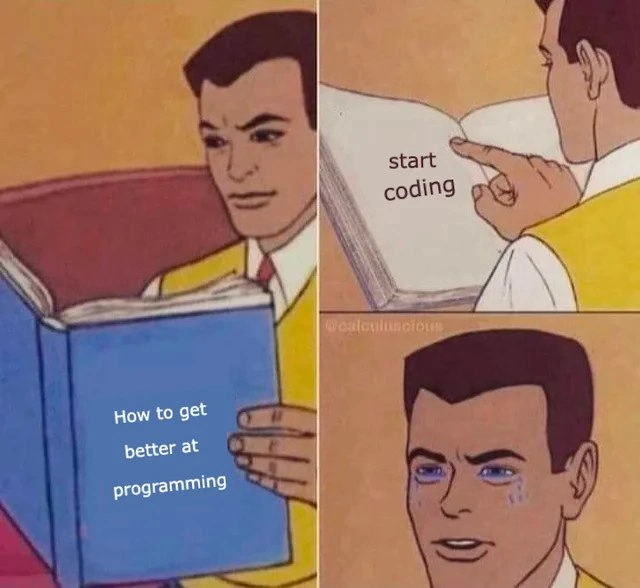
In this vintage-style comic, a developer eagerly opens a hefty book titled “How to get better at programming” expecting profound wisdom. Instead, he finds a single blunt instruction: start coding. The humor hits home for seasoned developers because it satirizes the universal truth that there’s no mystical shortcut or 10x productivity hack — you improve by writing code, period. The meme exaggerates this by implying the entire book’s advice boils down to two words. It’s a playful jab at our tendency to search for secret formulas in tutorials, books, or blog posts, when the real answer has been right in front of us: roll up your sleeves and code something.

This resonates in the developer community as classic CodingHumor because we’ve all been that person hoping for a quick fix. It’s relatable humor born from shared experience. Think about all the times a junior programmer (or even an experienced one in a new domain) has scoured the internet for the one weird trick to master a language or dramatically boost their DeveloperProductivity. We binge-watch courses, read books like “Clean Code” or “The Pragmatic Programmer,” or hunt for tips on becoming a 10x engineer. We accumulate theoretical knowledge and book-based motivation, expecting an epiphany. But as this meme wryly points out, that epiphany usually comes only after we actually start coding and learning from real experience. The surprised blank stare in the final panel isn’t just shock; it’s a moment of “Is it really that simple? Why didn’t I do this earlier?” Many of us have felt the sting of that realization in our careers.

From a senior developer’s perspective, the joke also pokes fun at the learning culture in tech. We often encounter newcomers who fall into “tutorial purgatory” – an endless loop of following step-by-step examples and reading about programming without ever building their own project from scratch. This meme embodies the advice every mentor gives at some point: the only way to actually get better at programming is by programming. It’s essentially the RTFM (Read The Flipping Manual) ethos turned on its head: here the manual itself says stop reading and go build something. The simplicity is hilarious because it cuts through all the excuses and procrastination. There’s a hint of “tough love” that veteran coders know well: you can’t avoid the grind of coding if you want to improve.

On a deeper level, this reflects a well-known truth about skill mastery. In software engineering, there’s even an old proverb: “No Silver Bullet.” It means there’s no single magical solution that will instantly solve all your problems or make you a rockstar developer overnight. We have fancy tools, frameworks, and methodologies, but none of them replaces hands-on practice. Improvement is iterative and gained through ContinuousLearning: write code, see it fail, debug, learn, and repeat. The meme literally gives a one-page recipe for that iterative process. It’s funny because it feels oversimplified, yet it’s essentially accurate. The gap between knowing and doing is huge in programming. You might know what a data structure or an algorithm is in theory, but you truly understand it after you’ve implemented it, hit all the edge cases, and maybe even crashed your program a few times. Only then do abstract concepts solidify into real, usable knowledge.

By highlighting practice over theory, the joke also underlines why seasoned devs nod knowingly: we remember trying to prepare “enough” before diving in – and how that often just delayed the real learning. The truth is that coding can be intimidating at first (fear of bugs, making mistakes, feeling dumb), so reading feels safer. But no amount of reading error messages in a book compares to seeing a real error in your compiler or logs and figuring it out. Real-world coding throws curveballs: environment issues, library conflicts, user input you didn’t expect – things no tutorial perfectly covers. That first time you deploy an app and nothing works, you learn more in an afternoon of debugging than from weeks of hypothetical study. As a result, the meme’s simple_solution_meme punchline – “just start coding” – lands as both comedic and motivating. It’s basically the programming equivalent of a fitness coach revealing the secret to getting fit (spoiler: you have to exercise 💪). We laugh because part of us was hoping for an easier route, but we also recognize the wisdom: to get better at programming, you have to program.

To experienced eyes, this one-pager advice also hints at the phenomenon of analysis paralysis, where you overthink or over-research so much that you never actually begin. The meme’s abrupt directive is a shove past that paralysis. Sure, it’s crucial to read docs and learn concepts – seasoned devs do that continuously – but it must be coupled with implementation. A senior engineer might chuckle remembering how they meticulously read about best practices for a new framework, but only when they built a small app with it did things start to click (and all the gotchas popped up). It’s painfully funny how often we overcomplicate self-improvement. Imagine a thick manual with hundreds of pages, and chapter one — the only chapter — is “Code.” It’s absurd, yet there’s elegance in that minimalism.

Let’s break down the message in more concrete terms that ring true for developers:

  • Hands-on experience vs. Theory: You can memorize syntax or read about design patterns, but applying them in a real project uncovers nuances you’d never grasp from descriptions alone. For instance, reading about databases is fine, but your first real query optimization crisis will teach you more than any chapter on indexing.
  • Breaking out of Tutorial Hell: Following tutorials feels comfortable because you’re copying known solutions. But the minute you try a project without a script, you confront the unknown. That discomfort is exactly when real learning happens. As the meme’s context tags suggest, practice_over_theory is the way out of that limbo.
  • The Myth of Perfect Readiness: Many juniors think they must absorb a ton of knowledge before they’re “ready” to build something meaningful. In reality, you’ll never feel 100% ready. Start coding now, and you’ll gradually fill in the knowledge gaps as you go. The surprised guy in the comic represents that moment of accepting you’ll learn more by doing than by planning.
  • Continuous improvement: Every senior developer’s journey is basically an iteration of writing code, making mistakes, learning, and improving. It’s an infinite loop (well, until retirement 😅). You don’t become “better” in one leap; you level up one commit at a time.

To put it in pseudo-code, the algorithm for DeveloperGrowth might look like this:

# Pseudo-code for continuous developer growth
while True:  # endless loop of improvement
    code()               # write some code (start coding, as the book says!)
    learn_from_mistakes()  # run it, debug, and learn what went wrong or could be better
    apply_new_knowledge()  # use that learning in the next coding session
    # (No break here; the cycle repeats as long as you're a programmer)

There’s beauty in the meme’s blunt advice. It cuts through all the fluff. As a community, developers joke about how often the simplest solution gets overlooked. We chase new libraries, fancy methodologies, or the “perfect” way to learn, but at the end of the day, writing more code – even small, experimental programs – is how you climb the LearningCurve. The meme’s author is essentially handing out the ultimate “productivity hack” with a wink: Just Code It. No expensive book or course needed! And that mix of truth and absurd simplicity is what makes the joke land so well. It reminds every coder of that core principle we tend to forget when we’re stuck in our heads: open your editor, and start coding. Everything else follows from there.

Description

Three-panel meme in a vintage comic style shows a man in a yellow vest reading a large blue book. Panel 1: the book’s cover text reads "How to get better at programming." Panel 2: he opens to the first page, and the only printed words are "start coding," which he points at with his index finger. Panel 3: he stares blankly ahead, clearly surprised by the book’s overly simple advice. The joke highlights a common developer truth: improvement comes from hands-on practice rather than endless reading or tutorials, a lesson especially relevant to juniors chasing productivity hacks

Comments

14
Anonymous ★ Top Pick After two decades of uml, SAFE, and 60-page architecture PDFs, page one is still: “git clone && let reality refactor your assumptions.”
  1. Anonymous ★ Top Pick

    After two decades of uml, SAFE, and 60-page architecture PDFs, page one is still: “git clone && let reality refactor your assumptions.”

  2. Anonymous

    After 15 years in the industry, I've finally mastered the art of reading O'Reilly books cover to cover while my IDE sits idle, accumulating dust and outdated dependencies. My bookshelf has perfect system design, but my GitHub contribution graph looks like a barcode scanner having an existential crisis

  3. Anonymous

    Twenty years in and the senior version of this book still has one page: 'read the error message.'

  4. Anonymous

    This perfectly encapsulates the senior engineer's dirty secret: we've all got that O'Reilly collection gathering dust while we frantically Google the same Stack Overflow answers we bookmarked five years ago. The real 'How to get better at programming' is just 'start coding,' but that would make for a very short - and emotionally devastating - book. It's the software equivalent of buying gym equipment and then crying when someone suggests you actually use it

  5. Anonymous

    Turns out the optimal learning pipeline is merge to main; prod will teach exponential backoff, idempotency, and humility faster than any textbook

  6. Anonymous

    Two decades in, the real manual reads: start coding - then let CI failures, code review scars, and tight feedback loops do the rest

  7. Anonymous

    Books teach patterns; production exceptions teach architecture

  8. Deleted Account 4y

    truth.

  9. @kvrvgixzis 4y

    bruh

  10. dev_meme 4y

    stop

    1. @Roman_Millen 4y

      Stop what?

  11. @Daler_XYZ 4y

    Ahah

  12. @affirvega 4y

    But what if... what if I write awful code?

    1. @CcxCZ 4y

      That's the point. You best learn from mistakes you made yourself.

Use J and K for navigation