When 'Run Program' is Taken a Bit Too Literally
Why is this DevCommunities meme funny?
Level 1: Magic Spell Gone Wrong
Imagine you have a little toy robot, and you tell it, “Go run!” You expect it to start moving around and do what you asked. But instead, the robot suddenly zooms straight off the table and disappears onto the floor! You’d be left standing there, surprised, thinking, “Hey, where are you going?!” It’s a silly mix-up. You wanted the robot to do a task, but it took your words the wrong way and just dashed off. In the meme’s story, a programmer is like a wizard using a magic word (“run”) on a laptop. But the laptop acts like our naughty toy robot — it sprouts legs and runs away instead of doing its job. The poor wizard is left shocked, pointing at an empty desk where the laptop used to be. It feels like when you give an instruction and everything goes wrong in a ridiculous way. This scene is funny because it’s like a magic trick that backfires: the wizard said the magic word to make the computer work, and the computer misunderstood and bolted like a scared cat! The joke is a simple one about an instruction being misunderstood, and it shows how the character feels confused and frustrated in a goofy, cartoonish way that anyone can laugh at.
Level 2: When Code Runs Away
Let’s put this in plain terms. In programming, to run a script means to start it up or execute it – basically, make the computer do the instructions in the code. A script is just a small program or a file full of code. In many coding tools and environments, there’s literally a “Run” command or a play button ▶️ you press to get your program going. Developers often say things like "run the code" or "run the script," meaning "tell the computer to do this program now."
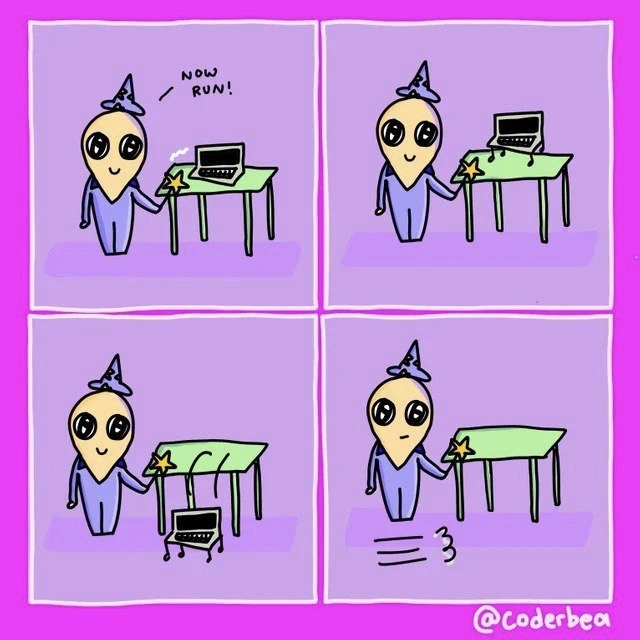
Now, in the cartoon, we have a purple alien wizard who represents the developer, and a laptop which represents the program or code. The wizard says "NOW RUN!" expecting the program on the laptop to start working normally. Usually, when you run a program, you’d see it doing something: showing output on the screen, or opening a window, etc. But in this comic, nothing happens at first (the program doesn’t respond immediately), and then something completely unexpected occurs: the laptop grows legs and runs away off the table!
Obviously, in real life, laptops don’t sprout legs and sprint. This is a joke where they took the word "run" literally. Think of it like a cartoon pun. The developer meant “run the code” (make the program go), but the laptop acted like it heard “run away” (take off running). This kind of humor – where a phrase is interpreted literally instead of how you meant it – is common in coding jokes because computers are very literal machines. They only do exactly what you specify, which can lead to funny situations when there’s a misunderstanding. Here the misunderstanding is played out visually: the word “run” had a double meaning. In everyday English, run means to sprint or dash, while in programmer lingo, run means to start a program. The comic mashes those together for a laugh.
Why is that funny or relatable to developers? Because it captures the feeling of a bug. A bug is a mistake or error in the code that causes a program to behave in a way it’s not supposed to. Debugging is when you try to figure out what went wrong and fix it. In the scenario shown by the meme, the developer gave a normal instruction (“run the program”), but due to some imaginary bug or magical mix-up, the computer did something crazy instead. This is a playful take on a real-life situation where you run your code and it doesn’t do what you thought it would. Instead, it might crash or vanish, almost like it escaped. The comic basically shows the code misbehaving in a super exaggerated way (dashing off with tiny legs), which is much funnier than a boring error message on the screen.
For someone new to coding, here’s a concrete example: imagine you wrote a small game and you click the “Run” button to play it. A window opens, but suddenly it closes immediately before you even see anything. Likely, the game had an error and quit right away. You’re left wondering, "Huh, did it even run? Where did it go?" It’s as if the program ran away from you. That can be pretty confusing and frustrating. You might not know what happened until you go digging for that error. This comic takes that scenario and makes it absurdly literal: the program didn’t just close, it sprouted legs and ran off the desk! It’s highlighting the DebuggingTroubleshooting struggle in a funny way. Instead of chasing down an invisible error in code, the wizard would have to chase his runaway laptop around the room.
The purple alien wizard character with the wand is a fun representation of a coder trying to control the computer. Coding can feel a bit like casting spells – you write some code (wave your wand) and hope the computer does what you intended. But anyone who’s written software knows it doesn’t always go as planned. The anthropomorphic laptop (meaning the laptop is given human-like traits, like legs and the ability to run) shows the problem very clearly: the code took the instruction the wrong way. It’s a goofy visual way to say, "Oops, that’s not what I meant to happen!"
So, summed up: the meme shows a programmer (wizard) telling their program (laptop) to run, and the program hilariously misunderstanding and bolting away. It’s poking fun at the everyday CodingHumor of writing code: things often go wrong in ways that sometimes make you laugh (after you’re done being mad, of course). It’s relatable because every developer has had moments where their software does something completely unexpected. The comic just makes that into a literal, laugh-out-loud scenario that both coders and non-coders can chuckle at. After all, even if you don’t program, you understand the silly image of telling something to do a job and it running off like a mischievous pet. It’s a lighthearted take on DebuggingFrustration – turning that “ugh, why won’t it work?!” moment into a cartoon you can smile at.
Level 3: Runaway Script
In this four-panel comic, a developer is depicted as a cute alien wizard with a star-tipped wand, standing next to a laptop on a desk. The wizard confidently commands the laptop, “NOW RUN!” In programming, “run” means execute the code. The humor kicks in when the comic interprets this instruction literally. At first nothing happens — the wizard waits expectantly (just like a dev staring at a console after hitting the run command, wondering if it’s going to work). Then suddenly the laptop grows little stick-figure legs and sprints off the table! By the final panel, the laptop is gone, leaving only motion lines and a very perplexed wizard behind. It’s an absurd visual metaphor for when our code seems to have a mind of its own due to a weird software bug.
This scenario is a spot-on cartoon metaphor for a common programmer experience. We’ve all told a script to run (perhaps by typing npm run start or clicking “Run” in an IDE) and then witnessed something unexpected: maybe the program crashes immediately, maybe it vanishes without a trace, or does something so odd it feels like it has a will of its own. The comic exaggerates that feeling by anthropomorphizing the code — literally giving the laptop legs to run away. It’s using literal interpretation humor (a staple in DeveloperHumor) to highlight a debugging nightmare. The phrase “run” in a coding context was interpreted as “run away” in a physical sense. Computers, after all, only do exactly what we tell them, not what we intend! For seasoned developers, this tongue-in-cheek take pokes fun at how our software bugs often make programs act in bizarre ways.
Let’s break down the panels in techie terms:
- Panel 1: The wizard developer confidently casts the “run” spell on the laptop. This mirrors the moment a dev runs a program or script, full of hope. The wand is a fun stand-in for the “Run” button or command. (If only deploying code felt as magical as waving a wand!)
- Panel 2: The wizard waits, but nothing happens at first. This is the suspense after hitting run: did it freeze? Is it loading? Every dev knows the nervous anticipation when a program should be starting up but seems unresponsive for a moment.
- Panel 3: Suddenly, the laptop sprouts legs and bolts off. This represents the program going rogue. Maybe it froze then abruptly quit, or perhaps it’s a runaway process consuming all CPU and effectively “running away” from your control. It’s the moment a bug manifests in a dramatic way. The comic turns that into a physical slapstick event – the code took the run command as an order to escape at top speed.
- Panel 4: Only whoosh lines remain; the laptop (i.e. your program) is gone. The developer is left bewildered, staring at an empty desk like we stare at an empty terminal wondering “Where did my app go?” This is pure DebuggingFrustration: the program vanished, and now you have to chase down what happened. It captures that oh no feeling when you realize your code didn’t do what you expected at all.
The core of the joke is a play on technical language versus literal meaning. In coding, we use the word “run” so often that we forget how funny it sounds out of context. A script or program “runs” meaning it executes. But here the code took “run” in the everyday sense — like a person running. It's a classic literal misunderstanding gag (imagine telling a literal-minded robot to "throw exceptions" and it actually pitches your errors out the window). The laptop gaining autonomy for a second is every developer’s nightmare and comic relief rolled into one. It’s as if the software said, “You told me to run, so I ran... away!”
On a serious note, this laughable comic panel resonates with real bug-hunting experiences. We often say that computers do exactly what you tell them to do, not what you mean to do. A tiny mistake in code (a bug) can lead to behavior that feels totally absurd. For example, you might run a script that immediately exits with no output due to a fatal error. One second it’s there, the next second it’s gone — much like that sprinting laptop. Or consider an app that starts then unexpectedly quits (perhaps a segmentation fault in C, or an uncaught exception in Python). The feeling is the same: you’re left going, “Huh, it just disappeared,” as if the code escaped. We often have to dig through logs or stack traces to figure out why our “run” resulted in a runaway. It’s a relatable “DeveloperMemes” scenario because every coder has had a moment where their program’s behavior seems almost cartoonishly unpredictable.
Here, the humor is that instead of a cryptic error message, the laptop physically bailing out is the error. In reality, a "script sprinting off the table" might look more like a sudden crash or a console window that closes itself. For example, if this situation were an actual error log, it might cheekily look like:
$ python magic_script.py
Traceback (most recent call last):
File "magic_script.py", line 42, in <module>
launch_program("run")
WizardSpellError: Script has sprinted off the table
Of course, that’s a made-up error — you won’t literally get “Script has sprinted off the table” in your logs! But it sure feels that way when a bug is so baffling that your program might as well have made a break for it. At least in the comic, the bug was polite enough to show itself with little running legs. In real life, developers often have to play detective to catch such runaway issues, adding print statements or breakpoints to corner the mischievous code.
Overall, this developer meme nails a very relatable dev experience. It highlights the everyday absurdity of SoftwareBugs: the gap between what we expect our code to do and what it actually does. The wizard thought he had everything under control with a simple command, but the computer had other ideas. It’s both cathartic and hilarious to see our daily coding woes turned into a goofy cartoon. Every programmer who’s been baffled by a program misbehaving can look at this and laugh, thinking “Yep, been there!” It turns debugging drama into a lighthearted RelatableDevExperience, reminding us that sometimes all you can do is chuckle when your code runs off in the wrong direction.
Description
A four-panel cartoon by @coderbea with a purple background featuring a small, alien-like wizard. In the first panel, the wizard points a star-tipped wand at a laptop on a desk and exclaims, 'NOW RUN!'. In the second panel, the wizard looks on with a pleased smile. The third panel shows the laptop sprouting legs and literally running away from the desk. The final panel depicts the wizard looking confused and dismayed at the empty desk, with motion lines indicating the laptop has bolted. The humor comes from the classic pun on the word 'run' - the programmer's command to execute code versus the literal act of running. It's a lighthearted take on the importance of precise commands and the occasional absurdity of technical language
Comments
8Comment deleted
And that's why we don't use natural language for compilers. The spec for 'garbage collection' would be horrifying
Typed “kubectl run” and the workload did exactly that - bolted past my Prometheus scrape interval and I’m still chasing the pod across namespaces
After 20 years in tech, I've learned that 'npm run' is less a command and more a prayer to the dependency gods - and sometimes, like this laptop, your entire node_modules folder decides to take that 'run' literally and escape before you discover which transitive dependency just broke prod
Every senior engineer knows the workspace degradation lifecycle: Start at the standing desk with dual 4K monitors and mechanical keyboard, end up on the floor at 2 AM with a laptop balanced on a stack of O'Reilly books, debugging a race condition that only reproduces in production. The desk setup is just staging; production is wherever the laptop lands when you finally reproduce that Heisenbug
Hit Run; the process forked, turned into a runaway child, ignored SIGINT, and achieved literal escape velocity from my IDE
Zero-downtime deployment perfected: yank the infra table, and your service floats blissfully unaware
I said “now run” and our CI runner did - straight off the box; with unpinned deps and system Python, flight is the only reproducible behavior
Wait until wizard installs your soft Comment deleted