Skip to content
DevMeme
3419 of 7435
Project manager re-punctuates the “no meetings day” memo to allow meetings
Meetings Post #3752, on Sep 27, 2021 in TG

Project manager re-punctuates the “no meetings day” memo to allow meetings

Why is this Meetings meme funny?

Level 1: Twisting the Rule

Imagine your school announces a “no homework day” – a day where teachers won’t give any homework at all. You and your friends get excited, thinking, "Great, I can play all evening!" But then one clever teacher takes a marker and adds a little punctuation to that announcement. Suddenly the sign reads, “No, homework day!” Now it sounds like the teacher is saying, "No, it’s a day for homework!" All your hopes for a free day vanish because of that tiny change. It feels sneaky and unfair, right? You’d probably be upset that something fun was taken away by a simple trick with words. That’s exactly the feeling this meme is poking fun at. The company promised a day with no meetings – which is like a no-homework day for the office – but the manager turned it into “actually, we will have meetings!” It’s funny in a silly way, but also a bit frustrating – kind of like when you think you’re getting out of chores, and someone changes their mind at the last second.

Level 2: No Meetings Day 101

Let's break down this meme in simpler terms, especially if you're new to the concept of a "no meetings day":

  • Project Manager (PM): This is a role in a company (often tech companies) for someone who plans and oversees projects. A PM organizes the team’s tasks, sets deadlines, and often holds meetings to check progress. They are basically the people scheduling status meetings, planning sprints, and ensuring everyone knows what they should be doing. In the meme, the guy in the suit with the red pen is labeled as the Project Manager – he represents that role.
  • "No Meetings Day" policy: This is a rule some companies have where on a certain day (say every Wednesday or Friday), no one is allowed to schedule any meetings. The idea is to give everyone, especially developers, a day to work with no interruptions. If you've ever had days full of back-to-back meetings, you know how hard it is to get actual work done. A "no meetings day" is supposed to fix that by freeing up an entire day for focused work.
  • Meeting overload: This means having too many meetings. When we say someone suffers from meeting overload, it implies their calendar is so full of meetings (status updates, planning sessions, etc.) that they barely have time to do their real job (like writing code, designing, or whatever their core work is). It's a common problem in many companies – you spend all day talking about work instead of actually doing the work.
  • Corporate culture and rules: Every company has a corporate culture, which is like the personality and norms of the workplace. Some places encourage lots of check-in meetings, while others try to minimize meetings. When management sends a memo or management announcement about a new rule (like a meeting-free day), it becomes part of the company's official policy. But sometimes the actual behavior (culture) doesn’t change easily. People might ignore the rule or find loopholes if it conflicts with their habits or needs.
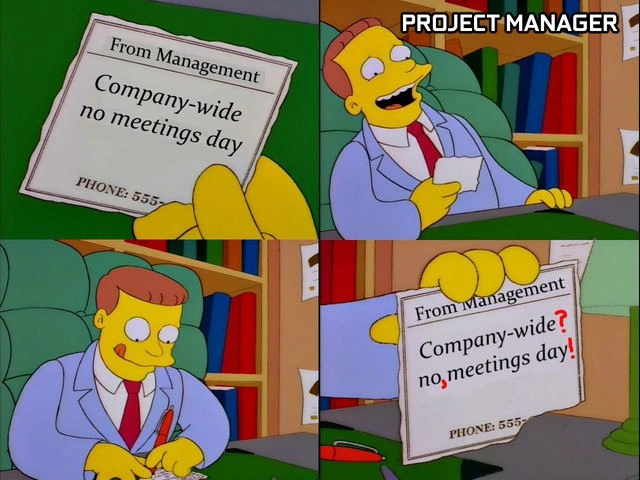
  • The Simpsons meme format: The images here are scenes from The Simpsons, a famous animated TV show known for its humor. Meme creators often take screenshots of characters from the show and add their own text to fit a joke. In this four-panel format, each image is like a panel in a comic strip telling a story. Here, the story is: the boss announces "no meetings day" (panel 1), the Project Manager reads it (panel 2) and then slyly picks up a red pen (panel 3) to change the text, and finally shows the memo edited to mean the opposite (panel 4). Using The Simpsons characters (who are very recognizable and expressive) helps make the joke funny and easy to understand.
  • The punctuation trick: Punctuation refers to symbols like commas, periods, question marks, etc., that we use in writing to separate sentences or clarify meaning. Changing punctuation can totally change a sentence. For example, there's a classic joke comparing "Let's eat, Grandma!" with "Let's eat Grandma!" – the comma makes a huge difference in meaning (one is inviting Grandma to eat, the other is... suggesting we eat Grandma!). In this meme, the PM adds a question mark and a comma to the sentence "Company-wide no meetings day". Originally, that meant "a day with no meetings across the whole company." After the edit, it reads like someone is saying: "Company-wide? No, it's meetings day!" which comes across as "No, it's not company-wide; instead, it's a day of meetings." In simpler words, the manager basically changed "no meetings day" into "yes, meetings day" by adding a couple of punctuation marks. It’s a sneaky way to flip the meaning.

So, what’s happening overall? The company tried to implement a meeting-free day to give everyone a break from meetings. But the Project Manager in the joke finds a way to wiggle out of it. He literally re-punctuates the memo to change its meaning, implying that the "no meetings" rule doesn’t apply universally. This reflects a common experience in workplaces: a policy is announced, but someone finds a clever (or obnoxious) way to avoid following it. For a junior developer just experiencing office life, the meme is showing in a funny way that sometimes even clear rules like "no meetings" can get bent by those who are really attached to their meetings. It’s highlighting a bit of ManagementHumor: managers sometimes believe their meetings are so important that not even a company-wide directive will stop them. The result? Developers still end up in meetings on the very day they were promised they wouldn’t have any. It’s equal parts funny and frustrating, especially if you were looking forward to that uninterrupted coding time.

Level 3: The Punctuation Loophole

This meme perfectly captures a sneaky corporate maneuver: a well-intentioned no meetings day policy gets completely derailed by one manager’s clever use of punctuation. In the Simpsons-themed panels, a cheerful Project Manager gleefully alters a memo that originally read “Company-wide no meetings day”. With a red pen flourish, he injects a question mark and a comma, transforming it into “Company-wide? no, meetings day!”. That tiny punctuation manipulation flips the meaning on its head, effectively turning a meeting-free day into a mandate for more meetings. It’s a hilarious, exaggerated metaphor for how management can twist the spirit of an announcement through technicalities – a grammatical loophole in this case – to suit their own agenda.

Seasoned developers find this painfully relatable. It lampoons the classic corporate culture clash between makers and managers. Engineers value uninterrupted focus time and despise needless MeetingOverload, so companies introduce a no_meetings_day_policy (often something like “No-Meeting Wednesdays”) to preserve one sacred day of deep work. But the joke here is that even when upper management announcements try to curb meetings, a manager who lives by Gantt charts and status updates will find a way to schedule that “one quick sync”. In real life, we’ve seen meeting-free days quietly ignored or cynically rebranded. (“It’s company-wide? No. Our team can still meet because we’re special.”) This Simpsons meme format illustrates those project manager shenanigans in a visual punchline: the PM literally subverts a meeting-free day by editing the memo itself. It’s comedic, but it’s uncomfortably close to reality at many organizations.

Why is this so funny to developers? Because we’ve all been there. Picture a team excited for a meeting-free day, ready to dive into coding or design work without interruptions. Then along comes that manager (much like the smirking character in the meme) who basically says, “Oh, that policy isn’t really for us. We have important meetings to do.” It’s the letter-of-the-law vs. spirit-of-the-law issue. The memo said “Company-wide”, but by punctuating it as “Company-wide? No”, the manager interprets it as “Not company-wide, so our group is exempt.” This is humor by absurd literalism, similar to a coder exploiting a vague specification. It’s like a spec injection exploit – the PM found a bug in the policy wording and hacked it. A single question mark here works like adding a semicolon in the wrong place in code: it completely changes the execution. MeetingCulture in many companies often finds such “creative” ways to keep meetings going, even on supposed blackout days.

The senior engineers chuckling at this meme know that CorporateCulture can be ironically self-defeating. We institute policies to protect productivity, then undercut them with exceptions. In fact, the situation is a textbook anti-pattern:

  • Policy: “No meetings on Friday so everyone can focus.”
  • Reality: Thursday and Monday get double-booked, and some manager still calls a Friday meeting “because just this once…”.
  • Outcome: Developers still have fractured time, and the policy becomes a running joke.

And if that sounds absurd, consider that many offices have literally scheduled meetings to discuss how to cut down on meetings. Yes, really. It’s the kind of meta-irony that makes this meme feel so on-point. The project manager’s big grin as he edits the memo is basically every manager who’s ever thought, “Meetings are my job, so no meetings would mean I’m not doing anything!” There’s an underlying truth: while engineers (the “makers”) need long, uninterrupted blocks to be productive, managers operate on a cycle of frequent check-ins and updates. It’s the famous “maker’s schedule vs manager’s schedule” conflict. A no meetings day threatens the manager’s routine, so they might unconsciously (or deliberately) sabotage it. The humor is darkly cathartic – laughing to keep from crying. We see the absurdity in a boss essentially editing the rules to make sure the status quo of endless meetings continues. It’s funny because it’s true: give some managers a rule limiting meetings, and they’ll twist the wording until “no meetings” becomes “no, meetings”. You can practically hear developers facepalming across the office.

Description

Four-panel Simpsons meme. Panel 1: a yellow hand holds a wrinkled memo that reads "From Management - Company-wide no meetings day - PHONE: 555". Panel 2 (captioned "PROJECT MANAGER"): the smiling manager at his desk proudly examines the notice. Panel 3: he smirks while readying a red pen. Panel 4: the memo is shown again, but punctuation has been added so it now reads "Company-wide? no, meetings day!", twisting the policy’s meaning. The joke highlights how project managers sometimes bend well-intentioned "no meetings" initiatives, a common frustration for engineers craving uninterrupted focus time

Comments

7
Anonymous ★ Top Pick Hand a PM a “no meetings day” memo and you’ve just handed them a mutation-testing challenge - one comma flip later and the whole suite’s failing because you’re triple-booked at 9
  1. Anonymous ★ Top Pick

    Hand a PM a “no meetings day” memo and you’ve just handed them a mutation-testing challenge - one comma flip later and the whole suite’s failing because you’re triple-booked at 9

  2. Anonymous

    After 20 years in tech, I've learned that 'no meetings day' is like eventual consistency in distributed systems - theoretically possible, but in practice, someone's calendar will always diverge from consensus

  3. Anonymous

    A project manager without meetings is like a distributed system without consensus protocols - technically possible, but it fundamentally questions the entire architecture. The real question is: if a PM has no meetings scheduled, do they even exist in the org chart? This is the enterprise equivalent of a philosopher asking 'if a tree falls in the forest and no one is around to schedule a retrospective about it, did it really fall?'

  4. Anonymous

    No-meetings day deployed via all-hands email: because the only consistent thing in CAP is management's hypocrisy

  5. Anonymous

    Management: “No‑meetings day.” Project Manager: “We need a clarification sync on the comma.” RFC raised, steering committee convened, recurring invite sent - calendar Tetris back to 100%

  6. Anonymous

    The 'no meetings day' spec lacked input validation and was vulnerable to punctuation injection; the PM exploited it into 'no, meetings day' - time to put a WAF on Calendar and go async-first

  7. @beton_kruglosu_totchno 4y

    cringe

Use J and K for navigation