Bug Fixing: A Vicious Cycle of Regression
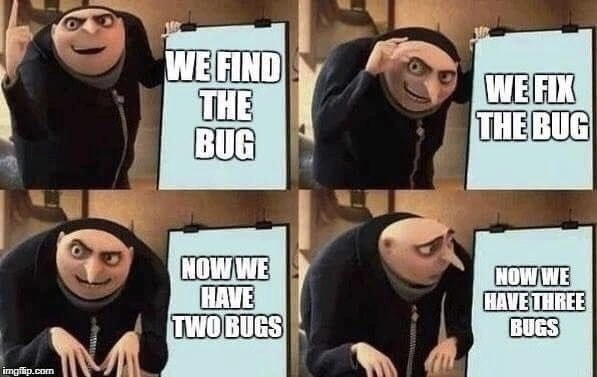
Why is this Bugs meme funny?
Level 1: Whack-a-Mole
Remember those arcade games where you smack one mole and then two more pop up? Fixing bugs in code can feel just like that. You think you solved the problem – got it! – but then, surprise, a couple of new problems jump up right after. It's like trying to plug a leak in a dam with your finger: you stop one leak, and suddenly water starts spurting out from two new cracks. The humor here comes from that oh-no moment we all recognize. You go from feeling "Yay, I fixed it!" to "Uh-oh, now it's even worse..." in a flash. Just like Gru in the meme goes from proud to panicked, anyone who’s tried to fix something only to have new troubles pop up can laugh at how true (and ridiculous) it feels. It's a funny way to say: sometimes solving one little problem makes a couple of new ones appear, and all you can do is shake your head and smile.
Level 2: Chain Reaction
Think of a time you wrote or worked with some code and hit a problem – that's a bug (a mistake causing the program to not work properly). In this meme's story, the team proudly shouts "We find the bug," meaning they've located what's causing a software error. Next slide: "We fix the bug." Success, right? Not so fast. Suddenly, "Now we have two bugs." Oops! Fixing that first issue accidentally caused another problem (bug number two). And by the final panel, poor Gru is staring at "Now we have three bugs" – yet another bug has appeared. This domino effect of one fix leading to new breakages is a classic newbie developer rite-of-passage and a source of endless debugging frustration.
Why does this happen? Often because in software everything is connected. Changing one part of the code can unexpectedly affect another part — we call these side-effects (unexpected secondary changes). It's like removing a gear from a machine; other pieces might stop moving correctly. For example, imagine you fix a glitch that was preventing users from signing up. Great! But that code was also (unknowingly) used when users update their profile. After your "fix," the sign-ups work now, but profile updates start crashing – you fixed one feature and unintentionally broke another. When a new bug appears in an area that previously worked, we call it a regression. In simple terms, something that had no bug before has now "regressed" into having a bug again because of your recent change.
Developers deal with these regression chains a lot. It's why we write tests and do careful code review – to catch new bugs that sneak in with a fix. The meme exaggerates to three bugs for comedy, but it's poking fun at a real feeling: every time you think you've solved a problem, two more problems pop up to take its place. Especially in big, complex applications (imagine thousands of lines of code), it's easy to miss how one fix might break something else. This is also a lesson in code quality: clean and well-designed code tries to minimize these surprises by isolating components (so fixing one piece doesn't break others). But in messy real-world projects, a simple bug fix can turn into a game of whack-a-mole, with developers chasing new issues that emerge from the fix. Gru’s changing expression — from confident to shocked to defeated — is basically the emotional rollercoaster a coder goes through during a long day of debugging such chain reactions.
Level 3: Hydra-Driven Development
In a seasoned developer's eyes, this meme evokes the dreaded Hydra effect in code: cut off one bug's head and two more spring forth. It's a darkly comic truth that fixing bugs in a complex system often reveals or introduces new issues. At an advanced level, we recognize that each bug isn't isolated – it's often entangled in a web of logic. Tightly coupled components, hidden side-effects, and decades of technical debt mean that solving one problem can ripple unexpected changes through a codebase. The moment Gru smugly says "We fix the bug," every senior dev knows to brace for impact – because we've learned the hard way that a "simple fix" rarely remains simple.
Why does Gru's plan backfire into "Now we have three bugs"? Regression bugs love to crash the after-party of a fix. Perhaps the original defect was masking deeper problems; by patching it, you've unleashed dormant issues (like sleeping monsters awakened). Or maybe the fix itself was a quick band-aid that didn't account for a subtle detail, inadvertently breaking another feature. Example: you correct an indexing error that was causing a crash, but now a different module consuming that data freaks out because your "fix" changed the format of the output. Surprise! In quelling one crash, you ignited two more in parts of the system you didn't even realize were connected.
This is humor by way of shared trauma. Every experienced developer has shipped a patch thinking "that ought to do it," only to have QA or users immediately uncover new failures elsewhere. The meme's escalating panels mirror what we cynically call "bug whack-a-mole": smack one down, watch two more pop up. It's funny because it's true – an exaggerated true, but close enough that we wince-smile. It's a commentary on how software complexity laughs at our simple plans. Those cheerful planning boards in Gru's hands? They might as well be our JIRA tickets multiplying each time we think we're done.
Underneath the laughter lies a hard-earned lesson in code quality. Robust, well-tested code ideally shouldn't spawn new bugs from a fix – but reality often falls short of that ideal. Lack of unit tests or integration tests means you don't catch the regressions before shipping. Legacy code full of brittle assumptions ensures that if you tug on one thread, half the tapestry unravels. There's an unwritten Murphy's Law of programming: any fix can spawn new bugs in direct proportion to your confidence in the fix. Gru's horrified expression in the third panel? That's basically the look of a senior engineer discovering their hotfix at 3 AM broke the login service and the payments service simultaneously.
The industry pattern here is the vicious cycle of patching without refactoring. Instead of addressing underlying design flaws, we slap on a fix and hope nothing else breaks – until it does. It's a cycle perpetuated by tight deadlines, pressure from management ("just fix it, ASAP!"), and sometimes our own hubris thinking we understand the whole system. Seasoned devs have learned to approach any bug fix with caution and extensive testing, aware that code can be as temperamental as a house of cards. The meme exaggerates to three bugs, but honestly, it can feel exponential – an infinite loop of bug-fix-bug. We laugh so we don't cry, relating deeply to Gru's swiftly derailed plan.
Description
This meme uses the four-panel 'Gru's Plan' format from the movie Despicable Me. In each panel, the character Gru stands next to a presentation board. In the first panel, Gru is enthusiastic, and the board reads 'WE FIND THE BUG'. In the second, he points to his head with a clever expression, and the board says 'WE FIX THE BUG'. The third panel shows Gru looking devious, but the plan takes a turn with the text 'NOW WE HAVE TWO BUGS'. In the final panel, Gru looks back at the board with a horrified and confused expression, as the text has changed to 'NOW WE HAVE THREE BUGS'. A watermark for 'imgflip.com' is in the bottom-left corner. This meme perfectly encapsulates the frustrating experience in software development where an attempt to fix a single bug inadvertently creates multiple new ones. This phenomenon, known as regression, is a common nightmare for developers, especially when working in complex, highly-coupled, or poorly tested legacy codebases. It humorously depicts the 'one step forward, two steps back' feeling of a debugging session gone wrong

Comments
17Comment deleted
Software engineering abides by the law of conservation of bugs: bugs are never created or destroyed, only transformed into new, more interesting bugs
Squashed the bug; its two eventual-consistency replicas and the read-repair copy immediately elected a new primary
The only thing more reliable than our CI/CD pipeline is the mathematical certainty that every hotfix will spawn exactly n+1 new bugs, where n is the number of stakeholders watching the deployment
Ah yes, the Hydra Pattern - where fixing one bug spawns two more, each more elusive than the last. It's the universe's way of reminding us that our 'quick fix' in a tightly-coupled legacy codebase without adequate test coverage is really just a down payment on tomorrow's production incident. Senior engineers know this dance well: you confidently patch the null pointer, only to discover you've now introduced a race condition and broken backward compatibility with a client integration from 2015 that nobody documented
Fixing that one obvious bug in the monolith? Congrats, you've just unmasked the two regressions it was gatekeeping
That one-line hotfix removed a compensating error and broke an undocumented contract - congrats, you’ve shipped bug-as-API and its two replicas
We fixed the bug by adding retries to a non-idempotent write behind an eventually consistent cache - congrats, you’ve horizontally scaled it into distributed bugs
Dynamic typing in a nutshell Comment deleted
C programmers be like: auto Comment deleted
auto in C and old C++ (pre-11) was used to make compiler place variable automatically -- on stack or in registers (there were keyword register or such) in new C++ (from C++11) auto is used when you want compiler to determine type of variable. auto a = vector<int>(); // vector<int> a; auto b; // error: what type? auto c = 10; // int c; auto d = 10.; // double d; auto e = 5.f; // float e; auto q = a.size(); // size_t q; Comment deleted
don't care, auto go brrr Comment deleted
well, that means c programmers can't go brrrr Comment deleted
Well, good thing in c you won't need to use a variable with type: map<pair<int, int>, vector<int> > Comment deleted
Well what do you use in c instead? Comment deleted
shit ton of GNU macros Comment deleted
I use c++ But, jokes aside, I've only used C for posix libraries, and arrays have been enough, other big names can be typedef'd out Comment deleted
😂😂😂😂😂 Comment deleted