Skip to content
DevMeme
5444 of 7435
The Developer's Plea When the Backlog is Bottomless
MentalHealth Post #5967, on Apr 18, 2024 in TG

The Developer's Plea When the Backlog is Bottomless

Why is this MentalHealth meme funny?

Level 1: No More Chores

Imagine you have a list of chores to do today, like cleaning your room and taking out the trash. You work hard and finish them, hoping to finally relax. But then, just when you’re about to rest, your parent comes in and says, “Oh, also, can you wash the dishes and fold the laundry?” Now you have even more chores added on when you’re already tired. You’d probably feel like crawling under a blanket and saying, “Please, no more!”

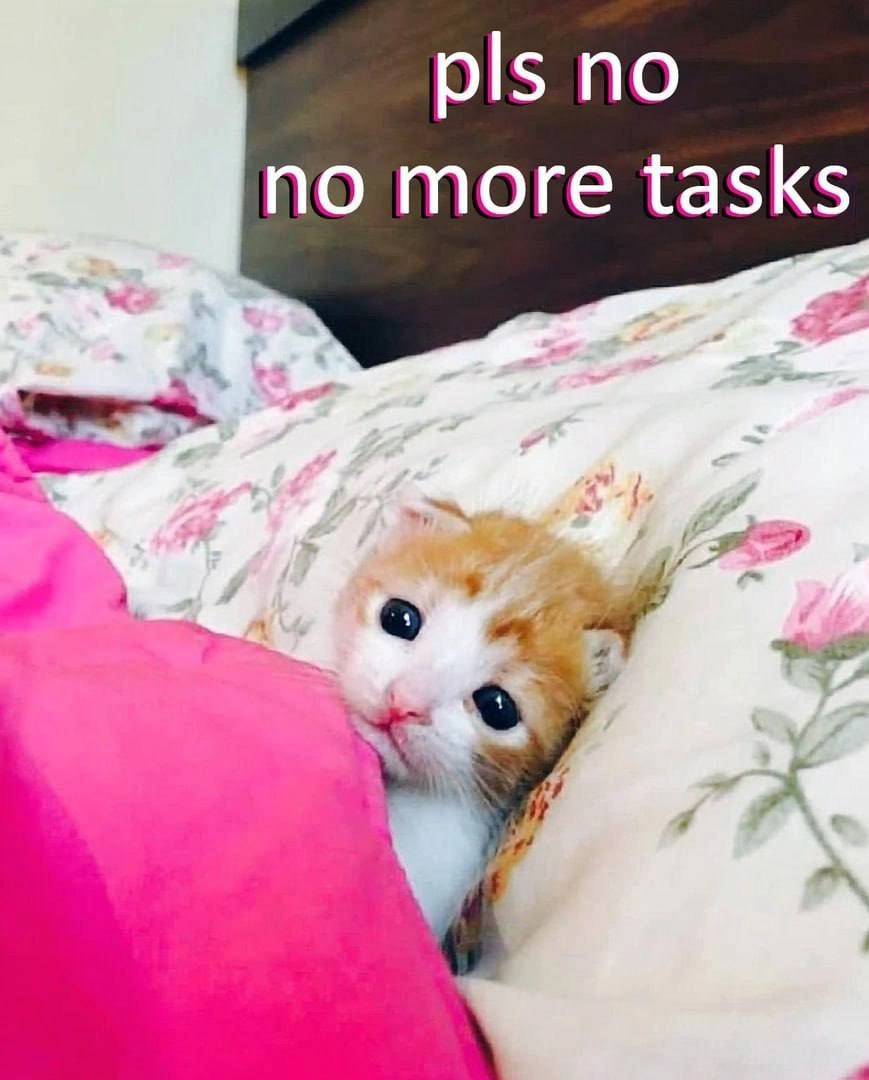
This meme is showing that same feeling using a little kitten. The kitten is wrapped in a blanket on a bed, looking up with big sad eyes as if saying, “Please no, no more tasks.” In the world of the meme, the “tasks” are like the chores in our story. The kitten represents a person (specifically a computer programmer) who has been working a lot and is exhausted. But people keep asking them to do more and more work, just like parents adding more chores. The kitten hiding under the covers is exactly how that person feels – they want to hide away because they just can’t handle any more work right now.

It’s funny and cute because we don’t expect a tiny kitten to be talking about tasks. By using the kitten, the meme makes a serious feeling (being overworked and tired) seem a bit lighter. It’s like when you’re very tired and you jokingly say, “I’m going to hide in my bed so no one can give me more homework.” Anyone, even if they’re not a programmer, can understand that feeling. We’ve all had moments when we just wanted to get cozy in bed and hope no one asks us to do anything else.

So, the big idea is simple: too much work can make anyone feel like this kitten – ready to hide under a blanket to escape it. The humor comes from recognizing that feeling in ourselves and seeing it expressed in such a cute, dramatic way. It’s a way of saying “I’m really tired of all this work!” but with a picture that makes people smile.

Level 2: Ticket Avalanche

Let’s break down what’s happening here in simpler terms. In Agile development (a popular way to manage software projects), work is organized into periods called sprints. A sprint is usually 1-2 weeks long, and the team has a list of tasks to complete in that time, known as the sprint backlog. These tasks might be user stories (features to implement) or bug fixes (problems to fix). The idea is that at the start of the sprint, the team agrees on how many tasks they can finish. Ideally, no new tasks should be added during the sprint so the team can focus and actually get stuff done.

Now enter reality: often new tasks do get added — an important customer bug, a surprise feature request, or a manager suddenly saying “this just has to be done now.” This is called scope creep when extra work sneaks in beyond what was planned. It’s like if you planned to do 5 chores today, but then your parents keep adding more chores as you go. By the end of the day, you’ve done 8 or 10 things instead of 5, and you’re exhausted.

In the meme, the text “pls no, no more tasks” is exactly what a developer feels when this happens. The backlog (to-do list) that was already full is now overflowing — a true task overload scenario. It’s essentially a ticket avalanche: imagine each task is a “ticket” in a tracking system like Jira or Trello, and suddenly a bunch of new tickets come rolling down on you like an avalanche. The cute orange-and-white kitten under the blanket represents the developer. It’s small, tired, and looks a bit scared – just wanting to hide away. This reflects how a developer might feel: small and helpless under a pile of tasks that just keeps growing. The kitten’s big pleading eyes say “please, I can’t handle any more.” Developers might not literally crawl under a blanket in the office, but inside they do feel like curling up and hiding when work becomes overwhelming.

Let’s define a few terms from the meme’s context:

  • Sprint Backlog: This is the list of tasks the team plans to complete in the current sprint. For example, if you’re a dev, your sprint backlog might have items like “Add login feature (5 points)” or “Fix crash on iPhone (3 points)”. The team should stick to this list once the sprint starts.
  • Scope Creep: This means the scope (the amount of work) “creeps” larger and larger beyond the original plan. In everyday terms, it’s when more and more work gets added unexpectedly. In our context, scope creep is those extra “one more” tasks that managers keep pushing into the sprint. It’s a big reason projects run late or teams get stressed.
  • Deadline Pressure: Many sprints or project phases end with a deadline – say, a release date or a demo for a client. Deadline pressure is the stress felt as that end date nears. If the backlog grows last-minute, developers might have to rush or work overtime to meet the deadline. That pressure can be intense.
  • Burnout: This is what happens when someone is overworked and exhausted for a long time. They might feel extremely tired, lose motivation, and even get ill. In tech, developers can face burnout if they keep having to do crunch time (lots of extra hours) each sprint. The meme is a light-hearted warning sign: the kitten’s tired face is like a burnout warning. It says, “I’m at my limit.”

Now, why do these extra tasks keep appearing? Often it’s due to management or product decisions. A Product Manager (PM) might think: “Oh, if we can just squeeze in this one more feature, our product will be so much better!” Or a client finds a serious bug and the team has to address it immediately. Sometimes it’s poor planning – maybe the team underestimated how long the planned tasks would take, and while they struggle to finish those, new issues pop up. In a healthy corporate culture, the team would push back and say “No, we can’t take more right now,” and the new tasks would wait for the next sprint. But in many companies, saying “no” is hard. Developers end up saying “okay…” and taking on the additional work to keep the bosses happy. The end result is the team feels overworked and tired.

The pastel floral bedsheets and pink blanket in the meme create a sense of a cozy, safe space – almost like the kitten (the developer) is trying to find comfort. Companies often talk about caring for employees’ work-life balance (making sure people have time to rest and a life outside work). But when push comes to shove and deadlines loom, that balance can go out the window. The meme’s contrast – a comfy bed but an anxious face – highlights this irony. It’s like, “We gave you a calm work environment (bean bag chairs! free coffee!) but also here are a ton of last-minute tasks… good luck!” Developers recognize this situation, which is why the meme is so relatable. It’s tagged as DeveloperHumor and AgileHumor because it’s making a joke out of something that happens a lot in software teams.

On a more positive note, memes like this also circulate as a way for developers to support each other. If you’re a newer developer and you feel this way, know that you’re not alone. Every developer, even seniors, have had moments of feeling utterly swamped. The meme uses a cute animal to soften the blow and say, “Hey, we all feel like hiding sometimes when the work keeps piling on.” It’s a gentle reminder to managers and teammates too: don’t overload your people. After all, even the most energetic kitten (or coder) needs a break when the tasks become too many.

Level 3: Scope Creep Show

In the dark comedy of corporate Agile life, this meme nails a feeling every seasoned developer knows too well. Picture a sprint backlog that’s supposed to shrink over a two-week sprint, yet somehow it grows mid-iteration—much like a monster in a horror show. The tiny kitten peeking from under the blanket is basically a dev peering out from a cocoon of exhaustion, silently begging “pls no, no more tasks.” It’s funny because it’s painfully true: despite all the Scrum ceremonies and promises of sustainable pace, management just can’t resist sneaking in scope creep at the last minute. Each new user story or bug ticket added feels like another jump-scare in the sprint: you thought you were safe, but here comes “just one more quick task.”

Why is this scenario so familiar that it hurts? Let’s unpack the satire:

  • Sprint commitment vs. reality: In theory, a team commits to a fixed set of user stories at sprint planning. In reality, halfway through the sprint an urgent feature request or bug fix swoops in. The backlog that should be burning down suddenly balloons up. Burn-down? More like burnout chart.
  • “Just a quick fix” fib: There’s that classic line from a stakeholder or PM (Project/Product Manager): “It’s a small change, shouldn’t take long.” Seasoned devs know this innocent request often hides an iceberg of work. By Friday, that “small change” has you refactoring half the module at 2 AM. Deadline pressure makes managers optimistic (or desperate), and they push extra tasks assuming devs can magically compress time.
  • Velocity vs. sanity: Agile tracks velocity (how many story points the team completes per sprint) as a measure of productivity. But when higher-ups obsess over velocity metrics, they start cramming in more tasks to boost the numbers. The result? The team’s productivity might look good on paper this sprint, but at the cost of sanity. Think of it as spending your health points to gain sprint points. The kitten’s wide, worried eyes = the dev realizing their work-life balance is about to be vaporized for the sake of an arbitrary number.
  • Management & corporate culture: There’s an unwritten rule in some workplaces: never say no to higher-ups. If a client or boss yells “urgent!”, the team must oblige. Corporate culture often rewards being a “team player” – which somehow translates to accepting unrealistic workloads with a smile. The meme’s cute animal comic relief masks a real problem: a culture where pushing back on extra tasks feels impossible. So developers cope by joking about it with memes instead. (Because if we didn’t laugh, we’d cry, right?)
  • Burnout in disguise: That kitten under the blanket isn’t just adorable – it’s a lighthearted symbol of developer fatigue. It’s the end of the sprint, you’ve been crunching nonstop, and you’re feeling as small and vulnerable as a kitten. The cozy bed setting contrasts with the anxiety in the kitten’s eyes, just like a tech company touting a “great culture” with snacks and beanbags while developers panic under deadlines. The message is clear: I just want to hide and recover; please no more JIRA tickets today.

To really drive it home, here’s a quick comparison of Agile ideals vs real-world practice that this meme pokes fun at:

Agile Principle (Ideal World) Actual Practice (Real World)
Sprint backlog fixed after planning Scope creep sneaks in mid-sprint with extra tasks
Embrace a sustainable pace (no overtime) Last-minute crunch, overtime till midnight 😩
Team commits to what they can deliver Management keeps pushing “just one more” until team overload
Healthy work-life balance for devs Burnout and “no more tasks, please” kitten vibes

And if code could express this absurdity, it might look like:

sprint_tasks = ["Task1", "Task2", "Task3"]  # initial sprint plan
while sprint.in_progress():  
    if incoming_request():  # oh no, a wild new task appears  
        new_task = PM.ask_for_feature()    # "Could you also just..."  
        sprint_tasks.append(new_task)  
        developer.energy_level -= 10       # drains the poor dev's energy  
        print("pls no, no more tasks")     # our kitten-level plea  
# end of sprint: developer is now under the blanket recovering

In this snippet, every time a incoming_request() triggers, a new task is jammed into sprint_tasks, and the developer’s energy_level goes down. The print statement echoes the meme’s cry of despair. It’s a tongue-in-cheek way to illustrate how task_overload happens: the loop represents an ongoing sprint, and each iteration piles on more work until the developer is figuratively (or literally) hiding under a blanket.

Ultimately, the humor of this meme lands because it exaggerates a relatable dev experience. Every veteran engineer has felt like that kitten, pleading for mercy when the ticket queue just won’t quit. It’s a knowing wink to all the times we’ve seen a sprint go off the rails. The combination of a cute kitten and the desperate “pls no, no more tasks” text perfectly captures the mix of vulnerability and quiet protest running through developer culture. We share these memes in Slack or Teams as a safe way to say “I’m burned out” without directly shouting at our managers. It’s catharsis wrapped in cuteness. And hey, it’s easier to digest a hard truth about scope creep and burnout when an adorable kitten delivers the message.

Description

A reaction meme featuring an adorable small kitten, primarily white with ginger patches on its head, peeking out from under a floral-patterned duvet. The kitten has large, dark, expressive eyes that look directly at the viewer, conveying a sense of vulnerability and exhaustion. A bright pink pillow or part of the bedding is visible on the left. Overlaid on the upper portion of the image in a simple, sans-serif font is the text 'pls no no more tasks'. The technical context of this meme is the universal feeling of burnout and being overwhelmed by an unending stream of work. It perfectly captures a developer's internal monologue at the end of a long week, during a packed sprint, or when a project manager adds 'just one more thing' to their plate. It's a humorous and relatable expression of the mental fatigue that comes from constant context switching, mounting technical debt, and the pressure of deadlines in the software development lifecycle
Comments

11
Anonymous ★ Top Pick This is my face during sprint planning when they say 'we have a few small, high-priority tasks to add.' I've seen 'small tasks' turn into multi-quarter refactoring epics
  1. Anonymous ★ Top Pick

    This is my face during sprint planning when they say 'we have a few small, high-priority tasks to add.' I've seen 'small tasks' turn into multi-quarter refactoring epics

  2. Anonymous

    Me when the PO hits “Add to Sprint” after commitment - congrats, we just turned our burndown into an eventually-consistent ledger of guilt

  3. Anonymous

    When the PM says "it's just a small change" on Thursday afternoon and you've already mentally committed your weekend branch to /dev/null

  4. Anonymous

    When your sprint velocity is 40 story points but stakeholders keep adding 'critical P0s' mid-sprint, and you've already burned through your technical debt budget just keeping the legacy monolith alive. At this point, even your IDE is suggesting you take a mental health day, and your git commits are just variations of 'please no more.' The backlog grooming session is tomorrow, and you know there are 47 unestimated tickets waiting with your name on them - each one mysteriously marked as 'should be quick.'

  5. Anonymous

    That kitten is my thread pool at 5pm Friday - saturated, WIP limits ignored, and product keeps queuing “one last tiny task” like tail latency isn’t a thing

  6. Anonymous

    We run Kanban with strict WIP limits; Product ships new tickets over UDP at 4:59pm - no flow control, just packet loss and guilt

  7. Anonymous

    When your sprint backlog hits escape velocity but your soul velocity drops to kitten-buried-zero

  8. @hagesake 2y

    Mood

  9. @realVitShadyTV 2y

    When right after daily go take nap, and heard this group chat new message sound 😭

  10. @Saeid025 2y

    Welp if you don't have enough task in your hands, create your own tasks 😁

  11. @azizhakberdiev 2y

    contribute to open source

Use J and K for navigation