A Fair Trade: Compilation for Spaghetti
Why is this CodeQuality meme funny?
Level 1: Quick Clean, Big Mess
Imagine you’re cleaning your room in a rush. Clothes, toys, papers are all over the floor. Instead of sorting everything out properly, you shove all the mess into your closet and pull the door shut. A few minutes later, your parent comes by, takes a quick look, and says, “Wow, your room is so clean!” You smile, feeling proud that you got that praise so easily. But behind that closet door? It’s pure chaos – stuff piled haphazardly, ready to tumble out.
This meme is just like that. The “Compiled successfully!” message is like the parent saying “Good job, no errors here!” – it feels really good to hear. The spaghetti code is all the junk you hid in the closet – a tangled, messy pile that hasn’t really gone away. The joke is that as long as everything looks okay on the surface (the program runs with no immediate errors), we act like everything is great, even if underneath there’s a big mess. It’s funny and relatable because everyone loves getting a gold star ⭐ for effort, even if we know we took a shortcut to get it. In simple terms: we traded doing the job the right way for getting a quick thumbs-up. And just like a hidden mess in a room, spaghetti code might come back to cause trouble later – but in that moment, hey, at least we’re happy it “looks” all good!
Level 2: Compiled & Convoluted
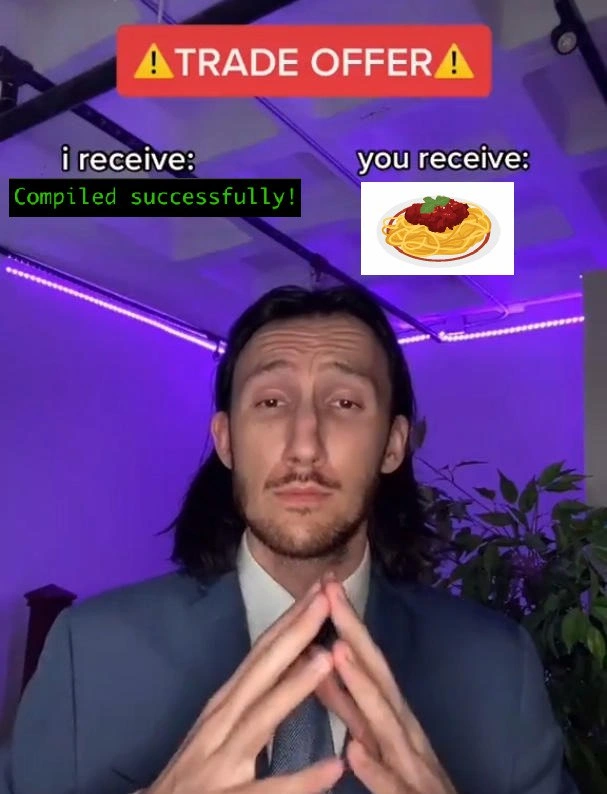
Let’s break down the joke in straightforward terms. This meme uses the popular “Trade Offer” format: an image of a suited man (with a somewhat mystical purple-lit background) stating what each side of a “deal” gets. On the left it says “i receive: Compiled successfully!” and on the right, “you receive: plate of spaghetti”. In a coding context, this translates to: “I (perhaps the compiler or the immediate gratification part of your brain) get a program that compiles with no errors, and you (the project or the future-you who maintains the code) get a dish of spaghetti code.” It’s a lighthearted way to poke fun at the fact that sometimes we, as developers, are so happy to see our code finally compile that we’ll accept writing lousy, messy code to get there.
First, some key terms and elements in this meme:
Compiled successfully – In software, compiling means converting source code (the text of a program you write) into an executable program or machine code. Many languages like C, C++ or Java have a compile step. When you see a message “Compiled successfully!” in bright green text on your terminal, it means the compiler didn’t find any syntax errors or type errors – basically, your code is technically correct enough to run. It’s like the compiler saying “All good! I made something that can execute.” This message is a moment of joy for developers, especially after struggling with error messages. It’s a green light.
Spaghetti code – This is a slang term for code that is exceedingly messy and tangled. Why spaghetti? Imagine a bowl of spaghetti noodles: they twist and turn everywhere, and it’s hard to follow one strand from start to finish. Spaghetti code is the same idea: code with a tangled control flow that’s hard to trace. It might have lots of nested
ifstatements, loops inside loops, functions jumping around (or in older languages, lots ofgotostatements). There’s often little organization – no clear separation of concerns – just one long, twisty block that “does it all.” Spaghetti code tends to happen when people write code quickly without planning or when a program is patched over and over without refactoring. It works, but it’s hard to understand or change. If you try to update one part, you might unexpectedly affect something in another part, because everything’s interwoven like noodles. In short, spaghetti code = poor CodeQuality (low readability, low maintainability).Trade Offer meme – This is an Internet meme format that became popular on TikTok and Reddit. The image typically shows that suited man rubbing his hands together, with the text “I receive: ___ / You receive: ___”. It’s used to describe humorous or ironic “deals.” Here the deal is obviously lopsided and funny: one side gets the satisfaction of a clean compile, the other side is stuck with a plate of spaghetti (messy code) as the cost. The warning emojis (⚠️) at the top and the formal wording mimic the original meme style, making it instantly recognizable to frequent meme viewers. In this case, the meme is tailored to developers by showing a terminal-style output (“Compiled successfully!” in green monospaced text) and a clip-art of spaghetti, tying into common programming themes.
Now, why is this funny to developers, and even to those just starting out? Think about when you first learned to code. Often, your first concern is just getting the program to run. You might write some pretty rough code just to make it work – all in one function, or repeating code in multiple places – and as long as it finally compiles without errors (or runs without crashing), you’re thrilled! That feeling of “Hooray, no errors, it works!” is very real. The meme taps into that joy: seeing “Compiled successfully!” pop up can make your day, especially after a series of frustrating compiler errors.
However, as you write more code, you quickly learn there’s a difference between code that just works and code that is well-structured. Spaghetti code often sneaks in when you’re laser-focused on solving a problem quickly. For example, you might not bother breaking a task into functions or you might hardcode a bunch of special cases, resulting in a long, winding script. It compiles and runs, yes, but if someone (including future-you) tries to read it later, they’ll have a hard time understanding what’s going on. It’s the kind of code where adding a new feature or fixing a bug is like pulling a single noodle out of a pile – you’re not sure what else will come with it.
To illustrate, here’s a tiny example of a spaghetti-ish approach versus a cleaner approach:
# Example of "spaghetti" style repetition:
if len(users) > 0: print(users[0].name)
if len(users) > 1: print(users[1].name)
if len(users) > 2: print(users[2].name)
# ... and so on for each possible index ...
# It works and will run (or compile in a compiled language), but it's very repetitive and hard to maintain.
In the above pseudo-code, we’re repetitively checking and printing user names. It will execute (and if this were in C++ or Java, it would compile fine), but imagine if users had 100 elements – we’d need 100 lines! This is convoluted and unstructured. A cleaner approach would be to use a loop to handle an arbitrary number of users, but writing it the messy way was perhaps “quick and dirty.” This is what we mean by trading code quality for a quick result. The code gives the right output (prints all the names) and the compiler would be perfectly happy with it, but it’s not good code by any standard.
Now relate this back to the meme: “You feed me spaghetti code, I claim compilation success.” It humorously personifies the compiler or build system as this shady dealer saying, “I don’t care how messy your code is, I’ll still give you the thumbs up that it built correctly.” And “you” (the developer) receive that thumbs-up in exchange for handing over a tangled mess. It’s funny because normally a trade implies both sides get something of roughly equal value – but here one side (the compiler or the immediate gratification) gets a working program, and the other side (the quality of your project, or your future self) gets stuck with a maintainability nightmare.
For a new developer, the meme is a lighthearted cautionary tale. It’s saying: Just because your code compiles doesn’t mean it’s clean or healthy code. Early on, seeing no errors is such a relief that it’s easy to ignore how messy the solution might be. Over time, though, you’ll likely revisit some old code and think, “Oh no… this is spaghetti code. What was I thinking?!” The meme gets a laugh because we’ve all felt the temptation to declare victory at “Compiled successfully” and call it a day. It highlights the classic beginner (and sometimes hurried professional) mindset: “If it works, then job done.” The reality is, working code can hide big problems if it’s organized poorly.
In summary, the joke works on two levels. On the surface, it’s the absurd visual of trading a delicious looking plate of spaghetti for a green “Compiled successfully!” message – a quirky, unexpected pair. On a deeper level, it’s a witty commentary on developer habits: the trade-off between fast results and good code structure. It’s amusing to anyone who’s written code, because we know that thrill of a successful compile, and we also know the regret of dealing with spaghetti code later. As a learning point: strive not to serve spaghetti in your codebase – your compiler may be satisfied, but your collaborators (and future you) will thank you for well-structured, readable code. 😊
Level 3: Green Build, Red Sauce
Every seasoned developer has felt the guilty relief this meme portrays. It’s 11 PM, the deadline is tomorrow, and the code has turned into a patchwork of quick fixes — a full-on spaghetti code special. You hit “build” for the hundredth time and suddenly... Ding! Compiled successfully! — the sweet green text of victory. In the meme’s Trade Offer format, the suited figure (a popular TikTok meme character with those glowing purple lights) is essentially playing the role of the compiler (or perhaps the developer’s short-term mindset) saying: “I receive: your janky, tangled code. You receive: a clean compile.” It’s a tongue-in-cheek deal with the devil that developers strike in crunch time: sacrificing code clarity and future maintainability for the immediate gratification of a working build.
Why is this so funny (and painful) to people in software? Because it’s too real. We’ve all been there, trading away a bit of our soul (or the next maintainer’s sanity) for that magical “it runs” moment. CodeQuality best practices preach that we should refactor messy code, write clean abstractions, and avoid hacks – but reality often has other plans. Tight deadlines, looming demos, or that urgent hotfix in production can pressure even diligent developers into saying "screw it, as long as it compiles". The meme perfectly captures this Faustian bargain: short-term success in exchange for long-term technical debt. The “red sauce” on the spaghetti in the image might as well be the red flags we’re ignoring. Meanwhile, the compiler’s reassuring green “Compiled successfully!” message is like a big green checkmark that lets us momentarily pretend everything is fine.
There’s a dark humor in how developers sometimes measure success. Ideally, working code should also be clean and maintainable. In practice, teams often celebrate the build passing or the feature shipping, and only later lament how hard the code is to extend. The meme’s trade offer highlights that disparity: we cheer the passing build and pass along the mess. For a senior engineer, this hits a bittersweet note. You laugh, remembering the times you proudly announced “It compiles, ship it!” only to spend the next week untangling that very code during code review or QA. It’s the classic scenario of “It worked… but at what cost?”
Consider a real-world scenario: an on-call developer at 3 AM frantically patching a critical bug. They might write something horrendously convoluted in the heat of the moment, just to get the system running again. The immediate payoff is huge – alarms stop, the service is back up, and they finally see that reassuring compile/test pass. Victory. But a day later, fully awake, they stare at the code and realize they’ve created a creature from the spaghetti lagoon. The technical debt hangover is real. As a veteran dev, you learn to recognize this pattern. You might even preface a hacky section in code with a comment like:
// TODO: Refactor this mess later. It works for now.
...knowing full well “later” might not come soon. The meme speaks to that shared experience: the terminal (no pun intended) relief of a successful compile versus the latent dread of dealing with the hacky solution beneath it.
The Trade Offer meme format itself adds a layer of irony. It frames the situation as a calculated deal, as if we consciously choose this trade. In reality, it often doesn’t feel like a choice – circumstances offer us a cruel bargain and we take it. The meme’s humor is in that exaggerated clarity: it’s like the compiler (or our rushed mindset) is sliding a contract across the table: “I get your messy code, you get a passing build – deal?” And the tired developer, seeing no other way at the moment, shakes on it. Deal. The suited man’s faintly smug expression in the image even mimics how you feel making the trade: half-embarrassed, half-satisfied.
Ultimately, experienced devs laugh at this meme with a wince because it’s a reminder of lessons learned. We know that “compile success” is a low bar – the code could still be full of logical bugs or become a nightmare to debug. We’ve learned (the hard way) that investing time in code quality saves pain later. But we also remember our early years (or early yesterday) when we rejoiced at a successful build after a struggle, regardless of how ugly the code turned out. It’s funny because it’s true: in the heat of the moment, that trade offer is tempting, and many of us have accepted it. The meme’s brilliance is distilling that universal developer temptation into a simple, relatable visual: two columns labeled “I receive” and “You receive”, making explicit the unspoken exchange we’ve all been guilty of. And hey, at least we got a good laugh (and a running program) out of it, right?
Level 4: AST vs Pasta
Deep inside the compilation process, the compiler doesn’t judge your code’s style – it simply parses and processes whatever you feed it. When you hand over a plate of tangled logic (our infamous spaghetti code), the compiler’s parser breaks it down according to the language’s formal grammar, constructing an Abstract Syntax Tree (AST). The AST is like a structured map of your code that the compiler uses to generate machine instructions. Amazingly, even the most convoluted, twisty program can be turned into a valid AST as long as the syntax is correct. To the compiler, your code’s shape doesn’t matter – it can be a neat lasagna or a messy spaghetti bowl – as long as it adheres to the language rules.
This highlights a fundamental separation between syntax and architecture. A compiler checks for things like matching brackets, correct type usage, and scope resolution – it ensures the code is formally correct. But it has no concept of “good” or “bad” code quality. There’s no bytecode annotation saying, “this part is spaghetti.” 😅 From a theoretical standpoint, properties like maintainability or clarity aren’t something a typical compiler can enforce. They’re not formal grammar rules; they’re human-oriented concepts. In computer science terms, compilers work at the level of context-free grammar and static semantics, not at the level of your program’s design patterns or logical clarity. The compiler’s job is to answer the yes/no question “Is this program valid according to the language specification?” – not “Is this program well-designed?”.
It’s fascinating because you could write a monstrously complex function with dozens of nested conditions and gotos, and as long as it respects the language syntax, the compiler will proudly emit a *“Compiled successfully!”* message. In fact, historically, the term “spaghetti code” was coined to describe code with a flow so tangled (often due to excessive goto statements) that if you drew its execution paths on paper, they’d look like a bowl of spaghetti. Yet, languages like C or BASIC happily compile such goto-laden programs. Edsger Dijkstra’s famous 1968 letter “Go To Statement Considered Harmful” warned about this exact chaos. But interestingly, compilers never outright banned goto – they leave the responsibility of avoiding tangles to developers. Why? Because from the compiler’s ultra-literal perspective, goto is just another valid instruction. The compiler is an enabler of Turing-complete creativity (or mischief): if the language allows it, the compiler will build it, whether your code is elegantly modular or a big ball of mud.
There’s a whole discipline of static analysis and software metrics that steps in where compilers don’t. For example, cyclomatic complexity measures the number of independent paths through your code (each loop or if adds a path). A simple, well-structured function might have a cyclomatic complexity of 5, whereas a spaghetti monstrosity full of twists could score 50. But a standard compiler won’t flinch at that complexity number; it’s concerned only with correctness, not quality. Advanced tools (linters, code analyzers, style checkers) operate alongside compilers to catch the messiness – things like unreachable code, overly complex functions, or code that doesn’t meet style guidelines. These tools might emit warnings for spaghetti-like code, but they’re essentially extra teachers grading the code’s cleanliness, whereas the compiler is just the exam proctor checking that you filled out the form correctly.
In summary, at this deep technical level, the meme highlights an inherent limitation of compilation: “garbage in, gospel out.” The compiler will emit a perfectly runnable program from your source, even if that source is a tangle of kludges. It’s a powerful reminder that “compiled successfully” ≠ “designed well.” The trade offer being made – give the compiler syntactically correct spaghetti, and it will give you a working binary – is rooted in the very nature of how our tools operate. Formal correctness is guaranteed (barring compiler bugs), but qualitative goodness is outside the compiler’s purview. The result? You end up with a program that runs and a codebase that might make the angels of CodeQuality weep. Yet the compiler sits blameless, flashing its green light, having kept its end of the bargain.
Description
This meme utilizes the popular 'Trade Offer' format from TikTok, where a person in a business suit proposes a deal. At the top, a red banner reads 'TRADE OFFER'. The offer is split into two sides: 'i receive:' shows a terminal-style message 'Compiled successfully!', and 'you receive:' shows a cartoon image of a plate of spaghetti with meat sauce. The person in the image has their hands clasped, looking earnestly at the viewer as if making a serious business proposition. The humor lies in the developer jargon where 'spaghetti code' refers to code that is tangled, unstructured, and difficult to understand or maintain. The meme cleverly satirizes the mindset of prioritizing a successful compilation over writing clean, quality code, a trade-off that often leads to significant technical debt
Comments
10Comment deleted
The compiler is like a lazy contract lawyer; it'll confirm all the words are spelled correctly, but it's up to you to realize you just signed away your team's sanity for the next six months
“Compiled successfully” after weaving 37 global singletons together is just the compiler underwriting your 18% APR technical debt
After 20 years in this industry, I've learned that 'Compiled successfully' is just the compiler's way of saying 'Your technical debt application has been approved - enjoy untangling this in production at 3 AM when the original author has long since moved to a farm upstate.'
Ah yes, the classic 'compiles successfully' - that beautiful moment of false confidence before you run it and discover you've merely achieved syntactic correctness while delivering semantic chaos. It's the software equivalent of a restaurant proudly announcing they've successfully turned on the oven, while you're still waiting for actual food. Senior engineers know this feeling intimately: when your CI pipeline goes green but you're already mentally preparing the postmortem for production
Trade offer: I get “compiled successfully”; you inherit a dependency graph shaped like spaghetti - compilers validate syntax, not Conway’s Law
Trading “Compiled successfully!” for spaghetti code is paying your SLOs on a credit card - approved now, compounded at 3am
Green build today, lifetime of 'who wrote this?' meetings tomorrow
yes. Comment deleted
Working for food Comment deleted
Writing spaghetti code for spaghetti salary Comment deleted