Skip to content
DevMeme
3558 of 7435
The Fundamental Law of Project Budgets
TechDebt Post #3895, on Nov 2, 2021 in TG

The Fundamental Law of Project Budgets

Why is this TechDebt meme funny?

Level 1: Twice the Work

Imagine you want to save your allowance, so you buy a cheap toy instead of a well-made one. The cheap toy costs less, which seems good at first — you didn’t spend much money. But after a few days, it breaks because it wasn’t built well. Now you really want a working toy, so you end up going back and buying another toy (maybe an expensive one this time). In the end, you spent money twice: once on the cheap toy and then again on the replacement. You realize if you had just paid for the better toy to begin with, you would have spent less overall and had a good toy from day one. It’s frustrating, right? You tried to save money by doing something cheaply, but it backfired. That’s exactly what the meme is joking about — not spending enough to do something properly, and then having to spend even more later to do it over. You end up doing double the work (or spending double the money) for the same result, which is both funny in a sad way and a lesson learned: doing it right the first time is usually the smarter choice.

Level 2: Cheap Now, Costly Later

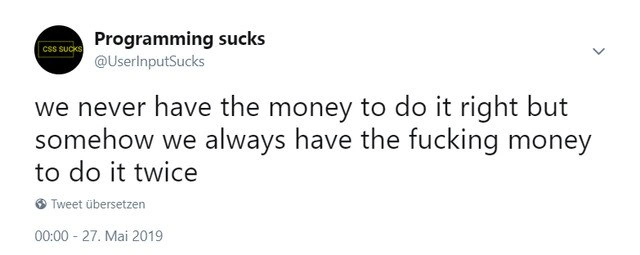
This meme highlights a simple idea: trying to save money at the start of a software project often means you’ll spend even more money later to fix or redo it. The tweet says, “we never have the money to do it right but somehow we always have the money to do it twice.” Let's unpack that in straightforward terms.

  • "Do it right" means doing a software project properly from the beginning. That includes spending time (and thus money) on good design, thorough testing, writing clean code, and considering future maintenance. It might involve hiring enough developers, using quality tools, and not rushing the work. For example, doing it right might mean writing unit tests for your code or taking an extra week to polish the user interface.

  • "Do it twice" refers to the unfortunate outcome where you have to redo work or fix major issues later on. If a project wasn't done right initially, it can fail or cause problems, and then the company must allocate more money to address those problems. "Doing it twice" might mean a partial rewrite of the software or a big repair effort after a failure. Essentially, it's rework – doing what should have been done in the first place, but under worse circumstances.

Why would anyone choose to not do it right the first time? Often because of budget constraints and time pressure. In many companies, the people in charge of budgets (like project managers or executives) set a limit on how much can be spent on a project. They might say, "We only have 3 months and X dollars to build this product." If building it the right way would take 4 months or more money than X, they often cut corners to fit within the budget. This could mean skipping steps that they think are "optional," like writing extra tests, refactoring messy code, or doing a security audit. From their perspective, these things might seem too expensive or not immediately necessary.

However, skipping these steps creates what developers call technical debt. Think of technical debt like borrowing time: when you rush or do something cheaply in coding, you're taking a "loan" that you'll have to pay back later with interest. For instance, if you don't write clear code now, you'll spend more time later trying to fix or update that confusing code. If you don’t test a feature now, you might spend much more time debugging a problem with it in production. The debt "interest" is the extra effort and money required down the line.

A simple example: imagine a software team is building a shopping website. Doing it right would involve thoroughly testing the checkout process. But maybe the client or boss says, "We don't have the budget for extensive testing; just release it!" So they release the website without proper testing — this saves money now (no testers to pay, faster launch). Initially, everything seems okay. But a few weeks later, customers start complaining that orders are getting duplicated or lost due to a bug in the checkout code. Uh-oh! Now the company has to scramble to fix this. They pull developers back into emergency mode, possibly pay for expedited updates or even compensate unhappy customers. The fix might also require taking the site offline, resulting in lost sales. In the end, the money lost and spent on this recovery could be far more than the cost of the testing that was skipped. This is "having money to do it twice" — because the company did end up paying for the work to be done (fixing the checkout properly), just much later and under worse conditions.

From a junior developer’s point of view, this is a frustrating cycle. You might think, "Why not just invest the time and money to make it solid from the start?" The meme resonates because many of us have had that thought. Stakeholder expectations and corporate habits play a big role here: bosses or clients often focus on short-term goals like hitting a release date or staying under a monthly budget. They might not fully understand that cutting quality actually increases the total cost. There's even humor in the industry around how a manager’s decision can lead to an “I told you so” moment for engineers later. But when things go wrong, everyone suffers — developers have to work overtime to fix things, and managers have to request even more budget to clean up the mess they initially tried to avoid.

In summary, this meme is poking fun at a real trade-off that happens in engineering and business. Cutting costs early on (no money to do it right) almost always leads to technical debt and problems that require more money later (money to do it twice). It’s basically saying, “If you don’t pay for quality now, you’ll pay for failure later — and that usually costs more.” The humor is that this is so common and yet companies keep making the same mistake. Even if you're new to the field, you'll likely encounter this paradox, and one day you'll chuckle (or groan) at how true this little tweet was.

Level 3: Pennywise, Code Foolish

This meme tweet nails a brutal truth in software engineering: companies claim there's no budget to do it right, yet somehow there's always budget to do it twice when the first attempt fails. It's a classic case of technical debt and short-sighted project management. Seasoned developers recognize this as the penny-wise, pound-foolish approach to software: saving a dime upfront ends up costing a dollar in inevitable rework. The tweet’s profanity-laced frustration (“always have the f***ing money to do it twice”) perfectly captures that exasperation of seeing an underfunded project blow up, then watching management open the money floodgates to fix the mess.

We've all been in that 3 AM on-call war room, muttering "If only they'd funded a proper fix in the first place...". The pattern is so common you could write it in pseudo-code:

if (!budgetForProperSolution) {
    implementQuickAndDirty();  // skip quality to "save" money
}
if (system.breaksBadly()) {
    allocateEmergencyFunds();
    rebuildProperly();         // money magically appears for rework
}

That snippet is basically the meme in code form. First, no money for doing it right leads to a quick-and-dirty release. Then, once the system breaks badly (downtime, bugs, angry users), suddenly there's an emergency budget to rebuild or fix it properly. The tragicomic twist: the emergency fix usually costs far more than doing it right would have. Think overtime pay, hiring expensive contractors, damage to reputation – the works.

This is the crux of technical debt: by not "paying" for quality upfront, the organization incurs a debt that accrues interest. They saved maybe 10% of the budget by skimping on testing or architecture, but later pay 150% in panic-fueled rework. For example, a team might skip a code review phase to meet a deadline (saving some budget), only to have a critical bug in production that takes the site down. Now the company spends twice as much on a swarm of engineers debugging and patching the issue in a hurry, not to mention the lost revenue during the outage. The initial savings turn out to be a mirage.

Why does this keep happening? Often it's baked into corporate culture and incentive structures. Managers get kudos for delivering a project under a tight budget or before end of quarter, so they tell engineering, "cut the scope, skip the tests, just ship it." The stakeholders cheer when Version 1 launches "on time and under budget." But when Version 1 promptly falls on its face (because those best practices were ignored), it's crisis mode: all hands on deck, project reboot, now with a bigger budget. In essence, the organization defers the cost to the future – an accounting trick that always backfires technologically. It's like celebrating that you didn't pay for insurance, and then shelling out a fortune after an accident.

This paradox is a well-known pitfall in project management. There's even an old saying: "If you don't have time to do it right, you must have time to do it over." Here it's about money instead of time, but the principle is the same. Below is how these false economies play out in real life software projects:

Shortcut to Save Money Boomerang Cost Later
Skip code reviews and QA testing 💥 Critical bugs in production -> expensive hotfixes
Postpone refactoring sloppy code 🤕 Codebase collapse -> costly full rewrite
No budget for security hardening 🔓 Data breach -> huge fines + emergency cleanup
Understaff maintenance/devops 🔥 System outages -> pay overtime + hire consultants

Each short-term cut leads to a bigger long-term expense. The meme is darkly funny to us senior devs because we've lived this. We’ve seen budget constraints used as an excuse to do a rush job, and then watched the same bosses spend twice as much cleaning up the ensuing disaster. It’s a cynical joke and a coping mechanism: laughing to keep from crying when the technical debt bill comes due. In short, organizations never seem to have money to "build it right", but they always find money to build it twice – and every experienced engineer can only sigh and nod at that bitter truth.

Description

A screenshot of a tweet from the account 'Programming sucks' (@UserInputSucks), which has a profile picture that reads 'CSS SUCKS'. The tweet itself is a widely known aphorism in the software world: 'we never have the money to do it right but somehow we always have the fucking money to do it twice'. This pithy statement perfectly encapsulates the frustration developers feel with short-sighted project management. It's a critique of the common business practice of prioritizing speed and low initial cost over quality and robust architecture. This inevitably leads to accumulating technical debt, which must be paid down later with expensive refactoring, rewrites, or extensive bug-fixing sessions - the costly 'second time' the tweet refers to. The sentiment is deeply relatable to senior engineers who have repeatedly witnessed this cycle of trading long-term stability for short-term gains
Comments

13
Anonymous ★ Top Pick We call that 'agile development.' The first time is the MVP, the second time is the 'MVP v2' that's actually just fixing the first MVP
  1. Anonymous ★ Top Pick

    We call that 'agile development.' The first time is the MVP, the second time is the 'MVP v2' that's actually just fixing the first MVP

  2. Anonymous

    Funny how refactoring is “non-budgetable toil,” but the inevitable rewrite becomes a “digital transformation initiative” and suddenly the CFO finds seven figures under the couch

  3. Anonymous

    The only thing more expensive than hiring a senior engineer is not hiring one and watching three juniors build it wrong twice while the PM insists the timeline hasn't changed

  4. Anonymous

    The engineering equivalent of 'measure once, cut twice, buy more wood, cut again, hire a contractor' - except the contractor is your exhausted team six months later, the wood is your original codebase now in production, and management still doesn't understand why the 'simple fix' became a complete rewrite. At least the second time around, you'll have battle-tested opinions about which architectural patterns to avoid

  5. Anonymous

    Do it right once: 'No budget.' Catastrophic outage: 'Unlimited funds for the rewrite - stat!'

  6. Anonymous

    Amazing how "no budget for tests" turns into a funded rewrite after the SEV-1 - interest on tech debt compounds faster than the AWS bill

  7. Anonymous

    Enterprise budgeting: doing it right is OpEx, doing it again is CapEx - so we invest heavily in repeatability

  8. @ciser0 4y

    😂

  9. @BreadCrumberWay 4y

    Jajajajajajajajaja

    1. @IlyaOnTheInternet 4y

      English pls

      1. @f0cu53d 4y

        Hahahahahahaha

  10. @xlib4k 4y

    Bazed

  11. @sav_iz_l 4y

    *time

Use J and K for navigation