Group project duel: citing sources card defeats anti-plagiarism argument in code copy
Why is this CodeQuality meme funny?
Level 1: Citing Isn’t Writing
Imagine your teacher asks your group to make something on your own, like bake a cake for a class project. You plan to bake it from scratch, but your friends have a different idea. They want to buy a ready-made cake from a bakery and just tell the teacher which bakery it came from (that’s like “citing a source” for the cake). You protest, “Hey, we’re supposed to bake it ourselves! Copying a cake and saying where we got it isn’t the assignment!” But your friends think that as long as they give credit to the bakery, it’s okay to not do the work. In the end, you feel frustrated and defeated because they don’t understand why it’s wrong. This meme is showing that same scenario with code: it’s silly and funny because adding a little note about where the code came from doesn’t change the fact that you didn’t actually write it. It’s like trying to get credit for someone else’s work by saying “but I told you who did it!” – which of course, isn’t how doing your own project is supposed to work.
Level 2: Copy-Paste Conundrum
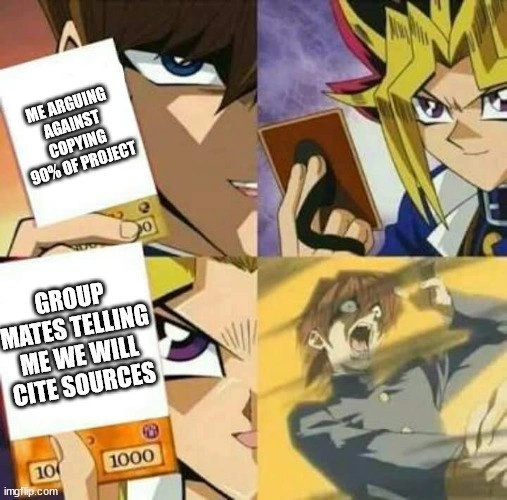
This four-panel anime meme format uses a famous scene from Yu-Gi-Oh! to visualize a classroom coding drama. In the first panel, a character (Kaiba) represents “me”, the student who argues against copying 90% of the project’s code. This student is basically saying, “Let’s not plagiarize most of our code; we should write it ourselves.” In the second and third panels, the other character (Yugi) is the group mate responding with “We will cite sources” – meaning the group plans to copy a lot of code but will cite (give credit to) where they got it from. The final panel shows Kaiba blasted backward in defeat – a humorous way to say the argument was lost and the group’s citing idea won out. The meme exaggerates the situation to make it funny, but it’s referencing a real CollaborationChallenge in group projects: how do you complete the assignment, especially if some teammates want to take a dubious shortcut?
Let’s break down the key ideas and terms:
- Copy-paste coding: This means taking code written by someone else (from the internet, past students, etc.) and literally pasting it into your project. It’s a quick fix when you don’t know how to write something yourself. Here, the group wants to copy nearly the entire project’s code from elsewhere. That’s extreme – essentially doing almost none of the original coding work.
- Citing sources: In essays or research papers, if you use someone else’s words or ideas, you add a citation (like a reference or footnote) to credit the source. The group mates are treating the code the same way – they think if they add a comment or note saying where the code came from, it won’t count as cheating. For example, they might plan to put a comment in the code like, “// Function copied from ExampleProject on GitHub, credit to so-and-so.” They believe this citation will make the code copying acceptable.
- Plagiarism in code: Plagiarism means presenting someone else’s work as your own. In programming classes, copying code from the web or another student is usually considered plagiarism, just like copying text in a writing assignment. Even if you mention the source, it can still be against the rules, because the assignment is to test your ability to write that code. The meme’s joke is that the group thinks citing will erase the plagiarism issue, but academic integrity policies typically don’t agree.
- Code quality: This refers to how good, clean, and maintainable the code is. When you slap together code from different sources, the code quality often suffers. The borrowed code might use different naming styles, have extra stuff you don’t need, or be hard to debug because you didn’t write it. Writing 10% of the code and copying 90% could create a Frankenstein project that’s hard to understand. Plus, if you don’t fully understand the copied code, you can’t be sure it even fits the project well or is efficient. So from a learning perspective, it’s bad for code quality and for your own skill growth.
- Learning curve: This term describes how much learning effort is needed to understand or create something new. In a coding class, the learning curve can be steep – it takes time and practice to learn how to implement features or algorithms. Faced with a tough assignment, some students get tempted to shortcut that learning curve by finding pre-written solutions online. In this scenario, rather than climb the learning curve (figuring out how to write the code), the group wants to skip it by copying someone else’s work. They hope that by citing the source, they won’t get in trouble for not doing the hard work themselves.
- Communication breakdown: This is when a team fails to communicate effectively, leading to misunderstandings or conflict. Here we have one student clearly communicating “Copying code is not okay,” but the teammates either don’t listen or don’t agree. The result is a communication breakdown: the group isn’t on the same page about what’s ethically or technically acceptable. The meme humorously shows this breakdown as an anime battle of wills. The conscientious student loses the debate in the meme, meaning the communication didn’t convince the others. In real life, that breakdown can cause a lot of stress in group projects, as people end up working with very different assumptions.
- Collaboration challenges: Working on a team project in coding can be challenging. You have to agree on how to tackle the work. Some challenges include dividing tasks, merging code, and yes, agreeing on standards like not plagiarizing. In this meme, the collaboration challenge is ethical: do we build original code or do we cheat a little to save time? The team disagrees, which is a classic group project struggle. One person might worry about getting a zero or learning nothing if they copy, while others might worry about running out of time or not knowing how to do it from scratch. Ideally, the team should communicate and perhaps ask a teaching assistant for help rather than copy. But in practice, CollaborationChallenges like unequal effort or different priorities can lead to situations exactly like this meme, where the “shortcut” approach wins out internally.
- Academic integrity: This means honesty and responsibility in school work. It includes not cheating, not plagiarizing, and doing your own work (or properly crediting allowed references). In coding classes, academic integrity usually means you should write your own code and only get help or use code from elsewhere if the instructor says it’s okay (and even then, you must cite it or limit it). The group in the meme is skirting the academic integrity rules. They think that by citing sources, they remain honest – because they’re not hiding where the code came from. However, most professors would still consider this cheating if the assignment expected an original implementation. The student arguing against copying knows this. The group might be confused because in English or history class, you are encouraged to cite sources. But a programming assignment is more like a test of skill: you can’t just copy someone’s answers and say where you got them. That defeats the purpose of the assignment.
Finally, note the Yu-Gi-Oh reaction meme context: Yu-Gi-Oh is an anime about dueling with cards, each card having special powers. On the internet, it’s common to label the cards or characters with text to represent an argument or situation. Here, the card duel format emphasizes how one argument “trumps” another. The phrase “You activated my trap card!” is a famous line from the show, and citing sources is treated like a surprise trap card that reverses the situation. It’s a fun, nerdy way to depict the conversation. The losing character flying backward is exactly how a lot of students feel when their reasonable objection gets overruled by group mates who just want an easy way out. Even if you haven’t seen the anime, the panels clearly show who wins the argument. Developer humor often borrows these pop culture frames to dramatize our everyday tech and learning struggles. In short, the meme is saying: In my group project, I tried to insist “No plagiarism,” but my friends countered with “Don’t worry, we’ll cite the code we copy,” and that ridiculous idea somehow won. It’s funny, a bit painful, and very relatable to anyone who’s been the responsible one in a group project.
Level 3: Citation Trap Card
In this dramatic Yu-Gi-Oh!-style showdown, one student’s commitment to academic integrity faces off against the ultimate group-project trap card: “We’ll just cite the sources!” The meme labels Seto Kaiba (smirking with a card in hand) as “me arguing against copying 90% of project.” That’s the conscientious developer voice warning, “Hey, copy-paste coding most of our app is basically plagiarism and bad for code quality.” It’s a familiar refrain in college coding assignments (and even in real software teams) when someone suggests simply lifting huge chunks of code from the internet. Yugi, in turn, confidently plays the counter-card labeled “group mates telling me we will cite sources.” In the third panel, we get a close-up of Yugi’s determined face and that devastating card text promising to cite sources, as if it’s a magic spell to legitimize copying. Finally, Kaiba is flung backward in defeat, eyes bulging in shock. The developer humor here comes from how absurdly yet accurately this scenario captures a real-world CollaborationChallenge: the exasperated teammate who insists on doing things right, versus the group who think they’ve found a clever loophole. It’s communication breakdown meets anime hyperbole – a silly but painfully real depiction of a group project argument imploding.
Why is this so funny (or cringey) to anyone who’s been through a CS class? Because it satirizes the naive logic many students (or junior devs) have when under pressure: “We found code online that solves our problem, let’s just use it. It’s not cheating if we add a reference, right?” The humor shines through the over-the-top duel metaphor. A legitimate concern about plagiarism and code quality is personified as a powerful duelist, but he gets obliterated by the ridiculous counter-argument of citing sources – portrayed as an unstoppable holographic monster card. It’s an ironic role reversal: normally, citing sources is what teachers encourage in research papers, but here it’s being used as an excuse to do 90% less work. The meme exaggerates it to 90% of the project being copied – an amount that would make any instructor’s hair stand on end – which highlights the audacity. The fact that “We will cite sources” is offered with full confidence (and wins the “duel”) pokes fun at how group mates sometimes genuinely believe this academic-sounding strategy will bypass any plagiarism issue. The one student’s well-founded protest is flung aside as if he’s the unreasonable one. Any seasoned programmer or TA reading this can practically hear the collective facepalm.
Underneath the humor is a grain of truth about learning and developer ethics. In real software development, we do reuse code – via libraries, Stack Overflow snippets, or open-source modules – but it’s done carefully, and usually only when allowed by license or project policy. You might include attribution in comments or documentation, which is a professional way to cite sources in code. However, in an academic setting (and often for good reason), you’re expected to write your own solution to learn the concepts. Dropping in someone else’s function and adding a comment // Source: Some StackOverflow post doesn’t earn you points for originality. In fact, universities deploy sophisticated plagiarism detectors (like the MOSS system or similar) that don’t care if you left a courtesy note to the original author – they’ll still flag that your code is suspiciously identical to another source. So the group’s “brilliant” idea is both ethically flawed and likely ineffective. But within the group’s dynamic, it often feels like you’re dueling over principles: one side values learning and genuine CodeQuality, the other side just wants to get the job done by any means. This meme nails that feeling with a tongue-in-cheek anime reaction: the principled coder gets dramatically KO’d by peer pressure and a loophole argument. It’s a comedic take on a serious Communication gap – the kind that leaves one teammate frustrated and astonished that the others don’t see what’s wrong. And as any battle-scarred student or dev knows, sometimes the LearningCurve is not just about coding skills, but also about learning how to convince (or cope with) your collaborators who might be wielding logic from a completely different dimension. In short, the card of “citation” doesn’t magically negate plagiarism, but in this meme it’s played as the ace that defeats the hero’s honest stance – a scenario as exasperating as it is laughable for those of us who’ve been there.
Description
Four-panel Yu-Gi-Oh! anime meme. Panel 1: Seto Kaiba smirks while holding a duel card; the card area is overlaid with the text "ME ARGUING AGAINST COPYING 90% OF PROJECT" in bold white capitals. Panel 2: Yugi raises his own card confidently, no additional text. Panel 3: Close-up of Yugi’s eyes and card with overlaid text "GROUP MATES TELLING ME WE WILL CITE SOURCES". Panel 4: Kaiba is flung backward, eyes wide, mouth open, dramatically losing the duel. The humor highlights a common academic coding scenario where teammates justify massive copy-paste reuse by promising to add citations, touching on plagiarism, code quality, and collaboration ethics familiar to developers and CS students
Comments
10Comment deleted
Adding “// credit: StackOverflow” above 10k lines of GPL won’t fool the license scanner - or legal - when they summon Blue-Eyes White Subpoena
It's all fun and games citing Stack Overflow until you realize half your codebase has conflicting MIT, GPL, and 'I found this on a random blog in 2009' licenses, and now legal wants a word about that production deployment you pushed last Friday
Citing the source doesn't change the license - but in group projects the only license that matters is the professor's attention span
When your teammates think 'git blame' is a citation format and Stack Overflow is a bibliography. Sure, you'll cite sources - right after you copy-paste that entire authentication system, rename a few variables, and call it 'inspired by industry best practices.' At least in production, nobody asks for a works cited page, just a postmortem when it inevitably breaks
Protip: “We’ll cite the repo in the README” isn’t a dependency strategy - it’s how you accidentally adopt GPL and an on-call policy for code you don’t understand
Me: No copy-paste. Team: Hold my 'npm i the-wheel' - now it's architectural dependency debt
"We'll cite sources" is how you end up with a bibliography-shaped SBOM, surprise GPL in prod, and a codebase that's 90% copy, 0% context
I don't get it? Comment deleted
if i got it right, meme about group wants to steal 90% of foreign project and leave a link to original source instead of creating something unique Comment deleted
Isn't it like free and open-source software is created? Comment deleted