The Escalating Absurdity of Turing Completeness
Why is this Languages meme funny?
Level 1: Everything Is a Computer
Imagine you have a simple toolbox. First, you take out a basic hammer (that’s the C language in our meme) – it’s just a normal hammer that hits nails. It’s good at what it does and nothing unexpected happens when you use it. You smile a little, “Yep, it’s a hammer, it works.”
Now someone shows you a Swiss Army knife with a secret trick (that’s like C++ templates). It looks like a regular tool at first, but then you find out it can unfold into a hammer, a screwdriver, and it has a little gear that somehow acts like a tiny machine doing a task for you automatically. Your eyes widen – wow, this thing not only holds tools, it can do stuff on its own! You’re intrigued and lean in, thinking “Cool, I didn’t know it could do that!”
Next, you see a robotic multi-tool (think of Rust’s type system here). At first glance, it’s a toolbox, but it’s actually so smart that it won’t even let you make a mistake. Suppose you try to hammer a glass nail (silly idea) – the tool literally stops you and says “that’s not safe.” In fact, this tool is so clever, it can rearrange its parts to fix issues before they happen. It’s like the toolbox has a brain! Now you’re really amazed – mouth open, going “This is unbelievable!” The toolbox is not just a passive thing; it’s actively thinking and solving problems for you. This is another level of wow, right?
Finally, someone brings out what looks like an ordinary keyboard or remote control (this represents Vim’s key commands). But they tell you, “Press this secret combination of buttons, and it will build a whole house for you.” It sounds crazy – just pressing keys can trigger something that complex? You try it: you tap a long sequence of buttons in a specific pattern… and suddenly robots and tools spring out and start constructing a house automatically. 😮 In other words, with just the right button presses, you managed to do an incredibly complicated task. Now your excitement goes through the roof – your face turns red and you’re jumping with joy like it’s pure magic. “No way, how is that even possible?!”
That’s exactly what the meme is joking about: that we started with a plain tool (a simple programming language) and ended with the idea that even our key presses could unleash unlimited power. It’s funny because it’s an exaggeration – normally, you don’t expect a keyboard or random feature to act like a full computer on its own. But in the programmer world, we often find surprises where a thing can do much more than you’d think.
So in simple terms, the meme is saying: programmers get more and more excited as they discover that each thing (a language, or part of a language, or even an editor) is like a computer by itself, capable of really fancy tricks. By the last panel, it’s completely over-the-top and silly – which is the point of the joke. It’s tapping into that childlike amazement: “Wow, everything around me can secretly come alive and do any task if I know the magic way to use it!” Just like a kid would be thrilled to learn their toy can transform into a robot, developers feel a mix of giddy excitement and laughter when they realize their tools have these almost absurd superpowers.
In the end, it’s all about being surprised by possibilities. The meme makes us laugh by showing a make-believe scenario where each step is more astonishing than the last. Even if you don’t get the tech details, you can relate to the emotion: it’s the same as seeing a simple gadget turn into something unbelievably capable – it starts normal and ends in “This is insanity, but I love it!”
Level 2: Turing Complete 101
Let’s break down the technical terms and concepts in this meme in simpler terms. The central idea here is Turing completeness. In plain English, saying something is Turing-complete is a fancy way of saying “you can use this system to calculate anything, given enough time and memory.” It comes from Alan Turing, one of the founders of computer science, who described a simple abstract machine (imagine a device that reads and writes symbols on an infinite tape according to some rules). If a programming language or a set of commands can mimic that machine, then there’s basically no limit (in theory) to what it can compute. Most general-purpose programming languages (like Python, Java, C, C++, Rust, etc.) are Turing-complete – you can write any algorithm in them.
Now, the meme jokes about weird things being Turing-complete, not just languages in the usual sense. It’s comparing different layers or features:
C – represented by the classic book cover “The C Programming Language”. C is a simple, low-level programming language (often called a C family language since C++ and others build on it). The caption says “Not Turing Complete,” which is a bit tongue-in-cheek. When you write and run a C program, of course it can do anything any other program can (print things, do math, loop, etc.). But here they imply that at compile time (when the program is being converted to machine code by the compiler), C doesn’t let you do complex logic. C’s compilation is straightforward – basically translating your code to machine instructions. Unlike some newer languages, C doesn’t perform big computations during compile time; it leaves all that for when the program actually runs. Key point: C was designed to be simple and predictable in how it compiles. There are no fancy mechanisms in the C compiler that act like a general-purpose computer – you can’t ask the C compiler to, say, calculate the 1000th prime number while compiling. So in that specific sense, it’s “not Turing-complete at compile time.”
C++ Templates – C++ is an extension of C (hence the name C++: “C plus plus” literally means an increment of C). One feature C++ added is templates. Templates allow writing code that works with any data type. For example, instead of writing two functions to swap integers and swap strings, you can write one template function
swap<T>that works for any typeT. That’s generic programming. Now, the wild thing: people found out you can use templates in a very creative way to do calculations during the compilation step. This is called template metaprogramming. Essentially, you write tricky templates that recursively define stuff, so the C++ compiler has to resolve them and in doing so, it’s kind of running a program. This can get pretty extreme – you can compute Fibonacci numbers, factorials, or solve puzzles using nothing but templates. So the meme’s caption “Turing-Complete Templates” means the C++ template system is powerful enough to act like a full programming language on its own. It’s as if the compiler (the program that builds your code) is running an algorithm that you encoded in the templates. For a newer developer, this sounds bizarre: normally we think the compiler is just a translator, but here it’s doing actual computation. The reaction image shows Vince looking intrigued: indeed, developers were both excited and shocked when they learned about this capability. It’s a bit like discovering a hidden mode in your calculator that can play games – unexpected and cool, but also a “Whoa, should I really be doing that?” moment. In practical terms, this is used for advanced libraries – for instance, templates can generate optimized code depending on types, or do static assertions (checks) so mistakes are caught before running the program. But if overused, it also makes the compile process slow and errors hard to understand, which is part of the shared joke among programmers.Rust’s Type System – Rust is a modern programming language that came on the scene around 2015. It’s designed for performance like C++ but with a big emphasis on safety (preventing things like crashes, data races, etc.). Rust achieves this with a very strict and expressive type system. A type system is basically the set of rules in a language that defines how you can use data. For example, it stops you from treating a number as a text string, or from calling a function with the wrong kind of argument. Rust’s type system goes further – it also encodes ownership and lifetime rules (to ensure memory is managed safely), and lets you define traits (which are like interfaces or contracts that types can implement). The meme says “Turing-Complete Type System,” suggesting that Rust’s type-checking stage is so elaborate that it can carry out arbitrary computations. This is similar in spirit to C++ templates, but happening in a different part of the compilation: in Rust, the compiler might be figuring out trait implementations or constant expressions that can be as complex as you want. For instance, Rust allows writing const functions (functions that the compiler can evaluate at compile time if you call them in a constant context). It also has things like impl Trait with complicated bounds (requirements) that the compiler has to evaluate. If you chain those in a tricky way, you can imagine the compiler essentially solving a puzzle – and that puzzle could be made as hard as any general computation. For a junior developer, it’s enough to know: Rust’s compiler is doing a lot for you. It can catch many mistakes before you ever run your program. But because it’s doing so much reasoning, people have managed to make little “programs” within the type system just to push the limits. The meme shows Vince’s eyes bulging out – because to a programmer, the idea that the type system itself (normally something boring that just labels things as integers or strings) could do full computations is mind-blowing and kind of funny. It’s like your spell-checker not only correcting your grammar but also writing essays for you on the side.
Vim Keybindings – Finally, the curveball: Vim. Vim is a text editor, famously loved by programmers who prefer keyboard commands over using a mouse. In Vim, you switch modes and press sequences of keys to edit text very fast. For example,
xdeletes a character,dddeletes a whole line,ppastes, etc. These key commands can be combined and repeated. Vim also allows macros – you can record a sequence of key presses and replay them, even in a loop (like “do this on every line of the file”). Vim keybindings being “Turing-Complete” is an overstatement played for laughs. It’s saying: if you are clever enough with those key macros, you could theoretically make the editor do any computation. While not literally used as a programming language, Vim is extremely powerful. Developers joke that editors like Vim or Emacs are so extensible that they’re almost like operating systems or programming languages by themselves. (Fun fact: Emacs, another programmer’s editor, actually includes a Lisp programming language interpreter, so it truly is a programming environment. Vim has its own scripting too.) The meme’s final panel implies a scenario where someone has essentially programmed Vim’s keys to do something crazy – like maybe solve a math problem or generate code – just with key presses. The image of Vince glowing red and ecstatic matches how some devs feel about Vim’s power: once you learn it, you feel almost invincible in how quickly and magically you can manipulate text. So, calling Vim’s keybindings Turing-complete is a humorous exaggeration of how powerful and complicated they can be. It’s the meme’s way of saying, “Haha, look, we even turned our editing process into a full programming exercise!”
Now, why are these things put together? It’s highlighting a trend: as programming has evolved, we keep adding layers where computation can happen:
- In C, computation is only at runtime (when the program runs).
- In C++, we added computation during compile-time (with templates acting like programs that run inside the compiler).
- In Rust (and some other modern languages), even the type checking and compile-time evaluation got so powerful it’s like a mini-computer in there.
- And outside the code entirely, our tools (like editors) have gotten scripts and macros, so they too are computationally powerful.
This is both cool and kind of comedic when you step back. It’s like if you had a car, and over the years, the engine started driving another little engine during maintenance, and then even your steering wheel got an AI of its own. Each step made the system more powerful but also more complex.
For a newer developer, it’s worth understanding:
- Metaprogramming: This term means “programming about programming.” C++ templates and Rust’s advanced types are forms of metaprogramming – you write code that generates or influences other code during compile time. It’s like writing a recipe that, when followed, writes another recipe.
- Turing-complete vs not: Some languages or config files intentionally are not Turing-complete to keep things simple. For example, JSON (a configuration data format) isn’t Turing-complete – it can’t do loops or calculations, it just holds data. That’s on purpose, so it’s only used for data, not logic. Conversely, a language like Python or JavaScript is Turing-complete – you can implement any algorithm with them. In our case, saying Vim’s keybindings are Turing-complete is joking that something not usually considered a “language” (just key shortcuts) is as powerful as a programming language.
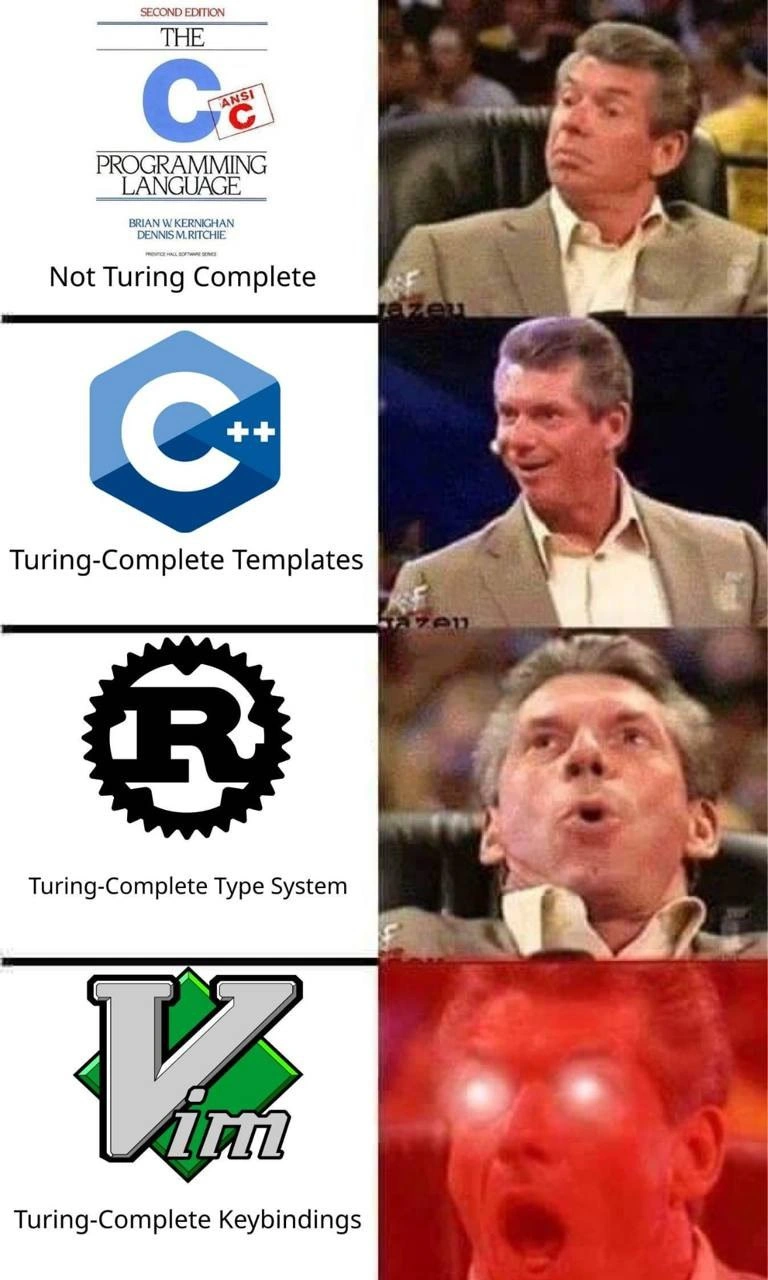
Lastly, the reaction meme format: The meme uses four images of Vince McMahon reacting with increasing excitement. This is a popular format on the internet to show escalating enthusiasm or craziness. Each image corresponds to the caption next to it:
- Calm Vince = not impressed (C’s simple compile).
- Leaning in Vince = interested (C++ doing tricks with templates).
- Shocked Vince = very impressed (Rust’s compiler doing even more advanced tricks).
- Overjoyed Vince with glowing eyes = over-the-moon, mind blown (Vim’s ridiculous power, which is kind of a humorous overstatement).
Developers often use this format to poke fun at technical comparisons by mapping them to those facial expressions. It’s a way to communicate, “if you think that was cool, wait till you see this!”
So put it all together: This meme is a joke about how far we push complexity in programming. It starts with something straightforward and then stacks on layers until it’s outright absurd. It tickles programmers because it references real things (C++ templates are a bit wild, Rust’s type system is very powerful, Vim is super flexible) but exaggerates to make us laugh. Even if you don’t know all the details, the pattern of “more and more powerful/complicated” is clear. And knowing the term “Turing-complete” just adds that extra nerdy punch to the joke – it’s like the meme is saying “this stuff is so powerful, it’s theoretically limitless!” which is both awesome and comical.
Level 3: When Compilers Compute
So why is this meme so hilarious to developers, especially the experienced ones? It’s because it captures a ridiculous arms race in programming language design – the way features have evolved to let more and more work be done before a program even runs. The meme uses the famous Vince McMahon reaction sequence to dramatize a progression that software folks know all too well:
- Old-school C – straightforward, no surprises at compile time. (Vince is calm, almost bored.)
- C++ templates – suddenly the compiler itself is doing elaborate gymnastics via templates. (Vince leans forward like “oh interesting!”)
- Rust’s type system – the compiler’s type checker is now effectively a mini-computer proving things about your code. (Vince is shocked and thrilled – eyes wide.)
- Vim keybindings – even outside the compiler, our editing tools are so powerful it’s like you’re programming with just key presses. (Vince loses his mind, glowing red – ultimate hype.)
This escalation is poking fun at our community’s obsession with Turing-completeness and meta-programming. Each step is an increasingly insane example of “Look what else can secretly act like a computer!”
In the first panel, C is labeled “Not Turing Complete.” Now, any seasoned dev knows C is a full programming language (of course it’s Turing-complete when running a program). But we interpret that caption as “C’s compile-time capabilities are not Turing-complete.” In practical terms, with C you don’t worry that your compiler will suddenly need to solve an arbitrary puzzle – it compiles code in a straight pass, and aside from simple macros or #ifdef checks, it isn’t doing complex computations. Working in C feels very manual and transparent: you write code, it compiles to machine instructions in a predictable way. There’s no magic happening behind the scenes. Senior developers often have a nostalgic appreciation for this simplicity – there’s less that can go wrong in compilation. No ridiculously long template error messages, no compiler taking ages to evaluate your elaborate generics – just compile and go. Vince’s neutral face in panel 1 reflects that normalcy: nothing to write home about here.
Then comes C++ in panel 2 with “Turing-Complete Templates.” This is a nod to a legendary quirk of C++ that every experienced C++ programmer learns (sometimes the hard way!): you can do real computation in the template system. This is called template metaprogramming. For instance, template metaprogramming lets you compute constants at compile time, generate code, or conditionally include code depending on types. Initially, templates were meant to let you write generic containers like std::vector<T> that works for any T. But over the years, C++ programmers turned templates into a compile-time playground. Need to unroll loops at compile time for performance? Templates. Want to calculate a lookup table during compilation? Templates. In fact, the community discovered you could implement something as crazy as a compile-time quicksort or a finite state machine using recursive templates. This reached a zenith with tricks like SFINAE (Substitution Failure Is Not An Error, a pattern where the compiler silently chooses one template or another based on what fits – effectively giving you an if/else logic in the type system). By the time template metaprogramming was fully unleashed, we had essentially injected a full interpreted language into C++’s compilation process. Seasoned devs have a sort of love-hate relationship with this. It’s impressive (and sometimes super useful for performance and compile-time checks), but wow can it make the compile process complicated and the error messages nightmarish. There’s a classic joke: “C++: where your code might compile or might require a PhD to decipher the template errors – roll the dice!” The meme’s second stage gets a chuckle because we’ve all seen someone abuse templates – writing code that almost no one else can understand just to be clever or to squeeze out some performance. Vince’s face there – that intrigued grin – is basically the C++ community’s mix of pride and “hehe, this is wild stuff” when talking about things like template metaprogramming. We’re proud of our language’s power, even if it sometimes feels like using a chainsaw to carve a turkey.
Moving to panel 3: the Rust logo and “Turing-Complete Type System.” Now, Rust is relatively newer, but among experienced programmers (especially those into language design or strong type systems), it’s well-known that Rust’s types are very sophisticated. Rust introduced the concept of generics with traits and lifetimes to ensure memory and thread safety. And it can do amazing things at compile time: check for misuses of memory, enforce that you handled all cases in a match, evaluate constant functions (const fn), etc. The joke specifically calls out Rust’s type system as Turing-complete. That triggers a knowing laugh if you’ve heard of how powerful trait bounds and associated types can be. It’s a bit like the C++ templates scenario – Rust can figure out a lot at compile time. In fact, there’s a genuine fear or joke among Rustaceans (Rust developers) whenever someone asks “Can the Rust compiler do X for me automatically?” – often the answer is “Yes, in theory, but you might summon the wrath of long compile times or compiler errors if you try.” For example, if you try to implement mutually recursive traits without a base case, the compiler will error out with something like "overflow evaluating the requirement..." – basically the compiler saying “I tried to reason about your types and I think you made me go in circles.” That is the hallmark of a system reaching Turing-completeness: you can construct a scenario that makes the compiler work as hard as an arbitrary program (and potentially never finish if it wasn’t guarded). Senior devs find this funny because we intentionally build these super-smart compilers (like Rust’s) to catch our mistakes early, but in doing so, we’ve also made them so complex that they can get tied in knots. We’ve all heard how Rust’s compile times can be long – now we joke, “well, it’s busy solving NP-hard problems in my trait bounds, of course it’s not fast!” There’s also a bit of one-upmanship here: Rust fans (and I say this lovingly) enjoy pointing out how advanced Rust’s type system is compared to older languages. “Our types are so powerful, they’re basically a programming language of their own,” they might boast. This meme winks at that attitude: Yep, Rust’s type system can compute stuff so well, it hit Turing completeness. Vince’s astonished face captures how we feel when we first realize just how much work Rust is doing on our behalf before the code even runs. It’s like having a brilliant but slightly insane assistant who tries every possibility in the background to ensure your program is correct – you’re impressed, though maybe a bit concerned for their health. 😂
Now the grand finale – panel 4 with Vim. For any developer who’s been around editor battles (the classic Editor Wars of Vim vs Emacs vs others), this part lands as a hilarious exaggeration. Vim is revered for its efficiency, using keybindings to navigate and edit text at lightning speed. But here we’re essentially saying, “Forget languages, forget compilers – my text editor’s keyboard shortcuts are Turing-complete!” This is funny on multiple levels. First, Vim’s keybindings are notoriously hard for beginners. Ever seen a newbie accidentally open Vim and not know how to quit? That’s a rite of passage. There’s even stackoverflow questions like “How do I exit Vim?” with thousands of upvotes – it’s a meme in itself! The reason is Vim is modal (keys do different things depending on mode) and uses single-letter commands that can be combined like a mini language. For example, 3dw in Vim means “delete 3 words”. You can get crazy: y$ yanks (copies) to end of line, or ci" changes inside quotes, etc. With enough of these, experienced users edit text with surgical precision. But to an observer, it looks like line noise – a flurry of keypresses doing magical transformations. Now, calling those keypress combinations “Turing-Complete” jabs at how complex and powerful they appear. It suggests that if you string together enough Vim commands, you could calculate anything or build any result, just as you would by writing a program. Honestly, this isn’t far-fetched: Vim has macros that allow loops (e.g., you can record a macro that moves down a line, does something, and then have a command like 10@q to run that macro 10 times, or even @q inside the macro to repeat until a condition). People have done whacky things like implementing simple games or solving problems using Vim macros as a stunt. And with Vimscript, you have an entire scripting facility (with variables, conditionals, loops) inside the editor. So yeah, Vim can automate and compute a lot. The humor for seasoned devs is the absurdity of celebrating that. Vim enthusiasts already half-jokingly treat Vim like it’s sacred (“I do everything in Vim, I write code, compile, read email, make coffee…”). So this meme takes that to 9000: “Ha! Even our keybindings are essentially a programming language – fear us!” Vince’s final over-the-top ecstatic expression is like the collective roar of Vim lovers claiming ultimate victory in Editor Wars with the most ridiculous claim possible. It’s self-aware and tongue-in-cheek: nobody is literally writing an application solely by pressing Vim keys in sequence… right? Well, if someone could, a Vim user would be the one to try, just for bragging rights. 😅
In essence, the senior perspective here is recognizing the pattern: each example is about metaprogramming or unintended uses: writing code that runs at compile time or using tools in unintended, highly abstract ways. The meme exaggerates to make a point: sometimes we, as developers, get way too excited about doing things in the most convoluted, “clever” way possible. It’s making fun of that impulse. We’ve all met the guru who did something wild with templates or wrote a whole logic in a Bash one-liner or turned Excel into a database with macros (heck, Excel formulas are Turing-complete too!). The progression from C to C++ to Rust to Vim is a journey from the ordinary to the WTF. It starts reasonable (C is simple), gets fancy (C++ adds fancy templates), then super nerdy (Rust types prove theorems about code), and finally downright absurd (Vim keystrokes are computing devices). Each step resonates with industry in-jokes:
- C++ template metaprogramming being both amazing and infamous (we still remember the template-heavy libraries that made compilation a slog).
- Rust bringing academic type concepts to mainstream systems programming (and the community pride in its compiler’s thoroughness).
- Vim being the power tool that is almost a rite-of-passage to master (and the endless debates with Emacs folks on which editor can do more).
The meme cleverly satirizes the idea that more complexity = better. By panel 4, it’s clearly poking fun at that escalation. Yet, it’s good-natured – it’s something devs laugh with because we secretly love these insane capabilities even as we joke about them. It’s the kind of humor you share with colleagues after spending a day wrestling with a template error or adding one too many layers of abstraction: “We’ve over-engineered so much, next thing you know even our keyboards are Turing-complete, hahaha!”
To someone who’s been in software for a while, there’s also a subtext of “we keep reinventing the wheel, adding interpreters on top of interpreters.” We went from machine code to high-level languages to those languages having their own mini-languages inside (templates, macros, etc.). It’s like Russian nesting dolls of computation. This meme captures that nested absurdity in a comical way.
And of course, the use of Vince McMahon (the WWE CEO) reaction images adds a layer of parody – it frames the whole thing as an over-dramatic reveal. In wrestling, Vince is known for his theatrical, exaggerated reactions, which map perfectly to the tongue-in-cheek “OMG no way!” escalation here. Tech folks enjoy this format because it blends a pop culture meme with niche tech humor – a perfect recipe for a viral developer joke.
So, at the senior level, this meme is funny because it rings true about our tools getting ever more powerful (sometimes needlessly so), and it joyfully mocks our tendency to geek out about theoretical capabilities. It’s one of those “it’s funny because it’s true (to an extreme)” moments. We recognize each step:
- We’ve compiled plain C programs – boring, nothing fancy.
- We’ve seen or written insane C++ template magic and had that mix of pride and shame.
- We’ve marveled at Rust’s compiler catching our mistakes, essentially doing heavy lifting that we used to do in our heads (or not do at all, leading to bugs).
- We may have spent hours customizing our Vim or Emacs, basically programming our editor to suit us. Thus, the meme is like a mirror, reflecting our community’s quirks in an exaggerated sequence. It leaves us both nodding in agreement and laughing at ourselves. By the end, you can almost hear a group of veteran devs chuckling, “Heh, what’s next? Turing-complete coffee mugs that decide if you deserve caffeine?” – Because the way things are going, nothing would surprise us!
Level 4: Turing Tar-Pits Everywhere
Turing completeness is a deep theoretical concept from computer science – it means a system is as powerful as a universal Turing machine, able to perform any computation given enough time and memory. In formal terms, if a language or even a feature of a language can simulate arbitrary logic (loops, conditionals, and memory), it's Turing-complete. This is the bar for universality in computation. Once you have that power, some wild consequences follow – like the fact you can’t, in general, predict what programs will do (the infamous Halting Problem). Turing-completeness is why we can’t write a perfect analyzer to catch all infinite loops or crashes: a sufficiently flexible program can emulate any other program, so detecting all bad behavior would solve unsolvable problems. It’s both the holy grail and the beautiful curse of general-purpose computing.
But here’s the twist: a system doesn’t have to look like a programming language to be Turing complete. Mathematically, many surprising things turn out to have this universal computing power. Rule 110 cellular automaton (just simple colored cells updating), Conway’s Game of Life, or even a bunch of door-opening puzzles in Zelda have been shown to simulate a computer. For developers, finding Turing completeness in weird places is like an extreme sport – and this meme jokes about exactly that escalating absurdity in familiar tech. Each panel celebrates a new “OMG it can do that too?!” moment as we realize our tools have borderline mad-scientist levels of computational power hidden in them.
Let's unpack the progression. The first panel shows the classic K&R C book – plain old C, the quintessential systems language from the 1970s. C is powerful (you can write an OS in it), but its compilation process is relatively straightforward. Crucially, the C compiler doesn’t execute arbitrary logic for you; any real “computation” happens when your program runs, not during compile time. The meme labels this “Not Turing Complete.” Strictly speaking, standard C as a language is Turing-complete (you have loops, pointers, recursion – you can compute anything given enough memory). However, C’s compile-time capabilities (like the C preprocessor and type system) are not Turing-complete. The C preprocessor is a simple text substitution engine with no loops or full conditionals – it can’t, say, compute Fibonacci numbers or run an arbitrary algorithm during compilation. Likewise, C’s type system is very minimal – it won’t suddenly start solving puzzles for you. This is by design: keeping compilation decidable and simple. So in the context of this meme, “Not Turing Complete” humorously means no crazy meta-computation happening at compile time in C. It’s a baseline – the executive (Vince McMahon) is unimpressed because nothing insane is occurring yet. It’s just a normal programming language doing normal things.
Now enter C++. The second panel – with Vince starting to lean forward – features the C++ logo and the caption “Turing-Complete Templates.” This refers to a famous quirk: C++’s template metaprogramming system is so powerful that it accidentally achieved Turing completeness. Templates in C++ were originally meant for generic programming (write a function or class once and use it for any data type), but developers discovered you can abuse templates to perform arbitrary computations while the code is compiling. 😮 In C++, you can nest templates recursively and use specialization as a form of if logic. It’s been proven that by cleverly crafting templates, you can make the compiler do things like calculate prime numbers, generate lists, or even interpret a different language – all before your program even runs. One notorious example was a template-based program that computed the value of 2^n at compile time, and even a complete Brainfuck interpreter implemented in C++ templates (no joke!). This effectively turns the compiler into a primitive execution engine for a “program” written in template syntax. Since it has loops (via recursion) and conditionals, yes, C++ templates are Turing-complete. The result? Metaprogramming in C++ can produce insanely complex error messages and very slow compile times, because the compiler is essentially solving a puzzle you encoded in types and templates. The meme highlights this as an escalation: the C++ compiler can do non-trivial computation (making Vince go “Hmm, that’s interesting!”). It’s as if the language grew a second layer of programming – one that runs at compile time. This is the first absurd level: the language’s type templates have become a mini programming language of their own. Seasoned devs have a mix of awe and horror about this. It’s powerful (you can auto-generate optimized code, do static checks, etc.), but it’s also notoriously difficult to debug. There’s an old joke that template errors in C++ are as long as novels and as comprehensible as line noise hieroglyphs. Still, the sheer fact that templates form a Turing-complete system is an irresistible nerdy thrill – we turned the compiler into our personal compute engine for repetitive tasks. No wonder Vince is leaning in, intrigued.
In the third panel, things go further off the rails: the Rust logo appears with “Turing-Complete Type System.” Now Vince McMahon’s eyes are bulging in excitement. Rust is a modern systems language that a lot of C/C++ folks love for its safety guarantees and strong compile-time checks (memory safety, ownership rules, etc.). Rust’s type system and trait system are extremely expressive – so expressive that they’ve essentially smuggled in full computational power. This means, in principle, you can encode arbitrary algorithms in Rust’s types, where the Rust compiler’s borrow checker and trait resolver will go crunch through them. We’re not talking about running code at runtime – we mean doing computation solely through the act of type checking. 😲 For example, Rust’s traits (interfaces that types can implement) can be conditionally implemented based on other trait implementations. You can set up a scenario where determining the correct type involves recursive reasoning (“does type X implement trait Foo? Well, only if X satisfies these conditions which might involve another trait…” and so on). If you chain these conditions just right, the compiler is essentially evaluating logic that’s equivalent to a program. In fact, there have been fun demos where misuse of Rust’s powerful impl Trait rules or constant generics leads to the compiler performing fancy calculations or, conversely, getting stuck deep in recursion. The Rust compiler team had to set recursion limits (like “type bounds can’t nest more than 128 deep” by default) specifically because you could otherwise make the type checker loop forever – a direct sign of Turing-completeness. We’ve effectively built a logical inference engine inside the compiler. This isn’t unique to Rust – Haskell’s type system is famously Turing-complete as well (with type families and GHC extensions you can do crazy compile-time proofs). But Rust doing it is both awesome and amusing because Rust advertises safety and predictability – yet even its type system is powerful to the point of being unpredictable if abused. The meme cranks up the absurdity here: not only do our programs run computations, not only do our templates run computations, now the very types and compile-time rules are doing computations. We’ve reached a new meta level. It’s like we keep pushing the “computation” stage to earlier phases: first runtime (normal), then compile-time (C++ templates), then even before actual code generation, in the semantic analysis phase (Rust’s types). Each step, Vince’s reaction intensifies because this is extremely meta and delightfully ridiculous. It’s as if the language is saying, “Why even run your code at all? I can solve the problem in the compiler for you, with types!” The humor here is a mix of admiration for these language feats and a bit of “this is madness” at how far we are willing to push computational logic into every nook and cranny of our tools.
Finally, the meme hits the peak with the fourth panel: the green Vim logo and the caption “Turing-Complete Keybindings.” Here Vince is beyond excited – he’s glowing red with an over-the-top ecstatic face. This punchline is poking fun at the almost mythical power of Vim, the classic modal text editor. Vim is famous for its cryptic yet extremely efficient keybindings (like pressing dw to delete a word, or yy to copy a line – everything is done with keyboard shortcuts that can be combined in countless ways). Vim aficionados brag that they can perform surgical editing at the speed of thought by chaining key commands. Now, calling Vim’s keybindings “Turing-complete” is deliberate hyperbole – it humorously suggests that Vim’s editing commands are so powerful and composable, you could theoretically use them to simulate any computation. Is that really true? Possibly, in a roundabout way! Vim does allow you to record macros (a sequence of key presses that you can replay), and you can even make those macros call themselves or loop by invoking them multiple times. The text buffer (your open document) can serve as a kind of memory tape. In fact, people have done astonishing things entirely in Vim – like writing complex edit scripts, or even games and animations using Vim commands. Combine Vimscript (the built-in scripting language, which definitely is Turing-complete) with key macros, and Vim becomes a programming environment in its own right. There’s a tongue-in-cheek saying that Vim is not just an editor, it’s an operating system (Emacs users say the same about Emacs, which literally has a Lisp interpreter inside). This meme takes that to the extreme: even the key combos in Vim are essentially a programming language, one so complete and powerful it might as well compute anything. That idea is absurd and hilarious – imagining a developer toggling Vim’s Normal mode and entering some arcane keystroke sequence to solve a math problem or launch a rocket 😜. It resonates because Vim’s command language does feel like a secret code to outsiders. Newcomers joke about not even being able to exit Vim (:q! to quit, folks) because it’s like needing a cheat code. Power users, on the other hand, chain commands to perform massive edits in seconds, almost like writing and executing a program with just key presses. So calling Vim’s keybindings Turing-complete is a comedic exaggeration that feels true in spirit. It’s the crescendo of this joke: we started with normal code, went into templates, then types, and now even our text editor usage is depicted as a computational masterpiece. At this point, reality has been left behind in favor of geeky fantasizing. Vince McMahon’s glowing, euphoric face says it all – this is the ultimate absurd delight for a programmer: my text editor can theoretically solve any problem if I just wield it right!
Underlying this humor is a gentle poke at the culture of metaprogramming and the one-upmanship of programming language enthusiasts. We often marvel when we discover that something unexpected is a universal computer. It’s a bit of a nerd flex to say, “Haha, even my config file language is Turing-complete, I could code an app in it (but I won’t).” Each of these stages – C++ templates, Rust’s type system, Vim – represents a kind of “overkill” in programmability. They’re Turing tarpits: you can do literally anything in them, but it’s painfully impractical to do so for real work. And yet, the mere fact that you could is exciting! It appeals to the hacker mindset of bending tools in unintended ways. As the famous epigram goes:
“Beware of the Turing Tar-Pit in which everything is possible but nothing of interest is easy.” – Alan Perlis, Epigrams on Programming
This meme ironically embraces the tar-pit instead of beware-ing it. Each panel is basically saying “Oh, you gave me a tar-pit? AWESOME, let’s dive in!” 🤣 It’s celebrating the absurd level of power hidden in layers of our technology stack that were originally meant for something else (types, templates, editor commands). It’s the kind of joke seasoned developers cackle at, because we’ve seen how over-complicating things (like abusing templates or macros) can be both brilliant and disastrous. The escalation is key to the humor – it starts believable and ends in total absurdity. By the time we claim keybindings have full computing power, the satire is at max. It’s a loving roast of our tendency to add complexity: from the simple C days to the current era of complex languages and tools that have more features than an overstuffed Thanksgiving turkey.
In summary, at this deepest level the meme riffs on a core CS concept (Turing completeness) and shows how it creepingly invades every part of programming: languages, type systems, build processes, even editors. It tickles the part of a programmer’s brain that delights in clever hacks and theoretical possibilities, even those with no practical use beyond saying “Because we can!” The red-glowing excitement is both genuine (cool tech!) and mocking (this is over-the-top). It’s a fun reminder that in the world of computing, anything that can become a computer eventually will – often with hilarious consequences for those of us who then have to debug it.
Description
A four-panel meme using the Vince McMahon reaction format to escalate the concept of Turing completeness in programming tools. The first panel shows the cover of the book 'The C Programming Language' with the text 'Not Turing Complete,' paired with an unimpressed Vince McMahon. The second panel displays the C++ logo with 'Turing-Complete Templates,' and McMahon appears intrigued. The third panel features the Rust language logo with 'Turing-Complete Type System,' showing a much more excited McMahon. The final panel, the punchline, shows the Vim editor logo with 'Turing-Complete Keybindings,' and McMahon's eyes are glowing red with ecstatic energy. The humor comes from the escalating absurdity of where Turing completeness - the ability for a system to perform any computation - is found. It starts with a (jokingly incorrect) baseline for C, moves to the known-but-esoteric feature of C++ templates, then to the powerful Rust type system, and culminates in the hyperbolic joke that even Vim's complex keybinding system is a computational environment, a nod to the editor's legendary power and complexity

Comments
63Comment deleted
C++ templates let you compute at compile time. Rust's type system lets you prove theorems at compile time. Vim keybindings let you accidentally summon a demon at edit time
We’ve made templates, type systems, and even keybindings Turing-complete - now the only thing that never halts is the cloud bill for the compile farm trying to prove it
We've gone from "undefined behavior is a feature" to "my text editor can compute the halting problem if I just remember the right chord progression."
The real plot twist? Discovering your build system's YAML configuration is also Turing-complete, which explains why your CI pipeline can solve the halting problem but still can't figure out why it randomly fails on Tuesdays
Modern stack: compute in C++ templates, prove it in Rust’s types, and deploy via Vim keystrokes - the only undecidable part is the requirements
C++ templates were the warning shot; VSCode keybindings prove even your keyboard needs dependent types to halt
Turing completeness always migrates to wherever code review can’t see it - first templates, then trait bounds, and eventually your vimrc; at this point :q! is basically undecidable
How the hell C can be Turing incomplete, go have a sleep Comment deleted
This is an argument about the specification of C, not any particular implementation. The fact that no real machine has unbounded memory is totally irrelevant Comment deleted
The reason why ISO C isn't Turing-complete is precisely the limit of addressable space. You can write another language in C which handles memory differently. Comment deleted
Well, no, you can't write an interpreter in C and hope it has access to unlimited space, because it's still subject to C memory model Comment deleted
asm(...) invented in Comment deleted
you can make a different memory management system via loopholes, but you have to rewrite every single piece of code to use it. Comment deleted
like, how? Comment deleted
Practicality doesn't matter. It's just wankery about the specifics of language definition. Comment deleted
I'm fairly sure you can implement UTM or unbounded version of brainfuck using fread()/fwrite() and relative seeks only. Comment deleted
I'm pretty sure fread/fwrite is not in the C standard Comment deleted
standard c you mean without syscalls? Comment deleted
standard C I mean the C as specified by the C standard Comment deleted
like, ISO C Comment deleted
ANSI C Comment deleted
There are no such thing as a syscall in C standard, that's implementation thing. But it does have a standard library. And that defines some OS interfaces including file access. Comment deleted
huh, seems like you're right. I thought files were only defined in POSIX Comment deleted
does... does that mean free-standing C is not, strictly speaking, C? Comment deleted
also, i don't know why i'm stuttering. Comment deleted
I guess? Speaking of that, there are loads of C implementations with paged memory access. Comment deleted
POSIX defines filedescriptor stuff C89 defines FILE* stuff Comment deleted
I didn't mean it directly I thought by standard C you mean things without the system/os specific features Comment deleted
https://port70.net/~nsz/c/ Comment deleted
then how are turing complete languages made? Comment deleted
Well, guess what, they aren't :) Comment deleted
No Turing-complete implementation of a language exists in the real world. Comment deleted
The C memory model does allow for an infinite amount of memory, even if the memory space is bounded Comment deleted
Volatile accesses allow the same address to effectively reference more than one byte of memory Comment deleted
In fact, you could access as much memory as you want in C from just one address if you hate yourself enough Comment deleted
how? Comment deleted
Multibyte control code written to the address selecting the real address followed by the access you wish to make to the same address Comment deleted
Think address/data hwregs but on steroids Comment deleted
More like this Comment deleted
like using pointers to pointers ? Comment deleted
Create a fake array pointer to wherever you want. You can try to read from it and in normal OSes the kernel should prevent you from reading stuff outside if your app’s allocated memory. Ofc this is a hw feature since BC 300 or something Comment deleted
C != the environment it runs in under an OS Comment deleted
If you can run it on hardware in ring0 you can read write wherever you want anyway Comment deleted
what do you call turing complete ? Comment deleted
Can somebody explain? Comment deleted
Okay. Let me just make myself some tea first. Comment deleted
Alan Turing has a bunch of different stuff (deservedly) named after him. One of these is idea of an universal computer. Accompanying that is a proof that given infinite resources every kind of universal computer can emulate any other (that is to say there is a way to mechanically translate the program from one to other). One of such theoretical computer is one he described and which is called Universal Turing Machine. It's not of much use besides that when you implement it in a computational system you prove that that system is universal, or how we'd call it today: Turing-complete. The key part there is that this is all math proofs and hence the theoretically unbounded resources. The one claim above that C is not Turing-complete because the standard defines a datatype that must be able to address all available memory and thus memory must be finite is about difference between the theoretical model with infinite resources and actual implementation — there is no computer with infinite memory. I find that claim rather bogus as the C standard also defines file access API and I'm pretty sure that isn't size-bounded. By the way Brainfuck — the original and most used version does use static memory of IIRC 256 values, so not Turing-complete. Comment deleted
Give this guy a raise Comment deleted
Too bad, he was killed after that for being gay. Comment deleted
I know that and the enigma story of him Comment deleted
But I meant you for explaining. Comment deleted
Thanks man Comment deleted
Yeah, I know. Comment deleted
Are you from Redmond? Address space could be backed even by clay tablets. Comment deleted
should I remind you that Turing machine is mathematical abstraction? Comment deleted
it's not about having infinite storage, it's about the lack of bounds on it. And about bullshit, I might introduce you to COBOL. Yep, that old ugly bastard in case of IBM version isn't limited by the language reference, only by compiler. Comment deleted
portability, you don't have to check whether you hit the bound or not inside the code on different systems Comment deleted
the word "compiler" flew around your head the same way as "mathematical abstraction"... Comment deleted
OK, C is not turing complete. But what about macros? Comment deleted
actually the question is who gives a fuck to being turing complete Comment deleted
Only if fed to itself recursively. Comment deleted
I somehow doubt that Comment deleted
I have a vague impression that he devised the test during last moments of his life, possibly while waiting for the suicide method to take effect Comment deleted