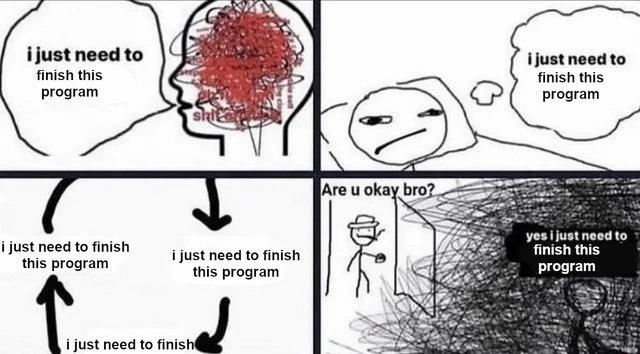
Endless mental loop of finishing that one program, spiraling into scribbled burnout
Why is this Deadlines meme funny?
Level 1: Just Five More Minutes
Picture a kid trying to draw a perfect picture with crayons. He keeps adding more and more to it, trying so hard to finish it just right. Every time he tries to fix one little part of the drawing, he accidentally messes up something else. He gets so frustrated that he eventually just scribbles a big black cloud over the paper in anger. Now his friend or parent comes by and sees him all upset and asks, "Are you okay?" The kid, barely looking up from the torn, scribbled paper, insists, "I'm fine, I just need to finish this!" even though he's clearly not fine at all. It's like when a child begs for "just five more minutes" to keep trying, even though they're exhausted and the whole thing has become a big mess. We find it funny in the meme because we've all seen (or been) that kid: totally absorbed in trying to finish something, repeating "I’m almost done!" over and over, while everyone else can see they'd be better off taking a break. It's a silly, relatable reminder that sometimes the more you push yourself to finish when you're tired and frustrated, the more you just go in circles – whether you're drawing with crayons or coding on a computer.
Level 2: Just One More Fix
Let's break down what's happening in this meme in plain terms. We have a programmer who keeps saying "I just need to finish this program." This phrase is repeated over and over in the panels, which shows he's stuck in a loop of trying to finish a coding project but not actually reaching the end. In programming, an infinite loop is when a set of instructions keeps repeating forever because there's no clear condition to stop. Here, the developer's mind is in an infinite loop: he keeps thinking he’s almost done, yet he never actually finishes. Each time he fixes one thing in the code, something else probably breaks or needs attention, so he ends up back where he started: "Just need to finish..." round and round.
Now, why is he turning into a big scribble in that third and fourth panel? That scribble represents stress and burnout. Burnout for a developer (or anyone) means you're completely exhausted and worn out mentally, often after working too hard or for too long. The black scribbly head shows that he's frazzled and overwhelmed. He’s been stuck on this programming task for so long, with so much frustration, that his mind feels like a tangled mess. This often happens under deadline pressure – which means there's a due date coming up soon (like an assignment due tomorrow or a project deadline at work) and the person is feeling stressed about finishing in time. When you're under a tight deadline, especially if you procrastinated (delayed getting started or left a lot of the work until the last minute), it can lead to panic and frantic last-minute coding, just like we see here.
Debugging is a big part of what's going on. Debugging means finding and fixing errors or problems (bugs) in your program. It’s a normal part of coding: you write code, something goes wrong, and you troubleshoot it. But debugging can be tricky and unpredictable. Often, you fix one bug and then discover another, or your "fix" causes a different part of the program to break. That can feel like you're looping in circles. For a newcomer, imagine trying to get your code to run correctly for a school project. You think you're almost finished, but then you run the program and it crashes. So you fix that crash, run it again, and now a different feature doesn't work. You fix that, and now two other things break. It's frustrating! This meme exaggerates that situation – the developer has probably been debugging so many issues back-to-back that he's at his wits' end, still telling himself he'll be done if he just fixes the next problem.
Let's talk about productivity and why working non-stop can backfire. Productivity means how much useful work you get done in a given time. When you're well-rested and focused, you might solve problems quickly. But if you've been coding for hours and hours, especially late into the night, your productivity drops. You start making more mistakes because you're tired. You can see this happening to the character: he's been coding so long (likely late-night coding, given the context) that he's basically turned into a zombie at the keyboard. This ironically makes it even harder for him to finish the program, because in a tired state he might keep introducing new bugs. It's a bit like trying to do homework when you haven't slept – you end up writing nonsense or doing the math wrong, and then you have to redo it.
The meme also touches on the mental health side of being a developer. Programming can be really rewarding, but it can also be mentally taxing. When you're stressed about a project or stuck on a tough bug, you can feel strong anxiety – basically a mix of worry and pressure that you're not solving the problem fast enough or that you might miss your deadline. If you keep pushing yourself without a break, that anxiety and stress build up. The result is what we call developer burnout: you stop enjoying the work, you feel exhausted all the time, and you might even have trouble concentrating or feel irritable. In the meme, the main character is clearly in the burnout zone (he literally becomes a scribble to show how scrambled his brain feels), but when his friend peeks in and asks "Are u okay bro?", the developer says "yes I just need to finish this program". That's a bit of dark humor, because obviously he's not okay – he's practically falling apart – but he's so fixated on his code that he can't admit it.
If you're new to coding, this meme is basically a funny cautionary tale. It’s common to underestimate how long a programming task will take. A beginner might think, "I'll just add this last feature or fix this one bug and I'll be done in 10 minutes," only to find themselves still debugging three hours later. The phrase "Just one more fix" is something developers often say to themselves. It's a way of staying motivated, but it can also become a trap if you don't step back occasionally. And the "Are you okay?" part – that's something you should actually listen to in real life. It might be a friend, family member, or even your own inner voice noticing you're getting too frustrated or tired. The smart move (which our scribble-headed friend in the meme isn't doing) is to take a short break, maybe get some sleep, and come back with a clear head. Often when you do that, you'll realize the problem isn't as unsolvable as it seemed at 3 AM.
In summary, the meme uses a simple loop and a scribble drawing to depict a programmer stuck in an endless cycle of debugging under a deadline, resulting in severe frustration and burnout. It's poking fun at how developers – especially when inexperienced or under high stress – can push themselves to the brink while insisting "I’m fine, just one more fix!". Anyone who's coded long enough has experienced a smaller version of this. Maybe you haven't literally turned into a scribble monster, but you've probably felt fried and obsessive about finishing a project at some point. The lesson for a junior developer here is: be mindful of the "just one more fix" loop. It's okay to take a breather when you're stuck; in fact, it's often the best way to actually finish that program and keep your sanity intact.
Level 3: Sisyphus of Software
Every seasoned developer recognizes this scenario all too well. What starts as a simple task – "I just need to finish this program, it’ll only take a bit" – mutates into a marathon debugging session that stretches into the night. The humor (and horror) here comes from how relatable that endless loop is to anyone who's coded under pressure. You fix one bug, and two more pop up like a hydra: a classic case of debugging whack-a-mole. Each time you think you've squashed the "last" issue, another emerges, resetting the cycle. This is the Sisyphus of Software – pushing that project boulder uphill towards "Done", only to have it roll back with a new bug at 99% complete.
The meme's four panels capture the spiral of crunch mode perfectly. In the first panel, the developer is calm, confidently telling himself "I just need to finish this program." Fast-forward a bit: the second panel's frowning face and scribbled brain show creeping developer frustration as things aren't going as smoothly as hoped. By the third panel, the looping arrows visually scream infinite debug loop – he's caught in a cycle of late-night coding and repeated attempts to wrap things up. By the final panel, our protagonist has morphed into a full-on burnout scribble-monster, still muttering the same mantra about finishing the program. The punchline is the tiny stick-figure friend at the door asking "Are u okay bro?" – something many of us have heard from a coworker or loved one when we're neck-deep in a death march project. And of course, the coder responds "yes I just need to finish this program", completely oblivious to his own disheveled, mentally fried state. It's funny in that dark, laugh-so-you-don't-cry way: we see ourselves in that disarray, stubbornly refusing to admit defeat or exhaustion even as the room (and our brain) is on fire.
This meme satirizes deadline pressure and the lies we tell ourselves to cope with it. Maybe there's a looming release date or a manager repeatedly pinging for that feature, and the developer had been a bit procrastinate-y or overly optimistic about the remaining work. So he pulls a heroic all-nighter fueled by stale coffee and sheer willpower. "Just one more hour, just one more fix," he repeats while the clock ticks past midnight into the absurd a.m. hours. Ironically, the longer he grinds, the more developer productivity plummets. Fatigue leads to mistakes – perhaps each quick patch applied at 3 AM introduces a new bug by 3:15. This debugging pain feeds the spiral: every rushed fix begets another issue, keeping the finish line perpetually out of reach. Yet many of us have been there, caught between stubborn determination and creeping dread as the deadline looms ever closer.
The industry pattern being poked at here is crunch culture – the misguided notion that just working harder and longer will brute-force the project to completion. In reality, it's often a trap. The "just need to finish" mindset becomes a form of tunnel vision. You're so laser-focused (and anxious) to declare victory that you ignore how badly you're burning out. Management might even unknowingly encourage this: ever had a boss who sees slipping timelines and says "We really need everyone to push harder"? The result: developer burnout. You get programmers in zombie mode, mumbling "I'm fine" from behind screens filled with chaotic code and failing tests. It's practically a rite of passage in some environments – war stories of coding until dawn, eyes gritty and red like the scribble in this cartoon, insisting everything is okay when it's clearly anything but.
Let's not ignore the mental health angle. Software development is mentally intensive work, and when you're stuck in a problem loop, your developer anxiety skyrockets. You start worrying: "If I don't finish this soon, I'll blow the deadline, let the team down, maybe even get in trouble." That anxiety fuels the refusal to step away from the keyboard. It's a cruel irony that the more stressed and sleep-deprived you are, the less effective your debugging becomes – yet you feel you can't afford to stop. The meme nails this irony: the coder's brain is essentially on fire (hence the chaotic scribble), but he insists he's fine. This is a comedic exaggeration of real burnout behavior: denial. Many devs will brush off concerns with a hollow "I'm good, just fixing one last thing" even as they write nonsense code and their git commit messages devolve into "WIP - attempt #57" and "really-final-final-fix.sql".
If you're an experienced dev, you can practically feel the headache behind that scribbled face. You know that sometimes the healthiest move – taking a break, getting sleep, asking for help – is exactly what a fried brain resists doing in crunch mode. The friend in the doorway is that little reality check we all tend to ignore when we're in the zone (or rather, in the spiral). The meme resonates through the software community because it's a truthful, if exaggerated, snapshot of a common experience. It's simultaneously a cautionary tale and a nod of solidarity. We chuckle at it because we've survived that infinite loop ourselves, and looking back, it's easier to see how ridiculous (and how human) that situation was. In the moment, though? In the moment you're the scribble, convinced that salvation lies in just one more line of code. As any grizzled coder will tell you with a wry smile: that's usually when you need to call it a night – otherwise you might end up debugging the bugs you introduced while half-asleep, trapped in a loop that even Ctrl+C can't break.
Level 4: The Halting Problem IRL
The developer in this meme is basically a non-terminating process personified. In theoretical computer science, Alan Turing's famous Halting Problem proves there's no general algorithm to decide whether an arbitrary program will ever finish running or loop forever. Here, we're seeing that play out in real life: the programmer keeps recursing on the same thought "I just need to finish this program" without reaching a base case. It's like their brain executed a function with no exit condition:
function finishProgram() {
// do some coding tasks...
fixLastBug();
polishFeature();
// missing a condition to stop!
finishProgram(); // recursive call with no base case - oops
}
Without a clear termination condition (like a base case in recursion), this mental "algorithm" runs ad infinitum, just as a while(true) loop spins forever. Each loop iteration adds more cognitive load, akin to a stack frame piling up until you get a mental stack overflow of burnout. The scribbled red mass drawn over the character's head in panel 2 could be seen as a tangled call stack or a CPU hitting 100% usage on a thread stuck in a busy-wait. There's no break statement to be found in his thought loop.
This infinite debug loop also hints at the nature of complex software: finishing a program can be an undecidable problem in itself. Every time our intrepid coder thinks they're at the end, a new edge case or bug emerges, effectively resetting the loop. It's reminiscent of approaches to the halting problem where any presumed solution leads to a contradiction – here, any assumption of "done" leads to a new "not done" discovery. If you squint, you can almost consider each "I just need to finish..." iteration as an additional computation step in a Turing machine that hasn't reached a halting state.
One could draw parallels to computational complexity as well: trying to achieve a completely bug-free program is like approaching an asymptote – you get closer and closer to "done" but never quite reach it, burning ever more resources for diminishing returns. It's the developer's version of Zeno's paradox, an endless series of half-tasks each taking you halfway to the finish line but never letting you arrive.
Even the "Are u okay bro?" check in the final panel functions like an external watchdog timer or an OS health check pinging a hung process: the outside world is effectively asking the program (developer) if it's still alive or stuck. And just as a rogue process might feebly respond "still running" while thrashing the disk, our scribble-headed coder insists "yes I'm fine, just need to finish this program", keeping the loop alive. In a darkly comedic way, the meme captures how a developer's mind can deadlock on a task, fighting the laws of computability and eventually succumbing to mental burnout when no break condition is set.
Description
Four-panel hand-drawn meme in black-and-white stick-figure style. 1) Top-left: a calm outline of a head with the caption "i just need to finish this program". 2) Top-right: the same head, now frowning and slightly tilted, again captioned "i just need to finish this program". 3) Bottom-left: a circular flow-chart arrow looping back on itself three times; at each point of the loop the text reads "i just need to finish" and "i just need to finish this program", visually depicting an infinite cycle. 4) Bottom-right: a doorway scene with a small stick figure asking "Are u okay bro?" while the main character is engulfed in a dense black scribble replying "yes i just need to finish this program". The repetition illustrates a developer trapped in a procrastination/debugging spiral where the simple task of “finishing the program” expands into overwhelming mental load, symbolizing deadline pressure, burnout, and the perpetual ‘just one more fix’ mindset common in software engineering
Comments
12Comment deleted
“I just need to finish this program” = unit tests green locally, integration tests intermittently red in CI, prod still on Java 8, feature-flag checklist longer than RFC 7230, and Kubernetes deciding the init container is optional on alternate Tuesdays - so yeah, practically done
After 15 years in the industry, I've learned that 'just finishing this program' is the same lie we tell ourselves that 'this microservice will definitely stay micro' - both end with architectural therapy sessions and a git history that reads like a descent into madness
This is what happens when your brain enters an infinite while loop without a proper exit condition - you keep iterating on 'just finish this program' until stack overflow occurs in your mental state. The real bug isn't in the code; it's the missing break statement in your work-life balance logic
Translation of 'I just need to finish this program': while(!done_done){idempotent_migrations(); retries(); metrics(); SLOs(); runbook(); feature_flag(); timezones();} - the ninety-ninety rule running in production
Flow state event loop: while (!done) { ignore_life(); code_harder(); } // yields never
“I just need to finish this program” is a non-terminating recursive function; every call adds tests, telemetry, perf fixes, compliance, and a migration - turns out the base case was removed in a refactor
tell me you have burnout without telling me you have burnout Comment deleted
lazy piece of shit procrastinating Comment deleted
i just need to finish university assignments... i just need to finish university assignments... i just need to finish university assignments... i just need to finish university assignments... Comment deleted
If you need to finish the assignments, then — congratulations! — at least you have started working on them. 😁 Comment deleted
that's true :D It's a procrastination cycle every quarter tho, so... Comment deleted
*at least you remember that you have assignments Comment deleted