The Overwhelming Proliferation of '-Ops' Buzzwords in Tech
Why is this IndustryTrends Hype meme funny?
Level 1: Too Much of a Good Thing
Imagine you found a really cool trick or toy at school, and it was so great that everyone wanted to copy it. For example, you discover that adding a little sugar makes your oatmeal taste better (yum!). Seeing this, your friends start adding sugar to everything – their soup, their salad, even their milk. At first, a bit of sugar was a good idea, but now it’s going too far and things that shouldn’t be sweet are getting sugary. You’d probably laugh and also feel a little grossed out, saying, “Okay guys, please stop – not everything needs sugar!” This meme is showing the same feeling, but with grown-ups and their big ideas. One good idea (DevOps was the “sugar” for making software better) got copied so much that people are putting it on everything, even where it doesn’t fit. It’s funny because it’s silly to see it everywhere, but also a bit frustrating – just like too much sugar can spoil the food. The men in the picture are laughing and begging at the same time, which is exactly how we feel when everyone keeps using a special word over and over: it was a good idea, but enough already!
Level 2: Buzzword Breakdown
If you’re new to tech, seeing every term end in “Ops” can be confusing. Let’s break down what these buzzwords actually mean (and why people keep inventing more):
Ops = Operations: In all these words, “Ops” is short for operations, meaning the day-to-day tasks of running software or processes reliably. In a company, “operations” covers things like managing servers, deploying updates, monitoring systems, handling outages – basically keeping things running smoothly.
DevOps (Development + Operations): This is the original term that started it all. DevOps is a culture and set of practices where development engineers and IT operations work together closely. Instead of developers just writing code and tossing it to ops to deploy (the old way), DevOps teams share responsibility. They use automation, like CI/CD pipelines (Continuous Integration/Continuous Deployment), to ship code faster and more reliably. Think of DevOps as breaking the wall between “makers” (devs) and “caretakers” (ops) so software gets from code to production without drama. It’s not just a job title, but a philosophy of collaboration.
MLOps (Machine Learning Ops): This applies DevOps-style ideas to machine learning. Data scientists build models, but how do those models get continuously updated, deployed, and monitored in production? That’s where MLOps comes in. It’s about versioning datasets, automating model training, deploying ML models as services, and monitoring their performance (did our model’s accuracy drop?). MLOps engineers help bridge the gap between experimental ML code and a reliable production system, so new AI features can roll out smoothly.
DataOps (Data Operations): Similar concept, but for data analytics pipelines. In DataOps, teams treat data processing (like ETL jobs, data transformations, database updates) with the same discipline as code. They use automation and testing to ensure data is handled reliably. The goal is to avoid the “wild west” of ad-hoc scripts and instead have well-engineered, repeatable processes for data – because bad data can crash apps just like bad code.
CloudOps (Cloud Operations): This usually means running and managing infrastructure in the cloud. Instead of racking physical servers, CloudOps teams use cloud platforms (like AWS, Azure, GCP) and manage resources there. They handle things like scaling servers up/down, configuring networks and storage, and making sure cloud services stay online. It’s basically traditional IT operations, but in the cloud era – dealing with virtual machines, containers, and cloud services.
AIOps (AI for IT Operations): Now we get into buzzword-on-buzzword. AIOps means using Artificial Intelligence to assist with IT operations. Imagine software that watches logs and metrics and uses AI algorithms to detect problems or predict outages before humans notice. It’s a fancy way to say “let’s apply machine learning to our monitoring and DevOps processes.” In theory, it can automate routine fixes or highlight unusual patterns. In practice, it’s often a marketing term for smarter monitoring tools.
ChatOps (Chat Operations): This one is a bit different – it’s about the way people work. ChatOps means integrating operational work with chat platforms (like Slack or Microsoft Teams). For example, instead of logging into a server to deploy code, an engineer might type a command to a chatbot in a chat room like
@deployBot deploy my-app. The chatbot interfaces with the CI/CD system and replies with results. ChatOps makes ops tasks more collaborative and visible to the whole team via chat, turning chat rooms into a sort of operations center.NoOps (No Operations): This term sounds like magic. NoOps suggests a world where developers don’t need a separate operations team at all. How? By using platforms and automation so advanced that all the traditional ops tasks are abstracted away. For example, using serverless computing or fully managed services means developers just deploy code and the platform handles the rest (scaling, patches, etc.). The joke is, there’s always someone doing ops behind the scenes – it’s just that in a NoOps approach, it might be the cloud provider’s SRE team instead of your own. NoOps is essentially the idea of “operations invisible to the dev team.” It’s appealing, but in reality even serverless apps require careful configuration and monitoring (so ops never truly disappears, it just moves).
Other “[Something]Ops” flavors: The meme lists many more: FinOps (short for Finance Operations, focused on controlling cloud costs and budgeting so your cloud bill doesn’t explode), RevOps (Revenue Operations, aligning sales and marketing data/processes to squeeze out more revenue – mostly a business thing), BizOps (Business Operations, a strategic team improving internal processes and strategy execution). It’s not just tech: even HROps (HR Operations) and LegalOps (Legal Operations) have emerged, meaning folks in HR or legal who streamline their departments’ workflows with an operations mindset. You can see the pattern – take any field and add “Ops” to signal “we run this with efficient processes and maybe some automation.”
For a newcomer, it’s a lot of buzzwords to digest. 😅 Just remember: all these terms borrow from DevOps at heart. They’re about breaking silos, using automation, and treating processes as repeatable engineering problems rather than one-off manual tasks. The reason people keep adding new “Ops” is because the idea of DevOps was successful – so other areas want to capture that success by saying “Hey, we do Ops too, but for our domain.” Sometimes it’s genuinely useful (like applying DevOps ideas to machine learning gave us MLOps, which helps get AI models into production). Other times it’s more of a branding exercise. As a junior dev, don’t panic if you hear a new ___Ops term – try to link it back to its roots: it usually means “applying structured, automated operational practices to ___.” And yes, even if the term sounds silly (looking at you, NoOps), there’s probably a real idea or pain point it’s addressing under the hood.
Level 3: Opsification Overdose
The explosion of “-Ops” suffixes in tech has reached absurd levels. What began as the sensible concept of DevOps – bridging development and IT operations for faster, more reliable deployments – has morphed into a rampant buzzword bingo. Today, every department feels compelled to coin its own XOps term. We have MLOps for machine learning models, DataOps for analytics, AIOps for automated incident handling, even FinOps for cloud spending. It’s a veritable TechBuzzwords arms race. Each new variant stretches the meaning of “ops” a little thinner. The result? Seasoned engineers are groaning under Ops suffix fatigue, laughing and crying at the state of industry hype.
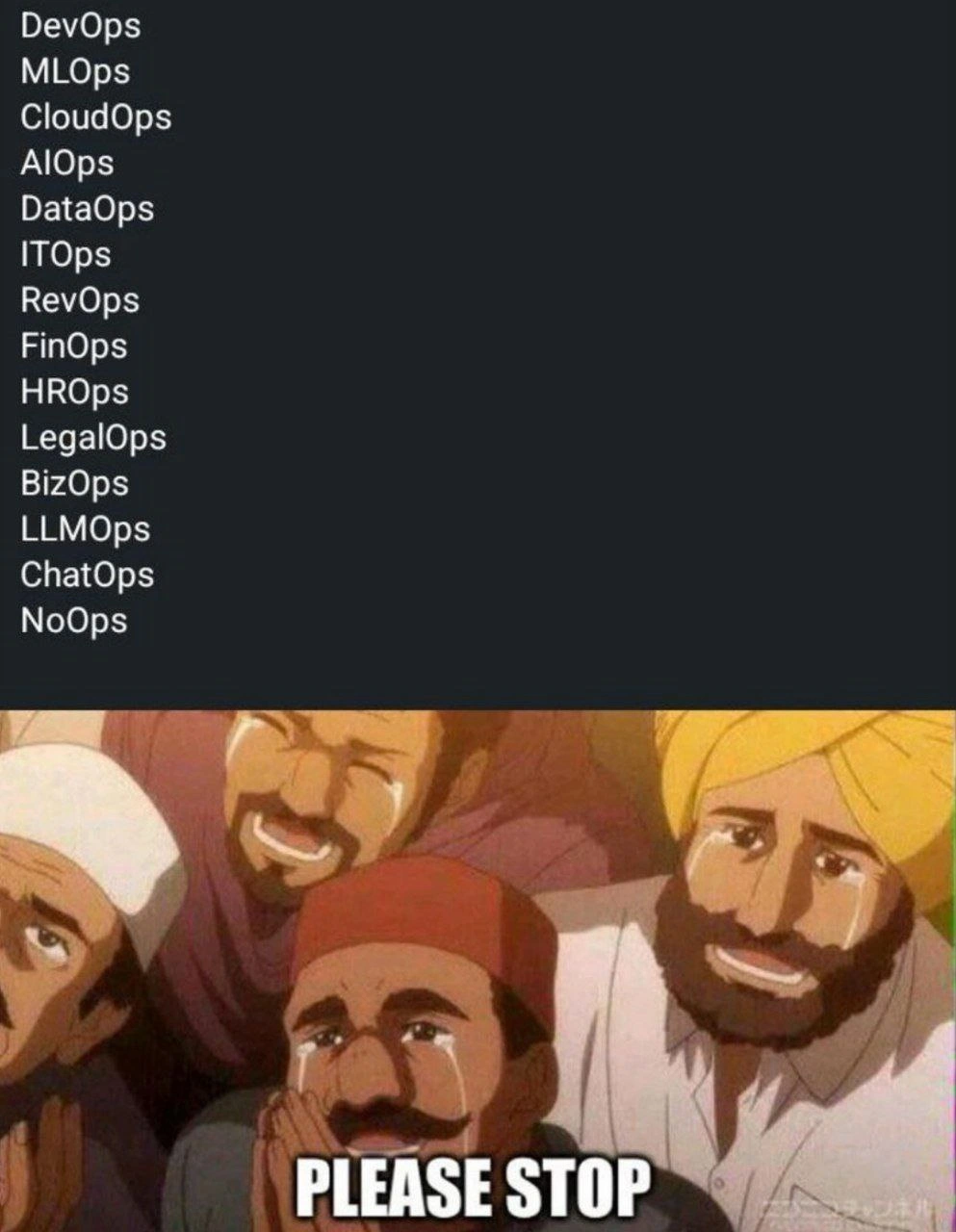
Why is this meme so painfully funny to experienced DevOps and SRE folks? Because it nails an IndustryTrends truth: meaningful ideas are getting diluted into marketing fluff. DevOps was originally a cultural shift (DevOpsCulture) toward collaboration and shared responsibility. But as the hype cycle took over, every team started slapping “Ops” onto their name to seem just as transformative. We ended up with a naming bandwagon running wild – from CloudOps teams (who ironically do what sysadmins always did, just in the cloud) to BizOps groups (which sound techy but often do classic business strategy with fancier titles). The meme’s top panel listing DevOps, MLOps, CloudOps, AIOps, ... NoOps reads like a manic checklist of every trendy ops-flavored term. It’s essentially a BuzzwordBingo card filled to completion, leaving no buzzword un-oped. By the time we hit NoOps (the claim that we can eliminate operations entirely through automation), any veteran engineer is already chuckling in disbelief. (NoOps, really? We’ve come full circle to “no operations at all” while we’re drowning in operations terminology.)
In practice, this “suffix syndrome” leads to some ironic outcomes. Companies spin up a new SomethingOps team for each niche, often without empowering them with the DevOps principles that actually matter (like automation, monitoring, or breaking down silos). Tools and vendors jump in to sell OverEngineering solutions for every flavor of Ops – some helpful, many just rebranded old ideas. We see junior engineers with titles like ML Ops Engineer or DevSecOps Specialist handed siloed tasks, even though DevOps was supposed to break silos. It’s the classic industry pattern: take a good concept, repeat it everywhere as a slogan, and watch the meaning evaporate. The humor here comes with a side of tragedy: those anime characters on their knees, tears streaming, pleading “PLEASE STOP,” perfectly represent battle-scarred SREs and cynical veterans internally screaming as yet another exec says, “What we need is more [InsertLatestTrend]Ops!”
Underneath the laughter is a shared pain point (DevOpsPainPoints). Real DevOps culture change is hard – it requires shifting mindsets and trust. But coining a new buzzword is easy; it’s a shortcut to sound innovative without doing the work. The meme exposes that empty hype: every new Ops term is like a coat of glossy paint on the same old car. Insiders nod knowingly because they’ve attended the “Buzzword Bingo” meetings and watched management chase the latest jargon (TechHypeCycle), rather than fixing root problems. The plea “please stop” isn’t just about annoyance – it’s almost a prayer from engineers for sanity to prevail, for focus on fundamentals instead of rebranding everything. In the end, the meme humorously calls out our industry’s tendency to turn genuine practices into self-parody. It’s a mix of irony and exhaustion that every senior DevOps practitioner feels when they hear there’s now LLMOps (yes, Large Language Model Ops is a thing) or when someone cheerfully announces, “We’re doing NoOps now!” (because apparently deploying on serverless magically means operations vanish into the ether). We laugh because otherwise we’d cry – and the anime guys are doing both.
Description
This is a two-panel meme format commenting on tech industry trends. The top panel has a dark grey background and displays a vertical list of fourteen terms, each ending with the suffix '-Ops'. The list starts with established concepts like 'DevOps', 'MLOps', and 'CloudOps', and progressively becomes more niche and absurd, including business functions like 'FinOps', 'HROps', 'LegalOps', and culminating in 'LLMOps', 'ChatOps', and finally 'NoOps'. The bottom panel features a popular anime meme template of several men with dark hair and facial hair, crying profusely with expressions of anguish. A bold, white, all-caps caption at the very bottom reads 'PLEASE STOP'. The meme satirizes the rampant trend in the tech and corporate world of appending '-Ops' to every conceivable field, diluting the original meaning of DevOps and creating a sea of often meaningless jargon. It perfectly captures the fatigue and cynicism of experienced engineers who are weary of buzzword-driven development and the endless hype cycles

Comments
27Comment deleted
We've finally achieved OpsOps: the practice of managing the operations of all the other Ops teams. Their primary deliverable is a quarterly report on synergy, written in YAML
Give it one more quarter and finance will demand “PowerPointOps” so their slide decks auto-scale to investor expectations
Remember when we just called it 'keeping the servers running' and the only ops we worried about was whether Black Ops had dedicated servers? Now every department needs their own Ops framework, and I'm waiting for JanitorOps to optimize our garbage collection patterns
After 20 years in the industry, I've watched 'Ops' evolve from a simple operations team to a Cambrian explosion of portmanteaus. We've gone from 'just deploy it' to needing a taxonomy PhD to understand our job titles. Next quarter's forecast: BreathingOps (optimizing oxygen intake during incident response) and ExistentialOps (questioning why we automated ourselves into managing automation of automation). The real irony? NoOps was supposed to end this madness, but instead became just another entry in the list - a perfect metaphor for how every solution in enterprise tech eventually becomes the problem it promised to solve
NoOps? That's the unicorn SREs chase while LegalOps audits the FinOps budget
We’ve reached Suffix-as-a-Service: append “Ops” to any team and it sounds production-ready - meanwhile NoOps is the only one that ships exclusively in slide decks
Every new XOps is just Conway’s Law compiled into acronyms - the same three engineers still carry the pager
MemeOps posted this Comment deleted
The Next fase Comment deleted
Senior Advisory Prompt Engineer Comment deleted
BlackOps Comment deleted
Wtf is NoOps? Comment deleted
OOps Comment deleted
Lmao Comment deleted
It never StOps Comment deleted
StOps Comment deleted
Real Ops Comment deleted
JackOps Comment deleted
Whats that? Obfuckation or standard library? Comment deleted
Looking for DevSexOps in the meme but can't find it... Comment deleted
Lmao Comment deleted
GitOps Comment deleted
To me ChatOps is the funniest since it's people rediscovering commandline, but now wrapped in HTML5 and loads of JavaScript. Comment deleted
bruh naw i refuse, chatops should be a meme name and not real Comment deleted
OpsOps Comment deleted
I'm gonna call cOps Comment deleted
Sliding on my ops Comment deleted