Skip to content
DevMeme
5504 of 7435
Roku's Patent for Injecting Ads Over HDMI Sparks Outrage
Hardware Post #6033, on Jun 1, 2024 in TG

Roku's Patent for Injecting Ads Over HDMI Sparks Outrage

Why is this Hardware meme funny?

Level 1: The Pause Screen Surprise

Imagine you’re watching your favorite cartoon or playing a video game, and you decide to hit pause because you need a quick break. Normally, when you pause, the show or game just freezes where it is — nothing changes until you come back and hit play again. Pretty simple, right? Now picture this: the moment you pause, your TV suddenly shows a commercial – maybe an ad for a toy or a new show – all on its own! You’d probably be confused or annoyed, thinking, “Hey, I didn’t ask for this ad… I just wanted to pause!”

It sounds silly, but that’s exactly the idea being talked about. It’s like if you pressed the pause button and the TV said, “Oh, you’re not watching anything for a second, let me put up an advertisement for you!” This is funny in a kind of ridiculous way because we usually expect ads when a show ends or maybe at scheduled breaks, not exactly the instant we decide to take a personal break. It’s as if you were reading a storybook, and every time you stopped on a page to think or went to get a snack, a person sneaks in and slips an advertisement page into your book until you start reading again. You’d come back and go, “Where did this come from? I just paused!”

The reason people are joking and upset about it is that it feels like you can’t get a moment of peace away from commercials. Even your pause time could be used to sell you something. It’s funny because it’s so over-the-top – like a friend who can’t stop trying to sell you stuff even when you’re literally not doing anything. And it’s a bit upsetting because, well, no one likes to be disturbed by an ad right when they’re taking a breather. So the meme is highlighting that crazy idea: a TV that takes advantage of you pausing your game to pop up an ad, turning a quiet break into yet another billboard. In simple terms, even hitting pause might not save you from commercials!

Level 2: Cables with Commercials

Let’s break down what this meme is talking about in simpler terms. Roku is a company that makes streaming devices and smart TVs. They filed a patent (basically a legal claim for a new idea) for a system that would allow their TVs or devices to show you advertisements by taking over what’s on the HDMI cable. HDMI is that common cable that connects things like your Xbox or PlayStation console (or a DVD/Blu-ray player, or cable box) to your TV. It carries the video and audio signal. Under normal circumstances, an HDMI connection just faithfully sends whatever the console outputs straight to the TV screen — nothing extra, nothing less. It’s like a highway from your device to your display, and the TV is just the exit ramp showing the content.

Now, Roku’s idea is to put a toll booth on that highway that says, “Oh, you stopped driving (paused) for a moment? Here’s an ad before you continue.” In practical terms, imagine you press the pause button on your game. Usually, the game’s pause menu would just sit on the screen until you unpause. Roku’s patented concept is that the TV (if it’s running Roku software) would notice this pause and on its own overlay something else on the screen – likely a commercial or an advertisement. So instead of just seeing your paused game or movie scene, you’d see, say, a banner for a new show or a little video-in-video ad for some product. When you’re ready to resume and hit play, the ad would disappear and you’d go back to your game. Essentially, the TV inserts itself in between your console and your eyeballs and says “since you’re not doing anything for a second, how about looking at this ad?”

This is what we mean by ad injection at a hardware level. Ad injection generally means inserting ads into a place they weren’t originally. We’ve seen it in software — like free apps that suddenly pop up an ad, or some ISPs that sneak ads into web pages. But here we’re talking about ad injection through a hardware connection (the HDMI cable). It’s unusual because HDMI is a low-level stuff; your Xbox isn’t asking the TV to do this. The TV would be taking initiative on its own. Roku’s system would have to detect a pause somehow. Consoles don’t broadcast “I am paused” openly, but a smart TV could infer it by noticing the image hasn’t changed for a while, or if the console’s audio goes silent, or perhaps by using a feature of HDMI called CEC (Consumer Electronics Control) that allows TVs and consoles to send basic commands to each other. For example, some TVs can automatically switch inputs or control a PlayStation’s playback via CEC. It’s possible Roku’s tech could use something like that or other signals to know the state of the device.

Let’s clarify a few terms and concerns mentioned:

  • HDCP: This stands for High-bandwidth Digital Content Protection. It’s a form of encryption on HDMI meant to stop people from pirating content (like recording a Netflix movie by intercepting the HDMI signal). Your Xbox or Blu-ray player encrypts the video, and your TV decrypts it, assuming it’s authorized. If Roku’s TV is going to put ads on top of something like a Netflix stream or a Blu-ray movie, it has to be careful. The TV can decrypt the video (since it’s an authorized display), but once it starts mixing in other content (the ad), it’s sort of tampering with the protected stream. Normally, only approved things can touch that video. So there’s a security aspect: this method is walking a fine line on what the TV is allowed to do with a protected signal. If done clumsily, it might violate content protection, or simply cause an error where the movie won’t play because the system thinks something fishy is happening. Roku would need to implement this in a way that stays within the rules (or at least doesn’t trigger the protections).

  • Privacy concerns: For the TV to know when to show an ad, it has to know what you’re doing with your devices. That means it’s monitoring your HDMI feed. If you’re playing a game, the TV is essentially watching the game too in a basic sense (to know when you pause). People get uneasy about that because it feels like another layer of being watched. Today, lots of smart TVs already track what you watch (there’s a practice called “ACR” – Automated Content Recognition – which logs what’s on the screen for marketing data). Here, Roku could gather data like “User paused a game at 7:32pm and resumed at 7:40pm, we showed ad X and they played it for Y seconds.” That’s valuable info in the world of advertising, but it’s your living room – traditionally a private space. This crosses into what some call Surveillance Capitalism: companies making money by surveilling (watching) user behavior. The meme resonates because developers and users are worried about this erosion of privacy, especially at the hardware level, where you might not expect it.

  • Hardware humor: There’s an ironic joke here. We generally think of cables and ports as dumb conduits — like your power outlet doesn’t decide when to charge your phone, it just delivers electricity. HDMI, likewise, should just deliver video. The idea that a company wants to hijack that to shove in ads is almost cartoonishly villainous in tech terms. It would be like your USB charger pausing charging your phone to display a little ad on the phone screen – it’s just not something you expect from hardware. So technologists find it darkly funny: even the HDMI cable isn’t safe from ads!

  • Vendor lock-in and Marketing vs Reality: Roku might advertise this feature as a benefit: “When you pause, get helpful suggestions or artwork on-screen!” Something like how some streaming services show screensavers with show recommendations when idle. But if it’s ads, users might not be so enthusiastic. If this is built into Roku TVs, and all of them do it, you’re stuck with it unless you switch TVs. That’s vendor lock-in — the vendor’s feature is baked in, and you can’t easily avoid it. Sure, maybe you could turn it off in settings (if they allow), but if not, you’ve effectively bought into an ecosystem where your TV has a say in how you use other devices. Other TV manufacturers might refrain or proudly announce “we don’t inject ads,” which could influence buyers. It becomes a selling point either way. The fact that it’s patented means Roku could even license this tech to others or hold the idea so others don’t copy it without permission. In any case, it blurs the line between your devices: now your console’s experience isn’t only controlled by you and the console — the TV manufacturer has a slice of it, too.

To put it simply, Roku’s patent is about monetizing idle time on your TV. When you pause (idle time), that screen space is seen as free real-estate to show advertisements. Technically, it’s a clever (if sneaky) use of the TV’s capabilities. But from a user’s viewpoint, it feels like an unwelcome intrusion. You pressed pause for a break, not for an ad. Developers find this both amusing and alarming: amusing because it’s such an over-the-top example of squeezing ads literally into the wires, and alarming because if one company is thinking it, others might too. It’s a classic case of Security vs Usability trade-off as well: the device doing secure signal handling is now doing something less secure (ad overlay) to serve business interests, potentially at the cost of user experience quality.

Here’s a little pseudo-code to illustrate the concept in a tongue-in-cheek way:

# Pseudocode for what Roku's ad-injection might do behind the scenes
while True:
    frame = hdmi_input.get_next_frame()
    if frame.is_static_for(seconds=5):   # detected a pause (no movement)
        screen.overlay(Ad(content="Buy Stuff!", duration=30))
    else:
        screen.display(frame)  # just show the incoming frame normally

In this exaggerated snippet, the TV is constantly checking frames coming from the HDMI input. If it sees the image hasn’t changed for 5 seconds (meaning you probably paused), it overlays an ad (“Buy Stuff!”) for 30 seconds, otherwise it just passes through the game frames. In reality, the implementation would be more complex (and hopefully more graceful), but that’s the basic idea: detect pause -> insert ad -> return control back.

So, the meme’s joke is essentially: “Roku found a way to stick ads into your game console’s feed whenever you pause. Now even your HDMI cable wants to sell you something.” For anyone who values their privacy and just a clean gaming or viewing experience, that thought is both funny in its audacity and a bit worrying. It’s pushing the boundary of what’s acceptable in the name of advertising. And for developers (especially those in security or hardware), it’s an eye-rolling “of course someone tried to patent that” moment — yet another front in the endless war between user experience and monetization.

Level 3: Man-in-the-Middle Marketing

From a senior developer’s perspective, this patent is a textbook case of AdTech going amok and an IndustryTrend hitting a new low. We’ve grown cynically familiar with ads in mobile apps, websites, even on smart fridge screens — but ads spliced into a paused console game via the HDMI cable feels like crossing a red line. It’s simultaneously impressive in a twisted way (technically pulling off that ad injection is non-trivial) and incredibly gross as the tweet puts it. Why gross? Because it’s a brazen breach of the unspoken contract between user and device: when I pause my Xbox, I expect nothing else to happen. I certainly don’t expect my TV to say, “Oh look, you paused – here’s a billboard while you’re idle!”

The humor (tinged with horror) among veteran engineers comes from the architectural absurdity of it. HDMI was meant to be a dumb pipe, not an ad delivery mechanism. It’s like finding a billboard inside a VPN tunnel — conceptually ridiculous. We joke about "surveillance capitalism" all the time: the idea that every moment of user inactivity is just untapped monetization potential. Well, here it is in hardware form. The meme captures that absurd dystopian innovation: a pause screen becoming billboard space. Seasoned devs are shaking their heads thinking, “We finally got rid of popup ads in browsers, and now they’re gonna pop-up ads on my console through my TV?!”

Consider the real-world scenario: You’re deep into a gaming session on your PlayStation or Xbox. Nature calls, so you hit pause and step away. By the time you’re back, your Roku TV has helpfully dimmed your epic paused scene and overlayed a bright ad for the latest streaming show or a new soda. Instead of your static game menu, you see “Coming this fall: Yet Another Superhero Spinoff!” blinking on the screen. It’s intrusive and jarring — exactly the kind of thing that would make a user exclaim “what the heck?!” and maybe fumble for the remote to close the ad. If implemented, this feature could single-handedly revive the lost art of screen-saver paranoia, where you’re afraid to let anything sit idle too long lest an ad pounce out.

Why would a company do this? Follow the money. Roku (and many Smart TV makers) operate on razor-thin hardware margins. The real gold mine is in ongoing revenue: subscriptions, data harvesting, and advertising. A paused screen is basically dead air – in a marketer’s eyes, that’s wasted opportunity. So the patent is a way to squeeze an ad impression into that gap. It’s a case of MarketingVsReality: Marketing will call it an “Interactive pause feature providing useful content and recommendations!” Reality: it’s an unsolicited ad when you least expected one. Experienced devs have seen this pattern: any unclaimed user attention (even a few seconds of it) will eventually be monetized. As a dark joke, we’ve half-expected our IoT devices to start doing this (“Your coffee maker is idle... please enjoy this coffee brand ad!”). Roku just decided to make it literal for TVs.

The privacy concerns here are significant. For the TV to know you’ve paused your Xbox, it has to constantly monitor the HDMI input. That means your TV is effectively “watching you play,” keeping tabs on your gameplay or viewing status. Today it’s detecting a pause; tomorrow it could be recognizing what game or movie you’re watching to tailor ads (“Playing Halo again? Here’s an ad for energy drinks!”). Seasoned engineers will recall prior scandals like smart TVs from Vizio and others actually tracking what viewers watch and sending data back for ads. This patent is like the next chapter of that saga: not just quietly tracking, but actively altering your experience in real-time based on that surveillance. It’s SecurityVsUsability too – the device is essentially exploiting a security loophole (since it’s in your trusted HDMI path) to do something you never asked for. Normally, a man-in-the-middle attack is when a malicious actor intercepts your connection; here it’s an official feature by the vendor. There’s an irony that isn’t lost on any security engineer: Roku is patenting a * sanctioned MITM strategy *. Sure, they own the hardware, but from the user’s standpoint it feels like a betrayal by your own tools.

Think about signal integrity and reliability as well. HDMI can be temperamental; anyone who’s dealt with flaky HDMI switches or AV receivers knows how finicky handshakes can be. Now imagine a Roku OS arbitrarily inserting ads — what happens when the game resumes? Does the TV seamlessly remove the ad overlay, or do we get a flicker, a delay, maybe an HDMI resync with that dreaded “black screen while the TV re-handshakes”? In the worst case, maybe the console throws an HDCP error because it didn’t expect the frame buffer to be fiddled with. The user experience could degrade: “Press pause, wait for ad... press play, wait for the ad to disappear... hope the video feed comes back properly.” It introduces new points of failure in an otherwise straightforward setup. As any battle-scarred systems engineer will tell you, new complex features = new bugs. An ad-injection routine misfiring could even crash the TV’s UI or hog resources, turning a simple pause into a mini reboot nightmare.

There’s also a vendor lock-in / ecosystem angle. Roku might implement this on Roku TVs (which run their OS) or perhaps via a Roku device that other inputs pass through. Users might not get a choice to disable it – after all, more ads = more revenue. If you hate it, your option might be “buy a different TV.” But if this idea catches on, other TV manufacturers (Samsung, LG, etc.) could say “hey, not a bad idea” and roll out their own versions. Suddenly, it becomes an industry norm (in a nightmare scenario). The backlash potential is huge; consumers generally accept ads on free or subsidized platforms (like YouTube or Freemium games), but on a device they paid for and on content from another device? That feels like a bait-and-switch. Tech veterans might recall the outrage when Samsung Smart TVs started inserting banner ads in menus or when Amazon’s Prime Video interface got cluttered with ads for Amazon’s own shows. This Roku plan is that on steroids: co-opting any device’s content for ads.

In essence, this meme strikes a chord with developers because it encapsulates a trend we’re painfully familiar with: monetization at any cost, even if it means turning a trusted hardware pathway into ad space. It’s funny in a dark way — we laugh and say “what’s next, ads in my text editor when I stop typing?” yet the fact a major company even filed this patent means the satirical what-if scenarios are inching closer to reality. The tweet’s author calling it “incredibly gross” got unanimous nods from the dev community. It highlights how DataPrivacy and user trust keep getting eroded by invasive ideas, and how the line between genuine innovation and cynical profit-hacks is often blurred in our industry. Roku’s HDMI ad gambit is one of those ideas that makes engineers laugh, then shudder, and double-check that their fancy new TV doesn’t have a secret “ad injection” setting waiting to be activated in a firmware update.

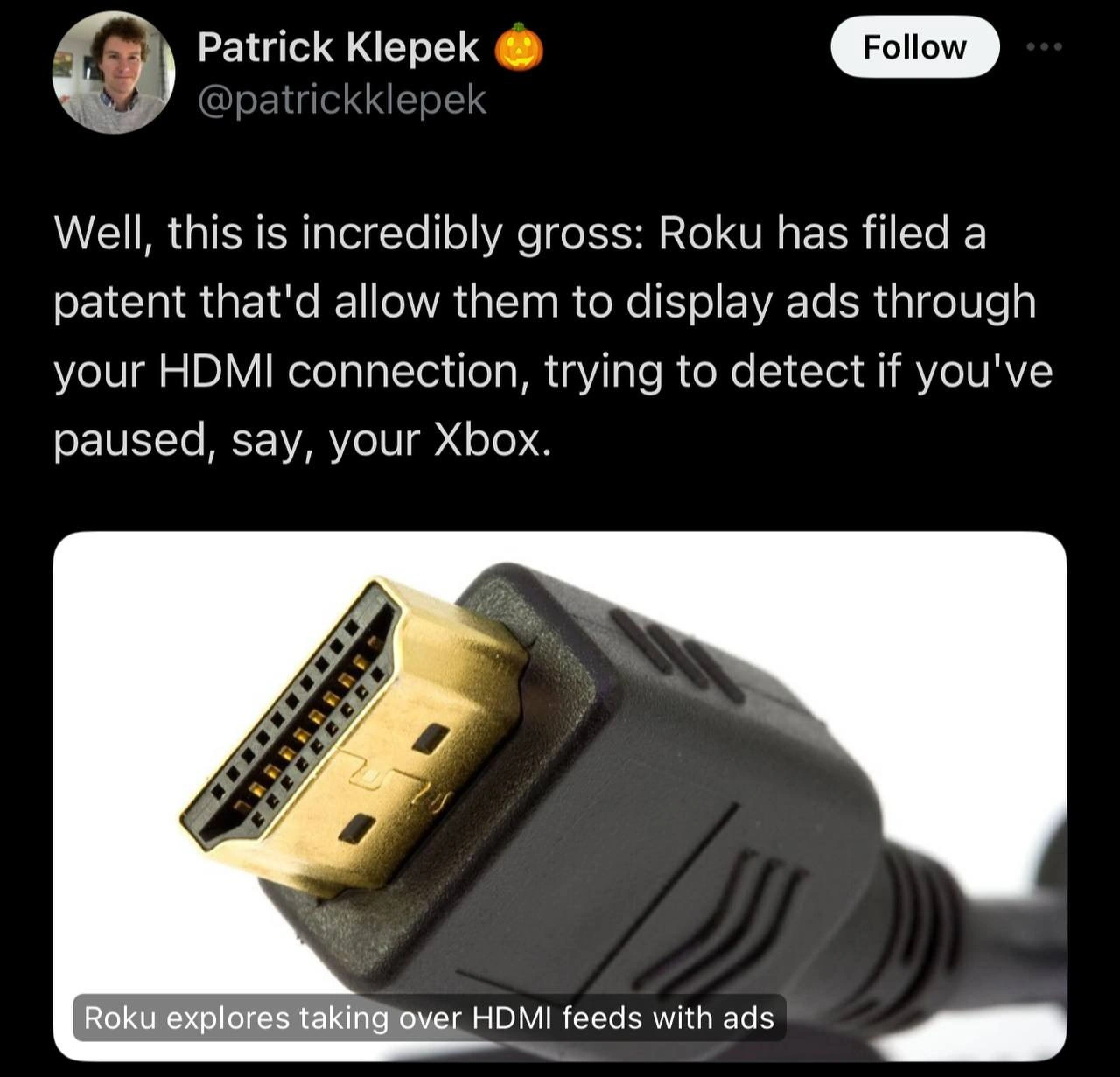
Tweet in the meme: “Well, this is incredibly gross: Roku has filed a patent that'd allow them to display ads through your HDMI connection, trying to detect if you've paused, say, your Xbox.” – Patrick Klepek@patrickklepek

To summarize the absurdity from the seasoned dev POV, consider this comparison:

What We Expect Normally What Roku’s Patent Proposes How It Feels
Hitting pause on a game simply freezes the action on screen, nothing more. Hitting pause would trigger the TV/device to overlay a targeted ad on your screen. Like a pop-up ad jumped out the moment you took a break – unwelcome and annoying.
An HDMI connection just transmits exactly what the source device outputs, no alterations. The HDMI connection is monitored and intercepted by the TV’s system to insert extra content (ads) into the feed. Your HDMI cable turns into a billboard conduit, which feels almost like a prank on the user.
Devices (console and TV) respect user actions and stay in their lane (console does games, TV just displays). The TV doesn’t stay in its lane – it uses your pause action as a signal to do its own marketing thing. A violation of user trust, as if your own gadget is eavesdropping and taking advantage of you.
Privacy: when you pause, it’s an offline action – no one else knows or cares. Privacy: the TV is actively analyzing your usage (detecting that pause) and possibly phoning home data about it to ad servers. Feels like being watched even when you’re just chilling – a creepiness factor added to a normal pause.

Level 4: HDMI Handshake Hijack

At the hardware signal level, Roku’s patent envisions a form of man-in-the-middle interception on an HDMI connection. Normally, when you plug your Xbox into a TV via HDMI, there's a secure handshake: the devices negotiate formats, and if HDCP (High-bandwidth Digital Content Protection) is in play, they also exchange encryption keys. This creates a trusted link so that high-quality video (and protected content) can flow from your console to your screen without eavesdropping or tampering. What Roku proposes effectively breaks with convention — the Roku device (or Roku-powered TV) would insert itself into this trust chain on purpose.

To pull this off, the Roku hardware must monitor the HDMI data stream in real-time, detecting patterns that indicate a "pause" state. Perhaps the video frames stop changing (a static image or a game’s pause menu appears) or maybe a CEC (Consumer Electronics Control) signal hints that playback was halted. Once a pause is detected, the device would overlay new content (an advertisement) into the HDMI output. Under the hood, this means the device’s video pipeline has to buffer or redirect frames — essentially splicing in ad frames or an ad video stream over the incoming source. In technical terms, the Roku box/TV becomes a frame compositor, mixing the original HDMI feed with its own injected imagery. It’s as if the HDMI cable suddenly had a secondary feed OR the TV’s firmware decides to ignore the incoming frames for a moment and show something else.

This raises low-level engineering challenges. Timing is critical in HDMI streams; inserting an ad frame means careful synchronization so the display doesn’t blank out or throw an error. If the ad content’s resolution, color space, or HDR metadata differ from the game’s, the device might even need to perform on-the-fly scaling and color conversion to avoid a visible glitch. There’s also the question of HDCP: a Roku TV is an authorized HDCP sink (it can decrypt protected video from, say, a Blu-ray or Netflix on Xbox), but once decrypted internally, adding an overlay technically produces a new stream. Normally, re-encrypting would be required if that combined stream left the device, but since it’s the TV panel itself showing it, Roku may be skirting the edge of content protection rules. It’s a bit of a cryptographic tightrope – the system mustn’t trip the alarms that normally prevent unauthorized video output. Essentially, Roku’s patent is asserting: “Because we control the endpoint (the TV or intermediary box), we can play puppet-master with the HDMI input.” It’s a bold architectural stunt, turning a one-way trusted pipe into a two-way ad delivery channel.

From a theoretical standpoint, this idea repurposes concepts usually seen in secure network interception appliances or DVR boxes, and applies them to consumer hardware in real-time. It’s like a mini MITM attack (man-in-the-middle) but one the owner’s device itself performs under corporate orders. In security textbooks, the mantra is to prevent MITM for integrity – here the manufacturer is deliberately becoming one. The fundamental design of HDMI assumed the display would be a passive endpoint (show whatever the source sends, and nothing more). Roku is essentially patenting a method to violate that assumption in a controlled way. This leads to signal integrity questions: will the additional processing introduce latency or artifacts? Could it fail open/closed such that a paused screen sometimes doesn’t resume properly because the ad takeover glitched? Seasoned engineers know that fiddling with an HDMI handshake or stream can be like removing a Jenga block from the bottom of a tower – one wrong move and you get a no signal error or an HDCP compliance complaint. The absurdity here is that all this complex synchronization and potential fragility is being introduced not to improve the user’s experience quality or security, but to inject an advertisement. It’s a near hardware-level hack repurposed for adtech. No wonder the idea triggers geek alarm bells: it treats a digital AV standard–designed for fidelity and copy protection–as a canvas for SurveillanceCapitalism style shenanigans. The creeping scope of adtech has now reached the literal wires and protocols that were once considered untouchable neutral ground.

Description

This image is a screenshot of a tweet from user Patrick Klepek (@patrickklepek) discussing a controversial Roku patent. The tweet, on a black background, reads: 'Well, this is incredibly gross: Roku has filed a patent that'd allow them to display ads through your HDMI connection, trying to detect if you've paused, say, your Xbox.' Below the text is a high-resolution, close-up photograph of a gold-plated HDMI cable connector on a white background. A banner at the bottom of this image reads, 'Roku explores taking over HDMI feeds with ads.' The meme highlights a significant and concerning trend in tech where companies seek to monetize user experiences in increasingly invasive ways. For experienced engineers, this isn't just about another ad; it's about a fundamental violation of hardware and protocol boundaries. The idea of one device manipulating the signal of another, unrelated device via a standard like HDMI represents a major overreach with potential implications for security, interoperability, and user trust

Comments

26
Anonymous ★ Top Pick I'm looking forward to the bug where the ad injection fails, corrupts the EDID handshake, and bricks my monitor. That's the kind of disruptive innovation I expect from the smart TV industry
  1. Anonymous ★ Top Pick

    I'm looking forward to the bug where the ad injection fails, corrupts the EDID handshake, and bricks my monitor. That's the kind of disruptive innovation I expect from the smart TV industry

  2. Anonymous

    HDMI might soon stand for “Here’s Dreadful Marketing Interstitials” - finally, a man-in-the-middle attack you have to pay for

  3. Anonymous

    Remember when we thought the worst thing about HDMI was handshake failures? Now we're debugging ad injection at the physical layer. Next they'll be patenting a way to show ads in our git commit messages when we pause to think

  4. Anonymous

    Ah yes, the logical next step in the enshittification pipeline: not content with owning the OS, the app, or the content - now they want to own the *cable*. Can't wait for the inevitable CVE when someone discovers Roku's HDMI man-in-the-middle can be exploited to inject arbitrary frames. At least when we warned about 'smart' devices becoming attack vectors, we didn't expect them to patent the attack surface first. This is what happens when product managers discover HDMI-CEC exists and think 'but what if we made it worse?'

  5. Anonymous

    CAP theorem for living‑room platforms: you can’t have privacy, pass‑through integrity, and ad revenue - pick two; Roku clearly optimized for availability of ads when you hit pause

  6. Anonymous

    When adtech starts negotiating the HDMI handshake, CEC becomes Corporate Enforced Commerce - overlayAds() on pause, and the only standards‑compliant opt‑out is unplug()

  7. Anonymous

    Roku's HDMI patent: the hardware MITM attack where your Xbox pause becomes their ad endpoint

  8. @ZgGPuo8dZef58K6hxxGVj3Z2 2y

    This is a bit late news

  9. @reglnk 2y

    c'mon google already added an ads module to Android Open Source Project

    1. Kademlia 2y

      But discontinued a proper SMS and music player app

      1. @Agent1378 2y

        Use samsung there it all persists

        1. Kademlia 2y

          That's not part of AOSP

          1. @Agent1378 2y

            Well, if its open source then just write your own. Otherwise f** aosp

            1. Deleted Account 2y

              Lineage OS team has made their versions of those apps that follow material you 3 UI & theming, work reliably etc. If you need smth like this they're really good

              1. @Agent1378 2y

                Thanks I use samsung and am very happy

      2. @Araalith 2y

        The proper sms app is TrueCaller.

  10. @GLXBX 2y

    Tf is Roku?

    1. @leklaanc 2y

      Same question

    2. Kademlia 2y

      A set-top box like Apple TV or Kodi

  11. @Agent1378 2y

    Mostly, yes, but also mostly better than other androids (not considering prices)

  12. @Agent1378 2y

    As new as iphone 4 antenna problems "you are holding it wrong"

  13. @Agent1378 2y

    Same😄

  14. @qwnick 2y

    I am not sure that is possible tho. Pause screens are very different, I think only way to do it is for game to notify Xbox system and Xbox system notify HDMI hardware with a specific event.

    1. @theodolu 2y

      HDMI already has pirate recognition system

  15. @theodolu 2y

    Display port it is

    1. @ZgGPuo8dZef58K6hxxGVj3Z2 2y

      Yeah objectively better. Free, and its everywhere. Your laptops display is most likely eDP too

Use J and K for navigation