Skip to content
DevMeme
3126 of 7435
Code Simplicity vs. The Over-Engineered Masterpiece
CodeQuality Post #3445, on Jul 21, 2021 in TG

Code Simplicity vs. The Over-Engineered Masterpiece

Why is this CodeQuality meme funny?

Level 1: Fancy Math for a Simple Task

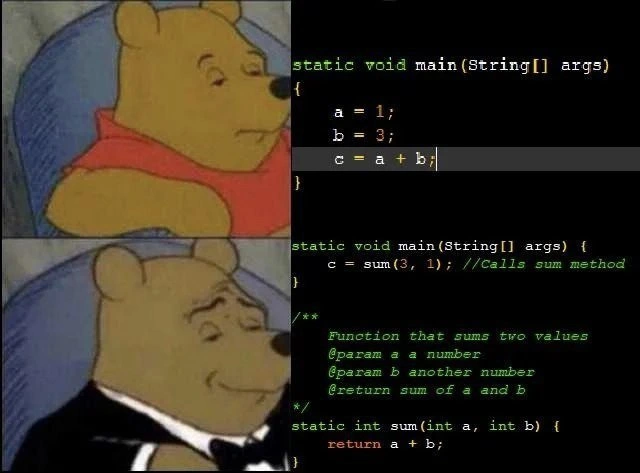
Imagine you ask two people to add 1 + 3. The first person just thinks for a second and says, “It’s 4.” Quick and simple, right? Now, the second person decides to be extra fancy. They put on a tuxedo and a monocle (like they’re going to a royal ball!), clear their throat, and announce: “Let us define a method of addition. Given two numbers, one shall compute their sum. For example, summing 3 and 1 yields the result 4.” They even hand you a little written note explaining each step of adding the numbers. 🤵‍♂️ It’s the same answer in the end (it’s still 4!), but the way they did it is super formal and detailed. This meme is funny because it’s comparing these two styles of answering the very simple question “what’s 1 + 3?”. The first style is plain and no-nonsense, and the second style is over-the-top fancy. It’s like doing a normal everyday thing versus doing that thing with a lot of unnecessary ceremony. We laugh because sometimes, especially in coding, we take a simple task and dress it up in a suit and tie just to feel like we’re doing it the “proper” way.

Level 2: Messy vs Classy Code

For someone new to programming, this meme highlights a basic lesson: organizing and explaining your code makes a difference! In the top half, the code is written all in one place (inside main). It does the job — it sets a = 1, b = 3, then calculates c = a + b. But that’s it: no explanation of what these numbers are for, no separation of ideas. It’s like writing a quick solution without any comments or structure. This is the “quick and dirty” approach – quick to write, but not very descriptive. If you’re a beginner, you might have written code like this in early exercises, where everything sits in the main method or one big function. It works, but if someone else (or you, a week later) reads it, they might have to guess what the purpose of those 1 and 3 is. Why 1? Why 3? Are they important values for something? When code has literal numbers like this scattered around, developers call them magic numbers – because their purpose is mysterious (like magic) unless you add some explanation.

Now look at the bottom half of the meme. Here, the code is refactored – meaning it’s reorganized without changing what it actually does. Instead of doing a + b directly in main, they’ve created a new function called sum. The main method now looks cleaner: it just calls c = sum(3, 1). All the details of how the addition is done are tucked away in the sum function. This is called method extraction: pulling out a piece of code into its own function. Why do this? There are several benefits a newer developer can appreciate:

  • Readability: sum(3, 1) is short and sweet. Anyone reading main can understand that c is getting the sum of 3 and 1, without immediately seeing the arithmetic. It’s like giving a short name to a concept.
  • Reusability: If you needed to add numbers in multiple places, having a sum(a, b) function means you don’t have to write a + b each time (avoiding repetition). You’d just call sum() wherever needed. In our simple example it might not matter, but imagine a bigger program – using a function prevents errors (you implement the logic once) and makes future changes easier.
  • Organization: It separates the what from the how. The main method’s job could be just orchestrating high-level steps (“calculate something, then print it” for instance), and the details of how to calculate are handled by helper functions like sum. This follows a core Clean Code principle: each function should have one job or responsibility. Here, main’s job is clearer after refactoring (maybe to coordinate the program flow), and sum’s single job is to add two numbers.

Another big change is the documentation comment above the sum function. In the meme’s refined code, you see a block starting with /** and lines like @param and @return. This is a Javadoc comment, a special way Java developers write explanations for classes and methods. The comment literally explains: this function sums two values, it has two parameters (a and b), and it returns the sum of a and b. Javadoc comments serve two purposes: they help someone reading the code understand it, and they can be used to generate HTML documentation pages for the code automatically. For a beginner, it might seem funny to explain something so obvious – “return sum of a and b” sounds like restating the code return a + b. But the idea is to demonstrate good habits: always document what your code is supposed to do. In larger programs, the logic won’t always be as straightforward as a + b, so getting used to writing clear comments is valuable. It’s like writing a short note for anyone who might use or change your sum function later, telling them exactly what to expect. And in many team environments, there’s an unwritten rule (or even a strict policy) that every function should have a comment explaining its purpose. That’s why the meme’s author added the comment – to show an idealized version of clean, well-documented code.

This side-by-side comparison is very relatable to developers learning about CodeQuality. When you first start coding, you might cram everything into one place (like that top panel code in main). But as you learn from mentors or through CodeReview feedback, you start to break your code into smaller pieces (functions) and write Documentation for others to follow. The top is essentially a novice’s approach (“I just need it to work”), and the bottom is closer to a professional approach (“Others will read this, so let’s make it clear and modular”). The humor is that here the professional approach is applied to the simplest problem possible. It’s the kind of thing you see in tutorials or college assignments about clean coding: take even a trivial snippet and improve its structure. If you’ve ever had a teacher or senior developer look at your code, you might have heard things like, “Give this calculation its own function” or “Please comment this code so people know what it does.” That’s exactly what’s happening between the two panels. The Pooh meme format makes it fun by showing the unimpressed face for the quick hack, and the classy satisfied face for the polished version. In short, the image jokingly teaches that writing code isn’t just about making the computer do math – it’s also about writing it in a neat, understandable way (and feeling a bit proud about it, too!).

Level 3: Refactoring Royalty

In this meme, Winnie-the-Pooh transforms from a plain red-shirted bear (looking unimpressed at sloppy code) into a monocle-wearing aristocrat (smugly pleased with refined code). It’s using the popular tuxedo_pooh format to contrast two coding styles in Java: a quick-and-dirty inline addition versus an elegant, well-documented helper method. The top panel’s static void main(String[] args) contains a brute-force snippet:

a = 1;  
b = 3;  
c = a + b;

Pooh’s bored face says it all – this is functional but hardly inspiring. There’s no explanation of what’s happening or why. The bottom panel, however, shows Pooh in a tuxedo delighted by a cleaned-up version:

c = sum(3, 1); // Calls sum method

with a proper Javadoc comment and a separate sum function:

/**  
 * Function that sums two values  
 * @param a number  
 * @param b another number  
 * @return sum of a and b  
 */  
static int sum(int a, int b) {  
    return a + b;  
}

This refactored approach follows revered CleanCodePrinciples – even for something as trivial as adding two numbers, it introduces a layer of abstraction (the sum method) and documentation for clarity. The humor here is that we’ve taken a simple operation and treated it with almost ceremonial importance. Seasoned developers recognize this pattern from countless CodeReviews: a reviewer might say, “Hey, instead of doing arithmetic inline, why not extract a method and comment it?” – a common refactor_example. The meme cranks that scenario up to 11 by putting our friendly bear in formal attire, implying that truly sophisticated code is achieved by such meticulous cleanup.

On a serious note, experienced devs know that breaking down code into well-named functions improves CodeQuality. A method like sum(int a, int b) might seem overkill for a + b, but imagine if that operation were more complex or reused – having a dedicated function makes the code more readable and maintainable. Each function serves a single purpose (hello, Single Responsibility Principle!), which means fewer mistakes and easier testing. Even here, the separate sum function signals, “This operation is defined once and can be reused,” avoiding duplication. We also get to label the action (“sum” is a pretty clear name), so any future reader immediately grasps what c = sum(3, 1) means, rather than parsing c = a + b and checking where a and b came from. CodeQuality isn’t just about making things work – it’s about making code understandable. And nothing says “I care about understanding” like writing an explicit function with a full documentation block for something your junior self might have scribbled in one line.

The inclusion of the Javadoc-style comment is an extra wink to those of us who’ve dealt with rigorous documentation standards. In Java, a comment starting with /** ... */ can be used to auto-generate documentation pages. Here it meticulously spells out that our sum function returns the sum of a and b. For a seasoned programmer, this comment borders on comical because the code return a + b; is self-explanatory. Yet, many of us have encountered coding standards requiring documentation for every public method, even ones as obvious as this. By showing Pooh relishing that comment, the meme pokes fun at our obsessive tendencies to comment everything. It’s a nod to the culture of Documentation: sure, it might be redundant for sum today, but in complex modules, these comments are lifesavers for the next developer (or your future forgetful self). Seasoned devs chuckle because they’ve written or reviewed comments that essentially describe that 2 + 2 = 4, feeling both silly and virtuous at the same time.

Another subtle aspect is the elimination of so-called magic_numbers. In the first snippet, 1 and 3 appear out of thin air – any reader wonders, why 1 and 3? Are they important? In the refined version, although they still appear as literals in the function call sum(3, 1), the act of calling sum at least frames them: we know these are two values being added. Ideally, in production code, we’d go further and give those numbers meaningful names or constants. But the meme sticks to focusing on method extraction and docs. The java_method_extraction here is straightforward: the arithmetic a + b in main got pulled out into its own sum function. This is literally the simplest form of refactoring – often taught in programming courses or mentoring sessions as a way to make code cleaner. It’s something senior developers do almost reflexively when a piece of code can stand on its own or might be reused.

What really makes experienced devs grin is how over-the-top the bottom panel feels for such a basic task. It’s as if a coworker took your 3-line quick fix and came back wearing a tuxedo, saying “Allow me to introduce our new well-documented utility function!” It reflects real-world scenarios in a funhouse mirror: think of those times you submit a simple patch and a meticulous colleague insists on polishing it to perfection. We laugh because we’ve been that colleague and the one scratching our head at the fuss. The bottom line: the meme perfectly satirizes the ethos of clean coding. It suggests that writing clear, documented code – even for adding 1 + 3 – is the hallmark of a true code aristocrat. And honestly, once you’ve spent a few 2 A.M. debugging sessions trying to decipher somebody’s messy logic, a tiny, neatly documented sum() method does feel like a royal treat. CleanCodePrinciples and thorough documentation might be tedious at times, but they pay off by making codebases civil and civilized – much like Pooh donning a tux, it classes things up in the realm of software.

Description

A two-panel meme using the 'Tuxedo Winnie the Pooh' format to contrast different coding styles. In the top panel, the standard Winnie the Pooh looks on with a simple expression next to a snippet of Java-like code within a `main` function that directly calculates `c = a + b`. This represents a straightforward, procedural approach. In the bottom panel, a sophisticated Winnie the Pooh in a tuxedo smirks approvingly next to a more 'correct' version of the code. Here, the `main` function calls a separate, dedicated `sum(3, 1)` method. Below, the `sum` method is meticulously documented with Javadoc-style comments explaining its purpose, parameters, and return value, before finally executing `return a + b;`. The meme satirizes the concept of 'clean code' by showing how applying principles like abstraction and documentation to a trivial operation can result in comical over-engineering. Experienced developers find this funny because it highlights the tendency, especially among those rigidly following textbook rules, to overcomplicate simple solutions in the name of 'best practices'
Comments

31
Anonymous ★ Top Pick That 'sum' function is just one JIRA ticket away from becoming a generic `ArithmeticStrategy` passed via a `NumericProcessorFactory` singleton
  1. Anonymous ★ Top Pick

    That 'sum' function is just one JIRA ticket away from becoming a generic `ArithmeticStrategy` passed via a `NumericProcessorFactory` singleton

  2. Anonymous

    Inline a + b is fine… right up until finance wants currency conversion, audit wants trace IDs, and legal wants 128-bit overflow checks - Tuxedo Pooh just pre-paid the abstraction tax

  3. Anonymous

    Ah yes, the classic 'AbstractSingletonProxyFactoryBean' approach to addition - because why write 'a + b' when you can create a fully documented, unit-tested, SOLID-compliant arithmetic microservice with OpenAPI specs, Kubernetes deployment manifests, and a 47-page architectural decision record explaining why addition deserves its own bounded context?

  4. Anonymous

    Ah yes, the classic 'sum' method - because directly adding two numbers is far too pedestrian for a *professional* codebase. Why write 'a + b' when you can craft a beautifully documented, statically-typed abstraction that future archaeologists will marvel at? Nothing says 'I've read Clean Code' quite like wrapping the '+' operator in a method signature. Next sprint: extract 'sum' into an interface, add a factory, and implement the Strategy pattern. The business logic of '1 + 3 = 4' demands nothing less than enterprise-grade architecture

  5. Anonymous

    Junior refactor special: swapped scope soup for arity fondue, now with interpretive Javadoc dance

  6. Anonymous

    In enterprise Java, '+' is a leaky abstraction - wrap it in SumService so Product can feature-flag math, Finance can swap in BigDecimal, Legal can audit it, and SRE gets a span for every addition

  7. Anonymous

    Classic enterprise refactor: inline a + b becomes SumService with Javadoc, ready for a strategy pattern behind a feature flag

  8. @LionElJonson 4y

    I dont know where the joke is, thats just how normal person would write a code

  9. @ZgGPuo8dZef58K6hxxGVj3Z2 4y

    Perfectly needed comments

  10. @neopulsar 4y

    Why the fuck you need whole function for sum two fucking numbers?

    1. @mmddvg 4y

      to not to repeat the "+" operator each time you wanna add two numbers

      1. @neopulsar 4y

        But it cost more time to calculate more time to compile and more symbols to type it's fucking pointless . I hope it's only for meme purposes 🤣

        1. @sylfn 4y

          is there inline in java?

          1. @feskow 4y

            C# > Java Because operator overload

    2. @sylfn 4y

      you can just use 2-dimensional array for doing that

    3. @misesOnWheels 4y

      BiFunction

      1. @feskow 4y

        Ohhhh, that meme makes sense now

      2. Денис 4y

        Autowired with spring BiFunction

      3. Deleted Account 4y

        BinaryOperator for better type safety and foolproofing (you don't want to have sum that adds String and Person)

    4. @p4vook 4y

      Because + is a fucking function

      1. Deleted Account 4y

        it is not in most langs, try to pass + to a hof, you can't

        1. Deleted Account 4y

          unless you use haskell or some other lang which actually supports it

  11. @okutaner 4y

    Need unit tests

    1. @neopulsar 4y

      PM says we spend to much time on CR and Unit Tests so we dropped it:D

      1. @sylfn 4y

        then they will say that you spend too much time on coding

        1. @neopulsar 4y

          This is the agenda for next meeting you know

          1. @RiedleroD 4y

            their motto: less coding, more code

        2. @RiedleroD 4y

          …probably in the daily 3hr meeting

  12. @thisisluxion 4y

    this is me flexing my skills to my friends

  13. @anyo822 4y

    *elegancy*

  14. @clockware 4y

    It's time to recall it https://github.com/EnterpriseQualityCoding/FizzBuzzEnterpriseEdition

Use J and K for navigation