The Absurdity of the 'Quick Call' Request
Why is this Meetings meme funny?
Level 1: No Time to Talk
Imagine your day is like a big puzzle, and every single puzzle piece is a task or a meeting you have to do. In the picture, the calendar is completely filled with colored blocks (those are meetings) with no gaps – just like a puzzle where every space is taken or a Tetris game where the blocks have stacked up perfectly with no empty rows. Now someone comes and says, “Hey, can we have a quick chat on the phone?” It’s funny because it’s so obviously impossible – there’s literally no free space left for even a tiny chat! It’s like your schedule is a glass jar that’s been filled to the top with rocks and someone is trying to put one more rock in – it just won’t fit. Or imagine you have school classes and activities every hour of the day, and then a friend asks, “Can you hang out real quick?” You’d probably laugh and show them your back-to-back classes saying, “I have no free time at all!” This meme is making a joke out of that feeling. The person’s calendar is completely full, so the idea of a “quick call” is silly. It captures the frustration in a playful way: sometimes grown-ups (like software developers) have so many meetings that they literally have no time left to do their actual work – or to squeeze in even one more chat. The picture looking like a crazy Tetris game just emphasizes how busy and jam-packed their week is. So the big idea is simple: when you’re extremely busy, being asked to add one more thing (even a short call) is hilariously unrealistic.
Level 2: The Quick Call Paradox
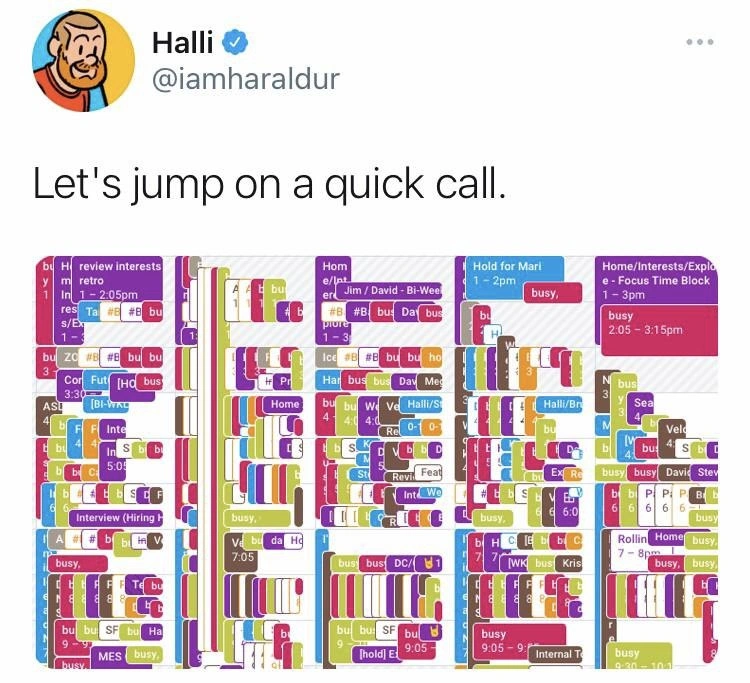
This meme shows a screenshot of a tweet from Halli (@iamharaldur) with the quote “Let’s jump on a quick call.” Right below that, you see an insanely crowded weekly calendar view, so full of colored rectangles that it truly looks like a Tetris game grid. Each rectangle is an event or meeting, and they’re all crammed edge-to-edge with virtually no empty space. The joke is that someone cheerfully suggesting a “quick call” clearly hasn’t looked at (or is choosing to ignore) how overbooked that calendar already is. In other words, there’s no quick anything when your schedule is this packed – finding 15 free minutes is like finding a needle in a haystack. This is the quick call paradox: those calls are supposed to be short and easy, but scheduling them becomes a complex puzzle.
To a newcomer in the tech world (or anyone new to office life), let’s break down what’s going on in that jam-packed calendar:
- Stand-up – A daily team meeting (often each morning) where every member quickly says what they did yesterday, what they’ll do today, and any blockers. It’s meant to be brief, typically 15 minutes, but when you have many of these “quick” meetings plus others, they add up fast.
- Sprint Retro (Retrospective) – A meeting at the end of a development cycle (sprint) where the team reflects on what went well or badly and how to improve next time. In the calendar it appears as “review interests retro...1–2:05pm”, implying it ran a bit over an hour. So even a meeting meant to improve process is taking a sizable chunk of time.
- Stakeholder Sync – A check-in meeting with stakeholders, who are people outside the immediate team that have interest in the project (like managers, clients, or other teams). It’s for aligning on progress and expectations. These are important but can be numerous. Each one is another colored block on that calendar (e.g. something like “Jim/David Bi-Weekly Sync” might be seen abbreviated).
- Interview (Hiring) – Many developers are also involved in interviewing job candidates. “Interview (Hiring)” in the calendar means the person is scheduled to conduct an interview. That’s an hour (or more) dedicated to evaluating a candidate rather than writing code. Necessary, but it’s yet another meeting competing for time.
- Focus Time – A block of time reserved by the developer for concentrated work (coding, debugging, designing) with no meetings. In the image we see something like “Home/Interests/Expl… – Focus Time Block 1–3pm” marked busy. This is essentially an attempt to carve out 2 hours of uninterrupted time. However, notice it shows “busy 2:05–3:15pm” overlapping – meaning even the focus block got partially eaten by another meeting. Ouch.
Each colored label corresponds to different calendars or categories. For example, one color might be all your team meetings, another for personal or “Home” calendar events, another for interviews, etc. The end result is a color-block calendar that’s visually chaotic. It’s a packed_calendar with overlapping meetings from 8 a.m. to late evening. The text is so tiny and truncated because there are so many events that the calendar app has shrunk them to fit on one screen. It literally looks like someone took Tetris blocks of various colors (the L-shapes, T-shapes, squares, etc.) and stacked them with no gaps. In Tetris, a perfect game fills every space; in a calendar, a completely filled week means you, the developer, have zero free time.
Now, when a colleague or manager says, “Let’s jump on a quick call,” they usually mean a short meeting, maybe 15 or 30 minutes, to discuss something that (supposedly) won’t take long. The humor here is that there is no 15-minute gap left for that call! It’s like someone trying to schedule an extra class for a student who already has classes every single period – there’s just no slot available unless you cancel or move something else. The meme exaggerates it to the point where even a quick call request becomes comically impossible. The calendar is overbooked and meeting-saturated – a phenomenon many office workers know too well.
This situation is extremely relatable humor in the tech community. Software engineers often complain that meetings cut into their “actual work” time. Every meeting has a cost: not only the time spent in the meeting, but also the time preparing for it and the time recovering from it. You can’t immediately snap back into writing complex code the second a Zoom call ends – you need to re-focus, recall where you left off. So if meetings are back-to-back, productivity suffers. New developers might not realize at first how much these little “quick calls” can derail an afternoon until they experience it. That’s why you’ll hear jokes like “This meeting could have been an email” – meaning the issue was minor enough to handle with a few written messages instead of a whole call. In a healthy MeetingCulture, people balance communication with alone-time to work. But in many companies (especially with heavy RemoteWork use of Zoom/MS Teams since 2020), the balance tips towards too many meetings. People start blocking “Focus Time” on their calendars defensively, as shown in the meme, just to signal “please don’t disturb me, I need to code.” Unfortunately, as we see, even that sometimes doesn’t stop another invite from landing smack in the middle of it.
In summary, the meme is highlighting a common junior-vs-senior tension too. Junior folks or non-engineers might innocently say “just a quick call” thinking it’s trivial, while senior engineers cringe because they know their schedule is a Jenga tower about to collapse. It teaches a subtle lesson: always check someone’s availability (or just send a message/email if possible) instead of assuming they can drop everything for a call. It’s a crash course in time management and respecting others’ time. The tweet format makes it funny and shareable – plenty of people will tag their coworkers joking “this is so us.” It’s both a laugh and a gentle nod toward a real productivity problem in modern workplaces. After seeing this, even a newcomer can understand why developers often appear grumpy about excessive meetings.
Level 3: One More Block Won't Hurt
Manager: "Let's jump on a quick call."
Developer: (glances at calendar Tetris) "Sure, I'll just schedule it between 11:59pm and midnight..."
In the realm of CorporateCulture, this meme hits on a painfully familiar scenario: the MeetingOverload that leaves no breathing room. The screenshot shows a kaleidoscope of overlapping meeting blocks, a calendar so saturated it resembles a wonky game of Tetris. Each colored rectangle is a meeting, and there’s virtually zero whitespace — as if someone played calendar Tetris and filled every last gap. The tweet’s punchline, “Let’s jump on a quick call,” is pure sarcasm, because any engineer looking at that packed schedule knows there’s nothing quick about finding an open slot.
This humor works on multiple levels for seasoned developers. It lampoons the MeetingCulture in many companies where an endless chain of stand-ups, planning sessions, status updates, and “quick syncs” devour the day. The overlapping blocks labeled things like “retro,” “interview (hiring),” or “Focus Time Block” hint at the absurd variety of commitments crammed in. Ironically, even Focus Time — the holy grail of uninterrupted coding — is marked “busy” and sliced apart, meaning someone double-booked a meeting right through the developer’s supposed do-not-disturb time. It’s a perfect illustration of communication overhead gone haywire.
Every experienced dev knows the DeveloperProductivity paradox here: you’re in meeting after meeting discussing work, but you get no time to actually do the work. It’s like a CPU spending all its cycles on context switching instead of executing actual processes. Each meeting is a context switch for your brain – you dump out the code you were holding in memory and load up a different context (“let’s talk hiring,” “let’s review Q3 goals”). Do that enough times back-to-back and your mental cache is thrashing. No wonder real deep work (the kind of focused coding that produces quality output) never happens when your day is split into 30-minute fragments. In software terms, your calendar is fully thread-blocked; every time slice is allocated, leaving no CPU time for user processes (coding tasks). And just like a server under too high a load, you start dropping productivity packets – maybe forgetting details from the 9 AM design review by the time you’re in the 3 PM client demo, because there’s been no downtime to consolidate memory.
Why is this so relatable and darkly funny? Because it’s true. The DeveloperFrustration is real: you see that one sliver of free time on Friday afternoon marked “Lunch” or “Focus” and you cling to it desperately – until someone pings, “Hey, saw a gap on your calendar, can we chat?” 😒 In many organizations, there’s an unwritten expectation to be constantly available. Especially with RemoteWork becoming the norm (as it was around 2020-2021 when back-to-back Zoom marathons became everyday life), every question, update, or brainstorming that might’ve been a hallway chat now manifests as a calendar invite. The result is a grotesque CommunicationOverhead: meetings about the project, meetings about those meetings, and meetings to plan more meetings. It’s an overload that eats into DeveloperProductivity like a memory leak gobbling up RAM.
Fixing this isn’t as simple as declining one invite. There are systemic reasons behind the madness. Companies preach focus time and work-life balance, but then the WorkplaceHumor of a schedule like this persists because no one wants to be “out of the loop.” Managers operate on a manager’s schedule (dividing their day into many small blocks), while developers need a maker’s schedule (few long uninterrupted blocks to code). When managers control the calendar, guess which schedule wins? It’s a cultural mismatch: managers feel a quick call is the fastest way to resolve something, while engineers dread the false start of a 15-minute chat that breaks an afternoon. Everyone’s incentivized to schedule yet another sync: to show progress, to get sign-offs, or because of FOMO on decisions. Declining meetings can be politically hard, especially if your boss is the one inviting. So the calendar keeps filling up like an overflowing Tetris stack, one block at a time, until it’s calendar chaos.
The meme’s visual exaggeration – a rainbow wall of meetings – resonates because it’s only a little bit exaggerated. Plenty of senior devs and tech leads have calendars that literally look like this screenshot. We’ve all seen that one engineer who’s double-booked in three places, perpetually saying, “sorry, I have to jump to another call.” 😩 The truth hiding under the humor is a serious time management problem. When every hour is a meeting, real work shifts to “after hours.” (Ever notice commits timestamped late at night? Now you know when the coding actually happened.) It’s a vicious cycle: the day is chopped up, so you work at night to compensate, leading to burnout – which ironically might lead to more meetings about burnout and productivity. Cue the dark laughter.
So, “One more block won’t hurt,” right? That’s the veteran sarcasm. In reality, that one extra meeting might be the piece that causes the whole stack to topple. In Tetris, when you complete a line it disappears, giving you breathing room. In calendar Tetris, completing a “line” of meetings just means you survived the day – and tomorrow’s stack of blocks is waiting. The only way to win is not to play, and yet here we are, color-coding our fate and hitting rotate on another meeting invite hoping it’ll somehow fit.
Description
A meme based on a tweet from Halli (@iamharaldur) that says, 'Let's jump on a quick call.' Below this text is an image of a digital calendar that is completely and chaotically filled with countless overlapping, multi-colored blocks representing meetings and events. The calendar is so fragmented and densely packed that it's impossible to find any free time, visually representing a state of being constantly busy and over-scheduled. The snippets of visible text on the calendar events include 'busy', 'retro', 'Interview', and 'Hold for Mari'. The joke stems from the ironic contrast between the casual, seemingly minor request for a 'quick call' and the visual proof that the person's schedule has no capacity for any interruptions. For experienced developers, this is highly relatable as it highlights the conflict between a meeting-heavy culture and the need for long, uninterrupted blocks of 'deep work' or 'flow state' to be productive in solving complex technical problems
Comments
7Comment deleted
That's not a calendar; it's a real-time visualization of a context-switching memory leak
My calendar already has more fragmentation than our microservices graph - add one more “quick call” and we’re basically introducing a cyclic dependency that blocks prod
After 15 years of optimizing distributed systems for microsecond latencies, I've discovered the true bottleneck in tech isn't network I/O or database locks - it's finding 30 minutes where two engineers' calendars align without triggering a cascade of rescheduled standups, architecture reviews, and that one PM's 'quick sync' that somehow requires three pre-meetings
When someone says 'let's jump on a quick call,' but your calendar looks like a failed game of Tetris where every piece is a meeting and the only line you can't clear is your actual work. This is the senior engineer's version of 'death by a thousand cuts' - except each cut is a 30-minute sync that could have been a Slack message. The real architectural challenge isn't designing distributed systems; it's finding a distributed 15-minute slot across four timezones where everyone isn't already in their seventh 'quick call' of the day
Calendar at 100% utilization, 0% productive throughput - the ultimate anti-pattern for deep work
My calendar is heap fragmentation; a 'quick call' is a stop-the-world GC that relocates focus time and leaks whatever attention was left
At org scale n, meetings grow O(n^2); my calendar is thrashing - your 'quick call' is basically a fork bomb