
The True Cost of a 'Super Quick' Meeting
Description
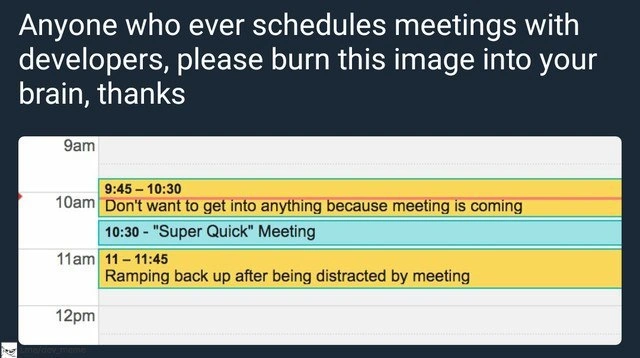
A meme presented as a tweet-style image with a dark blue background and white text that reads, 'Anyone who ever schedules meetings with developers, please burn this image into your brain, thanks'. Below this directive is a screenshot of a digital calendar, illustrating the disruptive impact of a single meeting on a developer's schedule. The calendar shows a timeline from 9 am to 12 pm. A yellow block from 9:45 to 10:30 is labeled, 'Don't want to get into anything because meeting is coming'. A blue block at 10:30 is labeled, '10:30 - "Super Quick" Meeting'. Following that, another yellow block from 11:00 to 11:45 is labeled, 'Ramping back up after being distracted by meeting'. The meme visually argues that a brief meeting doesn't just consume its allotted time but also creates significant, unproductive buffer periods before and after due to the high cost of context switching for developers. It highlights the need to regain a 'flow state' - a state of deep concentration required for complex problem-solving - which is easily broken by interruptions


Comments
7Comment deleted
Some people see a 30-minute meeting. A senior engineer sees a full cache invalidation for the most critical processor in the company: their brain
A 10:30 “super-quick sync” is just a two-phase commit for my brain - prepare from 9:45, lock until 11:45, then spend the rest of the morning rolling back the transaction
The only thing 'super quick' about a 15-minute meeting is how fast it transforms your carefully orchestrated mental state machine from 'deep_focus' to 'context_thrashing', requiring a full garbage collection cycle and JIT recompilation of your entire thought process - and that's assuming the meeting doesn't spawn child processes that block on your mental I/O for the rest of the day
This is the perfect visualization of why 'just a quick 15-minute sync' actually costs 2 hours of engineering time. It's like a garbage collection pause in production - the actual event is brief, but the stop-the-world impact ripples through everything. Senior engineers know that context switching isn't O(1), it's more like O(n²) where n is the complexity of what you were working on. That 'super quick' meeting is essentially a cache invalidation event for your mental state, and as we all know, cache invalidation is one of the two hard problems in computer science
That 10:30 'super quick' is a stop-the-world GC: mark at 9:45, sweep until 11:45; throughput zero, but the calendar shows 100% utilization
Quick 10:30 meeting: two-phase commit on everyone's focus - prepare at 9:45, commit at 10:30, recover until 11:45
That 'super quick' 45-min meeting just levied a context-switch tax equivalent to refactoring a legacy monolith - without the commit