The Fleeting Glory of a New Feature
Why is this SDLC meme funny?
Level 1: Sandcastle at High Tide
Imagine you spend all afternoon building a beautiful sandcastle at the beach. You’re really proud of it. But then, just as you put the flag on the top tower, a big wave comes in and whoosh! – your sandcastle is washed away. All that work disappears instantly. You’d probably feel upset or laugh in disbelief because it happened so fast. This meme is joking about that kind of situation, but for a programmer. The developer works hard to make a new feature (that’s like you building the sandcastle), and as soon as it’s done, they find out it’s going to be thrown out or isn’t needed anymore (that’s the wave knocking it down). It’s funny and a little painful at the same time, because it shows how quickly things can change. It’s that “Seriously? Already?” feeling. Everyone can understand the humor: it’s the “well, that was quick!” moment when something you just finished is suddenly gone.
Level 2: Feature Churn 101
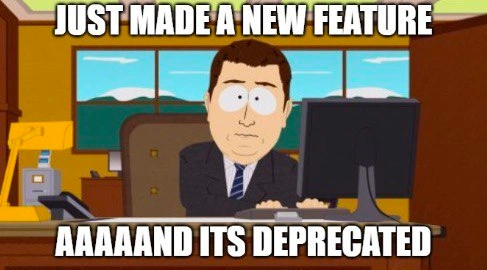
This image uses the famous South Park “Aaaand... it’s gone” meme format. In the picture, a cartoon businessman (from a South Park episode) is sitting at his desk with a computer, and in the original scene he tells a bank customer that their money vanished instantly. Here, the text has been changed to “JUST MADE A NEW FEATURE” at the top and “AAAAAND IT’S DEPRECATED” at the bottom. It’s portraying a developer who just finished adding a new feature to a codebase, and then immediately sees it flagged as deprecated – meaning it’s already marked to be phased out. The humor comes from that whiplash effect: “I just built this thing... and now we’re already saying not to use it?” It’s an exaggeration of how fast things can change in software development.
Let’s break down some terms and concepts from this meme in simpler language:
- Deprecated: In software, when something is deprecated, it means it’s officially discouraged from use and might be removed in the future. The feature still exists for now, but developers are warned, “don’t rely on this, it’s old or going away.” It’s basically a polite way for the project to say, “This is outdated; we have or will have a better option, so start moving off this.” In the meme, it’s funny because deprecation usually happens to old things, not something that was just created moments ago.
- Release cycle: This refers to how often new versions of a software are released. Some software has long release cycles (for example, a major release once a year), while others have rapid release cycles (updates every month, every week, or even daily in the case of continuous deployment). A fast release cycle means new features get delivered quickly – but it also means things change or get replaced quickly. In the meme’s spirit, a very short release cycle might result in a feature being introduced one day and slated for removal the next.
- Breaking change: A breaking change is an update that is not backward-compatible with older versions. In plain terms, it “breaks” something that used to work. For example, if Version 2.0 of a program removes or changes a function that was in Version 1.0, any code relying on that function will break until it’s updated. Developers generally dread breaking changes because it means extra work to adapt. The meme implies there’s a nonstop stream of breaking changes – as if every new release comes with something that invalidates what was done before.
- Technical debt: This is a metaphor programmers use to describe the consequences of shortcuts or quick-and-dirty solutions in code. Imagine you write code in a hurry to meet a deadline, skipping some best practices – that’s like taking on “debt.” It makes things faster now, but you’ll “pay” for it later when that code causes bugs or needs rework. Frequent deprecations and rushed replacements can create technical debt because old code might linger in the system or hacks are used to bridge new and old code. Over time, that debt builds up, and the codebase becomes harder to maintain (you start seeing messy parts that desperately need refactoring).
- Legacy code: Legacy code means old code that was written in the past and is still in use. It often carries the connotation of being outdated or inherited from someone else (and possibly not well-documented). Typically, code becomes “legacy” over years as technology or requirements move on. The joke in the meme is that a brand-new feature turned into legacy code almost immediately. One day it’s the cool new thing, and the next day it’s labeled “do not use, this is legacy.” That’s an extreme case of legacy designation!
- Overengineering: This means designing a solution that is far more complex than what’s actually needed. For example, imagine needing a simple bicycle but building a rocket ship instead – that’s overengineering. In software, teams sometimes implement very elaborate frameworks or features anticipating future needs that never happen. Such overengineered features often get thrown out or replaced when the team realizes a simpler approach would suffice. The meme’s scenario could happen when a team over-builds something and then quickly decides, “Hmm, this was too much; let’s deprecate it and simplify.”
- Software development life cycle (SDLC): This is the process of developing software from start to finish: planning, coding, testing, releasing, maintaining, and eventually retiring parts that are obsolete. Deprecation is actually a normal part of the SDLC – but it usually comes at the end, after a feature has lived a full life and a better alternative is available. The meme gets its punchline by skipping straight to that end-of-life step. It’s like if the entire life cycle of a feature (birth to retirement) happened in the blink of an eye. Normally you’d expect a new feature to stick around for a while, but here it’s born and then immediately sent off to retirement.
All these concepts tie into what’s happening in the meme: it’s about feature churn, meaning features are being added and removed in quick succession. If you’re a newer developer, you might have already felt a taste of this. For example, perhaps you learned a certain library or function when you started a project, and then a few months later a new version comes out that says, “Actually, don’t use that old method anymore; we have a new way now.” It’s a bit disheartening — one moment you’re proud that your code works, and the next moment you discover that approach is considered outdated. This meme blows that up to an extreme for comic effect: imagine working hard to finish a cool new feature, and literally the next day your team or the community says, “We’re deprecating that feature. It’s no longer the way to do it.” It captures a feeling of frustration and absurdity, but in a way that developers find hilarious because it rings true. Things move fast in tech, and sometimes it really does feel like you barely get to celebrate deploying something before you’re told to undo or redo it. The meme takes that feeling and makes it instant and over-the-top, which is why it gets a laugh.
Level 3: The Half-Life of Code
At the most technical level, this meme highlights the paradox of modern software development where a new feature’s life span can be fleetingly short. It's satirizing the phenomenon of extremely aggressive release cycles and continuous refactoring that lead to features being marked as “legacy” almost as soon as they land in production. In theory, a feature moves through the SDLC (Software Development Life Cycle) gradually and is only deprecated after a long period of use. But here the meme exaggerates that timeline to near-zero. It's a humorous nod to trends in our industry: frameworks pushing out breaking changes in rapid succession, product managers doing a 180° pivot right after deployment, or architects suddenly deciding that yesterday’s solution doesn’t fit today’s new paradigm. In other words, feature churn becomes the norm. Experienced engineers reading this likely recall shipping something only to see it deprecated in the very next release – you barely merge your code, and then you get an email announcement that “Oh, that feature? We’re removing it in vNext, sorry!”
Real-world scenarios abound: think of a library that rockets from version 1.0 to 3.0 in a year, with each major update deprecating or redesigning big chunks of the old API. Or internal projects where management demands “the latest tech” every few months, so the team constantly rewrites modules and immediately labels the last version as old news. Over time, this cycle generates tons of Technical Debt: quick changes leave behind half-removed code, compatibility shims, and documentation that’s instantly out of date. The codebase becomes a graveyard of features that had gloriously short lives. Each rushed replacement might solve one problem but often introduces two new ones – the classic whack-a-mole of software entropy (i.e. increasing disorder in the code). The result? The system’s Code Quality erodes as leftover deprecated bits and ad-hoc fixes pile up. We end up with methods still hanging around with comments like “// TODO: remove in next version” – and a dozen next versions later, they’re still there, haunting the code.
For comedic effect, we can express this absurd scenario in pseudo-code:
release_feature("CoolNewFeature") # 🚀 Feature shipped to production
deprecate_feature("CoolNewFeature") # 😢 Immediately flagged as deprecated
This is the programmer’s equivalent of a microlife: a feature goes from birth to end-of-life in two lines of code. The truth beneath the joke is that rapid versioning and nonstop breaking changes can make a developer’s head spin. One release you’re introducing AwesomeFeature(), and by the next release you’re slapping a @Deprecated tag on it and rushing to replace it with something “better.” It’s a tongue-in-cheek critique of how some teams or projects operate, where planning for deprecation almost seems like part of the design phase. The meme’s text “Finally shipped, instantly deprecated” could practically be the slogan of a project caught in this loop of overengineering and second-guessing.
This senior-perspective humor lands because it’s painfully relatable. It reveals the gap between how we want to develop software versus the chaotic reality. Ideally, we build stable features and support them for a long time. In reality, fast-moving projects (and occasionally fickle leadership decisions) can make our freshly released code feel ancient overnight. Seasoned devs laugh at this because they’ve been there: releasing a feature with pride on Friday, and by Monday hearing, “Yeah, we’re not going forward with that approach anymore.” It’s funny in a dark way — a coping mechanism for the whiplash of the eternal release-and-deprecate cycle. We chuckle and think, “Yep, story of my life… one day you’re the hot new thing, next day you’re legacy.” In the ever-evolving landscape of software, today’s shiny commit can indeed become tomorrow’s removal candidate, and that absurd reality is exactly what this meme pokes fun at.
Description
This meme uses the 'Aaaaand It's Gone' format from the animated series South Park. It features a male character in a suit sitting at an office desk with a computer, looking directly at the viewer with a neutral, slightly weary expression. The top text, in a white, all-caps font with a black outline, reads: 'JUST MADE A NEW FEATURE'. The bottom text, in the same font, reads: 'AAAAAND ITS DEPRECATED'. The scene is set in a typical office environment with a window showing a blue sky and mountains in the background. The humor stems from the frustratingly common experience in software development where a newly created feature becomes obsolete or is marked for deprecation almost immediately. This can happen due to rapidly changing business requirements, the release of a new framework version, or a sudden pivot in product strategy, making the developer's recent work feel instantly useless. It's a relatable scenario for senior engineers who have seen the fast-paced nature of the industry render their hard work irrelevant in a short amount of time
Comments
7Comment deleted
We have a new policy: all pull requests must now include their own deprecation plan. It saves time
Our SemVer policy is basically Schrödinger’s versioning - the feature is both 1.0 and deprecated until someone looks at it
The only thing that ages faster than our sprint velocity estimates is the React hook we just refactored everything to use
The modern software development lifecycle: Plan for 3 sprints, implement in 2, deprecate in 1, and spend the next 6 maintaining it anyway because three critical enterprise clients are still on that version and refuse to upgrade until their next fiscal year
New feature deployed at 10 AM; deprecated by 10:02 to avoid the next breaking change downstream
We adopted MAJOR-by-default semver: every feature ships with @Deprecated and a migration guide - the only stable interface is the deprecation notice
New KPI achieved: lead time to production in minutes, lead time to EOL in seconds - welcome to continuous deprecation