The Self-Inflicted Wound of Clever Variable Names
Why is this CodeQuality meme funny?
Level 1: The Mislabeled Cookie Jar
Think of it like this: you have a jar full of your favorite cookies, and a jar of boring broccoli. Now, as a joke, you label the cookie jar as “Broccoli” and the broccoli jar as “Cookies”. It’s super funny at the time because it’s like a prank name. But the next day, when you’re hungry for a cookie, you open the jar labeled “Cookies” (because of course you would — it says cookies!). To your surprise and confusion, that jar has only broccoli. Where did the cookies go?! For a moment, you panic or get puzzled, until you remember, “Oh, right… I mislabeled them as a joke.” Not so funny anymore, huh? You just tricked yourself and made finding your cookies a lot harder.
In this meme, the same kind of thing happens but with naming a variable in code. The developer gave a silly name to something important in the program (like mislabeling the cookie jar). It felt fun and harmless when they did it. But later on, when they try to find or use that thing, they’ve forgotten what the silly name meant (just like forgetting which jar actually had the cookies). The result? They feel confused and a little bit annoyed at their past self. The joke they made earlier turned into their own problem to solve. That’s why it’s funny — it’s a “joke’s on you” moment. The meme is basically saying: having fun with names today can become a mystery you have to solve tomorrow. Just like our mislabeled jar, it’s better to label things for what they really are, so you don’t lose your cookies (or your code’s meaning) when you need them!
Level 2: Naming Things 101
Let’s break down why this meme is funny and insightful for anyone learning about coding. In programming, a variable is just a container that holds some data – like a box with a label on it. The label is the variable’s name, and it should ideally tell you what’s inside the box. For example, if we have a variable that counts users in a chat room, a clear name would be usersCount or numberOfUsers. That way, whenever we see that name in code, we instantly know what it refers to. That’s called code readability or CodeQuality: how easily humans can read and understand the code.
Now, what happens if instead of a clear name, we use something funny or random? Imagine naming that user count variable LOL as a joke (commonly “LOL” means “laugh out loud,” but maybe here we think of it as short for “List Of Logins” – not obvious at all). It might give us a chuckle when writing it. But later on, when we or a teammate see:
let LOL = getActiveUsers();
// ... a day later
console.log(LOL.length); // Debugging: What was LOL? A list of what? Why is this funny name here?
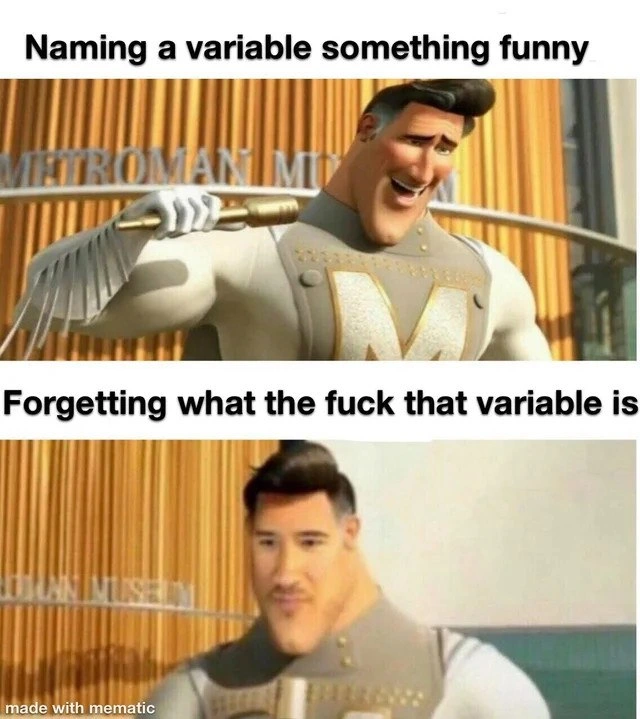
We’re left scratching our heads. Is LOL a list of something? Is it even a list/array or just a single value? The name doesn’t help us at all. This is exactly what the meme shows. In the top panel, the developer (represented by the cartoon hero Metroman) is excited and proud after naming a variable something amusing. In the bottom panel, the same developer looks confused and defeated because now they’ve forgotten what that oddly-named variable was supposed to do. The text “Forgetting what the f**k that variable is” is a very raw way of saying, “I have no clue what this name means anymore.” That’s a developer utterly stuck because of their own poor naming choice.
Why does this happen? Because naming things in code is actually pretty hard! It’s so well-known that there’s a joke saying: “There are only two hard problems in Computer Science: cache invalidation and naming things.” We use names everywhere in code (for variables, functions, files, etc.), and a bad name is like a bad clue in a mystery – it leads you the wrong way or leaves you with no idea what’s going on. A funny_variable_name might make sense only in the moment or only to the person who wrote it. Come “tomorrow” (literally the next day, or any later time), even that same person can experience a memory lapse in code understanding. Everyday life or working on other tasks causes you to forget the little joke or thought process you had when you wrote it. To another programmer (or your future self), the code reads like a riddle. That’s bad for Debugging_Troubleshooting because when there’s a bug (an error) and you need to fix it, you want the code to be straightforward. If you have to stop and decode what your own variable names mean, it’s like trying to solve a puzzle and fix a problem at the same time – frustrating and slow!
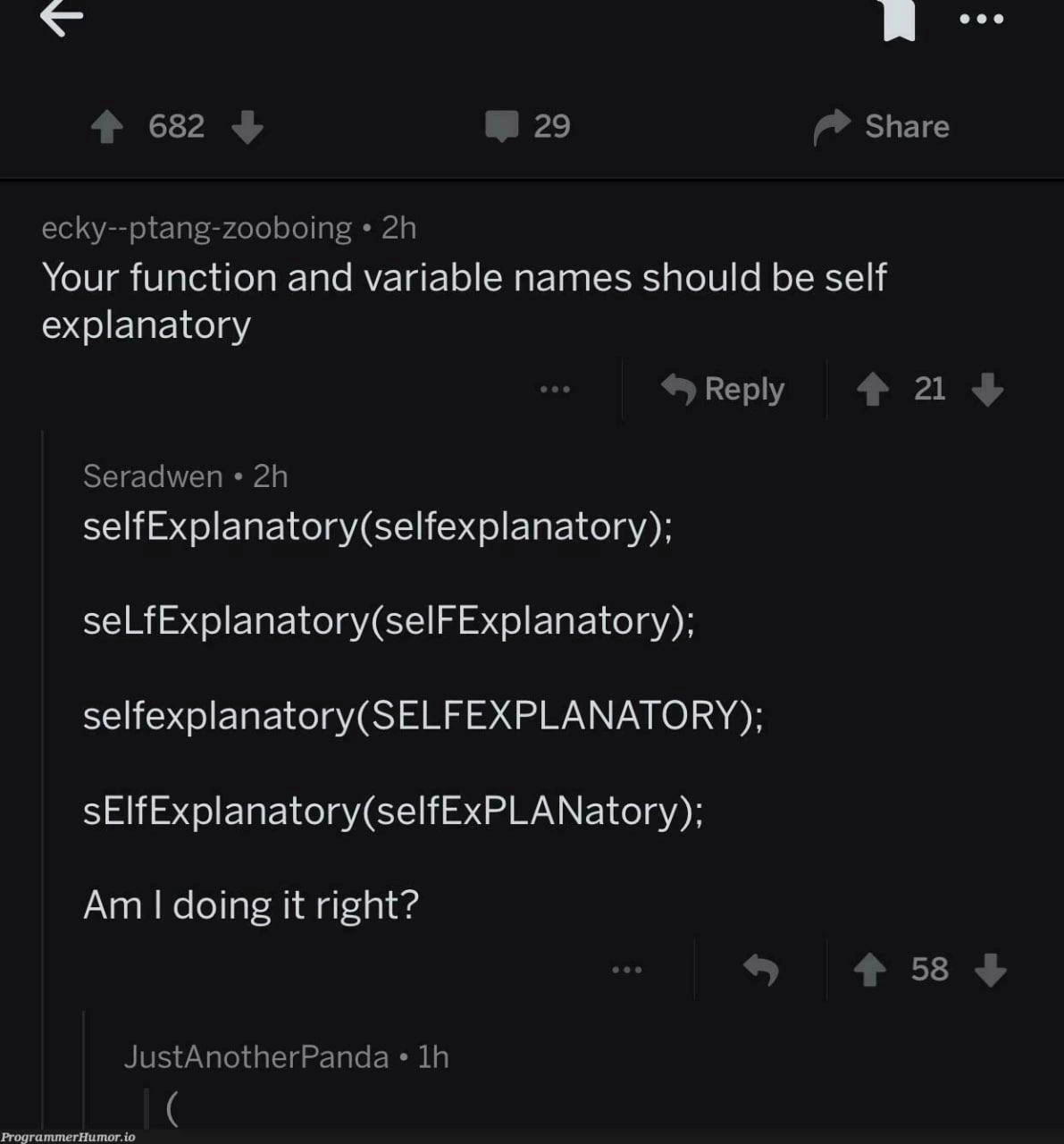
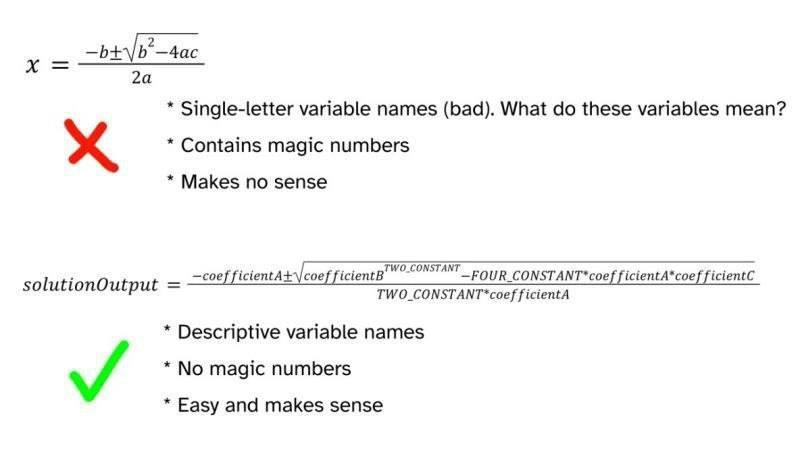
Good naming is part of what we call Clean Code Principles – a set of guidelines to write code that is easy to understand and maintain. One principle is “self-documenting code”. That means the code is written so clearly that it mostly documents itself without needing a lot of extra comments. Using descriptive variable names is a big part of that. For instance, instead of something goofy like x or doStuff, you’d name variables and functions for their purpose: customerList, totalPrice, fetchUserData(), etc. When another developer (or you in the future) reads that, it’s obvious what it might be. On the other hand, if you name a variable pumpkinSpiceLatte just because you were in an autumn mood, someone reading your code might spend a half hour searching the codebase to figure out what that variable really holds. That’s why this meme hits home for a lot of developers – it playfully exaggerates a real lesson: don’t sacrifice clarity for humor or cuteness in code. We’ve all felt that pinch of embarrassment or regret when a teammate points at variableNameLOL in a code review and asks, “Uh, what is this supposed to be?” and we realize the joke didn’t land when it comes to maintainable code.
The two-panel format of the meme itself is a mini story: Panel 1 shows the initial action – naming a variable something funny. The developer (Metroman from the Megamind animated film) looks thrilled and is showing off, which is exactly how it feels when you think you’ve come up with a clever code joke. Panel 2 is the consequence – forgetting what that variable actually is. Now Metroman looks blank and a bit embarrassed, similar to how a developer feels when their own code confuses them later. The contrast is the joke: yesterday’s “hero” dev who was smug about the hilarious name is today’s confused bug-fixer who regrets that decision.
For a junior developer or someone just starting out, the takeaway is clear. VariableNaming matters. It’s tempting (and frankly pretty easy) to slap in a funny or quick name when you’re focusing on getting something to work. But that small decision can snowball into a self_inflicted_bug or at least a headache down the line. Part of becoming a better programmer is learning from these moments. Yes, this meme is a joke, but inside the humor is real advice: choose clear, meaningful names for your variables and functions. Your future self (and your teammates) will thank you, and you’ll spend more time building cool things instead of deciphering what you meant by dataThingy007 or harryPotter in your code.
Level 3: Self-Inflicted Obfuscation
In this meme, a confident developer proudly gives a variable a funny, non-descriptive name, only to become utterly confused by that same name during debugging the next day. This scenario humorously exposes a classic CodeQuality pitfall: using clever or offbeat variable names at the expense of clarity. Every experienced programmer immediately recognizes the pattern. We’ve all chuckled at a cheeky name in our code (perhaps naming a loop counter cheeseburger for laughs) and then later muttered “What does cheeseburger even represent?” as we stare at our own code in frustration. It’s a form of self-inflicted obfuscation – unintentionally turning our code into a puzzle.
This resonates because it satirizes the perennial truth that “naming things” is one of the hardest problems in computer science. In the top panel, Metroman’s triumphant pose (with that golden "M" on his chest) mirrors the dev’s momentary pride in their witty naming. In the bottom panel, his blank, deflated expression represents the same dev confronted with the mysterious variable during a troubleshooting session, thinking “I have no idea what that stands for”. The humor lands so well among developers because it’s a shared DeveloperExperience: a prank you played on your future self.
From a senior perspective, this meme highlights why meaningful naming is a cornerstone of good software engineering. A variable name like **lol** or **ultimateAnswer** might get a laugh (hey, 42 is the answer to life, the universe, and everything, right?), but it utterly fails to convey intent. Code is read far more often than it’s written, especially during maintenance and debugging. When an oddly named variable surfaces in a bug hunt, it slows down Debugging_Troubleshooting dramatically. The developer ends up reverse-engineering their own code, or sifting through commit history to recall what “WTFValue” was supposed to hold. It’s funny in hindsight because it’s true: the technical debt created by poor naming can bite you almost immediately – sometimes as soon as “tomorrow,” as this meme jokes.
There’s also an element of tragic irony here that seasoned devs know too well. We strive for CleanCodePrinciples and high CodeReadability, yet in moments of fatigue or whimsy we might slip in a goofy name, thinking “I’ll remember this, it’s obvious (to me) right now.” But humans have limited context memory. By the next day or sprint, that context is gone and you’re cursing Past-You for naming a critical variable **wizardHat** or **do_not_delete**. The meme’s punchline, “Forgetting what the f**k that variable is,” bluntly captures the exasperation of debugging under these conditions. It’s a relatable mini-drama:
- Act 1 (Setup): Developer uses an inside joke or obscure reference as a variable name (instant gratification, team Slack chuckles ensue).
- Act 2 (Consequence): Time passes. The code (with its cryptic humor) is now a mystery. Production issue or new feature task brings the developer back into this code.
- Act 3 (Payoff): Developer as the detective, trying to recall or deduce the purpose of
**variableFormerlyKnownAsFunny**. Frustration and self-facepalming abound.
Experienced programmers have scars from such incidents, which is why many teams enforce naming conventions and code reviews flag goofy names. We know that a quick laugh isn’t worth hours of lost productivity. As the meme suggests, code can be a cruel mirror: what seemed clever or harmless today can make you look clueless tomorrow. The real comedy is that the joke always ends up on the original author. In professional practice, clarity trumps cleverness. The best case scenario for a “hilarious” name is that everyone gets the joke; the worst (and more likely) case is an endless “WTF” debugging session. As a result, senior devs live by the rule: use intention-revealing names. We chuckle at memes like this because we’ve learned (sometimes the hard way) that writing code is communication, and future-you (or whoever maintains your code) doesn’t share the context that made your joke funny. It’s all fun and games until someone has to read the code. This meme is a lighthearted reminder that in coding, clarity ages well – jokes do not.
Description
This is a two-panel meme featuring the character Metro Man from the animated film 'Megamind'. In the top panel, Metro Man has a wide, confident, and smug grin. The caption reads, 'Naming a variable something funny'. This represents the initial satisfaction a developer feels when being clever. The bottom panel shows Metro Man with a deflated, neutral, and slightly confused expression. The caption here reads, 'Forgetting what the fuck that variable is'. The humor stems from the universally relatable developer experience of choosing a funny or obscure variable name for temporary amusement, only to be confused by it later. This directly contradicts the principles of writing clean, readable, and maintainable code, a lesson often learned the hard way. For senior engineers, it's a nostalgic reminder of past mistakes and a common pet peeve during code reviews. A 'made with mematic' watermark is visible in the bottom-left corner
Comments
8Comment deleted
I once named a boolean 'isNotNotReady'. My future self spent an hour debugging it, then submitted a pull request to refactor my own code with a comment saying 'The original author should be fired.'
Friday-me named the critical feature flag “isBananaMode”; Monday-me is profiling why half the revenue flow is gated behind a fruit that exists only in an archived Slack thread from 2017
The real architectural debt isn't in your microservices - it's in that production variable named 'thingy' that somehow became load-bearing after three refactors and now powers half your payment processing pipeline
This perfectly encapsulates the hubris-to-regret pipeline every senior engineer has experienced: naming a variable 'yeetTheData' or 'thisWillNeverBreak' at 2 AM seems hilarious until you're debugging a production incident six months later, desperately grep-ing through 50K lines trying to remember if that variable holds a promise, a callback, or your career prospects. The real tragedy isn't the clever name - it's realizing your past self had zero empathy for your future self, and now you're both the victim and perpetrator of technical debt that no linter can catch
Senior dev mantra: Funny vars are like commit messages from juniors - hilarious in the moment, hell to decipher in prod outages
That variable you named "yeet" for fun? Six months later the incident RCA will debate whether it was idempotent, transactional, or just vibes
Every 'yeetCounter' saves 0ms at runtime and adds three business days to the PR review’s p99 cognitive latency
😒 Comment deleted