The Discrepancy Between a Clean UI and a Messy Codebase
Why is this TechDebt meme funny?
Level 1: Nice Outside, Messy Inside
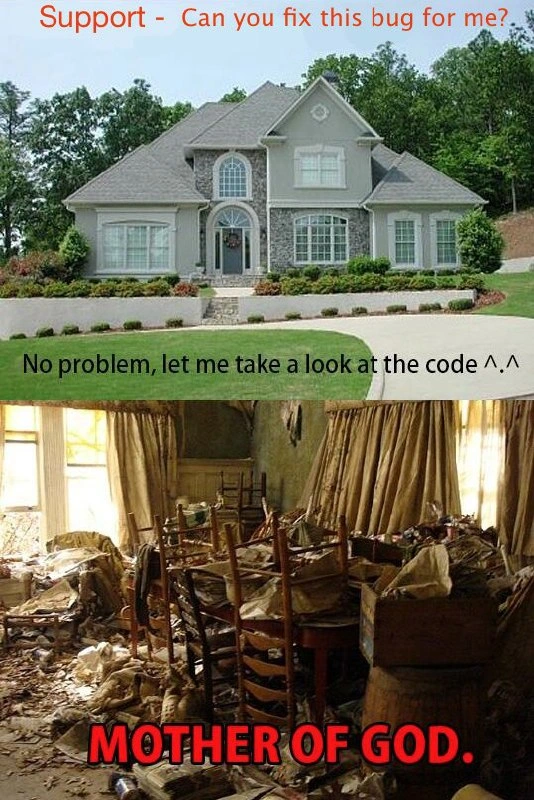
Imagine you see a beautiful house with a perfect front lawn and a fresh coat of paint. It looks wonderful from the outside – you’d think everything inside is just as tidy. Now your friend asks you to step in and help fix a small leaky faucet in the kitchen. No big deal, right? But when you open the front door, you freeze in shock: the inside of the house is a complete disaster. 😱 There are piles of junk everywhere, furniture is overturned, and it looks like no one has cleaned for years. You were expecting a quick little job in a nice home, but instead you’ve walked into a huge mess.
That’s exactly the joke of this meme. The “outside” of the software (what people see or the simple request to fix something) is like that pretty house. It makes you think, “Sure, this will be easy.” But the “inside” of the software (the actual code and how it’s made) turns out to be chaos, like a room full of trash. The developer’s reaction “MOTHER OF GOD” is just a funny way of saying, “Oh wow, this is so much worse than I thought!” It’s like if you opened a closet expecting a few coats to organize, and instead an avalanche of stuff fell out. The humor comes from that surprise: thinking everything was fine, then seeing the truth and being completely overwhelmed. In simple terms, it’s funny because something that looked small and simple on the surface turned out to be a giant messy project once you really looked.
Level 2: Pretty UI, Ugly Code
For a less experienced developer (or someone new to the project), the meme’s message becomes clearer with a bit of explanation. The outside of the house in the top image stands for the software’s UI (User Interface) or the part of the system that users and support folks see. It’s attractive, well-presented, and everything seems fine on the surface. When Support says “Can you fix this bug for me?”, they’re like a friend admiring a house’s curb appeal, assuming everything inside is equally orderly. The developer’s cheerful “No problem, let me take a look at the code!” reflects how we often approach a new bug: expecting to find a straightforward issue in an otherwise okay codebase.
Now, the punchline: the bottom image – a trashed, filthy room – represents the actual state of the software’s code behind the scenes. This is the backend, the internal logic and code structure that users never directly see. In the meme, the developer opens the code (walks into the house) and immediately encounters a messy codebase. Their shocked reaction, “MOTHER OF GOD,” is comedic exaggeration for “Oh no, this code is terrible!” It’s the moment a developer realizes a “simple” bug is not going to be simple at all because the program’s internals are a tangled disaster.
Let’s unpack some terms often used to describe such situations:
Legacy code: This usually means old code that has been inherited from earlier developers or previous versions of the software. It’s code written a long time ago, possibly using outdated practices or older technology. In a legacy system, many people might have worked on it over the years, and not all of them followed modern best practices. It’s like an old house with many additions and modifications done by different owners – some rooms might be well-built, but others are flimsy or bizarrely structured. When you dive into legacy code, you often find odd quirks and sections that make you think, “Why was it done this way?” The meme’s bottom half is essentially screaming “This code has been around forever and nobody kept it clean!”
Technical debt: This is a metaphor in software engineering comparing bad or quick-n-dirty code to financial debt. Imagine you take a shortcut in implementation to meet a deadline – that’s like borrowing time. It’s faster now, but later you “pay interest” on that shortcut because it makes future changes harder. Over years, a project might accumulate a lot of technical debt, meaning lots of clunky quick fixes and workarounds piled on top of each other. In the meme analogy, the scattered papers, broken chairs, and junk in that room are the result of many years of neglect and quick fixes thrown in without cleaning up. Just as financial debt incurs interest, technical debt makes every new bug fix or feature addition slower and more painful. Eventually, as the meme humorously shows, the codebase becomes a “house of horrors”: no one wants to clean it, but everyone is afraid of what will happen if we don’t.
Spaghetti code: This is a casual term for code with a very tangled, confusing structure. If code is spaghetti, it means the flow of the program twists and turns arbitrarily, much like a bowl of cooked spaghetti where all the noodles are entangled. There’s no clear organization; functions call each other in circular ways, logic is duplicated, and it’s hard to “follow the strand” to see where things go. In practice, spaghetti code might mean functions that jump all over the place or deeply nested conditions and loops that make your head spin when you try to follow them. A newcomer opening a spaghetti codebase feels just like someone stepping into that trashed dining room – overwhelmed and unsure where to even start cleaning. You move one piece (fix one part of code) and something unexpected pops out elsewhere. The meme exaggerates it as a shock, but honestly many new developers have that exact “Oh my goodness!” reaction the first time they see a real-world legacy project with spaghetti code.
Code quality: This refers to how well-written and maintainable the code is. High code quality means the code is organized, readable, and easy to modify without causing bugs elsewhere. Low code quality (as you’d guess) means the code is hard to read, full of hacks, and fragile – changing one thing might break another. The meme obviously highlights low code quality. The pristine exterior (good user experience) doesn’t guarantee good code quality underneath. In this scenario, the code might lack proper structure or documentation. Perhaps there are hardly any comments explaining how things work, or the comments that exist are misleading or outdated. For a junior developer tasked with fixing a bug, encountering low code quality is scary. It’s like being asked to find a book in a library where all the books are strewn on the floor and nothing is labeled. No wonder the developer in the meme is stunned.
Now, why is this situation funny (at least to developers)? It’s the sheer relatability. Almost every programmer, even relatively new ones, eventually runs into a codebase that’s far messier than expected. Maybe you join a new team, or take over a project from someone else, and discover that under the hood it’s a giant mess. The user interface, the part everyone sees, gave no warning of the chaos beneath – just as a house’s nice exterior wouldn’t tell you that the living room is a junkyard. This mismatch between expectation and reality creates a kind of dark humor. We laugh (sometimes nervously) because we recognize it: “Yep, been there, discovered that the hard way!”
For a junior developer, this meme is also an informal warning. It says: be prepared, sometimes fixing a bug isn’t about that one bug at all – it’s about navigating a legacy system that’s poorly designed. You might start with one small issue (“the app crashes when I click this button under certain conditions”) and then realize the entire module behind that button is so badly written that you have a lot of cleaning up to do. It’s almost never just one-line fix because of all the interconnected mess. This can be frustrating, but it’s a common scenario in software maintenance. The humor helps take the edge off that frustration – it’s better to laugh than cry when you open the code and see something utterly confounding.
In summary, the clean mansion = the nice-looking product, and the trashed interior = the ugly reality of the code. The phrase “haunted legacy codebase” from the title is apt: legacy code can feel haunted by past developers’ decisions. The “ghosts” are those mysterious functions or weird workarounds that no one fully remembers but everyone fears removing. The meme resonates with developers because it captures that exact moment of shock and dismay, in a situation we frequently encounter. The next time someone says “It should be a quick fix,” any developer who’s seen this meme might smirk and think, “Unless it’s a hoarder house in there… then we’re in for a ride.” It’s a funny-yet-educational reminder: don’t underestimate old, messy code – it can turn a simple task into a major debugging adventure.
Level 3: Curb Appeal vs Code Ordeal
On the surface everything looks pristine – the software’s user interface is polished like a suburban mansion with perfect curb appeal. So when Support casually asks, “Can you fix this bug for me?”, any unsuspecting engineer might cheerfully reply, “No problem, let me take a look at the code!” The meme’s top image (the beautiful house exterior) captures this naive optimism. But the punchline arrives as soon as the developer steps through the front door of the codebase. Instead of tidy logic and well-structured modules, they’re greeted by a scene of pure chaos – a decaying legacy code dining room littered with decade-old scripts, half-broken functions, and the ghosts of quick fixes past. The bottom image – a destroyed, hoarder-style interior – is that codebase: dusty global variables piled in every corner, spaghetti logic hanging from the ceiling, and tech debt cobwebs clinging to everything. It’s the kind of code quality nightmare that makes a battle-hardened programmer whisper “Mother of God…” in reverent horror.
This contrast is hilarious to experienced developers because it’s so painfully true. Many of us have strolled confidently into an unfamiliar project (especially one with a slick UI or a reputation for working fine) only to find it’s held together by duct tape, fragile hacks, and prayers to the CI/CD gods. The meme exaggerates it with the “haunted house” analogy – and honestly, it barely feels like an exaggeration. That pristine front-end you see? It might be calling an ancient backend module that hasn’t been refactored since the days of dial-up internet. The product’s façade is clean and modern, masking an architecture that’s one code commit away from collapsing under its own weight. This is classic technical debt at work: years of quick fixes and short-term solutions accumulating like junk in an attic, until the whole system is a maze of workarounds. The humor (and trauma) comes from how familiar this scenario is across the industry – it’s the unspoken horror story behind countless applications. Every senior developer has a war story about inheriting a codebase that looked fine from the outside but turned into a debugging nightmare once they peeked inside. It’s software’s equivalent of finding out the beautiful mansion is built on a foundation of sand (or perhaps on a burial ground of deprecated functions).
Let’s break down the horror show lurking in that bottom picture (the codebase interior). This legacy project likely started off innocently enough years ago, but as features were piled on and deadlines met, code quality was sacrificed for speed. Functions grew into monsters, modules intertwined in bizarre ways, and critical pieces were thrown together with little documentation. Imagine walking into a dining room where every chair, table, and shelf is broken or stacked with junk — in code terms, that’s:
- Massive “God” functions that span hundreds or thousands of lines, doing far too much. Tracing a single bug through a 500-line function with nested
if/elselevels 8 deep is like navigating a hedge maze with trap doors. - Spaghetti code structure where everything is tangled with everything else. One module quietly relies on global variables set by another module three directories away. Removing a single “minor” line can unexpectedly break five other features because of hidden couplings.
- Obsolete comments and commented-out blocks strewn about. You might find
// TODO: remove this hackcomments from 2009, eerily untouched. These are the codebase’s equivalent of cobweb-covered furniture – nobody dared clean them up, because who knows what would collapse? - Copy-pasted legacy modules that no one fully understands. There could be a
Utils_old_v2.cppfile still being called deep in the bowels of the app. It’s been “working fine” for years, but only because everyone is too scared to disturb it. - Hodgepodge of styles and tech: Parts of the code still use an older framework or language version (hello, Java 6 or early .NET), while newer patches bolt on modern bits. It’s like seeing a fancy new appliance in a kitchen with wiring from the 1950s – risky and inconsistent.
Each of these bullets is a classic hallmark of a messy codebase. When a developer descends into such a basement of horrors, a “simple” bug fix can turn into an archeological expedition. The code might be so brittle that touching one line is like pulling a piece from a Jenga tower – you’re praying the whole stack doesn’t collapse. This is why seasoned engineers cringed (and laughed) at the meme: we’ve all been that poor soul gingerly stepping through a legacy system wondering what unholy coupling or weird side effect will pop out next. The text “MOTHER OF GOD.” in big red letters across the wreckage perfectly captures that bug-fix whiplash: the moment you realize a 5-minute fix will take five days because the code is that bad. It’s a mix of terror, respect, and dark comedy – terror at how things got this way, begrudging respect that it still somehow works in production, and the comedy of recognizing this as a rite of passage in software development.
What makes this funnier (and sadder) is the discrepancy in perspective between Support and Engineering. The support team (or a project manager, or a client) sees the “mansion” – the features out front – and assumes everything behind the door is equally well-kept. They can’t imagine why fixing one UI glitch or a small bug could be a big deal. Meanwhile, the developer has PTSD from previous encounters with Big Ball of Mud architectures. They know that behind many seemingly clean products lies a hoarder house of code, accumulated through years of rushed deadlines and developer turnover. In the meme, the support person’s polite request and the dev’s initial “Sure ^.^” attitude represent that blissful ignorance. The smash cut to the trashed interior symbolizes the brutal reality check. The humor comes from that sudden contrast: it’s essentially the “expectation vs reality” gag, but tailored for programmers dealing with technical debt. And it’s so relatable – just about every developer has had a moment of walking into a codebase thinking “How bad can it be?” and then immediately thinking “Oh no. Oh nonono.”
Ultimately, this meme gets at an open secret in software: what you see as a user isn’t always indicative of the code quality underneath. A product can look slick and still be one deployment away from a meltdown because of all the hidden bugs and messy logic. It’s a sardonic reminder that debugging in a poorly-maintained system is like exploring a haunted mansion. Each fix might disturb some sleeping demons (bugs) in another corner of the code. As a cynical veteran might quip, “Sure, I can fix that bug… if you don’t mind exorcisms as part of the process.” The laughter this meme evokes is definitely a knowing laughter – a coping mechanism for the shared pain of battling monstrous legacy codebases that really should come with a warning sign: “Abandon hope, all ye who enter here.”
Description
A two-panel meme that visually contrasts the external appearance of a software application with its internal code structure. The top panel shows a large, beautiful, well-maintained house, representing the clean and polished user interface. Above it, red text reads: 'Support - Can you fix this bug for me?'. Just below the house, green text shows a developer's confident reply: 'No problem, let me take a look at the code ^.^'. The bottom panel presents a starkly different scene: the interior of a house in complete disarray, with overturned furniture, rubble, and general chaos, symbolizing a messy, unmaintained, and complex codebase. At the very bottom, the phrase 'MOTHER OF GOD.' is written in large, bold red letters, capturing the developer's shock and horror upon discovering the state of the underlying code. The meme is a classic illustration of technical debt and the common developer experience where a seemingly minor bug report leads to the discovery of a nightmarish legacy system
Comments
7Comment deleted
The UI is the Zillow listing; the codebase is the termite-infested foundation and leaky plumbing you only discover during the inspection
Turns out the bug lives in a React-wrapped COBOL-PHP monolith - basically a microservice if you squint hard enough and ignore the screaming GC logs
The git history shows one commit from 2009 titled "initial commit" with 47,000 files changed, and the README just says "Dave knows how it works."
Every senior engineer knows this moment: you confidently open a 'simple bug fix' in a legacy system, only to discover the codebase is held together by global variables, circular dependencies, and the tears of developers past. The pristine API documentation promised a well-architected system, but inside it's 50,000 lines of uncommented spaghetti code where changing a single boolean could trigger a cascade failure across three microservices that aren't actually micro. The real kicker? The original architect left five years ago, the last person who understood this module retired, and the only documentation is a README that says 'Good luck.' At this point, you're not fixing a bug - you're performing software archaeology in a codebase that violates every SOLID principle simultaneously while somehow still passing in production. Time to update that Jira ticket from 'Story Points: 2' to 'Story Points: ∞' and schedule a team meeting about 'strategic refactoring initiatives.'
Support's 'quick bug' is client's mansion facade; inside, it's 15 years of unchecked merges and zero-refactor commits
Support called it a tiny bug; opening the repo revealed a 300k-line monolith where the service locator mutates global singletons and feature flags are comments - ETA updated to “after the strangler‑fig migration.”
Opened the “quick bug” and found a 6k‑line GodObject wired with global state and a home‑rolled ORM; at this point, debugging is just structural engineering