Skip to content
DevMeme
2530 of 7435
The Slippery Slope of Technical Oversimplification
CS Fundamentals Post #2805, on Feb 27, 2021 in TG

The Slippery Slope of Technical Oversimplification

Why is this CS Fundamentals meme funny?

Level 1: Letters and Stories

Imagine you have a big, beautiful LEGO castle that took many hours to build, with towers, a drawbridge, and tiny brick dragons. Now imagine someone looks at it and says, “Eh, it’s just a bunch of plastic blocks.” You’d think, well technically yes – it is made of LEGO bricks – but they’re completely missing the awesome castle you created. That’s what’s happening in this meme, but with computers. Each statement is like saying a really complicated thing is “just” made of some simple thing, which is a pretty silly way to look at it.

It’s like saying a fairy-tale book is “just ink on paper” or your favorite cartoon is “just a bunch of colored dots on a screen.” Of course those things are made out of simple parts – letters or pixels – but what makes them special is how those parts come together. A book’s letters form a magical story; a cartoon’s pixels form characters and adventures. In the same way, a super-smart computer program (AI) is more than just a list of yes/no decisions (if statements). And a whole computer isn’t interesting just because it has millions of tiny switches inside; it’s interesting because of everything those switches are doing together, like letting you play games, talk to friends, or even detect cats in photos.

The meme is funny because the person keeps saying “it’s just this, it’s just that,” peeling away like layers of an onion, and ignoring the wonder of the whole thing. By the last panel, he’s basically dressed as a clown — meaning he’s being foolish. It reminds us of a kid who learns a little fact (“computers use only 1 and 0!”) and then goes around acting like they figured out the whole universe. Those facts are true, but just knowing that doesn’t mean you understand how everything works. So the joke is: yes, complex things are made of simple parts, but that doesn’t make them any less complex or amazing. The guy in the meme doesn’t get that, and that’s why we chuckle at him turning into a clown.

Level 2: Ifs, Bits, and Switches

Let’s break down each statement in this meme and explain what it means in real terms, and why each is an oversimplification of a much bigger concept. The meme’s joke is that each phrase on the left is technically referencing a true building block of computing, but overselling it as “just that” misses the full picture. We’ll also touch on the clown imagery – an Internet meme convention for someone making a fool of themselves.

  • “AI is just a bunch of if statements.” First, AI stands for Artificial Intelligence. In simple terms, AI is a field of computer science where programs perform tasks that normally require human intelligence – like recognizing faces in a photo, understanding language, or learning to play a game. Now, an if statement in programming is a basic instruction that says “if some condition is true, do X, otherwise do Y.” It’s how programs make decisions or branches. For example: if (temperature > 75) turnOn(airConditioner); else openWindow();. The claim that AI is just a bunch of if-else statements suggests that an AI system is nothing more than lots of hard-coded rules deciding what to do in each situation. Why is this oversimplified? Modern AI systems (especially machine learning models) don’t work by having a giant list of fixed rules for every possible input. Imagine trying to write an if for every object a self-driving car might see (“if you see a red octagon sign, it means STOP; if you see a person crossing, slow down; if the light is green, go…”). That approach doesn’t scale – there are endless scenarios! Instead, most AIs today learn patterns from data. For instance, a neural network learns to recognize a cat in a photo not by an if that checks “does this image have whiskers AND pointy ears AND…” (that would be a very long and brittle list of conditions), but by adjusting numerical weights through a training process so that it outputs “cat” for cat photos. Early AI in the 70s and 80s did use many explicit if-then rules (called expert systems), but those systems struggled with complex, messy real-world data. So, saying “AI is just if statements” is a bit like saying a modern car is just a horse and buggy because both get you from A to B – it ignores decades of development in between. It’s a classic AI humor punchline because it mocks people who don’t see the difference between a simple script and an intelligent system. It’d make any AI engineer grin (or cringe) because it’s such a reduction of their hard work to something trivial.

  • “Programming is just about loops and branches.” When someone learns to code, one of the first things they encounter are loops and branches. A loop (like a for loop or while loop) lets you run a chunk of code repeatedly, potentially many times. For example, “for each item in this list, do X.” A branch (usually an if/else statement) lets the code choose between two or more paths based on a condition (as described above). These are indeed fundamental concepts in programming – in fact, any program’s flow of control can be constructed using combinations of loops and branches (and straight-line sequences of instructions). So at a surface level, saying programming is “about loops and branches” points to those basics. However, this statement seriously oversimplifies what programming involves. Yes, writing code means using loops and conditions, but it’s also about how you use them and so much more: data structures (how you organize and store data in memory for efficient access), algorithms (the step-by-step logic or math for solving problems), error handling (anticipating and handling things going wrong), readability and maintainability (writing code that other programmers can understand and improve), etc. Real programming also involves planning, debugging, testing, and using frameworks or libraries that themselves encapsulate a ton of complexity. So, saying it’s “just loops and branches” is like describing a piano concerto as “just hitting keys” – technically that’s what’s happening, but it doesn’t capture the skill and complexity needed to make something meaningful. A junior developer might initially perceive coding as stitching together loops and if-statements (since that’s what early tutorials emphasize), but as they gain experience, they realize there’s architecture, system design, performance considerations, and many other layers. The meme highlights that contrast: a naive description vs. the richer reality. So while loops and branches are indeed computer science fundamentals in programming, focusing only on those is missing the forest for the trees.

  • “Everything finally ends up in binary with 1 or 0.” This statement refers to the fact that underneath all the software and high-level code, computers ultimately operate using binary representation. Binary is a base-2 number system that uses only two digits: 0 and 1. In a computer, a bit (binary digit) is the smallest unit of information, and it can be either 0 or 1 (often interpreted as “off” or “on”, or false/true). When we say everything ends up in binary, we mean that all types of data – whether it’s a number, a letter, a color in an image, or a machine instruction – are represented in the computer’s memory as a series of 0s and 1s. For example, the letter A is represented by the number 65 in the ASCII encoding, which in binary is 01000001. A color pixel might be represented as three numbers (for red, green, blue intensity), each stored in binary. Even the code of the program you write in a language like Python or C# eventually gets translated into binary instructions (often called machine code) that the processor executes. So this statement is actually accurate – digital computers are built on binary. It’s a core concept taught in any introductory computer science or electronics class and definitely part of computer science fundamentals. But saying “everything is 1s and 0s” by itself doesn’t explain how or why things work, it just states the end result. It can be an oversimplification when people use it to imply that higher-level complexity doesn’t matter (“why are you worried about how to manage a database or optimize an algorithm? It’s all just ones and zeros in the end!”). The truth is, while everything in a computer encodes to binary, the structure and interpretation of those bits is hugely important. Think of it this way: a big novel is just letters of the alphabet (if you break it down it’s all letters, which are like symbols, bit by bit). But how those letters are arranged into words and stories is the real substance; saying “it’s just letters” doesn’t tell you the plot or quality of the novel. Similarly, two software programs might both be “just ones and zeros,” but one might be a simple calculator and the other a complex video game – the binary alone doesn’t reveal that. So yes, every file on your computer – a song, a picture, this meme image – is stored in binary form. That’s a fundamental fact of how computers work, and a really cool one! But the meme is poking fun at someone treating that fact as if it’s the whole story or a grand revelation. Seasoned tech folks hear “it’s all ones and zeros” and think, “Well, duh… and so what?” It’s a statement of the obvious that doesn’t actually solve the practical challenges of programming.

  • “Transistors are just switches.” A transistor is an electronic component that is the building block of modern computer hardware. If you zoom in on a computer chip (like the CPU in your laptop or phone), you’d find billions of tiny transistors etched into silicon. Each transistor can be in a sense “open” or “closed” to electric current – acting like a switch. Specifically, a transistor typically has three terminals, and by applying voltage to one of them (the “gate”), it controls the flow of current between the other two (the “source” and “drain”). If current flows, that can represent a binary 1; if it doesn’t, that’s a binary 0. In this way, transistors can be connected together to form logic gates (like AND, OR, NOT gates that perform basic Boolean logic) and memory cells (that store a 1 or 0). So fundamentally, yes, a transistor functions as a switch – an automatic, electrically-controlled switch. Back in the very early days (1940s computers), instead of transistors, there were vacuum tubes acting as switches, which were much larger and less reliable. The invention of the transistor was revolutionary because it allowed these switches to be made incredibly small, fast, and reliable, leading to the microchips we have today. When the meme says “just switches,” it’s technically true in the sense that a digital circuit is a network of switches turning on and off. However, designing something like a modern processor involves far more than just flipping a switch on or off. There are layers of complex hardware design: combining transistors into useful configurations (flip-flops, adders, multiplexers), organizing those into functional units (like an arithmetic logic unit, caches, control units), and then coordinating everything with clock signals so that millions or billions of operations happen per second correctly. So calling transistors “just switches” is like calling an airplane “just metal pieces”. It doesn’t capture the ingenuity required to harness those switches. But it is true that when we boil it all down, the amazing graphics on your screen, the music from your speakers, and the programs you run are powered by an astronomical number of tiny switches switching on and off according to instructions. That fundamental simplicity is part of the wonder of computers – from simple switches we built up layers of abstraction to do incredibly complex tasks. The meme gives a nod to that wonder, but frames it in a way that mocks someone who might simplistically say “See? It’s all trivial!”

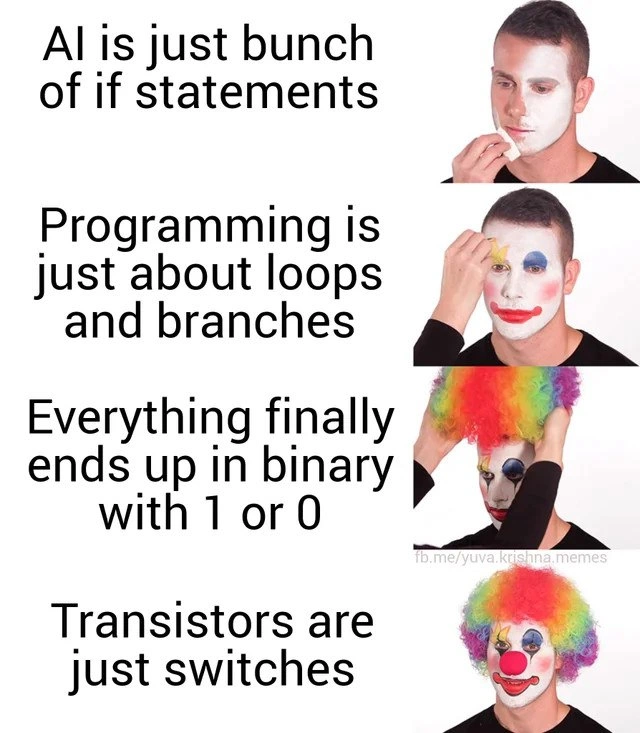
Now, about the clown imagery: The meme uses a popular clown meme format. On the right side of each panel, we see a man applying more and more clown makeup, and finally putting on a rainbow clown wig and red nose in the last frame. This format is an internet way of saying that the person is turning into a clown by his own actions or statements – basically, making a fool of himself. Each statement on the left is that action: as the person says each oversimplified phrase, he “earns” another piece of clown attire. By the final line (“Transistors are just switches”), he’s fully decked out as a clown, implying that reducing everything in computing to “just switches” is the pinnacle of foolish oversimplification (even if there’s a grain of truth to it). It’s a visual punchline showing that while each statement might sound superficially correct, the attitude behind them is laughable to those who understand the nuances. In the context of developer humor, calling someone a clown is a lighthearted way to say “You have no idea what you’re talking about, do you?” We often see this meme format when someone keeps doubling down on a silly opinion – each panel escalates the silliness. Here the opinion is that all of computer science can be trivialized to a few basic elements. And indeed, the oversimplification is the joke. By panel 4, he’s effectively saying nothing insightful at all (“switches switch!”), so we, the tech-savvy audience, get to laugh at how proudly obvious and simplistic it sounds.

In summary, each item in the meme corresponds to a real concept: AI algorithms, programming constructs, binary data, and transistor hardware. Those are like four layers of abstraction in a computer system, from very high-level (AI software) down to the very low-level (physical circuits). Understanding those layers is actually super important in computer science, but the meme humorously critiques the idea of brushing off the complexity of each layer by saying it’s “just” the next one down. It resonates with developers because we often have to explain to others that, yes, computers use binary and transistors, but that doesn’t make writing a complex program or training an AI model trivial. There’s always more than meets the eye in technology, and that’s why reducing it to one-liners will earn you a virtual clown wig in tech circles.

Level 3: Reductio ad Absurdum

In this four-panel clown meme, an unseen speaker keeps saying “It’s just X” about increasingly fundamental aspects of computing – and with each claim, he applies more clown makeup. This format is a tongue-in-cheek way to show someone turning themselves into a clown by making ridiculously oversimplified statements. The humor nails a common vibe in developer conversations: a know-it-all or skeptic tries to sound smart by boiling everything down to the simplest idea, but in doing so they miss all context and end up looking foolish. It’s a classic case of reductio ad absurdum, where an argument is carried to absurd lengths – here by reducing complex systems stepwise to trivial definitions. Seasoned developers immediately recognize this pattern and chuckle, because we’ve all met that person (or that online comment) proclaiming “Pfft, that fancy AI is basically just a bunch of if-else statements.”

Let’s walk through the layers of this developer humor:

  • “AI is just a bunch of if statements.” This line is a jab at the way some people dismiss artificial intelligence. In the world of AI/ML, especially during hype cycles, you get two extremes: people who think AI is magical pixie dust, and contrarians who retort that it’s nothing but ordinary code. Here the contrarian (the clown-in-progress) claims an AI is merely a long chain of if conditions. It’s funny because it’s such a drastic AI hype vs reality take. Yes, early “AI” in the 1980s (expert systems) was largely hardcoded rules – essentially lots of if-then logic crafted by humans. But modern AI, like image recognition or language models, doesn’t work by having a million hand-written if statements (you can’t feasibly write an if for every cat picture or every translation). Instead, it relies on statistics and learned patterns. A senior engineer knows the code for a neural network isn’t an endless list of conditions; it’s more likely linear algebra operations running on GPUs. So when someone waves off AI as just if/else logic, it’s an eye-rolling moment. The meme captures that eye-roll by literally painting the guy as a clown. It’s a sarcastic reminder that reducing machine learning breakthroughs to simple control flow is laughable to those who actually work with it.

  • “Programming is just about loops and branches.” This is the next claim as the clown makeup gets thicker. It’s referencing the idea that at its core, any program’s behavior is built from two basic control structures: loops (repeating operations) and branches (decision points, like if/else). In one sense, this is a nod to what every intro to programming class teaches – computer science fundamentals 101: sequence, selection, iteration. And truth be told, a huge amount of code is made of loops iterating over data and branches handling conditions. However, an experienced developer hears “programming is just loops and branches” and smirks, because it grossly downplays the complexity of real-world software development. It’s like saying painting is just about brush strokes – ignoring composition, color theory, perspective, etc. Yes, loops and branches are necessary building blocks, but they’re far from sufficient to describe programming. By the time you’ve worked on a real project, you know there’s so much more: designing data structures, managing state, handling concurrency, debugging weird bugs at 2 AM (when that one misplaced branch makes you question your life choices), writing tests, understanding frameworks... the list goes on. So hearing someone flatten all of software to “just write some loops and ifs” is both hilarious and slightly painful to seasoned devs. It’s the kind of statement that might come from a well-meaning outsider or a very green intern, and it usually makes senior engineers exchange knowing glances. The meme’s clown progression suggests: making such a statement is the moment you put on the clown nose. 🤡

  • “Everything finally ends up in binary with 1 or 0.” By the third panel, our clownified narrator is stating a fact that is actually true, but painfully obvious to any developer. Yes, when you get down to it, all data in a computer is just binary values, 1s and 0s. This is practically the first cool fact you learn in computer science: text, images, videos, programs – ultimately it’s all streams of bits in memory or on disk. We use binary because hardware likes two distinct states (on/off, high/low voltage) for reliability. So this statement isn’t wrong; it’s just that saying “everything is 0s and 1s” as if you’ve unveiled some deep insight will earn you some sarcastic slow claps from the audience. It’s akin to a biologist saying “ultimately, humans are just oxygen, carbon, and hydrogen atoms” – not incorrect, but not exactly a useful summary of biology. In context, by proclaiming this tautology with a face full of clown makeup, the meme implies that our oversimplifying friend thinks he’s hitting wisdom, whereas he’s really hitting peak obviousness. Experienced developers laugh because many of us have heard someone triumphantly reduce software to binary, as if that settles any debate about complexity (“Why worry about high-level architecture? It’s all just ones and zeros in the end!”). It’s a classic oversimplification where a newbie might think they’re on to a profound truth, while everyone else knows it’s trivially true and practically irrelevant to the problem at hand. We laugh because we do remember the awe of learning about binary… and we also remember outgrowing the notion that “binary explains everything” in any actionable way.

  • “Transistors are just switches.” In the final panel, our clown has donned the rainbow wig – the transformation to full clown is complete. Here the statement goes down to the hardware level, again stating something basically correct: a transistor, at its core, is an electrically controlled switch. In digital circuits, a transistor (or a few of them combined) acts like a tiny switch that either allows current to flow or blocks it, corresponding to a 1 or 0. That’s the physical basis for bits. Seasoned hardware engineers and computer architects indeed often explain transistors to newbies as “like light switches” or “like a water faucet controlling flow,” since that’s an accessible analogy. So why is this funny? Because our clown narrator is using this fact to supposedly demystify computing (“see, it’s just switches!”) while glossing over the astonishing complexity built on top of those switches. It’s the ultimate oversimplification. Yes, a modern CPU with billions of transistors switching billions of times per second is technically a bunch of on/off switches – and a Boeing 747 is just a bunch of metal parts bolted together, and the internet is just electrons zipping around. 😏 Stating it that way nullifies the genius of design and engineering that makes those switches do something as extraordinary as, say, rendering this meme on your screen. For a senior engineer, hearing “computers are just switches” is both amusing and exasperating. It’s like someone looking at a data center and saying, “All this is just some wires.” The meme’s final punchline is that by the time you’ve reduced everything to transistors-as-switches, you’re proudly describing the utterly obvious in a clownish attempt to sound insightful. The clown wig signifies that the speaker has fully embraced the fool’s role.

What ties all these panels together is the layers of abstraction in computing and how a little knowledge can be a dangerous (or at least comical) thing. Each statement drills down a layer: AI algorithms (high-level) → programming logic (mid-level) → machine code/binary (low-level) → transistor circuits (hardware). In reality, each layer is a rich discipline of its own. This meme pokes fun at reductive thinking: the notion that understanding the lowest layer makes the higher layers trivial. Every experienced developer knows that while each layer is built on the one below, mastering one layer doesn’t automatically solve the complexities of the next. We chuckle because the meme resonates with our experience: Computer science fundamentals are important, but you can’t hand-wave away AI or software engineering by saying “eh, it’s all just bits and switches.” The context here is very much inside-joke among developers. It’s a gentle jab at those who present themselves as tech sages by stating basic truths without grasping the deeper complexities. It’s also reflective of a sentiment we share when explaining our work to others: sometimes people oversimplify what we do (“you just write if-else and fix computers, right?”) and while we smile, internally we might be picturing this clown meme. In sum, the meme uses the clown meme format to lampoon the oversimplification of complex technology. Each oversimplified statement makes the speaker more of a clown, and for those in the know, it’s a hilarious progression because we’ve all heard some version of these claims. The next time someone says “AI is easy, it’s just code,” you might not say it out loud, but you’ll be thinking of that clown with the rainbow wig, honking the horn of obviousness. 🤡🚀

Level 4: Turtles All The Way Down

At the deepest theoretical level, this meme underscores the concept of abstraction layers in computing, reducing complex systems step-by-step to their simplest components. In computer science theory, we know that any high-level algorithm can be broken down into primitive operations. A fancy AI algorithm, for example, ultimately compiles to low-level instructions (like jumps and arithmetic), which in turn are just patterns of 1s and 0s that flip electronic signals. This is often described as “turtles all the way down”, referencing the idea that beneath each layer there’s yet another layer (like an infinite stack of turtles). Here each panel peels off one layer of abstraction: from AI code to programming constructs, to binary, and finally to hardware switches. Technically, it’s true – if you zoom all the way in, software becomes machine code, machine code becomes binary pulses, and binary pulses flow through billions of transistor switches. In fact, theoretical computer science has formalized this idea: any program can be constructed using just three basic structures (sequence, selection, and iteration – essentially straight lines, if-conditions, and loops). This was shown in the 1960s with the structured programming theorem. And down at the hardware level, Claude Shannon’s pioneering work proved that arrangements of switches (back then, relays) can implement Boolean logic, meaning you can build arithmetic and memory from just on/off switches. One popular teaching example is the NAND gate – a logic gate made from transistors – which is functionally complete, i.e., you can build an entire computer using nothing but NAND gates repeated in clever patterns. So yes, in a purist sense, AI might reduce to math operations, which reduce to low-level branch and loop instructions, which reduce to binary bits, which ride on transistor switches. It’s a beautiful chain: from fancy neural networks down to electrons dancing in silicon.

However, the humor (and absurdity) comes from using this truth to dismiss the complexity at each level. There’s a famous notion in computing known as the “Turing Tar Pit”: “Beware of the Turing Tar Pit, in which everything is possible but nothing of interest is easy.” Yes, your AI’s logic could be written as an enormous set of if statements or as one gargantuan truth table of binary values – after all, a universal Turing machine can, in theory, be built from a long list of simple rules. But such a reduction is impractical and incomprehensible. In practice, the emergent complexity at each abstraction layer is irreducible; you have to grapple with it using appropriate tools and theories. Think of how machine learning algorithms rely on linear algebra and calculus – a neural network isn’t literally dozens of if/else rules, but rather matrix multiplications and non-linear activation functions that adjust through training. Those continuous numeric computations don’t even translate cleanly into discrete if-then logic without losing what makes them “intelligent.” Or consider how an operating system manages a computer: yes, at the lowest level it’s flipping bits, but that doesn’t mean you could easily design an OS by reasoning about individual 0s and 1s. There’s a gap between the existence of a lower-level explanation and the ability to design or understand the system at that level. The meme highlights the reductio ad absurdum of saying “it’s all just ones and zeros.” Sure, even the most advanced AI or the most complex program, when boiled down to physics, is just electrons moving through transistors (which are pretty much switches turning on/off). But that’s like saying a Shakespeare play is “just letters” – it doesn’t capture the genius of the plot or characters. By dragging the explanation of AI/ML down to the level of computer science fundamentals (and then down to hardware), the meme jokingly demonstrates how oversimplification misses the whole point. It’s abstractions all the way down, and each layer matters. The clown in the meme is effectively ignoring the richness at each level of abstraction, gleefully proclaiming that everything reduces to the next turtle underneath. It’s a playful reminder that while our entire digital world does rest on simple binary switches, understanding and creating that world requires much more than just knowing the lowest-level truth.

Description

This meme uses the four-panel 'Putting on Clown Makeup' format to satirize the progressive oversimplification of complex technical concepts. On the left, a series of statements descend through layers of abstraction, while on the right, a man applies more clown makeup with each statement, indicating increasing foolishness. The progression is: 1. 'AI is just bunch of if statements' (applying white face paint). 2. 'Programming is just about loops and branches' (adding clown makeup). 3. 'Everything finally ends up in binary with 1 or 0' (donning a rainbow clown wig). 4. 'Transistors are just switches' (full clown costume). The meme humorously critiques the reductive arguments often used to diminish the complexity of technology. While each statement is technically true at a certain low level, they ignore the vast emergent complexity built upon those simple foundations. Senior engineers find this relatable as they frequently encounter this kind of dismissive oversimplification from less experienced individuals or non-technical stakeholders

Comments

15
Anonymous ★ Top Pick Sure, AI is just a series of if-statements. And Shakespeare is just 26 letters arranged in a specific order. The magic is in the arrangement
  1. Anonymous ★ Top Pick

    Sure, AI is just a series of if-statements. And Shakespeare is just 26 letters arranged in a specific order. The magic is in the arrangement

  2. Anonymous

    “Sure, AI is just a chain of IFs - IF you ignore the autograd engine, the tensor compiler, the RDMA fabric, and the on-call who turns into a clown every time one of those ‘simple switches’ flips at 3 a.m.”

  3. Anonymous

    This is what happens when you explain your ML infrastructure to the CEO who just discovered ChatGPT - by the time you get to explaining how your custom silicon accelerators work, you've already applied the full clown makeup trying to simplify 40 years of computer science evolution into soundbites

  4. Anonymous

    Sure, AI is 'just if statements' - and a skyscraper is 'just bricks stacked up.' This meme perfectly captures the journey from confidently dismissing decades of computer science research to explaining that transistors are 'just switches' - technically true, yet spectacularly missing the point. It's the engineering equivalent of saying 'Shakespeare just used the same 26 letters everyone else does.' The real humor hits when you realize we've all been this clown at some point, confidently reducing P vs NP to 'it's just about finding stuff faster' during a whiteboard interview

  5. Anonymous

    AI is 'just ifs' the way a Paxos cluster is 'just switches' - so which one do I flip to end the split brain at 3am?

  6. Anonymous

    Sure, it’s just ifs and switches - until a single bit goes metastable and suddenly true and false can’t reach quorum

  7. Anonymous

    Abstractions let us forget transistors are switches - until a single bit flip cascades into a full outage symphony

  8. @Supuhstar 5y

    We taught rocks to think by shoving lighting into them

  9. Deleted Account 5y

    why not?

  10. @grandpa_the_kid 5y

    Well in fact it's true) But for sure it's not that simple

  11. @NiKryukov 5y

    Life is just a chemical reaction

  12. @saidov 5y

    Sometimes you’d better stay only on one level of abstraction...

  13. @s2504s 5y

    И в чем он не прав?

    1. @Nefrace 5y

      Я ждал этого вопроса. Хороший вопрос. Следующий вопрос.

  14. @doodguy1991 5y

    Transistors are lightbulbs :^)

Use J and K for navigation