The C Plus Paradox
Why is this Languages meme funny?
Level 1: Missing Plus Sign
It is like someone saying they went back in time and stopped the maker of "Toy Story 1 and a half," and another person asking, "What movie is that?" The joke is funny because the speaker thinks they did something huge, but they cannot even name the thing correctly.
Level 2: Plus Plus
In many programming languages related to C, ++ is an operator that adds one to a value. A beginner might see code like:
int count = 0;
count++;
After that runs, count becomes 1. The name C++ is a joke on that idea: it suggests "C, but incremented" or "C with more added." The meme removes one of the plus signs and invents C+, then has another scientist point out the obvious problem: nobody knows what that is supposed to be.
The visual time machine matters because time travel stories often create paradoxes: change the past, and the present stops making sense. Here the paradox is tiny and nerdy. If the person changed language history, maybe C++ never became what developers know today. But the line says C+, so the joke is also about the character misunderstanding the name in the first place.
For newer developers, this is a friendly example of syntax humor. The joke depends on recognizing that punctuation in programming is meaningful. One extra character can change behavior, break a build, or in this case create a fake programming language.
Level 3: Incremental Timeline Damage
The speech bubble claims:
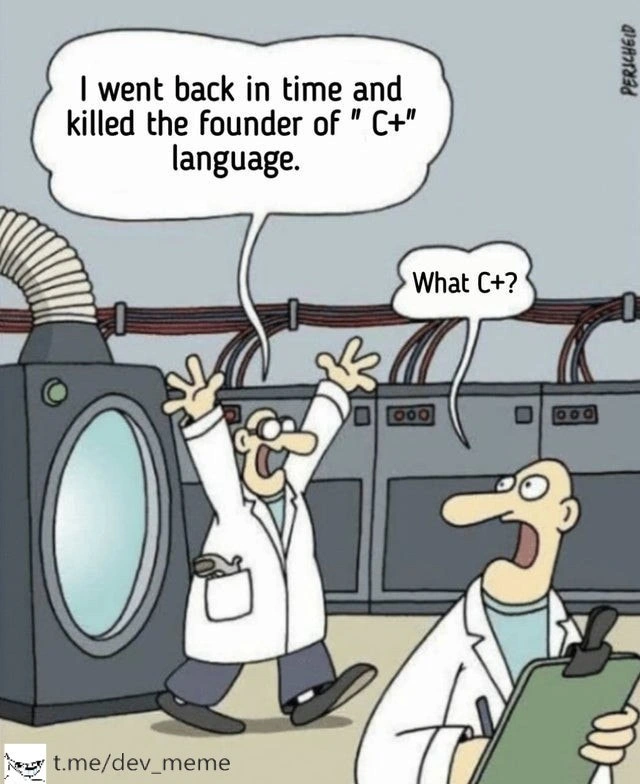
I went back in time and killed the founder of " C+" language.
The reply is the entire joke:
What C+?
The cartoon uses a time-machine setup to make a tiny programming-language pun feel like a paradox. C++ is named as if it were C with the ++ increment operator applied to it. In C-family syntax, x++ means "increase x by one." So if someone says they went back and killed the founder of " C+", the listener's confusion is correct: there is no mainstream language called C+ sitting neatly between C and C++. The missing plus sign is the punchline wearing a lab coat.
The senior-developer amusement comes from how much history is compressed into one silly label. C++ was designed by Bjarne Stroustrup as an extension of C with classes and stronger abstraction mechanisms, while still keeping a lot of C's performance model and compatibility pressures. That ancestry is why C++ can feel like a high-level language, a low-level language, a historical treaty, and a dare, sometimes all inside one header file.
The meme also pokes at how developers read symbols with far too much seriousness. To a non-programmer, C+ might look like a grade or a nearly plausible language name. To someone who has written i++ in a loop, the absence of the second plus is suspicious evidence. The clipboard scientist's What C+? is basically the compiler error in human form: identifier not found, timeline invalid, please consult your language standard.
There is also a quiet tech history joke here. Programming-language evolution rarely has clean intermediate steps. Languages are not built like numbered sequels where C, C+, and C++ all get orderly releases. They emerge from research goals, hardware constraints, workplace needs, compatibility bargains, and the occasional naming decision that becomes permanent because everyone is too busy shipping software to bikeshed it again.
Description
A cartoon laboratory scene shows two scientists near a large time-machine-like device and control panels. The excited scientist emerging from the machine says, "I went back in time and killed the founder of \" C+\" language." The other scientist, holding a clipboard, asks, "What C+?" and a small "t.me/dev_meme" watermark appears at the lower left. The joke is a programming-language wordplay on C++, imagining a timeline where removing the creator or one increment operator leaves only the nonsensical intermediate language name "C+."
Comments
1Comment deleted
Temporal coupling is bad enough without applying pre-increment to programming language history.