The Ancient Magic of Waiting for Dependency Indexing
Why is this IDEs Editors meme funny?
Level 1: Waiting for Magic
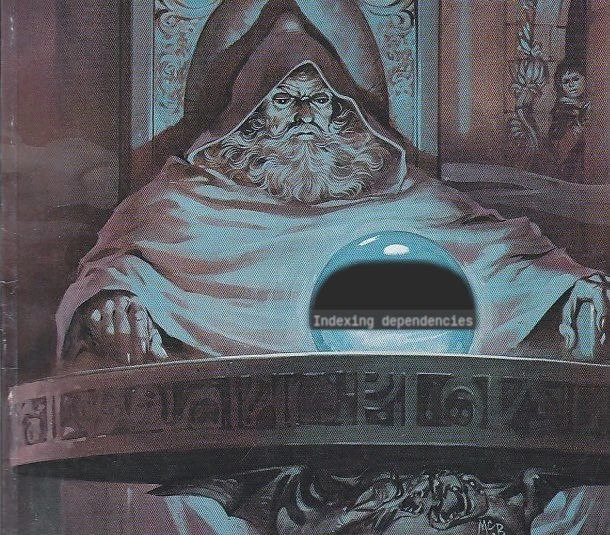
Imagine you’re about to play your favorite game, but first your friend (who’s a wizard in this pretend story) has to perform a long magic spell to set everything up. You’re just sitting there, watching him mutter weird words and wave his hands over a crystal ball, waiting and waiting. It feels like forever before you can finally start playing. Kinda funny, right? In the meme, that’s what a computer programmer feels like. The wizard is like a computer program getting ready, and the magic spell is the computer loading all the stuff it needs. It looks super mysterious and takes a while, and the programmer is just waiting, a bit impatiently. It’s funny because we don’t usually think of computers as magical—yet here we joke that the computer is doing some magic ritual every time it loads a big project. The big idea: even tech experts sometimes feel like they’re waiting for magic to happen when the computer is busy. It’s a silly way to say, “Getting things ready can take some time, so you need a little patience (and maybe a sense of humor)!”
Level 2: IDE Magic 101
Let's break down the joke for newer developers. First, what is an IDE? It stands for Integrated Development Environment – basically a feature-packed application for coding. Examples include IntelliJ IDEA, Eclipse, or Visual Studio. When you use an IDE, it does a lot of smart things for you: it can show errors in your code in real-time, suggest auto-completions, let you jump to definitions of classes or functions, and more. How does it manage these tricks? By doing some heavy lifting in the background, one part of which is indexing.
Indexing, in simple terms, means scanning through all your project’s files and the external libraries your project uses (these libraries are your dependencies) and making a quick-reference catalog of everything. Think of it like the index at the back of a textbook: it lists all the important terms (symbols like class names, functions, variables) and where to find them. An IDE does this so that when you later ask, "Hey IDE, go to the definition of MagicSpell class," it can instantly look up where MagicSpell is defined instead of combing through every file from scratch. Pretty neat – it’s like the IDE has a cheat sheet for your code.
Now, dependencies are those external pieces of code your project relies on. For example, if you're building a Java project and you use Spring Framework, or a JavaScript project using React, those frameworks are dependencies. They often come as many files (or one big package) that your project pulls in. The term DependencyHell humorously refers to the pain when managing lots of these or resolving conflicts between them. In our context, it's hinting that having tons of dependencies can slow things down – the IDE has to index all of them. Imagine a library with hundreds of utility functions: the IDE will systematically go through them to record what’s what.
For a newcomer, the first experience with this might be confusing: you open your project and the IDE is unresponsive or sluggish for a few minutes with a status message like "Indexing..." (often literally saying "Indexing dependencies" on the status bar). This is normal – the IDE is basically doing homework so it can help you more efficiently later. If you've used a simpler code editor (like VS Code without extensions, or Notepad++), you might not have seen this because those editors don’t precompute all this information; they trade some smart features for faster startup. But a full-fledged IDE, especially for big languages like Java or C++, will take this initial hit. It's like loading a big game: you wait at the loading screen while all the assets are prepared. Here the "assets" are definitions in your code and libraries.
The meme turns this mundane waiting period into a fantasy scene: a wizard with a crystal ball. Why a wizard? In programming, we sometimes jokingly call complicated or obscure processes "black magic" or "wizardry" – and waiting for an IDE can feel like waiting for a magic spell to finish. The wizard’s "dark ritual" is actually just the IDE churning through files, but to someone watching the screen, it feels mysterious and endless. The contrast is funny: a wizard performing ancient magic versus a modern developer sitting there, progress bar frozen at 90%. It emphasizes how mysterious and old-fashioned this indexing process can seem, even though it’s just everyday programming work under the hood. In short, the meme is poking fun at a common developer experience: the inconvenient wait every time our tool (the IDE) prepares our project's dependencies and source code for efficient use. Once the ritual... I mean, indexing... is done, we can finally start coding with the IDE’s help, but the waiting part can sure test our patience (and sense of humor!).
Level 3: Dependency Divination
Why do developers chuckle at this hooded wizard hunched over a glowing orb? Because it perfectly captures the vibe of waiting on your IDE to finish some mysterious housekeeping. The meme visualizes the IDE (often IntelliJ IDEA or Android Studio) as a grand sorcerer performing a dark ritual – "Indexing dependencies" – which is exactly what it feels like when you're anxiously watching a progress bar inch forward. This is classic developer humor: taking a painfully common situation (slow tooling) and exaggerating it with fantasy imagery. We’ve all been the coder staring at our screen, coffee in hand, as the IDE intones “scanning 1 of 4219 files…” like a wizard murmuring Latin. The intense stare of the wizard in the meme? That’s basically us developers, willing our tools to hurry up through sheer mental force.
From a senior dev perspective, the humor cuts deep because it’s a shared saga of modern coding: powerful IDEs and editors promise magic-like productivity (instant refactorings, code completion, on-the-fly error checking), but at the cost of these startup waits and periodic indexing sessions. Opening a large enterprise project or a sprawling open-source repo can trigger minutes of this dependency scanning purgatory. It’s practically a rite: import a new library or git pull a big update, and behold – the IDE enters its “circle of power”, CPU fans whooshing like a ritual chant. In team chat you’ll often see, “Hang on, IDE is indexing… again.” It's both frustrating and comically inevitable, much like a wizard who insists on elaborate divination before giving you an answer.
The term Dependency Hell usually refers to version conflicts, but here it's the sheer quantity of libraries that feels hellish. The more dependencies a project has (looking at you, enterprise Java and gigantic node_modules folders), the longer this indexing ceremony takes. Seasoned devs have coping strategies: some schedule a coffee break or stand-up meeting during the indexing, joking that the IDE’s progress bar is actually an oracle predicting break time. Others reminisce about simpler editors (hello Vim, Emacs) that start instantly – albeit without the "magical" intellisense that requires all this prep. Over years, we've learned that this quirky delay is mostly unavoidable. Sure, incremental indexing and better hardware help, but as projects and frameworks grow, our wizards (IDEs) just have more grimoires to sift through. It's a funny kind of Developer Experience (DX) tax: we sacrifice a bit of time upfront to gain superpowers in coding. And the meme nails it – it’s exactly like watching a bearded mage perform an obscure ceremony, hoping each second that he’ll finally declare, “It is done,” so we can get back to coding.
Level 4: Inverted Index Incantation
Deep inside an IDE's architecture, the seemingly mystical "indexing" phase is actually a rigorous computational ritual. When the wizard (your IDE) chants "Indexing dependencies", it's conjuring an internal inverted index and symbol table for your codebase. Much like a search engine prepping its data, the IDE parses every source file and library JAR (or node_module or binary) to catalog definitions and references. This involves compiler-like work: generating an AST (Abstract Syntax Tree) for each file, extracting symbols (classes, functions, variables), and mapping them to their locations. The result is a giant lookup table – a codex of all your code symbols – enabling instant "Go to Definition" or code completion later on.
This incantation is heavy. In big projects, there may be tens of thousands of files across your code and all those external dependencies. Indexing them can stress I/O and CPU: reading megabytes of source/jar files, computing hashes, and updating caches on disk. The time complexity roughly grows with the number of files and their size. Modern IDEs employ multi-threading and clever caching (reusing previously indexed data) to speed it up, but the first time (or after a clean build) it’s like summoning an elder spirit – you can't really rush it. There are fundamental limits: disk read speeds, CPU parsing throughput, and memory for storing the index. Garbage collection or swapping can even join the dark ritual if the index grows huge, making the process feel eternal. In fact, JetBrains (maker of IntelliJ IDEA) implemented a custom persistent index storage (inspired by databases like Lucene) to handle this torrent of symbols efficiently. But even with these optimizations, the sheer volume of data means you sometimes witness a progress bar creeping along as if reciting an ancient spell.
Ironically, this "waiting for the magic" is a trade-off born of logic, not sorcery. The CAP theorem might not haunt us here, but computer architecture does: indexing is an inherently sequential task when one file depends on another. Some language servers try incremental or on-demand indexing (only parsing what you open), but for a rich developer experience (DX), many IDEs still default to the all-encompassing scan. It's the classic upfront cost for powerful refactoring and code intelligence later. So, the humor is that something as high-tech as an IDE behaves like a slow, ancient ritual due to very real algorithmic workload. In other words, the arcane compilation feel is actually the sound of brute-force thoroughness – a mechanical sage poring over every scroll in your project's library of code. The wizardry here is just well-engineered tooling doing exhaustive bookkeeping. Even so, when you're staring at that cryptic progress text, it's easy to believe your IDE is busy with a genuine arcane indexing incantation in some digital sanctum.
Description
A classic fantasy illustration of a powerful, bearded wizard in a dark, hooded robe, gazing intently into a glowing blue crystal ball. This meme format is known as 'Pondering my Orb'. The text 'Indexing dependencies' is superimposed over the orb, turning the mystical act of scrying into a mundane developer chore. The humor captures the feeling of forced patience that experienced developers know well. When an IDE (like IntelliJ or VS Code) or a build tool indexes a project's dependencies, it can be a slow, opaque process where the developer can do nothing but wait, much like a wizard waiting for a vision to appear in a crystal ball. It equates a modern development bottleneck with an act of ancient, time-consuming magic
Comments
17Comment deleted
My IDE is currently 'pondering its orb,' which is a fancy way of saying it's trying to build a dependency graph without summoning a circular reference demon from the ninth layer of node_modules
Microservices reach prod in 45 seconds, but open the repo and the IDE still summons a hooded archmage for a half-hour chant called “Indexing dependencies” - the last true monolith on the team
The wizard has seen empires rise and fall, witnessed the birth of COBOL and the death of Flash, but nothing has aged him more than watching npm resolve peer dependencies
The wizard's crystal ball and IntelliJ's index share the same SLA: gaze long enough and you'll be shown the future - specifically, the part where you're still waiting and Gradle decides to re-sync
Every senior engineer knows this wizard intimately - he appears whenever you switch branches, update a single dependency, or dare to open a project on Monday morning. The crystal ball's 'Indexing dependencies' incantation is just the polite way of saying 'I'm rebuilding your entire dependency graph because one transitive dependency three levels deep changed a patch version.' The real magic trick? Convincing stakeholders that yes, you really do need those 47 minutes before you can start coding, and no, clearing the cache and re-indexing won't make it faster - it'll just restart the ritual from the beginning
In the monorepo, delivery dates are predicted by the oracle that says “Indexing dependencies” - our roadmap is just a very expensive topological sort
NPM's oracle ritual: indexing dependencies since CommonJS, because ESM still awaits its prophecy
Nothing turns a 64-GB laptop into a space heater faster than 'Indexing dependencies' - 100% CPU utilization, 0% developer throughput
now that's solid one 👌 Comment deleted
Damn... Comment deleted
Lmao Comment deleted
Any explanations? Comment deleted
They are pondering their orb Comment deleted
I try to search indexing dependencies, but I can only find some IntelliJ threads. No idea what that is. Any hints for me? Comment deleted
Well yeah. That’s about Java. The “prophet” is waiting for IDE to make all the magic Comment deleted
I see. Thankyou. Comment deleted
Lmfao Comment deleted