Agent 007: Licensed to cause production issues
Why is this OnCall ProductionIssues meme funny?
Level 1: No Work, All Mess
Imagine you have a friend who’s bragging about something silly. He says, “I’m like a secret agent at home, they call me 007!” and you ask why. He smirks and says, “0 chores done, 0 homework finished, 7 big messes caused!” Now, that sounds pretty funny, right? He’s comparing himself to the super-cool Agent 007 (James Bond), but instead of doing amazing missions, he’s done absolutely nothing good – and actually made things worse seven times.
It’s like if someone in school said: “They call me Captain Zero: I answered 0 questions right, turned in 0 assignments, and set off 7 food fights in the cafeteria.” You’d probably giggle because it’s obviously not something to be proud of, yet they’re saying it like it’s a title of honor. The humor comes from that contrast – acting like a hero, but actually being a bit of a troublemaker.
So in this meme, a developer (a computer programmer) is joking that his nickname “007” stands for doing no good work (0 fixes, 0 new things) and causing a lot of trouble (7 problems on the live website). It’s funny in a cheeky way, kind of like laughing at a clumsy character in a cartoon who keeps slipping on banana peels. The numbers 0-0-7 make us think of James Bond, but here it just means the person goofed up big time. In simple terms: he did zero of the things he was supposed to do, and seven of the things he wasn’t supposed to do – and he’s jokingly proud of it. It’s a silly, playful kind of joke that even if you don’t know coding, you can understand: doing no work and making a huge mess (multiple times!) is so bad it’s comical when joked about.
Level 2: Agent of Chaos
Let’s break this down for a newer developer (or anyone new to the joke). This meme is styled like a James Bond movie poster. James Bond’s code number is 007, which is famous from the spy movies. In those films, 007 is a top agent with a “license to kill” – basically, he’s allowed to do dangerous stuff and always succeeds in his missions with flair. Now, imagine giving that codename to a software developer, but instead of being a smooth hero, their "007" stands for 0-0-7 in a very different way:
- 0 bugs fixed: Bugs are mistakes or errors in software. Saying a dev fixed 0 bugs means they didn’t successfully solve any of the known problems in the code. For a junior dev, bug fixing is a common task – you take a known issue and try to make it right. This person apparently hasn’t fixed a single one. 😬
- 0 features completed: Features are new pieces of functionality or improvements in software. Completing a feature means you built something new that works. 0 features completed means they did nothing new or useful. So far, this engineer’s report card is empty of achievements.
- 7 production issues caused: Now, this is the kicker. “Production issues” (also called ProductionIncidents or just incidents) are problems that happen in production – which is the live environment where real users use the software (like a website or app that’s up and running). Causing a production issue is bad because it might crash the website, lose data, or interrupt service for users. This developer caused 7 such issues. We often call these “fires” or “outages” because everyone has to stop and urgently fix them, and it can be chaotic (imagine firefighters rushing to put out flames, except it’s engineers rushing to fix servers).
So the meme literally lists those three lines next to the numbers 0, 0, and 7. It’s formatted in a cool, dramatic style – big bold text, with the number “007” vertically, as if it’s something to be proud of. The humor is that normally being “007” sounds awesome (since it refers to James Bond), but here it’s describing a terrible performance record in a tongue-in-cheek way. It’s like the developer is bragging “They call me 007,” implying they’re as cool as Bond, but what they did to earn that nickname is completely the opposite of cool in a software team.
Why would engineers find this funny? Because it’s a form of TechHumor that plays on our everyday experiences. Pretty much every developer has encountered bugs and the pressure to add features. And unfortunately, many developers have also experienced the horror of breaking something in production – it’s one of the scariest moments in a coding career, especially early on. If you’re new, think of a production issue as the worst kind of bug: it’s not on your computer where you can quietly fix it; it’s out in the wild affecting real users, and everyone on your team might get alerted to drop everything and fix it now. Causing one production issue can make you feel really bad; causing seven sounds like an absolute disaster.
This meme exaggerates to make a point: imagine a developer who in a given time period (say a week or a project) manages to not fix anything, not build anything new, but instead breaks the live system seven times. It’s a nightmare scenario! It’s like a negative achievement unlocked. And the fact they phrase it as “They call me 007” is a form of DeveloperSelfDeprecation – a jokey way a developer might poke fun at themselves (or a colleague) after a really bad run. You know how sometimes, instead of getting angry, you just laugh at a situation because it’s so ridiculously bad? This is that kind of laugh. It’s relatable humor (RelatableDevExperience) for developers because many of us have had maybe a mini version of this: like “they call me 002 – 0 bugs fixed, 0 features, 2 outages caused in my first month” (said with irony while nervously laughing). It’s a way to cope with the stress and embarrassment by making it a joke.
Let’s clarify a few terms and concepts here:
- Bug: A flaw in the code that causes a program to produce an incorrect or unexpected result or to behave in unintended ways. For example, a bug could be as simple as a missing check that lets a user type letters where only numbers should be, causing a crash. Developers spend a lot of time fixing bugs to improve software quality.
- Feature: A feature is a new capability or enhancement in software. If we compare software to a car, a feature could be adding a new radio or a backup camera. In apps, a feature might be a new button, a new page, or a new function like dark mode. Completing a feature means you took an idea from start to finish and it now works in the app.
- Production: This is the environment where the application is actually running for end-users. Developers usually have separate environments like “development” (their own computers) and “testing/staging” (a safe place to try things out with nobody except testers or internal people watching). Production environment is the real deal – like a website’s public server. When code is “in production,” it’s live. Breaking production is a big deal because it can affect real customers and revenue.
- Production Issue/Incident: This refers to something going wrong in production. It could be a crash, the site going down, a major bug slipping through that stops users from doing something important, a security breach – anything that requires urgent attention. Companies often have alert systems (like pagers or phone alerts) and on-call schedules for engineers to respond 24/7. When a production issue happens, you might hear engineers say “we’ve got a fire” or “we’ve got an incident.” It’s stressful and teams treat it with high priority until it’s resolved.
- On-call: Some teams rotate who is “on-call,” meaning that person has to be ready to respond if a production issue happens, even if it’s 2 AM on a Sunday. If one developer causes 7 production issues, that on-call person (or multiple people) has had a very rough time. This contributes to the DeveloperFrustration angle of the meme: being woken up repeatedly to fix avoidable problems is something developers gripe about often.
- Developer Productivity: This usually means how much useful work (features, fixes, improvements) a developer gets done. It’s a tricky thing to measure, and this meme jokes about it by showing someone with literally zero productive output and only negative output. In real life, nobody wants to have a report that shows zeros and then a big number of failures – that would be a very bad performance review! It’s basically saying this person’s productivity is not just low, it’s in the red.
- 007 Reference: Just to be clear, 007 is James Bond’s agent number. It’s used here for wordplay. In the movies, “They call me Bond, James Bond” is the iconic line. Here, “They call me 007” is used because it fits the format of listing the numbers. It’s something people instantly connect with spy thriller coolness. Then we see the twist: those numbers stand for something very uncool in a dev context.
- Bond Parody: The whole style of the image (tuxedo, suave pose, bold spy-movie text) is imitating Bond posters. Instead of a real movie title like “No Time To Die” or “Skyfall”, it’s showing a “title” that is actually the joke about the developer. Visual parodies like this make the meme fun because it’s mixing two very different worlds – Hollywood spy action and everyday coding life – to make a funny point.
For a junior developer, the message can also be read as a light-hearted cautionary tale: don’t be in such a rush to deploy like an action hero, or you might end up with a license to crash things. In the software world, success isn’t measured by daring, last-second code commits (that’s more likely to cause a meltdown). It’s measured by careful testing, collaboration, and steady improvement. The “007 developer” in the meme is basically the opposite of what you want to be. And the fact that it’s written like a proud tagline is what makes it a joke – no real developer would be genuinely proud of causing seven outages!
However, developers might share this meme and laugh because a lot of us have been through embarrassing moments or know someone who had a streak of bad luck/mistakes. It’s a way to bond over those war stories. One person might say, “Remember when I took down the server that time? Haha, call me 001,” and another might reply, “Oh yeah? I accidentally emailed all 10,000 users at once with a test message – call me 002.” We cope by humor. It doesn’t mean these things are truly okay, but joking about it is a relief after the fact. This meme packaged that idea into a neat James Bond joke, which makes it very RelatableHumor for anyone in tech.
In short, for a newer dev: The meme is comparing a developer with a really bad track record to James Bond (agent 007) in a funny, ironic way. It lists out that the dev did zero bug fixes, zero new features, and caused seven issues in production, and frames that as if it’s their cool code name. It’s poking fun at the situation where someone’s contributions are upside-down (more harm than help). The reason it’s funny is the contrast and the shared understanding that messing up that much is absurd – thankfully, it’s usually not that extreme in real life, but we laugh because we know even one or two production mistakes feel awful. So it exaggerates to seven for comedic effect. As a junior, you can chuckle but also take note: maybe double-check your code, because you don’t actually want to be called 007 at work in this sense! 😅
Level 3: License to Kill (Production)
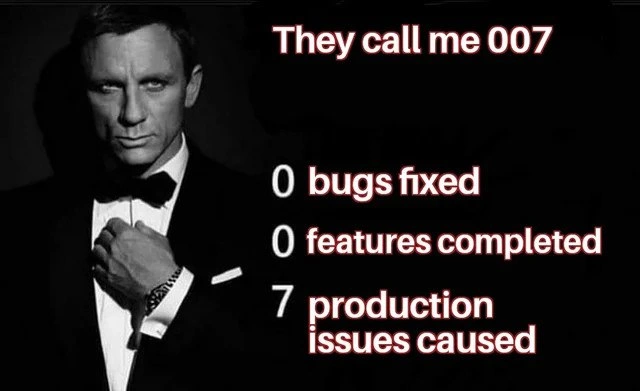
At first glance, this meme is a perfect fusion of spy thriller cool and software engineering disaster. It presents a black-and-white James Bond-esque poster with a tuxedoed figure adjusting his bow-tie, captioned in bold text: "They call me 007." But instead of a suave MI6 resume, the numbers 0-0-7 are hilariously redefined as a developer’s scorecard: 0 bugs fixed, 0 features completed, and 7 production issues caused. It’s a classic bond_parody that flips the famous “license to kill” into a license to kill production. For seasoned engineers, the humor hits like a well-timed production alert: it’s painfully relatable and darkly funny, because we’ve all either met or been this developer at some point (hopefully temporarily).
This is a joke about DeveloperProductivity turned upside down. In any healthy project, a programmer’s mission (should they choose to accept it) is to fix bugs and deliver features without blowing up the site. But our not-so-secret agent 007 here has a mission failure rate worthy of a villain monologue. The meme’s format mimics a performance review from hell: no bugs fixed (meaning this person either isn’t addressing known BugsInSoftware or didn’t manage to solve any), and no features completed (so nothing new or valuable delivered). Yet somehow they managed to cause 7 separate ProductionIncidents. 😱 In other words, this developer’s contributions are not just zero — they’re negative. Experienced devs sometimes joke about “net negative lines of code” or the mythical “-10x developer” who creates work for ten others, and here we have Agent 007 as the poster child of dev_metrics_failure: instead of earning a 10x productivity badge, they’re wielding a “license to break stuff” badge.
Why is this so funny (and cringey) to us old-timers? Because it satirizes a very real fear and reality in tech: one bad deploy can wipe out weeks of good work. Production is the live environment where real users are impacted, and causing even 1 serious incident (often called a SEV1 or P1 incident, i.e., high-severity ProductionIssue) is every developer’s nightmare. Now imagine 7 production issues attributed to a single person. That’s the stuff of on-call horror stories and war-room memes. We laugh because otherwise we’d cry – anyone who’s been on an OnCall_ProductionIssues rotation can practically hear the 3 AM phone alarms and envision the “database down – all hands on deck” slack messages. Seven outages caused by one engineer suggests either catastrophic incompetence or spectacular bad luck (maybe both). It’s an extreme case of "shaken, not stirred," where systems are shaken and confidence in the code is stirred (into panic).
The combination of elements here – the James Bond 007_reference and the abysmal dev track record – creates a multilayered joke. Bond is known for impeccable success under pressure, but our Developer 007 is a master of doing the opposite. The contrast between the admired super-spy and the infamous “super-firestarter” developer is pure comedic irony. A senior dev will chuckle at the phrase “They call me 007” because it implies coolness, only to see it immediately undercut by quantifying failure. It’s a playful jab at those Orwellian workplace metrics where you’re reduced to numbers – except here the numbers are a cause_vs_fix_ratio that’s through the roof (literally 7/0, which in math is an infinite undefined explosion – much like the production environment in this meme). In fact, if we treat “issues caused vs. bugs fixed” as a ratio, this agent’s score approaches a division-by-zero error:
issues_caused = 7
bugs_fixed = 0
cause_vs_fix_ratio = issues_caused / bugs_fixed # ZeroDivisionError: infinite chaos
No monitoring dashboard could chart that graph without bursting into flames itself. It’s a tongue-in-cheek way to illustrate that this dev isn’t just unproductive – they’re actively destructive.
Behind the humor, there’s a shadow of truth that senior engineers know all too well. Modern software teams place huge emphasis on testing, code reviews, and CI/CD pipelines to prevent exactly these kinds of catastrophic streaks. In an ideal world, no single engineer could single-handedly introduce seven separate production bugs without course correction after the first or second. That it’s seven suggests a systemic failure: maybe a blameless postmortem after incident #1 wasn’t so blameless behind the scenes, or perhaps management’s “move fast, break things” culture went a bit too far. The meme might be exaggeration, but it reflects real anti-patterns:
- Lack of QA/Testing: If features and bug fixes are zero, perhaps nothing was verified, and whatever changes did go out were ticking time bombs.
- Hero Culture or Blind Spots: Sometimes teams have a “cowboy coder” who slips under the radar. They might deploy unreviewed code (with a tuxedo-level confidence) directly to prod. The first explosion might be forgiven, but letting it reach seven means the organization didn’t act. Everyone was likely too busy firefighting to address the root cause.
- Metrics Misleading Management: On paper, if you only track “features completed”, this person’s 0 might have hidden the real damage until the ProductionIssues started piling up. It’s a joke about how DeveloperProductivity isn’t just about how many Jira tickets you close – it’s also about not creating new tickets labeled “SEV-1 outage: site down”.
- Bus Factor in Reverse: Usually, we worry about one person being indispensable. Here one person is indispensable to chaos. It hints that maybe this "007" had too much unchecked power or knowledge silo (like only they had access to deploy, and abuse that license). A senior dev reading this recalls tales of lone wolves breaking everything because no one else looked at their code.
And let’s not ignore the human aspect: DeveloperFrustration and burnout on the team. Production fires (especially repeated ones) are draining. If Agent 007 is on your team, you’ve probably spent long nights in incident calls, writing post-incident reports and apologizing to customers. The meme resonates because it’s self-deprecating and cathartic – it’s the kind of dark humor shared after surviving a rough sprint. A veteran engineer might chuckle, then rub their temples remembering that one colleague or that one deployment that turned them into an overnight insomniac. In a way, calling someone "007" with this meaning could even be an inside joke on a dev team after a bad week: "Well, Bob pulled a 007 this week – zero fixes, zero features, 7 new bugs in prod." It’s funnier to say that than to just scream in anguish.
The James Bond motif amplifies the joke: Bond is cool, polished, effective. This developer is the bizarro Bond: polished on the outside (maybe talks a good game, wears confidence like a tux), but leaving a trail of exploded databases instead of exploded enemy lairs. The spy_tuxedo_meme aesthetic just drives home how absurd it is to glamorize what is essentially a series of screw-ups. It parodies the idea of celebrating a code name or KPI when the reality is disastrous. In some tech workplaces, people facetiously reward the “production chaos agent” – think “honorable mention for breaking the build most often”. It’s sardonic. Seasoned devs are effectively saying, “We see what you did there, mixing Bond with our daily firefights. We’ve lived it, so we can laugh at it.”
So, why is this combination so effective? Because it’s layered with context that an experienced developer immediately appreciates:
- Shared Trauma: Deploying a bug that causes an outage gives you a sick feeling in the gut. Doing it repeatedly? That’s either comedic exaggeration or someone needs an intervention. The laugh comes from relief that it’s not happening right now, tempered by the knowledge that it easily could.
- Misaligned Metrics: Counting features or bug fixes alone misses the big picture. A dev boasting “I closed 50 tickets this quarter” means nothing if behind the scenes they quietly introduced security holes or downtime. The meme drags that truth into the spotlight: quantity of work means zip if quality is negative. It’s a jab at any workplace that rewards output without accountability.
- The One-Man Wrecking Crew: There’s an unwritten folklore in engineering teams about the dev who unintentionally became a chaos monkey. Netflix famously had a tool called Chaos Monkey to randomly cause failures in production to test resilience. Well, Developer 007 is like a human Chaos Monkey (unleashed without management’s intention). He’s the “Agent of Chaos” (pun fully intended) in the codebase, acting almost like an enemy spy embedded in the team, sabotaging from within. A senior dev might dryly joke: “We found the mole, he’s been in our dev team all along.”
- Coping Through Humor: Ultimately, this meme is a form of DeveloperHumor and DeveloperSelfDeprecation. It’s the industry’s way of saying “We’ve all had spectacular failures, and if James Bond were a developer having a bad year, this would be his stat line.” By invoking 007, it’s as if we’re giving that disaster-prone dev a cool codename to soften the blow. After all, if you’re going to mess up, at least do it with a bit of style and a meme-able nickname, right?
In summary, for the seasoned tech crowd, “Developer 007: 0 fixes, 0 features, 7 fires” is a sardonic salute (or roast) of those nightmare scenarios we work hard to avoid. It cleverly packages ProductionIssues and DeveloperFrustration into a cinematic joke, letting us laugh at the absurdity of a colleague (or ourselves) racking up more outages than accomplishments. It’s funny because it’s an exaggerated reflection of a truth we keep in the back of our mind: there but for the grace of good DevOps practices go I. In the end, every senior dev knows that the difference between a smooth release and a fiery meltdown can be razor-thin — and occasionally, someone will end up being “007” (at least for a sprint). The best we can do is learn from it, implement a few more safeguards, and maybe chuckle about it in a meme once the smoke clears. Bond might have “No Time To Die”, but in tech, sometimes we have no time to debug – so we make jokes and carry on.
Description
A popular developer meme featuring a black-and-white, high-contrast image of actor Daniel Craig as James Bond, looking serious and dapper in a tuxedo. Superimposed on the right side of the image is text with a slight red glow. The top line reads, 'They call me 007'. Below, the numbers are broken down into a developer's performance metrics: '0 bugs fixed', '0 features completed', '7 production issues caused'. The humor comes from the ironic twist on the suave, effective '007' spy persona, repurposing it to represent a developer having a disastrously unproductive and destructive week. It's a form of self-deprecating humor that resonates with anyone in tech who has accidentally caused more problems than they've solved during a release cycle
Comments
7Comment deleted
My manager said my performance was like a Bond movie: high stakes, lots of explosions in production, and the budget for cleanup is astronomical
Corporate 007: zero green pipelines, zero SLOs met, seven SEV-1s - code pushed straight to prod, shaken not staged
The only developer who can confidently put 'Expert at distributed systems' on their resume - they've successfully distributed failures across seven different production services in a single deployment
The 007 developer: licensed to deploy, not to test. While most engineers strive for five nines of uptime, this one achieves seven nines - seven production incidents, that is. It's the inverse of the 10x engineer: the 0.1x engineer who somehow manages negative productivity. In their defense, causing production issues does require a certain level of skill - just not the kind you want on your on-call rotation. They've mastered the art of turning every deployment into a learning opportunity for the entire organization about what NOT to do
Team nickname “007”: zero unit tests, zero canary releases, seven Sev1s - proof that our change failure rate is the only thing scaling
Bond's true license: deploy to prod sans review, rack up incidents, vanish before rollback
OKR achieved: 007 - zero velocity, zero defect burndown, seven Sev1s shipped; apparently my microservice is write-only to the incident queue