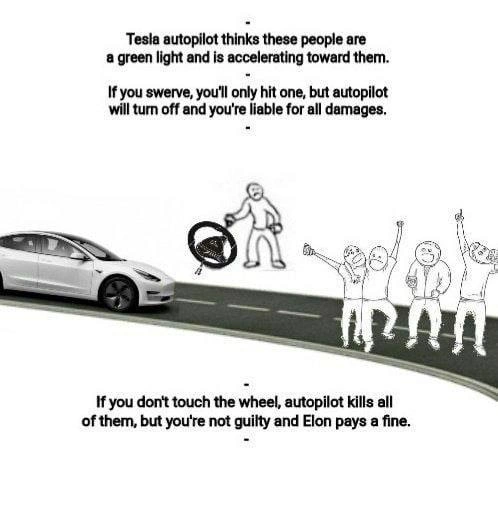
Autopilot misclassifies pedestrians as traffic signal, forcing a liability dilemma
Why is this AI ML meme funny?
Level 1: Runaway Robot Car
Imagine you’re in a car that’s driving itself like a big smart robot. Now, this robot car makes a crazy mistake: it sees a bunch of people crossing the road ahead, but it thinks those people are actually a green traffic light telling it to zoom forward. 😱 Green means “go”, so the car starts speeding up toward the people by accident. You’re sitting in the driver’s seat and realize what’s happening. You have two options, and neither is good:
- Option 1: Grab the wheel and try to turn or stop the car. If you do this, maybe you only hit one person instead of everyone. That’s better for saving lives. But because you took control, it now counts as your action. You would get blamed for the crash since technically you were driving at that moment. It’s like you become the driver right when the accident happens, so you’re responsible for it.
- Option 2: Don’t touch the wheel at all. Let the robot car keep going on its wrong path. This is awful because it means the car would hit all the people in front of it. 😢 However, since you didn’t interfere, you can say “I wasn’t driving, the car was!” In this case, you personally might not get in trouble with the law. Instead, the car’s maker (think of Elon Musk, the boss of Tesla, the company that made the car) would likely get in trouble or have to pay fines for the car’s mistake.
So either you do the morally right thing and fewer people get hurt but you get blamed, or you do nothing, more people get hurt, but you avoid blame. That’s a pretty horrible choice, right? This situation in the meme is like a modern version of a classic moral puzzle where no answer feels good (often called the trolley problem, like choosing which track a train should go down). It’s using dark humor to point out how weird self-driving car problems can be. We’re basically laughing (in a shocked way) at how the technology could fail in a silly way (mixing up people and a green light) and how the rules could end up punishing someone trying to help. It’s funny in a very twisted sense because normally we expect technology to make things safer, but here the “smart” car creates a scenario that’s super unsafe and even puts the human in a legal bind. The core of the joke is: the robot car messed up big time, and now the human inside has to choose between two really bad outcomes. It’s both scary and silly – scary because of the real danger, but silly and ironic because of who would get blamed.
Level 2: When AI Sees Wrong
Let’s break down what’s happening in this meme in simpler technical terms. We have a Tesla car using Autopilot, which is basically an AI-driven driver assistance system. Think of Autopilot as the car’s robot co-driver: it uses cameras, sensors, and a machine learning model to identify things on the road (cars, lanes, traffic lights, pedestrians) and to keep the car centered and at a safe speed. It’s pretty advanced technology – the car is partially driving itself – but it’s not perfect and still needs the human driver ready to jump in if it gets confused. The company (and Elon Musk, Tesla’s CEO) often talks about it like it’s nearly autonomous, but in reality it’s a work in progress with known limitations.
Now, the meme sets up an extreme example of Autopilot messing up. The text says the Autopilot “thinks these people are a green light and is accelerating toward them.” In other words, the car’s AI vision system has misclassified a group of pedestrians as a traffic signal that’s green. Misclassification is a fancy way to say the AI got something wrong – it put an object in the wrong category. This is like if your phone’s photo app looked at a picture of your dog and labeled it “cat.” Usually, misclassifications in AI are harmless or just funny (like a filter tagging a man as a “beardy lady” because it sees long hair). But in driving, a misclassification can be dangerous. Here, the car sees “green light” so it interprets that as “the road is clear, proceed.” And so it accelerates when it absolutely shouldn’t. It’s basically a bug in the AI’s understanding of the scene.
Why would an AI do something that ridiculous? Because AI vision doesn’t truly “see” like we do – it matches patterns. Maybe the group of people had some layout or color that the system’s training data associated with a green light. This is what we call an edge case: a situation that’s really unusual and wasn’t covered in training or testing. AI engineers try to anticipate edge cases, but there will always be weird scenarios the model isn’t prepared for. For example, early self-driving systems struggled with things like odd-shaped debris on the road or oddly dressed pedestrians (imagine someone in a full green costume – the AI might literally confuse that with a traffic light if it’s naïve enough!). Edge cases are the bane of robust AI – those one-in-a-million situations that can make even a smart system trip up. Edge_case_handling means having safeguards for those weird moments, like maybe defaulting to slowing down if sensors disagree or the situation looks freaky. In this meme’s story, clearly the edge case wasn’t handled: the car is doing the worst possible thing because it confidently but incorrectly thinks everything is fine.
Now, the second part of the meme talks about what happens if the human driver intervenes or not, and who gets blamed. Liability is the big word here – that means legal responsibility. With Tesla Autopilot (and similar systems), the official stance is that the driver is still responsible for the car at all times, even when Autopilot is on. It’s like having a very smart cruise control; it can do a lot, but you’re supposed to monitor it. In practice, if an accident happens under Autopilot, there can be investigations: was the driver paying attention? Was the system faulty? It can get tricky. The meme humorously (and a bit cynically) outlines two scenarios:
- You swerve and take control: In the meme, swerving would mean you manage to only hit one person instead of the whole group. Morally better? Probably – you’d rather harm one person than many. But the moment you yank the wheel, Autopilot disengages. The car basically says “Human, you’ve got this.” Now you’re effectively the driver. If a crash occurs in that moment (even if it’s mitigated), you are liable. All the damages, the legal blame, it falls on you because you were the one steering when impact happened. The meme explicitly says “you’re liable for all damages.” Imagine being that driver: you did the right thing to minimize harm, but now you might get sued or charged because legally it was your action. Yikes.
- You do nothing and let Autopilot continue: This is the “hands-off” approach. If you truly don’t touch the wheel or brakes, the car remains in Autopilot mode. In the meme’s hypothetical, that means the car goes straight and hits all the pedestrians (absolutely terrible outcome). However, because you technically didn’t do anything, the idea is you wouldn’t be personally blamed. Instead, it becomes a huge problem for Tesla and its Autopilot system. The line “you’re not guilty and Elon pays a fine” implies that perhaps the courts or regulators would put the fault on the car/computer (and by extension Tesla/Elon Musk). So you, the driver, avoid jail or lawsuits, but a lot more people were harmed. It’s a very dark scenario.
This setup is referencing the famous ethical dilemma known as the trolley problem (where one has to choose between action that harms one vs inaction that harms more). But it adds a modern legal spin: the incentive is twisted because the driver’s personal risk (legal guilt) is opposite to the moral choice. Usually, you’d expect laws to encourage you to minimize harm, right? But here, because of how liability with AI is set up, the law might punish you for intervening. So the meme is pointing out this bizarre loophole in autonomous driving: it almost disincentivizes the human from stopping the car’s tragedy, because doing so transfers all the blame onto the human.
For a newcomer to AI or driving tech, it’s important to know that in reality companies are actively discussing these situations. No car maker wants to be in a headline like “Autonomous Car Chooses Who Dies.” In fact, most autopilot systems are programmed to just brake or slow down when in doubt. They typically won’t say “swerve and hit that guy to save those others” — that level of choice is not really implemented; it’s too controversial and hard. The car would usually just try to reduce speed and follow the last known good trajectory. The meme is an extreme satire, basically saying: imagine the AI doesn’t brake at all because it doesn’t even realize there are people, and the only way to avoid maximum harm is the human’s intervention. It’s a bit of a dig at Tesla’s approach too, since Elon Musk often champions that Autopilot and Full Self-Driving will handle everything (and takes pride in the tech), yet here we’re imagining it failing spectacularly and Elon literally paying for it.
In simpler terms, this meme combines AI humor with a warning. The humor comes from the absurdity (“the car thinks people are a green light – how silly is that?”) and from the biting scenario of the driver’s choice (“save lives and get punished, or let the computer do evil and walk away innocent”). It’s poking fun at both the technology’s limitations and the weird state of AI ethics concerns and laws we have right now. If you’re new to this field, the take-away is: AI can and will make mistakes, sometimes really ridiculous ones, because it doesn’t truly understand the world – it just processes data. And when AI is in charge of something as serious as driving, those mistakes can lead to dire consequences. That’s why engineers and society are trying to figure out how to make these systems safer and decide who’s responsible when things go wrong. The meme just packages that serious issue into a dark joke scenario that tech folks nod and laugh at, even while nervously hoping it never happens in real life!
Level 3: Green Light, Red Alert
This meme hits seasoned developers and AI practitioners right in the anxieties. It takes the infamous trolley problem — “choose who to save in an inevitable accident” — and throws in a modern twist of corporate liability and buggy AI. In plain terms, the car’s Autopilot has a vision bug: it literally sees a group of people and thinks “Oh, that’s a green light, I have the right-of-way!” So the car is speeding up towards a crowd, all because of a classification error. That alone is a darkly funny image to anyone who’s worked with image recognition. (We’ve all seen an AI confidently label a dog as a pineapple or something absurd — funny in an app, not so much in a self-driving car on a public road!)
Now, the humor deepens with the driver’s predicament: if the human driver grabs the wheel to avoid the crowd (which is any decent person’s first instinct), the Autopilot will disengage. In Tesla’s design, any significant manual override (like steering or braking by the driver) instantly turns off Autopilot. It makes sense: the system yields control to you. But the meme exposes the catch: by intervening, the human becomes the active driver at the moment of impact. All of a sudden, legally and practically, it’s their accident, not the AI’s. The text spells it out: “If you swerve, you’ll only hit one, but Autopilot will turn off and you’re liable for all damages.” Oof. The developer in me cringes, because it’s true — the system basically says “Okay, you have the wheel... whatever happens next is on you.” It’s like a flawed fail-safe that dumps responsibility on the user at the worst possible time.
On the flip side, if the driver does nothing, the car plows ahead under Autopilot’s control and takes out all the pedestrians. That’s obviously horrific, but here’s the twisted bit: the meme quips that in this case “you’re not guilty and Elon pays a fine.” In other words, the blame shifts to the company or the machine. It’s a satirical jab at the idea that a Tesla owner could rationalize not intervening because legally they might avoid ruin by letting the car make the fatal mistake. This joke plays on real discussions in AI ethics and law — right now, there’s debate on who is responsible when an AI causes harm. And indeed, big companies often end up with fines or settlements (which, for them, might be easier to handle than an individual facing criminal negligence charges). The reference to Elon Musk is tongue-in-cheek: he’s the CEO of Tesla, often touting how advanced Autopilot is. If Autopilot did something this terrible, the meme suggests Elon (or Tesla) would be left holding the bag monetarily, while the car’s owner technically might dodge a manslaughter charge by saying “I didn’t do anything.” Dark, dark comedy.
From a veteran developer angle, this scenario condenses a lot of familiar themes: bugs in production, unexpected interactions between humans and automation, and perverse incentive structures. We’ve seen much simpler versions of this: e.g., a software tool where if users try to fix an error manually, it voids support warranties — so people sometimes leave it alone to not get blamed for tampering. In this case, that dynamic is dialed up to life-and-death scale. It’s absurd, which is why it’s funny, but it’s also uncomfortably close to reality.
Consider real occurrences: Tesla’s Autopilot (and similar systems) have failed to detect obstacles on rare occasions. One notorious example: the system didn’t recognize a crossing tractor-trailer against a bright sky, leading to a fatal crash. In another, an AI might “see” a late-afternoon sun and think it’s a yellow traffic light, causing a weird decision. These are edge cases that engineers work hard to eliminate. But no matter how much you test, reality always finds that one scenario you didn’t think of. Every senior dev knows the pain of that one bug in production that only happens with a crazy combination of inputs. Here, the crazy combo might be something like unusual lighting, a bizarre position of pedestrians, or even a glitch in the neural net’s model of the world. The meme’s example of confusing people with a green light is extreme, but it represents all those wild misreads an AI can have. Edge_case_handling is the unglamorous, critical work in AI: how do you detect when the system might be wrong? Ideally, the car would fail safe — e.g., if something doesn’t make sense (like a “green light” that’s moving like a person?), hit the brakes! But evidently in this dark joke, that didn’t happen.
Another thing an experienced engineer sees here is the human-machine interaction failure. In safety engineering, a huge concern is handoff problems: what happens when control shifts from automation to human? The meme scenario is basically the worst-case handoff. The Autopilot is about to make a lethal mistake; the human tries to correct last-second; the system essentially says “I’m out!” at the critical moment. It’d be like a co-pilot flying an airplane, making a mistake, and as the captain takes over to fix it, the co-pilot pulls the ejector seat on himself leaving the captain with a mess. We strive to design automation that works with the human, not against them. But the liability framework around today’s semi-autonomous cars kind of pits the AI and human against each other in terms of blame. The meme highlights this by the stark outcomes. A senior dev might chuckle here but it’s a grim chuckle, because it hints: maybe our systems and laws are setting drivers up to fail.
And yes, there’s a strong undercurrent of poking at AI hype vs reality. Tesla calls its system “Autopilot” and even sells a package called “Full Self-Driving.” In marketing, it sounds like the car can handle anything – like a superhuman driver. In reality, anyone experienced with it (or who follows tech news) knows it has limitations and can do dumb things, so you must stay vigilant. The meme exaggerates one such dumb thing to make a point: believing the hype blindly could lead to absurd tragedies. Seasoned devs often joke about how it’s always the edge case that gets you. Well, misreading a crowd as a green light is an edge case for the ages. It’s both ridiculously improbable and, if it happened, monumentally catastrophic – which is exactly what makes it meme-worthy.
To sum up the senior perspective: this meme is funny because it’s so outrageous and cynically true at the same time. It satirizes the idea that a high-tech AI could fail in a childishly simple way, and then the user gets entangled in a legal/moral quagmire because of how we’ve structured responsibility. It’s the kind of scenario that gets nervously joked about in self-driving car teams after hours: “What if our car mistakes a person for a green light? Who’d be sued?” Cue the uncomfortable laughter. The meme takes that uncomfortable laughter and splashes it in text form with a stick-figure diagram. AIhumor at its finest (and darkest).
# Pseudocode of the darkly comic logic:
object = autopilot.vision.detect_object()
if object == "green_light":
car.accelerate() # Autopilot thinks it's all clear, speeds up
elif object == "pedestrian":
car.brake() # Would stop, but this path isn't executed if misclassified
# Later...
if driver.touches_wheel():
autopilot.disengage() # Human intervenes, automation drops out
liability = "Human driver" # The driver is now responsible for the outcome
else:
liability = "Autopilot (Manufacturer)" # AI stays in control; blame shifts to the company
(In this tongue-in-cheek code, a misclassification means the car never calls brake() because it thinks those pedestrians are a green light. And the moment the driver grabs the wheel to correct course, autopilot.disengage() hands off both control and blame.)
Level 4: Black Box Morality
At the deepest level, this meme highlights a collision of machine learning limitations with ethical dilemmas in autonomous driving. The Tesla’s Autopilot vision system — a complex deep neural network — has essentially produced an adversarial misclassification: it looks at a cluster of pedestrians and labels them as a green traffic light. In the high-dimensional math of the network’s mind, some features of the scene erroneously activated the "go signal" classification. This kind of failure is a known nightmare in AI safety research. Neural networks are powerful but act as black boxes; they learn statistical patterns from training data, but they lack common-sense reasoning or an innate understanding of context. Here, the context is absurd (people are obviously not traffic signals!), yet the AI, operating purely on learned features, doesn’t know that. It has no built-in rule saying “humans ≠ go sign.” It only knows the patterns it has seen. If its training data or algorithms didn’t cover this scenario, the result is a deadly edge-case bug.
This leads to a scenario that feels like the classic trolley problem encoded in software, raising what one might call algorithmic ethics. In theory, one could try to program moral choices into a self-driving car: e.g., weigh outcomes and minimize harm. But today’s real autonomous systems don’t explicitly do that. They follow simpler directives (stay in lane, avoid obstacles) and rely on correct perception. If perception fails, the system can’t magically engage an ethical subroutine — it doesn’t even recognize there’s a moral choice to be made. The trolley_problem here arises from a chain of logical failures: first, a perception failure (pedestrians → “green light”), then a control logic that sees “green means go” so it accelerates. No higher-level reasoning intervenes because the AI doesn’t truly understand the situation; it’s just executing learned behavior.
From a systems perspective, this is a safety-critical bug. Robust autonomous systems are supposed to have multiple sensors and redundancies. For example, many designs use LIDAR or radar alongside cameras to ensure a detected object (be it a person or a sign) is confirmed by multiple data points. Notably, Tesla’s approach relies heavily on vision (cameras and neural nets) without LIDAR, betting on the AI’s ability to eventually handle all conditions. This meme’s scenario underscores the risk: a vision-only system might mis-see the world. Without a secondary check, the car will act on that false perception with full confidence. Researchers in AI limitations have documented similar oddities – like vision models that see a turtle and think it’s a rifle, or mistake a stop sign with a sticker on it for a speed limit sign. These are harmless in lab tests, but on the road such model misclassification can be fatal.
There’s also a profound legal and ethical dimension. In modern real-world terms, Tesla’s Autopilot is considered a Level-2 or Level-3 autonomous feature (on the SAE scale) where the human driver is meant to be the ultimate safety check. The meme exaggerates the legal outcome (implying “Elon pays a fine” if the AI causes the deaths) to poke at this question: legal_liability in AI-driven accidents is murky. Today, if a semi-autonomous car crashes, authorities often still blame the human operator for not intervening, precisely because the tech is not certified to make life-and-death decisions on its own. But as autonomy advances, we edge towards a future where an AI could carry more of the blame. This meme imagines that borderline: if the human does nothing, perhaps liability shifts to the manufacturer or the algorithm (hence Elon Musk, as Tesla’s figurehead, footing the bill). If the human intervenes, suddenly they become the actor. It’s a perverse inversion of the classic AI ethics concerns – the system encourages a kind of moral hazard where doing the right thing (saving people) personally penalizes the human. This dark irony isn’t just comedy; it’s a critique of how our current frameworks lag behind our technology. It’s a callout that we need better edge_case_handling in code and clearer laws for AIhypeVsReality scenarios where autonomous systems still fail in unpredictable ways.
Mathematically and theoretically, one could frame the situation as an optimization problem gone awry. The car’s policy (likely learned via deep learning on driving data) normally optimizes for obeying traffic rules and safety. But it can only optimize based on its inputs: here the input classification is wrong, so the optimized action (accelerate on green) is tragically misapplied. There’s no global objective function in the code that says “maximize lives saved” that could override the mistake. Formal methods folks might point out the lack of a provable safety guarantee — something nearly impossible to extract from a black-box neural network. It’s a reminder that despite all the AI hype, under the hood these systems are still crunching probabilities, not truly understanding semantics or morality. The humor is that we’ve ended up with a liability dilemma designed by accident: a loophole where the safest moral action for the human (swerve and spare many) conflicts with the safest legal action (don’t touch and let the machine take the fall). This is bleeding-edge ironic fodder for both AI engineers and ethicists, encapsulating why building AIsafetyresearch into autonomous vehicles is as much about philosophy and law as it is about code.
Description
Meme in minimalist black-and-white style depicting a Tesla on the left side of a curving roadway heading toward stick-figure pedestrians on the right. Centered text reads: "Tesla autopilot thinks these people are a green light and is accelerating toward them." Beneath, another line says: "If you swerve, you'll only hit one, but autopilot will turn off and you're liable for all damages." At the bottom, text concludes: "If you don't touch the wheel, autopilot kills all of them, but you're not guilty and Elon pays a fine." The scene humorously illustrates a trolley-problem variant where the AI vision model has mis-classified humans as a green light, raising questions about machine perception errors, edge-case handling, and legal responsibility in autonomous-vehicle ML systems
Comments
40Comment deleted
CV team: “Only 0.0001% of frames confuse pedestrians with green lights.” Architect: “Great, we’ve essentially shipped a stochastic trolley problem with an SLA measured in court dates.”
The real bug isn't in the computer vision model - it's in assuming we can delegate moral decisions to a neural network trained on dashcam footage while the legal framework is still running on Common Law v1.0 from 1066 AD
Autopilot disengaging 0.3 seconds before impact is the most elegant exception handler ever shipped: catch (Liability e) { rethrow_to(driver); }
The classic trolley problem, now with a SLA and terms of service. In production, we've discovered that the optimal solution to ethical AI isn't solving the trolley problem - it's ensuring the liability gets routed to a different microservice. Tesla's autopilot has apparently implemented the 'not my problem' design pattern: if the human touches the wheel, ownership transfers and the system gracefully exits with a legal exception. It's like a distributed system where accountability sharding means nobody's truly responsible - except perhaps the poor engineer who has to explain in the postmortem why the collision detection model classified pedestrians as 'green lights.' At least when your Kubernetes cluster makes a bad decision, it doesn't require a philosophy degree and a legal team to debug
Autopilot microservices: perception occasionally labels pedestrians “green,” planning accelerates, intervening flips “driver liable” - turns out the only truly autonomous service is blame propagation
Autonomy microservices in a nutshell: vision mislabels pedestrians as a light, planner floors it, and the liability service does a zero-downtime failover to Driver on the first torque sample
Autopilot's blameless postmortem policy: hands-off for AI root cause analysis, touch wheel and you're the SRE on-call for the pedestrian outage
Damn that's Sofie's choice Comment deleted
Какую бабку? Тормоз давить надо! Comment deleted
please use English in this chat Comment deleted
Which gramma? Brake, you should hit brake! Comment deleted
Thank you Comment deleted
No Comment deleted
Let Elon pay. Comment deleted
This is a great reaction format Comment deleted
👉👈 mine now Comment deleted
You are welcome! :) Comment deleted
Wonderful Comment deleted
The only question is w_h_y Tesla's autopilot recognizes them as a green light Comment deleted
Obvious, Irishmen in St. Patrick's day. Comment deleted
Tesla autopilot recognizes green light as people and slows down... Comment deleted
Tesla autopilot recognizes driver's hands on the wheel and speeds up on people Comment deleted
🌚 Comment deleted
if you hit the brakes, the car will stop right in front of the people, and the battery explodes, killing them and you. Elon pays an even larger fine and you're doubly not guilty (good ending) Comment deleted
if you try to switch gears, the Tesla will get confused and bore a tunnel straight to Elon's subterranean base where he's hiding all the lizard people (besides zucc) Comment deleted
(secret ending) Comment deleted
regardless of what you do, Elon manages to change public opinion into blaming you via a PR campaign that costs more than the fine itself, including attorney costs. (true ending) look up the case where McDonalds managed to convince everyone they got sued because someone was too stupid to hold a cup of coffee. Same shit. Comment deleted
oh and the one time bp invented the personal carbon footprint (well, popularized it) to distract from their recent gigantic oil spill. Truly hilarious. Comment deleted
capitalism was a mistake Comment deleted
But what is an alternative (for you)? Please, i dont want to live in gulag or shanghai Comment deleted
I don't know… Comment deleted
I won't pretend to know any better than any country's leader… Maybe humanity is just inherently shit, who knows. Comment deleted
And now we live with. Is everyone ready to buy those juice carbon credits directly or via increased price on high-quality products? Comment deleted
so... either I pay or Elon pays... Comment deleted
let's make Elon a little bit poorer then Comment deleted
like he would give a fuck about paying such thing Comment deleted
We are trying to decide what to do on the step 3. On the step 1 you somehow get a Tesla ans on the step 2 you are going for a ride. And who from you can allow to get Tesla? If you want it in car sharing, you need to get really big level in the system to even get in array of accounts who possibly can drive this car. Comment deleted
Basically, there's three things stopping me from getting into this scenario: - I'm not rich enough to drive a tesla. - I don't have a driver's license. - I'm not social enough to go for a ride to where people are Comment deleted
Regarding 3rd point How the fuck you transfer yourself to places on distance >1km from your home? Comment deleted
I usually don't 🙃 nah, I just turn my brain off and take public transit. There's no social interaction if there's no interaction. Comment deleted