Telling ChatGPT to Shut Up About Your Global Cursor
Why is this AI ML meme funny?
Level 1: The Backseat Helper
Imagine you just finished building a LEGO spaceship. It looks great, it holds together, you're proud of it. Then a robot helper leans over and says, "No offense, but that blue brick should really be on the other side." The ship flies fine. You didn't ask. So you do the only reasonable thing: you put your finger up and go "SHHHHHHHH" until the robot stops talking. It's funny because the robot might even be right — but sometimes you just want someone to say "nice spaceship."
Level 2: Globals, Smells, and Nits
A global variable is one defined at the top level of a program, accessible from everywhere — here, a cursor, the object you use to run database queries or track position. Globals work fine in small scripts, but in bigger programs they become risky: any function can change them, which makes bugs hard to trace and tests hard to isolate. That's why style guides call them a code smell — not broken, just a hint of future trouble.
AI coding assistants like ChatGPT or Copilot generate and review code. They're trained on millions of examples of "good practice," so they often append advice you didn't request — restructure this, rename that — even when your code runs perfectly. Early in your career this is confusing: it works, why is the robot upset? The answer is that "works" and "maintainable" are different axes, and the AI only knows the textbook one.
The relatable moment: you finally get something running after hours of debugging, paste it somewhere to ask one small question, and the response opens with a critique of your variable scoping. The shush is every developer's inner monologue at that moment, rendered in four panels.
Level 3: Out of Scope, Like Your Opinion
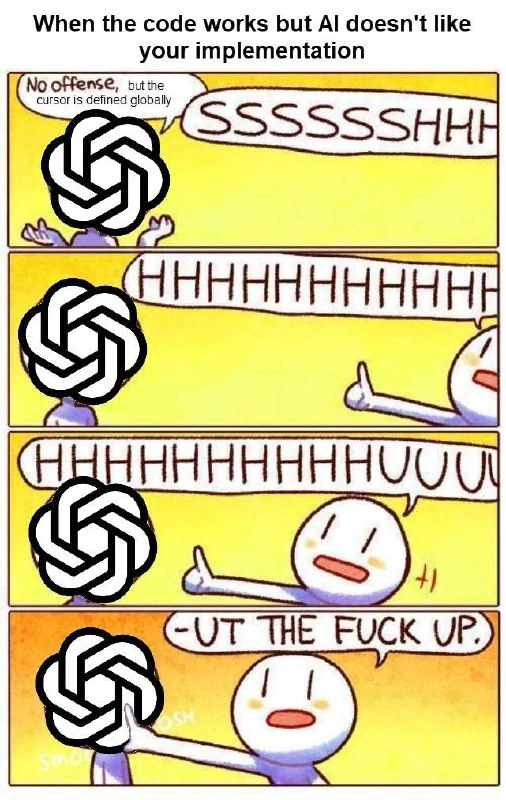
The caption frames it precisely: "When the code works but AI doesn't like your implementation." In the first panel, the character wearing the OpenAI logo as a head opens with the immortal hedge — "No offense, but the cursor is defined globally" — and the developer's response stretches across three panels of escalating "SSSSSSSHHHHHHH..." until the final orange panel lands "-UT THE FUCK UP." It's the Shut Up webcomic format applied to the defining friction of the AI-assisted coding era: the assistant that answers a question you didn't ask.
What makes this sting for working developers is that the AI is technically correct, which is the most infuriating kind of correct. A globally defined cursor (likely a database cursor or editor handle) genuinely is a mild code smell — shared mutable state, harder to test, awkward under concurrency. But the critique arrives with zero context sensitivity: maybe it's a 40-line script that runs once a month; maybe the global is a deliberate trade-off made three deadlines ago; maybe you asked the model to fix one bug and it volunteered an architecture review instead. LLM assistants are trained on a corpus saturated with style guides and Stack Overflow pedantry, so they reflexively pattern-match toward best-practice sermons. Unlike a human reviewer, they can't read the room — there is no room, only tokens.
The deeper satire is about the shifting power dynamics of code review. Human reviewers learned (sometimes through HR) to scope feedback: blocking issues versus nits, "consider" versus "must." AI assistants reset that social contract to zero, delivering unsolicited refactoring advice with the breezy confidence of a new hire who just finished Clean Code — prefaced by "no offense," the universal signal that offense is incoming. And the punchline beneath the punchline: developers now find themselves emotionally arguing with a text predictor, defending their globals to an entity that will cheerfully agree with them if asked twice. The shushing isn't really aimed at the model; it's aimed at the nagging awareness that the model has a point.
Description
A four-panel edit of the 'Shut Up' webcomic (yellow-orange background, blobby white characters) titled 'When the code works but AI doesn't like your implementation'. In panel one, a character with an OpenAI/ChatGPT logo for a head begins: 'No offense, but the cursor is defined globally'. The remaining panels show the developer character pointing and drowning the bot out with an elongated 'SSSSSSHHHHHHHHHHHHHHHUUUU...' culminating in '-UT THE FUCK UP.' The meme nails the modern code-review dynamic where an AI assistant volunteers unsolicited style critiques ('no offense, but...') about working code, and the developer responds with the only refactor that matters: silencing the linter with legs
Comments
6Comment deleted
The AI flagged my global as a code smell; I flagged its opinion as out of scope
My last experience with AI-dev: asked to prepare tests for some small module, and when one of them failed, AI started rewrite logic of my module to pass test… Comment deleted
TDD,LOL Comment deleted
"No offense but your code sucks" I know. Don't change it. Comment deleted
No soulless machine is permitted to throw shade on my divine shitcode Comment deleted
"let me just fix that" yeah no entire app crashes when you do that. Don't know why. Don't really care. "Understood! Let me just fix..." I said no. Comment deleted