Skip to content
DevMeme
4815 of 7435
The Perils of a Career in Technical Communication
Documentation Post #5274, on Jun 28, 2023 in TG

The Perils of a Career in Technical Communication

Why is this Documentation meme funny?

Level 1: Short and Not-So-Sweet

Imagine you write a long, loving thank-you note to your grandma for a sweater she knitted you. You mention how beautiful the sweater is, how it’s your favorite color, and how it reminds you of the nice summer days you spent at her house. You close the letter with lots of love and hugs. That’s the kind of warm letter anyone would appreciate, right? Now picture someone coming along with a big red pen and crossing out almost all of those heartfelt sentences! In the end, the note just says: “Dear Grandma, Thank you for the sweater. It is warm, it is soft, and it is blue. I think of you when I wear it. Thanks for being kind. Sincerely, [Your Name].” It’s very clear and polite, but it’s missing all the personal feelings. It reads more like a simple checklist than a warm thank-you. This is exactly what the meme shows, and it’s funny because the poor aunt (Aunt Bee) got a super short, business-like thank-you letter instead of a sweet one. It’s like if you gave someone a big hug and they responded with a formal handshake! The humor comes from how overly simple and factual the edited letter is – all the extra “fluff” (the kind words and memories) were removed. In other words, the thank-you note became “just the facts” and lost its warm, fuzzy heart.

Level 2: Bullet-Point Gratitude

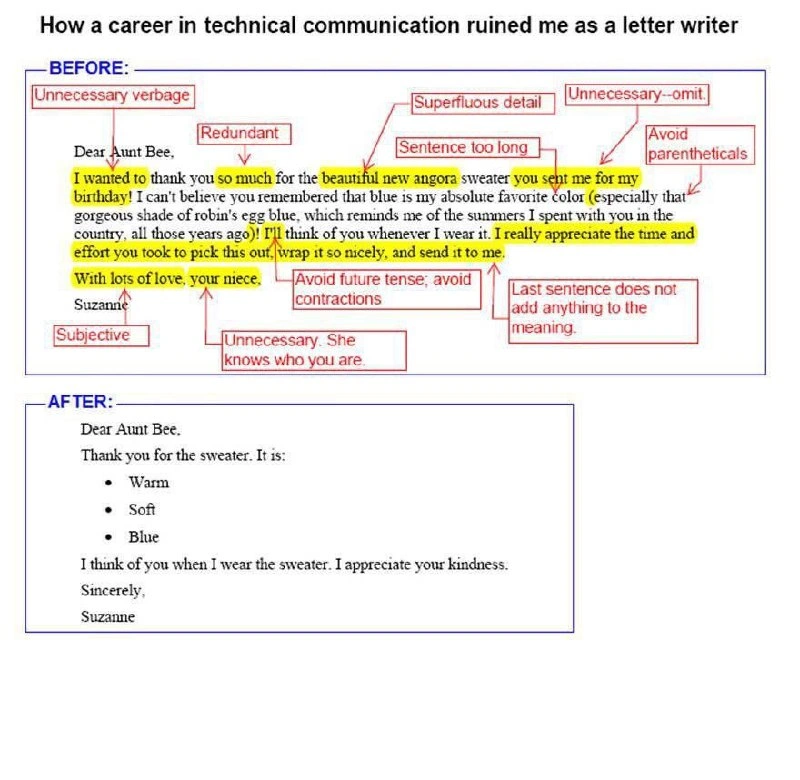
In this meme, we witness a before/after transformation that perfectly captures documentation humor. The scenario: a woman named Suzanne writes a warm thank-you letter to her Aunt Bee for a birthday present (an angora sweater). In the “BEFORE” panel, the letter is written in a very personal, flowing style – the kind of warm, appreciative note you’d normally send a loved one. It’s full of affectionate language and vivid detail: she gushes about the “beautiful new angora sweater”, mentions how blue is her favorite color (even recalling “that gorgeous shade of robin's egg blue” from summers in the country with her aunt), and expresses heartfelt thanks for the aunt’s time and effort in choosing and sending the gift. She even closes with “With lots of love, your niece, Suzanne”. It’s sweet and a bit verbose, as personal letters can be.

Enter the technical writer side of Suzanne’s brain – and everything changes in the “AFTER” panel. The meme jokes that her career in technical communication has “ruined” her ability to write a normal letter. All the warm, fuzzy, extra words get brutally edited out or rewritten. What remains is a brutally concise checklist-style note. The edited “AFTER” letter reads:

“Dear Aunt Bee, Thank you for the sweater. It is:

  • Warm
  • Soft
  • Blue I think of you when I wear the sweater. I appreciate your kindness. Sincerely, Suzanne.”

Let’s break down why this is funny and what’s going on, especially for someone newer to these concepts:

  • Technical Writing Style: The after-letter is written in a style that technical writers use for things like user manuals or software documentation. It’s very clear, direct, and only includes necessary information. Technical writers are trained to remove any fluff (unnecessary words or subjective opinions) and focus on facts. For example, instead of saying “I wanted to thank you so much for the beautiful sweater,” the edited version just says “Thank you for the sweater.” One sentence, very straightforward. This is part of the Keep It Simple approach. In documentation, you don’t say more than you need to.

  • Bullet Points: Notice how the qualities of the sweater (warm, soft, blue) are listed as bullet points in the AFTER version. Bullet points are a common tool in technical documents because they make information easy to scan and read. If you open any software manual or product description, you’ll often see bulleted lists of features. Here, the qualities of the sweater have been turned into what looks like a feature list. In a normal thank-you letter, you might write a flowing sentence like “It’s so warm and soft, and the color blue is just perfect!” But Suzanne’s inner tech-writer chops that up into a neat list:

    • Warm
    • Soft
    • Blue
      This is funny because nobody writes a personal letter like that – it resembles a product specification or a checklist rather than a heartfelt description. It’s as if she’s treating the sweater like a piece of tech hardware that needs its specs listed for Aunt Bee’s reference!
  • Clarity over Emotion (Verbosity vs. Clarity): The original letter had a lot of verbosity – which means it used many words and had a lot of extra detail. It was very emotional and personal (e.g., talking about summers long ago, favorite colors, etc.). The revised letter values clarity and brevity above all. It removes anything that’s not directly about thanking Aunt Bee for the sweater. For example, the line about summers in the country is completely gone in the AFTER version, because from a purely informational standpoint, Aunt Bee already knows those memories – and they aren’t needed to understand the current situation (the thank-you for the gift). In technical writing, especially in technical documentation, any detail that doesn’t help the user achieve their goal or understand the product can be seen as a distraction. So technical editors remove it. In the context of a letter, cutting out those personal touches makes the letter much more impersonal and dry – which is exactly why it’s humorous. Suzanne’s training has taught her to “omit needless words” (a classic writing rule), but applying that to a loving note feels over-the-top.

  • Redline Review & Edits: In the image, the BEFORE letter is covered in red notes and highlights, as if an editor attacked it with a red pen (or used Microsoft Word’s track changes feature). This is known as a redline review – editors or reviewers will mark up a document in red to show what should be removed or changed. Each red comment in the meme is a critique that a technical writing reviewer might make:

    • “Unnecessary verbiage” – means some words or phrases don’t add value and should be cut out. (For instance, saying “I wanted to thank you” is unnecessary if you can just say “Thank you.” The desire to thank is implied by the act of thanking itself.)
    • “Redundant” – means something is repeated or already known. (She signed “your niece, Suzanne”, but Aunt Bee knows Suzanne is her niece. In a manual, this would be like defining a term twice – not needed.)
    • “Superfluous detail” – means an extra detail that isn’t needed. (The bit about robin’s egg blue reminding her of summers past – a lovely detail for Aunt Bee, but not necessary to say “thank you for the sweater”. It’s like a line of commentary that doesn’t change the outcome.)
    • “Sentence too long” – long sentences can be hard to read, so breaking them up is preferred. (The editor likely split one long sentence into two shorter ones in the final version. In documentation, short, clear sentences help readers, especially if their first language isn’t English.)
    • “Avoid parentheticals” – parentheticals are those side-notes in parentheses. They can clutter a sentence or confuse readers if overused. The original had a parenthetical about the color (“especially that gorgeous shade of robin’s egg blue…”), which the tech writer in her removed entirely.
    • “Avoid future tense; avoid contractions” – Many style guides instruct writers to use present tense and avoid contractions in formal writing. Future tense (e.g., “I’ll think of you whenever I wear it”) was changed to present (“I think of you when I wear it”) in the final. And the contraction “I’ll” was expanded or adjusted to not use a contraction. This rule is about clarity and formality: “I’ll” could be seen as slightly informal, and future tense is less direct than present in certain documentation contexts.
    • “Subjective” – This label was likely put on words like “beautiful” or “gorgeous” which are subjective opinions. In technical writing, you generally avoid subjective adjectives because you want to be objective. For example, a user manual wouldn’t say “our phone has a beautiful screen,” it would say “the phone has a 6-inch OLED screen” and let the reader decide if it’s beautiful. In Suzanne’s edited thank-you, all those opinion words are gone; she only states facts (the sweater is warm, soft, blue).
    • “Unnecessary. She knows who you are.” – This refers to Suzanne originally signing off as “your niece, Suzanne.” In a formal editing sense, the reviewer says it’s unnecessary to state the obvious. In many technical documents or business letters, you wouldn’t include information the reader already knows because it’s seen as redundant. (Though in a normal personal letter, it’s just a polite or affectionate way to close – but the joke is the tech writer part of her doesn’t tolerate even that.)
    • “Last sentence does not add anything to the meaning.” – The last sentence of the original was something like “With lots of love” or a further flourish of appreciation. The editor deemed it adds no new information because she already thanked Aunt Bee and appreciated the gift. In a tech writer’s eyes, it’s repetitive. This is similar to how in a technical document, you might remove a sentence that just restates what was already said.

All of these changes reflect technical writing skills being over-applied. The final result is clear, structured, and technically correct, but the human touch is largely stripped away. This contrast is what makes it funny: it’s the collision of communication styles. On one side, personal communication (like a letter to family) is usually emotional, elaborate, and unique to the relationship. On the other side, professional technical communication is utilitarian, standardized, and focused on clarity and efficiency. Seeing family affection get translated into business-like documentation creates an absurd vibe. It’s like receiving a user manual for a hug.

People in tech, especially those who write documentation or have ever had to edit someone’s long-winded email, will chuckle at this because it’s so relatable. For example, new developers or interns might write a very long explanatory comment or commit message, and a senior might suggest “simplify that to one or two sentences.” Or perhaps you’ve had a manager or mentor review something you wrote and cut out half of it, saying it wasn’t needed. Over time, you learn to communicate more succinctly for work purposes. Suzanne in this meme has learned that lesson too well – she can’t stop herself from cutting needless words, even in a thank-you note to Aunt Bee!

The meme is categorized under Documentation and Communication for good reason. It highlights documentation practices (like using bullet points and concise wording) and how they affect communication. It also tags KISSPrinciple – which stands for “Keep It Simple, Stupid,” a famous mantra in tech and writing meaning don’t over-complicate things. The KISS principle is clearly at play — the final letter keeps things extremely simple: just a thank you and a short list of factual positives about the sweater. Almost too simple for a personal note!

It also falls under DocumentationHumor and TechHumor because it’s poking fun at the habits of technical writers and developers. There’s an inside joke in the tech community that sometimes engineers and tech writers become overly terse or literal. For instance, someone deeply ingrained in writing instructions might correct friends or family, or find themselves editing an email down for brevity without even thinking. This meme takes that to an extreme and comical conclusion. It reminds us that while these skills are great for writing manuals or README files, they can seem ridiculous in everyday life.

Anyone seeing the Before and After will immediately notice how the concise writing in the second panel, with its bullet-point thank-you, feels stiff and overly formal compared to the warm first draft. The phrase “How a career in technical communication ruined me as a letter writer” at the top of the meme spells it out: the author’s professional habits have “ruined” (in a joking way) her ability to write flowery, affectionate letters. “Ruined” is tongue-in-cheek here; obviously being clear and concise isn’t a bad thing in itself, but it’s humorously portrayed as a spoiler of fun, sentimental writing.

In summary, this meme is showing a before_after_meme scenario: before, we have a verbose but sincere thank-you note; after, we have a polished, efficient thank-you note that reads like a section of a technical document. It’s a funny comparison of verbosity_vs_clarity, demonstrating the extremes of each. For a junior or someone new to tech, it’s a lighthearted way to see just how much emphasis is placed on clarity and simplicity in technical fields. And it’s also a gentle reminder: context matters. The way we write for work (especially in technical documentation) is often very different from how we’d write to friends or family. Mixing those contexts can lead to comical results – like Aunt Bee receiving a thank-you letter that feels like a product manual!

Level 3: Ruthless Redlines

This meme hilariously exposes the KISS principle (Keep It Simple, Stupid) taken to an extreme by a seasoned technical writer. In the BEFORE panel, we see a heartfelt, florid thank-you note packed with gratitude, personal anecdotes, and emotional warmth. But a career in technical communication has turned the author into a ruthless editor: the letter is splattered with red annotations like an overzealous code review. Every instance of verbosity vs clarity is flagged and slashed. The technical writer’s internal style-guide alarm is ringing off the hook, marking up the note with comments such as “Unnecessary verbiage”, “Superfluous detail”, and “Avoid parentheticals”. Each markup mirrors the strict rules of documentation writing:

  • Unnecessary verbiage – Extraneous words are trimmed mercilessly. The original opening "I wanted to thank you so much..." gets refactored to a direct “Thank you”. Just as in clean code, there’s no need for a verbose preamble when a single clear statement does the job.
  • Redundant – Repeating known information is a cardinal sin in both writing and programming. The sign-off "With lots of love, your niece, Suzanne" is cut because Aunt Bee knows who her niece is; it's as redundant as defining the same variable twice in code.
  • Superfluous detail – The nostalgic aside about the gorgeous shade of robin's egg blue and summers in the country is delightful in a personal letter, but a technical writer treats it like dead code. It’s not directly contributing to the core message (the thanks for the sweater), so it gets the axe. Documentation humor often riffs on this habit of brutally excising any detail not mission-critical.
  • Sentence too long – One sprawling sentence is split or simplified. Long, winding sentences are hard to parse (for readers and for parsers!). Just as a developer breaks down a monolithic function for readability, the tech writer breaks sentences for clarity.
  • Avoid parentheticals – The original letter’s parentheses (whispering a little extra info about that robin's egg blue) are cut out. In formal technical documentation, parenthetical remarks are often removed or turned into separate sentences because they can distract or confuse if overused. The meme plays this up to show how even a sweet personal aside isn’t safe from the red pen.
  • Avoid future tense; avoid contractions – The note "I'll think of you whenever I wear it" is revised to "I think of you when I wear the sweater." This is classic technical writing skills in action: instructions and documentation usually use present tense and avoid contractions for simplicity and global understanding. It reads more like a user manual: factual and immediate. (Also, no contraction “I’ll” – many style guides say “do not use contractions” to maintain a formal tone and avoid ambiguity for non-native readers.)
  • Subjective – Words like “beautiful”, “absolutely favorite”, or “gorgeous” are flagged as subjective and thus unwelcome. In a user guide or API doc, we stick to facts; calling something beautiful or gorgeous is an opinion. The meme exaggerates this: even expressing how much she loved the color gets treated like a forbidden subjective statement. It’s as if the writer has a built-in linting tool for emotional language, deleting it with cold precision.
  • Last sentence does not add anything – The warm farewell "I really appreciate the time and effort you took..." is deemed informationally redundant (it repeats the appreciation already implied by saying thanks). The brutal editor within treats this like duplicate code and comments it out of existence. After all, the point has been made; why say it twice?

After all these redline edits, the poor thank-you letter has been refactored into the AFTER panel: a minimalist masterpiece of clarity. It reads almost like release notes or a Jira ticket update for “Project: Birthday Sweater” 😄. Bullet points enumerate the sweater’s features in a neat list, just as a spec sheet or changelog would list product features or bug fixes. The final note is brutally concise:

Dear Aunt Bee,
Thank you for the sweater. It is:
Warm
Soft
Blue
I think of you when I wear the sweater. I appreciate your kindness.
Sincerely, Suzanne.

This format screams technical documentation style. The letter has transformed into a checklist of facts: warm, soft, blue. It’s as if Aunt Bee’s gift was a product and our writer is documenting its specs for an instruction manual! The personal, poetic touch is replaced with a dry bullet list that any QA tester would love. Developers and tech writers reading this are likely grinning (or cringing) because it’s tech humor hitting close to home. We’ve all seen overly wordy documents get mercilessly edited down to raw essentials, or flowery marketing copy turned into straightforward support notes. The meme cleverly lampoons that process by applying it to a wholesome thank-you note – an absurd context for such rigidity, which makes it even funnier.

The KISS principle shines through here: Keep It Simple. Our technical communicator has certainly kept it simple – arguably to a fault. The resulting letter is crystal-clear and efficient, yes, but it’s also as emotionally dry as a server log. This duality is where the comedy lives: the clash between communication intended to convey feelings and the analytical style meant for clarity and utility. It’s the same comedic contrast as writing a love letter in the form of a GitHub README. In the tech world, we prize eliminating redundancy and sticking to facts – documentation should be concise, user-focused, and unambiguous. But when those habits bleed into personal life, you get something that’s both impressively clear and unintentionally cold.

For seasoned developers and writers, this “Before vs After” is instantly relatable. It evokes the memory of countless document reviews (or code reviews) where a senior engineer or editor slashes through fluffy text like a hot knife through butter. It recalls the relentless editing of a verbose project spec down to a lean outline, or a pull request where polite commentary is cut in favor of a terse bullet list. The redline review style comments in the image mimic how editors collaborate on Google Docs or Word, or how diffs appear in version control – except here it’s applied to Aunt Bee’s lovely note. It’s as if the letter was treated like an overly commented piece of code, optimized and minified for production!

Historically, the push for clear, minimal writing in tech came from the need to globalize documentation and make it accessible. Tech writers are trained to assume the reader might skim, or English might be their second language, so every unnecessary word is a barrier. The KISS principle itself originated in engineering decades ago to remind people that simplicity ensures reliability. In documentation, that means short sentences, active voice, and bullet points for easy reading. In the meme, Suzanne (our notional technical writer) applies these principles so rigorously that she ends up with a letter that feels more like a NASA checklist than a note to dear Aunt Bee. It’s a classic case of verbosity vs. clarity where clarity won the battle but perhaps lost the warmth.

In summary, the humor emerges from seeing a warm human expression transformed into a Spartan technical report. It’s the kind of joke you’d find pinned on a cubicle wall in a documentation department or shared in a Slack channel for tech writers. The meme is poking fun at how a professional skill – being concise and methodical – can overflow into everyday life in comical ways. Anyone who has spent hours simplifying paragraphs in a user manual or crafting the perfect succinct commit message can relate. It’s a nod to the fact that once you internalize the rules of technical writing, you start seeing “unnecessary verbiage” everywhere... even in a niece’s thank-you note to her beloved Aunt. The result? A thank-you note that is accurate and to-the-point – and unintentionally, ridiculously formal. This before-and-after contrast is both an indictment and an affectionate tease of the technical writer mindset, illustrating how the drive for concise writing can sometimes go a bit overboard.

Description

A two-part meme titled 'How a career in technical communication ruined me as a letter writer' contrasts a personal letter before and after applying technical writing principles. The 'BEFORE' section displays a warm, effusive thank-you note to 'Aunt Bee' for a sweater. This letter is heavily annotated with red boxes and arrows, pointing out supposed flaws such as 'Unnecessary verbage,' 'Redundant,' 'Superfluous detail,' 'Sentence too long,' and 'Avoid parentheticals,' effectively critiquing it like a piece of technical documentation. The 'AFTER' section shows the revised letter, which is stark, concise, and devoid of emotion. It reads: 'Dear Aunt Bee, Thank you for the sweater. It is: • Warm • Soft • Blue. I think of you when I wear the sweater. I appreciate your kindness. Sincerely, Suzanne.' The humor originates from the absurd application of technical writing's sterile, efficiency-focused rules to personal communication, stripping it of all humanity. It's a relatable scenario for senior developers who must constantly switch between writing precise, unambiguous documentation and engaging in normal human interaction
Comments

8
Anonymous ★ Top Pick This is what happens when you spend a decade writing RFCs. You start sending PRs for your family's holiday cards with comments like 'Nit: 'love' is a subjective term, suggest replacing with 'familial regards'.'
  1. Anonymous ★ Top Pick

    This is what happens when you spend a decade writing RFCs. You start sending PRs for your family's holiday cards with comments like 'Nit: 'love' is a subjective term, suggest replacing with 'familial regards'.'

  2. Anonymous

    Twenty years of API doc reviews and my thank-you notes now ship as RFCs: “Sweater MUST be warm, SHOULD be blue, MAY trigger nostalgia - gift acknowledged, ticket closed.”

  3. Anonymous

    After 15 years of writing API docs and arguing about Oxford commas in PR reviews, you start treating your mother's birthday card like a JIRA ticket that needs to pass linting rules and have zero redundancy - because why say 'I love you' when a simple boolean would suffice?

  4. Anonymous

    After years of writing API documentation and technical specs, this engineer has achieved the ultimate optimization: reducing a heartfelt thank-you letter to a JSON-like structure with bullet points. The real tragedy isn't the loss of warmth - it's that they probably spent 3 hours refactoring the 'AFTER' version to ensure maximum information density per character. Next iteration: replace the entire letter with a single HTTP status code: '200 OK, sweater received.' The code review feedback would be: 'LGTM, but consider using a more specific status code like 226 IM Used to indicate the sweater is already being worn.'

  5. Anonymous

    Years of writing RFCs means my gratitude now ships as acceptance criteria - warm, soft, blue - with “love” removed in review as redundant

  6. Anonymous

    PR reviews rewired my brain: now even sweater thanks pass linting with zero fluff warnings

  7. Anonymous

    A decade of PRs turned my thank-you notes into a changelog: Warm, Soft, Blue - acceptance criteria met, emotion deprecated, LGTM

  8. @zherud 3y

    Wait, is there an AI to do that?

Use J and K for navigation