Skip to content
DevMeme
2996 of 7435
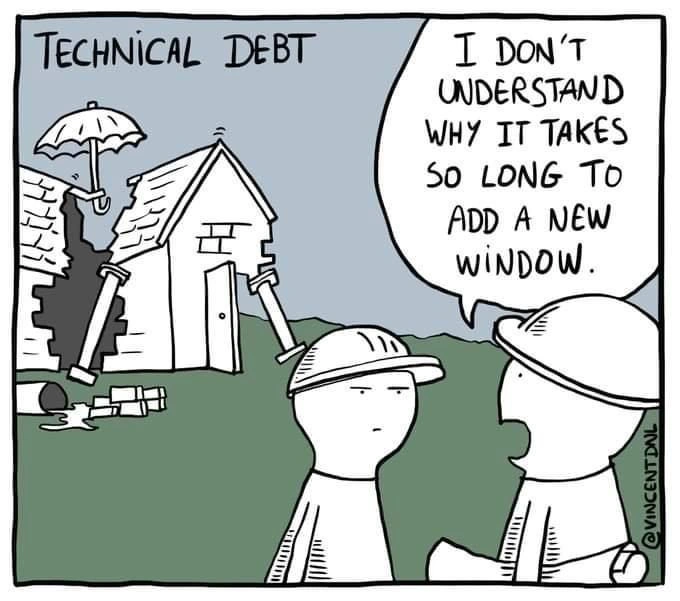
The deceptively simple feature request on a mountain of tech debt
TechDebt Post #3309, on Jun 22, 2021 in TG

The deceptively simple feature request on a mountain of tech debt

Why is this TechDebt meme funny?

Level 1: Shaky Tower

Imagine you built a really tall tower out of blocks but you didn’t stack them very neatly. The tower is wobbly and leaning – it could fall at any time. Now your friend comes along and says, “Hey, let’s add one more block as a window in the tower!” You know that if you even touch this shaky tower, it might collapse. Adding that one block sounds simple, but because the tower isn’t strong, it’s actually a huge deal to do it without everything crashing down. In the picture, the broken shed is like that unstable tower, and the person asking for a new window doesn’t realize the whole house is fragile. It’s funny and a little silly because one person thinks a small change should be easy, while the other person (the builder) is worried that the entire structure will fall apart. So the joke is basically: something that looks easy can be incredibly hard if what you’re working with is already a mess. It’s like your friend can’t understand why you’re so worried about adding one tiny block – but you know the tower’s about to tip over!

Level 2: Just Add a Window

In this meme, an old broken-down shed represents a software project full of technical debt. Technical debt is what we call it when developers take shortcuts in coding – like writing sloppy code or skipping tests to meet a deadline. It’s like making a deal with the devil: you get something done quickly now, but you’ll pay for it later when that code is harder to change or breaks easily. The shed is literally held up by random planks and even an umbrella, meaning the codebase has been propped up with lots of quick fixes and hacks over time. It’s barely standing! This is a crumbling architecture: a system design that has become very fragile due to all those band-aid solutions. Think of code that’s tangled and delicate – if you touch one part, something else might snap. There might be global variables, copy-pasted code everywhere, or outdated modules that nobody dared to upgrade. The sign “TECHNICAL DEBT” on the cartoon shack tells us that this poor project has a huge backlog of code improvements that were never done. Instead of rebuilding the “house” properly, the team kept patching it up.

Now, the funny part: a stakeholder (like a client or a manager – basically someone who has a stake in the project but doesn’t write the code) is asking, “Why does it take so long to add a new window?” In plain terms, they requested a new feature (the “window”) and they can’t fathom why it’s not done in an afternoon. This is a classic StakeholderExpectations problem. To someone non-technical, adding a small feature or a button or a field seems easy. “It’s just a window, just a small change!” – how complicated could it be? But the developers know that under the hood, the system is a mess. It’s hidden complexity: all the complexity is hidden behind the scenes in the code’s structure. Adding that new window might involve touching a part of the code that’s intertwined with many other parts. For example, imagine the code for the app’s features is all in one giant function or tightly knit classes. If you change one thing, ten other things might break because of implicit assumptions or tight coupling. There might not be proper interfaces or modules to isolate that change. It’s like the shed’s wall – you can’t cut a hole in it for the window without first dealing with the fact that the wall itself might not be stable.

For a junior developer or someone new to the industry, this meme teaches an important lesson: code quality matters. If a codebase has poor design or a lot of TechDebt (maybe from rushing through tasks in the past), then even straightforward tasks can become very time-consuming. The team might have to do refactoring (reworking old code to improve its structure) before they can safely add the new feature. Sometimes you hear seniors say, “We need to pay down the technical debt.” This means spending time now to fix and clean code (like reinforcing the foundation of the house) so that future changes are easier. If you skip this, you accumulate more and more “debt” and the interest on that debt is that everything new takes longer and might break stuff. This is a RealWorldTradeoffs scenario: in real projects, you often have to balance delivering features quickly (which can create messy code) and doing it the right way (which takes longer initially). The humor here is very relatable to developers because many of us have been in a meeting explaining to a perplexed boss why a one-line change actually requires a week of work. It’s a bit of “you had to be there” comedy – if you’ve dealt with legacy code, you’ll likely smirk and maybe cry a little inside.

In summary, “just add a window” isn’t just adding a window when your software system is like that shaky shack. The meme reminds everyone that small requests can hide big engineering effort if the underlying code structure is poor. It’s both a joke and a gentle warning: take care of your code’s architecture (keep your “house” in order) or you’ll end up telling your stakeholders, “Sorry, adding this tiny thing is taking so long because everything might crumble.” And nobody enjoys saying that! This picture has become a DeveloperHumor classic precisely because it captures that awkward reality in one image.

Level 3: Cracks in the Foundation

This cartoon perfectly captures a Technical Debt nightmare disguised as a construction scene. The construction analogy is spot on: the dilapidated shack labeled “TECHNICAL DEBT” represents a software system held together by band-aid fixes (those planks, pipes, and even an umbrella propping it up). In code terms, those props are the countless quick hacks and temporary patches applied over time to keep the project running. The spilled paint cans and debris are like leftover bug workarounds and half-finished refactors – remnants of past attempts to fix things that never fully cleaned up the mess. The whole structure is teetering on a shaky foundation, much like a legacy codebase with fragile architecture. One look and any senior engineer can tell: this house is a big ball of mud architecture-wise, ready to collapse if you breathe on it too hard.

Enter the bewildered stakeholder in a hard hat, asking “I don’t understand why it takes so long to add a new window.” This character represents a typical non-technical manager or client with StakeholderExpectations wildly out of sync with reality. To them, a “window” is just a small addition – in software terms, maybe a simple new feature or UI element. From the outside, it sounds trivial. After all, how hard could it be to cut a hole in the wall and pop in a window? But the seasoned developer (the other construction worker with the weary expression) knows the ugly truth: this isn’t just any wall, it’s a load-bearing wall in a rickety house. Cutting a new opening could bring the whole shack tumbling down. In software, this “window” feature request might touch a part of the code that is tightly coupled to everything else. The codebase might be so fragile that adding or changing one thing has cascading side effects. This is the HiddenComplexity that the stakeholder doesn’t see. The humor (tinged with pain) comes from that huge gap in understanding – a RelatableHumor moment for developers who’ve had to justify unexpectedly long timelines for “simple” requests.

Let’s break down why adding a “window” is a big deal in a tech debt shack. Over years, the team likely made ArchitectureTradeoffs favoring speed over quality – rushing out features and quick_fix_expectation patches to please stakeholders. Each shortcut was like adding another flimsy plank or nail to the structure without fixing the underlying foundation. These decisions accumulate interest, much like a financial debt. The term technical debt itself was coined by Ward Cunningham to describe how cutting corners in code can incur a future cost. Initially, skipping proper design or cleanup lets you deliver features faster (like taking out a loan to get something now). But the “interest” on this debt is paid in the form of slower development later, bugs, and the risk of catastrophic failure. Here, after many such RealWorldTradeoffs, the system’s code quality resembles that wobbly shack: any new change is perilous. The CodeQuality is so poor that even a minor addition requires major precaution. Developers might have to strengthen or rewrite parts of the “wall” (refactor the legacy code) just to safely add that window. It’s not simply inserting a few lines of code – it might involve untangling spaghetti code, updating an outdated framework, or rewriting a module that can’t support the new feature. In extreme cases, a seemingly small feature can trigger a refactor avalanche: “Sure, we can add a window, but first we need to rebuild half the house so it doesn’t collapse.”

Seasoned engineers know the architecture is fundamentally broken when every task feels like disarming a bomb. Common symptoms include: no unit tests to catch regressions (so you fear touching anything), mysterious couplings where unrelated parts break from a small change, and // TODO: fix this later comments scattered like landmines in the code (later never came). The cartoon’s imagery of an umbrella propping up a wall nails this perfectly – it’s like using try-catch to swallow errors or hot-fixing production at 3 AM with a one-liner, praying things hold together. We laugh (a bit darkly) because we’ve lived this: deploying a simple patch “small feature” that unexpectedly crashes production. It’s always that one extra window or one last straw that reveals how brittle things truly are.

The quote “I don’t understand why it takes so long” is practically every developer’s memory of a meeting with higher-ups. This meme’s DeveloperHumor works because it exaggerates a real communication gap. The stakeholder sees just the shiny new window (a benefit), while the developer sees the crumbling_architecture_meme behind the scenes. It’s a classic case of “the last 10% of the work takes 90% of the time” when your project is riddled with technical debt. Experienced devs chuckle (and wince) because they know adding one more thing without addressing the root issues is asking for trouble. It’s a reminder that RealWorldTradeoffs in software – pushing for speed and new features over maintenance – eventually lead to a precarious situation. The only real fix is to pay down that debt: rebuild and refactor the “foundation” properly. Until then, every new window_feature_request requires careful bracing, lots of explanation to non-engineers, and a bit of luck that the whole system doesn’t implode. The humor is equal parts catharsis and caution: “Go ahead, add the window… just don’t be surprised when the wall falls off.”

Description

A single-panel cartoon by Vincent Dail, titled 'TECHNICAL DEBT' at the top. The image uses a powerful construction metaphor to explain this software concept. In the background stands a dilapidated, crumbling white house, propped up by makeshift pillars and clearly in a state of disrepair, with a tiny umbrella patching a hole in the roof. In the foreground, two figures in hard hats are in conversation. One figure, presumably a client or project manager, holds blueprints and exclaims with frustration in a large speech bubble: 'I DON'T UNDERSTAND WHY IT TAKES SO LONG TO ADD A NEW WINDOW.' The other figure, representing the developer, stares back with a deadpan, weary expression, silently conveying the immense, unseen effort required to modify the fragile structure. The humor lies in the disconnect between the apparent simplicity of the request and the complex, fragile reality of the underlying system, a situation all too familiar to senior developers working on legacy codebases
Comments

12
Anonymous ★ Top Pick Sure, adding the window is a 1-point story. The other 20 points are for the emergency foundation work, asbestos removal, and structural reinforcement that we've been deferring for three years
  1. Anonymous ★ Top Pick

    Sure, adding the window is a 1-point story. The other 20 points are for the emergency foundation work, asbestos removal, and structural reinforcement that we've been deferring for three years

  2. Anonymous

    The window’s a three-line PR - the other 1,397 lines are us relocating the load-bearing singletons and untangling the circular dependencies currently moonlighting as support beams

  3. Anonymous

    After 15 years in the industry, you realize the hardest part isn't explaining why adding a button requires refactoring three microservices, updating five deprecated APIs, and migrating a database schema - it's explaining why the 'quick fix' from 2019 is now load-bearing infrastructure that powers half the company's revenue stream

  4. Anonymous

    Ah yes, the classic 'just add a window' request - because surely that load-bearing wall of spaghetti code from 2008, held together by regex duct tape and a single developer's tribal knowledge, won't mind if we just drill through it. The umbrella in the comic is particularly apt: it's the equivalent of wrapping everything in try-catch blocks while the foundation crumbles beneath. Every senior engineer has lived this moment - explaining to stakeholders that 'adding a simple feature' requires first excavating three layers of deprecated APIs, refactoring the authentication system that somehow got coupled to the email service, and praying the integration tests someone wrote five years ago still mean something. The real technical debt isn't the code - it's the compounding interest of explaining why we can't just 'make it work' without the whole thing collapsing

  5. Anonymous

    Adding a window is two hours; preventing the house from collapsing because RoofService imports BasementRepository through six singletons is three sprints

  6. Anonymous

    Not the window - it's the load-bearing if-else ladder from Y2K propping up the roof

  7. Anonymous

    Sure, we’ll add a window - right after we refinance the debt; that wall is our auth gateway, message bus, and cache invalidation strategy. The glass is load‑bearing

  8. @interfejs 5y

    tell that to my fucking manager

  9. @Odbjorn 5y

    Just send it to my manager

  10. @furqan 5y

    This is a really good illustration

  11. @furqan 5y

    To explain tech debt

  12. @NiKryukov 5y

    If you're homeless, just buy a house

Use J and K for navigation