Skip to content
DevMeme
2997 of 7435
Corporate Culture Clash: Google vs. Amazon
CorporateCulture Post #3310, on Jun 22, 2021 in TG

Corporate Culture Clash: Google vs. Amazon

Why is this CorporateCulture meme funny?

Level 1: Two Very Different Bosses

Imagine two stores on the same street, each with a very different boss in charge. At the first store, the boss is super nice to all the employees who work there. Every day, he brings them snacks, tells them “great job!” and maybe even gives them little gifts – it’s like he’s giving them flowers to make them happy. But when a customer walks into this store, the boss isn’t as friendly. If a shopper has a complaint or needs help, this boss might shrug it off or even be a bit rude, almost as if he’s pointing a toy gun at them to say “I don’t care” (not literally, but he just doesn’t seem to care about the customers as much as his workers).

Now, at the second store down the road, it’s the opposite. The boss there is all about the customers. Any time a customer comes in, this boss smiles, offers help and maybe free samples, and will do anything to make sure the customer is happy – it’s like handing a flower to every shopper. But behind the scenes in the staff room, this boss is really tough on the employees. He makes them work late, yells if they take a break, and is always pushing them hard – it’s as if he has a toy gun pointed at the staff saying “keep working or else!” (again, not a real gun, just a lot of pressure).

These two pretend bosses show two extreme ways a company could be run. One boss is treating his employees like gold but forgetting about the customers, and the other is treating the customers like royalty but being harsh on the employees. It’s a funny, exaggerated scenario that shows how silly it would be if a business only cared about one group and not the other. In real life, of course, a good company should try to keep both its workers and its customers happy. But this cartoon makes us laugh because it imagines what happens when a company goes to extremes in one direction – in one store the staff get all the nice treatment and the customers get the grumpy treatment, while in the other store it’s the reverse. Seeing those two opposite situations side by side is so over-the-top that it comes off as humorous.

Level 2: Customer-Obsessed vs Employee-First

This meme compares how two famous tech companies – Google and Amazon – each treat two key groups of people in their business: the employees (the people who work for the company) and the customers (the people who use or buy the company’s products). Both Google and Amazon are part of the elite FAANG companies (Facebook, Amazon, Apple, Netflix, Google), but they have very different reputations when it comes to workplace values. In other words, their corporate cultures (a term meaning the overall environment and priorities within a company) are almost opposites in this area.

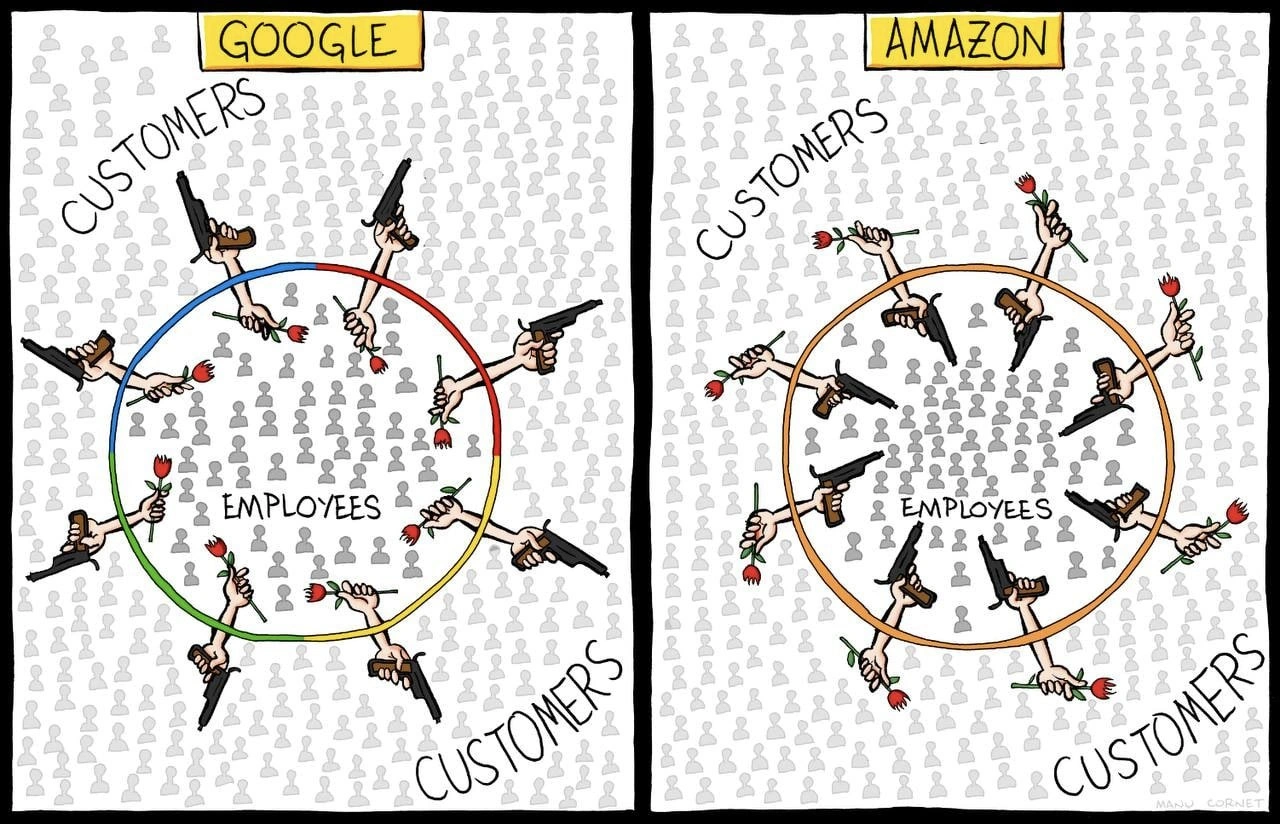
The cartoon uses a simple guns vs. roses metaphor to illustrate these differences. Here, a rose represents kindness, rewards, or positive treatment, and a gun represents pressure, harsh treatment, or negativity. (Fun fact: "Guns N' Roses" is also the name of a famous rock band, which makes the choice of symbols a witty pun for those who notice.) In the Google panel on the left, the company is depicted as giving roses to its employees (being very kind and generous to people who work at Google), while pointing guns at its customers (not giving the same level of care to the people who use Google’s products). In the Amazon panel on the right, it’s the opposite: Amazon is shown offering roses to its customers (going out of its way to keep shoppers and users happy), while aiming guns at its employees (putting a lot of stress and demands on the people working at Amazon).

Why would someone draw this? It’s highlighting each company’s focus or motto. Google’s culture is often described as employee-friendly. For instance, Google is famous for providing employees with perks like free gourmet meals, on-site gyms, massage rooms, and even allowing engineers to spend 20% of their work time on any project they want. This approach is sometimes summed up as an “employee-first” mindset, meaning Google leadership often thinks “if we take care of our employees, they will create great things for users.” In the cartoon, that idea is depicted by all the hands giving nice things (roses) to the EMPLOYEES inside Google’s circle. However, the downside (as the meme jokes) is that Google might not always prioritize its customers to the same degree. The guns pointing at "CUSTOMERS" suggest that users can feel ignored or hurt by Google’s choices. A real-life example: Google has a habit of shutting down some products or services that, while not crucial to Google’s business, are loved by a group of users. When those get discontinued, those customers feel like Google didn’t care about them.

On the other hand, Amazon’s culture is famously customer-focused. Amazon often talks about “customer obsession,” which means they always put the customer’s experience first. The company will go to great lengths to make shoppers happy – such as offering very fast shipping, easy returns, constantly adding new features, and keeping prices low. In the cartoon, the Amazon side illustrates this by having all the roses handed out to CUSTOMERS. That shows Amazon giving love and rewards to the people buying from them. But what about the employees? The hands with guns pointing at "EMPLOYEES" inside Amazon’s circle signify that working at Amazon can be very demanding. An “obsession” with customers often translates into a lot of internal pressure on employees to deliver results. Amazon employees are known to work long hours, have rigorous performance evaluations, and face a tough environment. (For example, warehouse workers have their productivity closely tracked, and software engineers might have tight deadlines and be on-call to fix issues at all hours.) The cartoon exaggerates this by showing guns aimed at the employees – of course Amazon isn’t literally threatening its workers, but it can feel intense or intimidating in terms of workload and expectations.

In business terms, employees and customers are both important stakeholders (people who have a stake in or are affected by the company). But this meme humorously suggests that each company has chosen one side to favor heavily. Essentially, Google is portrayed as a company that is extremely kind to its employees (like handing out roses to the staff) even if that means sometimes not bending over backwards for every customer. Amazon is portrayed as extremely devoted to pleasing customers (showering customers with roses) even if that means pushing its employees very hard (symbolically pointing guns at the staff to keep them in line). It’s an exaggerated cartoon way to show the trade-off in priorities: one company puts its employees first, the other puts its customers first. The joke is that taken to an extreme, both approaches look a bit absurd – ideally, a good company would find a balance where both employees and customers are treated well.

Level 3: Flower Power vs Firepower

In big tech, there's a constant balancing act between key stakeholders – mainly employees vs customers. This two-panel comic, drawn in the distinctive style of Manu Cornet (a Googler famous for wry tech cartoons), nails that tension with a vivid guns-and-roses metaphor. The left panel labeled Google shows a circle drawn in Google’s signature blue-red-yellow-green colors enclosing silhouettes marked "EMPLOYEES," with "CUSTOMERS" milling outside. Around that circle’s perimeter, alternating arms either extend inward holding out red roses to pamper the employees, or thrust pistols outward aiming at the customers. In the right panel labeled Amazon, the arrangement is inverted: an orange circle (evoking Amazon’s brand color) corrals the "EMPLOYEES," and the surrounding arms now offer roses outward to customers while pointing guns inward at employees.

To a seasoned engineer, this image hits on an all-too-real trade-off in corporate priorities. Google is notorious (in a good way) for its employee-first ethos. It’s the company of free gourmet cafeterias, on-site massages, liberal 20% time for passion projects, and TGIF all-hands parties. The unspoken strategy: keep developers deliriously happy and creativity will flow, ultimately benefiting users down the line. The cartoon’s roses offered inward represent all those perks and kindness showered on Googlers. But notice the guns facing outward: this humorously suggests that Google’s customers can end up feeling neglected or even "attacked" by Google’s decisions. Ever hear of a beloved Google product being suddenly killed? The joke among devs is "Don’t get too attached; it might be Killed by Google." When Google axed services like Reader and countless others, users felt like the company shot them in the back for the sake of internal priorities. The pistol pointing at "CUSTOMERS" in the drawing is a darkly comic way to say Google sometimes acts in its own (employee-driven) interest even if users get upset.

Flip to Amazon’s side: the entire script is reversed. Amazon’s culture is legendary for customer obsession – it’s literally Leadership Principle #1: "Customer Obsession: Leaders start with the customer and work backwards." The cartoon shows every rose extended outward beyond the circle, symbolizing Amazon bending over backwards to delight customers (fast shipping, ever-dropping prices, AWS uptime at all costs). But what about inside that circle? Those guns aimed at "EMPLOYEES" reflect Amazon’s equally famous reputation for being a brutal workplace for those on the inside. This isn’t literal violence, of course, but ask an Amazon engineer about on-call rotations or performance reviews and you might hear stories of stress and pressure that feel like having a barrel pointed at you. Amazon’s philosophy is often summarized as “the customer is king”, and implicitly, “employees must deliver, whatever it takes.” Long hours, PagerDuty alarms at 2 AM, and relentless metrics are the norm. Little wonder the arms are shown brandishing weapons inward: it’s a visual gag about management applying heavy pressure on its own people to meet customer needs. For example, if a critical AWS service hiccups at midnight, guess who gets woken up to fix it? The on-call developer (no dedicated overnight NOC to hide behind) will be scrambling to restore service because downtime hurts customers immediately. You build it, you run it – an Amazon mantra – is great for buyers and clients, but it means engineers live with that gun-to-the-temple urgency to keep things running.

The humor really lands because it’s exaggerating truths tech veterans swap over beers. Google’s staff enjoy lavish perks, sometimes to the point outsiders joke that Googlers are living in a pampered bubble while users deal with beta products and fickle support. Amazon’s workforce, conversely, is often pushed to their limits in a frugal, sink-or-swim environment, all in service of low prices and quick deliveries that customers love. It’s a classic "guns versus roses" metaphor depicting who gets the love and who gets the short end of the stick. The absurdity of literal guns and flowers draws attention to how stark this contrast can feel.

Historically, these cultures trace back to founder values and business models. Google, flush with ad revenue and a talent-driven innovation pipeline, believed that happy, empowered employees would create world-changing products (hence their unofficial motto, “take care of your employees and they’ll take care of your users”). Amazon, competing on razor-thin retail margins and aiming for customer loyalty, ingrained “the customer comes first, second, and third” into every process – even if internal niceties get sacrificed. Jeff Bezos famously kept an empty chair in meetings to represent the customer’s presence at the table, while Googlers were busy adding nap pods and game rooms to keep engineers’ morale high. The result? Two tech giants, both wildly successful, yet with inverted approaches to who gets pampered. From an insider perspective, this cartoon prompts a knowing, slightly pained chuckle: it nails the ironic truth that a company often hands out roses to one group and metaphorically points guns at the other, depending on its core values. Engineers who’ve been around the block (or survived a stint at either company) appreciate how accurately – if hyperbolically – this meme portrays the culture trade-off. It’s funny because it’s true... and also a little terrifying when you’ve been on the wrong side of that exchange at 3 AM.

Description

A two-panel cartoon by Manu Cornet comparing the perceived corporate cultures of Google and Amazon. Both panels depict a central circle labeled 'EMPLOYEES' surrounded by a sea of figures labeled 'CUSTOMERS'. In the 'GOOGLE' panel on the left, numerous arms emerge from the employee circle; the hands pointing inward at fellow employees are holding guns, while the hands pointing outward toward customers are holding red roses. In the 'AMAZON' panel on the right, the situation is reversed: the hands pointing inward at employees are holding roses, and the hands pointing outward at customers are holding guns. The comic satirizes well-known stereotypes of these tech giants. It portrays Google as having a pleasant, customer-friendly external image but a fiercely competitive and politically fraught internal environment. In contrast, it depicts Amazon as fostering internal alignment while directing all its aggression and competitive energy outward towards the market and customers, a nod to its 'customer obsession' and notoriously fierce business tactics

Comments

29
Anonymous ★ Top Pick The Google diagram is just a standard performance review cycle. The Amazon one is what happens right after a product manager says 'We should be more data-driven in our pricing strategy.'
  1. Anonymous ★ Top Pick

    The Google diagram is just a standard performance review cycle. The Amazon one is what happens right after a product manager says 'We should be more data-driven in our pricing strategy.'

  2. Anonymous

    Google’s resilience policy: if employee happiness dips below five nines, automatically retry with more roses; Amazon’s: if customer latency breaks 100 ms, trip the circuit and route all guns to the on-call

  3. Anonymous

    The only difference between Google and Amazon's org structure is that Google's circular firing squad has rainbow bullets for better diversity metrics

  4. Anonymous

    The meme perfectly captures the architectural difference between Google's 'we'll deprecate your favorite product but give you free lunch' approach versus Amazon's 'leadership principle #14: everyone is on-call, including customers.' Google employees get roses while pointing guns at users who dare use Reader or Inbox; Amazon democratically distributes firearms to all stakeholders, achieving true parity in workplace hostility. It's the difference between a company that kills your projects with kindness and one that implements 'disagree and commit' as a literal combat doctrine

  5. Anonymous

    Google customers enforce CAP theorem's Consistency at gunpoint; Amazon delivers Availability via rose-tinted eventual consistency

  6. Anonymous

    In Google’s schema, EMPLOYEE is the primary key and CUSTOMER a best‑effort cache; in Amazon’s schema, CUSTOMER is the primary key and EMPLOYEE an autoscaled spot instance with preemption enabled

  7. Anonymous

    Google optimizes for DX, Amazon for CX - whichever you don’t write an SLO for becomes the error budget

  8. @ZgGPuo8dZef58K6hxxGVj3Z2 5y

    Uff thats hard

  9. @Isaonn 5y

    with Amazon's messed up UX? Maybe vice versa?

  10. @ZgGPuo8dZef58K6hxxGVj3Z2 5y

    I waited for this version

  11. @prirai 5y

    In Google, it's the same.

  12. @prirai 5y

    Gun both sides.

  13. @sylfn 5y

    What about roses both sides?

    1. @ZgGPuo8dZef58K6hxxGVj3Z2 5y

      Nah thats unrealistic

  14. @punker 5y

    ахахаххаха (ahahahahahah)

    1. Deleted Account 5y

      where is translation!!!!! rofl

      1. @punker 5y

        added in brackets, sorr

        1. @picolino 5y

          lol

        2. @alexeyeva 5y

          those are actually parentheses...

    2. @dontmindmehere 5y

      *Laughing in Russian*

  15. @Roman_Millen 5y

    As a Twitch user, I highly disagree with the "flowers to the customers" part.

  16. @ZgGPuo8dZef58K6hxxGVj3Z2 5y

    I think people didn't get the joke

  17. Deleted Account 5y

    lmao

  18. @mainfme 5y

    Sure, and google, amazon, apple, facebook dont do this Small aged moron

    1. @nuntikov 5y

      Calm down

  19. @ZgGPuo8dZef58K6hxxGVj3Z2 5y

    Tell that to the 98% market share of it

  20. @mainfme 5y

    🤦🏻‍♂

  21. @sylfn 5y

    I don't think YB is shipped with Ubuntu, but it's available from torrents

  22. @callofvoid0 5y

    translation : yandex

Use J and K for navigation