Skip to content
DevMeme
5558 of 7435
Tech Startup Valuation vs. Scrappy Reality
Startup Post #6100, on Jul 9, 2024 in TG

Tech Startup Valuation vs. Scrappy Reality

Why is this Startup meme funny?

Level 1: Big Money for a Blanket Fort

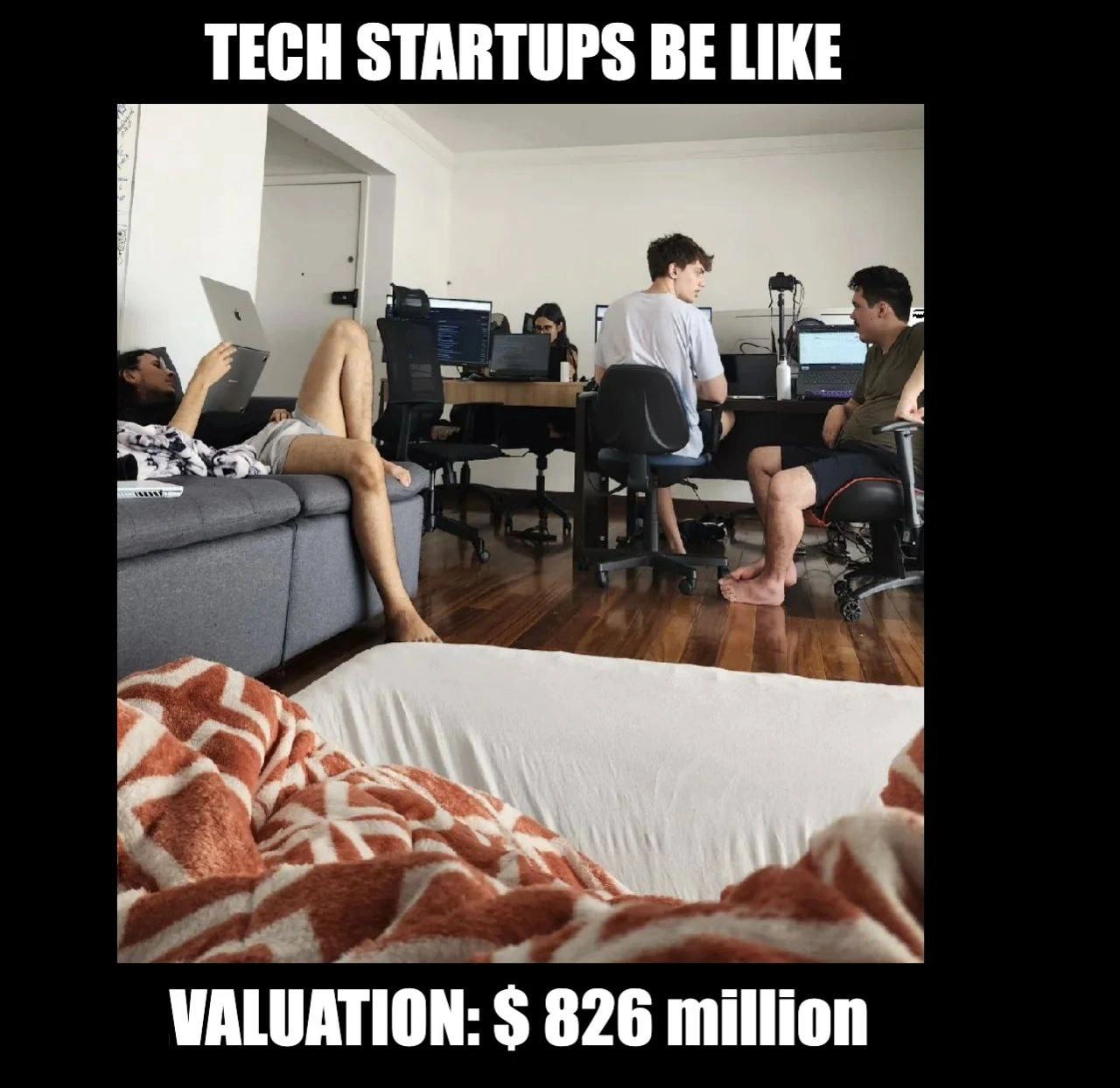
Imagine you and three friends build a little project in your living room – say, like a super-cool new treehouse made of couch cushions and blankets (that’s the kid equivalent of a startup in a home office). You’re all in your pajamas, maybe even barefoot, just having fun and working on this project. Now picture some rich adults coming by, taking one look at your cozy little blanket fort, and saying, “Wow, this is amazing! It must be worth a TON of money. In fact, here’s a giant bag of money because we think this could be the next big thing!” Suddenly they claim your pillow fort project is worth almost a billion dollars. That sounds crazy, right?

That’s exactly the joke of this meme. It’s funny because the scene is so casual and ordinary – just young people coding on laptops in a messy living room, kind of like kids playing and working on a fun idea. But the caption says the project is valued at $826 million, which is an enormous amount of money (imagine 826 million one-dollar bills!). It’s like someone saying your little lemonade stand on the sidewalk is worth as much as a big candy factory. The meme makes us laugh because of that huge contrast. It’s poking fun at how in the tech world, sometimes very small teams with just an idea and some early work can get told their thing is worth epic amounts of money (we call those super-valuable startups “unicorns,” like the magical creature).

So the emotional core here is the surprise and irony: the picture shows a scene we’d associate with a small, humble beginning (friends coding in a home, informal and relaxed – one’s even reclining on a couch under a blanket). Yet the words plastered on it shout a ridiculously big valuation, like something you’d expect for a big company with a skyscraper office. It’s like saying a tiny kitten will surely become a huge lion any day now – cute, a bit silly, and hopefully true but not guaranteed. Even if you’re not technical, you can get the humor: it’s the classic “looks like one thing, described as another.” And deep down, it’s also a little inspiring because many great things do start in small rooms with people in comfy clothes. But the meme mainly wants us to giggle at how over-the-top that money figure sounds compared to the chill barefoot vibe in the room. In short, big dreams can start on a couch, and sometimes people will believe in those dreams so much they’ll throw a mountain of money at them – funny, crazy, and kind of awesome all at once.

Level 2: Barefoot Startup Life

Now let’s dial down the jargon and explain what’s going on for a less experienced developer or someone new to StartupLife. This meme is poking fun at the contrast between how a startup appears (at least on paper to outsiders) and what it’s actually like on the inside. The image literally shows a group of young developers working from a living room – we see mismatched desks, gaming chairs, someone lying on a couch with a laptop held overhead, and yes, one guy coding barefoot. It’s an extremely casual home-office setup. There are monitors filled with code and terminal windows, which tells us real programming work is happening. There’s also a podcast-style microphone visible, hinting that they might be multitasking (maybe recording a promo, streaming, or pitching remotely – typical in a busy startup where everyone wears many hats).

The text of the meme has that classic Impact font with bold white letters on a black background. The top caption: “TECH STARTUPS BE LIKE” is internet-speak for “This is how tech startups usually are.” It’s setting up a stereotype or common scenario. The bottom caption: “VALUATION: $826 million” is the punchline. Valuation means how much the company is said to be worth according to investors. And $826 million is a huge number – that’s over three-quarters of a billion dollars! So essentially, the meme is saying: here’s this super informal, shoes-off bunch of folks coding in an apartment, and yet investors think the company is worth a fortune (almost a unicorn, which in startup lingo is a company worth at least $1 billion).

Why is this funny or noteworthy? Because usually when we imagine a company worth hundreds of millions, we picture big fancy offices, maybe a campus with perks, lots of employees, etc. But here it’s the opposite: inflated valuation on one side, and on the other side the reality is just a small early-stage team that hasn’t even moved out of a shared living space. This highlights a common theme in StartupCulture: early startups often start in very humble settings – garages, dorm rooms, living rooms – even while they talk big about changing the world and sometimes receive large investments. It’s the valuation_vs_reality gap. To a junior dev or someone outside tech, it might be surprising that investors throw such large sums at a project that’s literally being run from a couch. But in the tech world, it happens.

Let’s clarify a few terms and concepts featured here:

  • Startup: A newly established company, often in tech, trying to grow fast, usually with an innovative idea or product. Early-stage startups often have very few people and improvised work setups. Here, the startup’s “office” is just someone’s living room with a few desks and devices. This is early_stage_scrappiness – making do with what you have to get things off the ground.

  • Valuation ($826 million): This number is how much investors think the entire company is worth. It’s not cash in the bank; it’s more like a price tag based on potential. For example, if an investor buys 10% of the company for $82.6 million, that implies they value the whole company at $826 million. It’s a huge valuation for a company that appears to be just starting out. That’s why it seems inflated (blown up high). The humor is that a nearly billion-dollar valuation is being contrasted with a very un-glamorous workspace.

  • Unicorn: A term in the startup world for a company valued at over $1 billion. They’re called unicorns because they used to be very rare (like the mythical creature). Nowadays they’re a bit more common, but it’s still a big deal. At $826 million, this hypothetical startup is on the verge of “unicorn status.” The meme exaggerates by implying investors already consider it a unicorn-in-waiting (“unicorn imminent”) even though everything looks super down-to-earth at the moment.

  • Series A hype: Startups raise money in rounds. Series A is typically the first big round of venture capital funding after initial seed money. By Series A, a startup might have a prototype or some user traction, and investors put in a significant chunk of money hoping it will grow. The term “hype” means there’s a lot of excitement and lofty expectations. Sometimes that excitement (reflected in a high valuation) can get ahead of what the startup has actually built – that’s exactly what this meme is pointing out. The “spreadsheets outpace infrastructure” phrase means the business plans (spreadsheets forecasting huge growth, revenue, etc.) are far ahead of the actual tech setup (servers, code stability, etc.). In plainer terms: the company’s projected success is racing ahead of the reality of their product.

  • WorkFromHome / living_room_coworking: These tags highlight that the team is working from a home environment (literally in a living room) rather than a formal office. “Coworking” usually means sharing a workspace, often people from different companies sharing an office. Here it’s tongue-in-cheek because the coworkers are all on the same startup, just co-habitating their living space as an office. This has become more relatable with remote work being common now; many startups don’t rent offices early on to save money.

  • Barefoot coding / couch_dev_environment: These describe the casual working style seen in the image. One guy has no shoes on while at the computer – that’s very informal and would be unusual in a traditional corporate environment but is totally normal in a relaxed home or startup setting. Someone is coding on a couch, maybe even half lying down. It’s coding in comfort, albeit a bit improvised (not an ergonomic office chair or desk setup). This reflects the DeveloperExperience_DX of an early startup: you make yourself comfortable however you can, even if that means a couch or bed doubles as your office chair.

  • CorporateCulture vs StartupCulture: In a big established company (corporate culture), you might have formal offices, clear processes, departments for everything (HR, IT support, etc.), and people probably wear shoes and maybe business casual clothes. In StartupCulture (especially a very new startup), the vibe is completely different: it’s informal, everyone does a bit of everything (no fixed roles like just QA or just IT support – a developer might also be the tech support and the product manager all in one on different days). The meme is highlighting that contrast. Despite having a huge valuation like a big company might, the startup still behaves like a scrappy small team.

  • RelatableDeveloperExperience: This tag implies developers find this scenario relatable. Many developers have experienced or at least seen stories of this kind of thing: the times when you’re coding from an apartment with your buddies, or that feeling when the success on paper outpaces the actual code quality or preparedness. It can be exciting but also a bit scary for those writing the code, because they know what’s being promised to investors or users (“imminent unicorn!”) and what the reality is (“uh, we need to fix a lot of stuff and buy more chairs…”).

The bottom line at this level: the meme humorously contrasts big money and hype with humble beginnings. It’s saying, “Tech startups often look like this: super informal, hacked-together setups, yet they boast sky-high valuations.” For a junior developer, it’s a peek into startup life – it can be messy and unpolished, but investors often care more about potential growth than present polish. It’s both aspirational and ironic: aspirational because who wouldn’t want their small project to be valued at $826M, and ironic because that huge number doesn’t magically turn the living room into a fancy office or the prototype into a finished product overnight. That still takes a lot of hard work (and maybe a Series B round, who knows!).

Level 3: Unicorn in Pajamas

At first glance, this meme captures the early_stage_scrappiness of a startup where the workspace is literally a living room and the dress code is barefoot casual. There’s a surreal juxtaposition: a handful of developers in T-shirts, sprawled on a couch and cheap chairs, vs. a headline-grabbing valuation of $826 million. In tech StartupCulture, this contrast is all too familiar – it’s the classic scenario of valuation_vs_reality. Senior engineers chuckle (perhaps a bit cynically) because they’ve witnessed Series A hype where spreadsheets outpace infrastructure. In other words, investors see a potential unicorn (a startup racing toward a billion-dollar valuation) even while the codebase is held together by duct tape and hope. It’s venture-fueled optimism cranked to 11: a scrappy home_office_startup with more aspirations (and investor cash) than actual architecture.

Consider what might be happening behind those glowing monitors. The team is likely building an MVP (Minimum Viable Product) at breakneck speed. Testing? Logging? Resource monitoring? Probably minimal – when you’re in a living room “office” smelling yesterday’s pizza, you’re moving fast and breaking things. The humor here is partly in the inflated_valuation: a nine-figure number slapped on a project that’s literally being coded next to someone’s futon. Investors say unicorn imminent, yet the unicorn_status_irony is that this “future billion-dollar company” currently can’t afford an actual office (or even a matching set of chairs). In true StartupLife fashion, all available funding is going into growth and hiring (and maybe that fancy podcast mic on the desk), not comfy furniture or redundant servers. The photo angle – from under a patterned blanket – suggests someone is working or resting on a bed in the same room. It’s a couch_dev_environment with a side of work-from-bed. Talk about multitasking: one founder might literally be coding and power-napping in one continuous workflow.

From a DeveloperExperience_DX standpoint, this setup is relatable and cringe-worthy at the same time. On one hand, it embodies the freedom of a lean startup: no dress code, no bureaucracy, just pure coding zeal. On the other hand, any seasoned dev knows the chaos lurking here. The team’s probably one deploy away from discovering the joys of scaling issues. Continuous integration might be a manual git pull and a prayer. The code might be running on a single MacBook Pro under the desk doubling as “the server.” There’s likely no proper DevOps yet – when something breaks, one of these barefoot heroes ssh’s into a cloud instance from the couch, trying to fix a production bug with a blanket over their head at 3 AM. CorporateCulture this is not. There are no HR policies for “no shoes at work,” no IT department enforcing two-factor authentication – it’s the wild west of development. And yet, to the outside world (and especially to VCs and the tech press), these folks are rockstars poised to disrupt a trillion-dollar industry. The meme nails that absurd gap: the difference between the story investors are sold versus the messy reality on the ground.

It’s funny because it’s true: in tech, valuation often has a tenuous relationship with tangible assets or polished infrastructure. We’ve all seen startups where the series_a_hype included buzzwords like “AI-powered cloud synergy” in the pitch deck, while in reality the “AI” is a shaky Python script and the “cloud” is a single EC2 instance running on free tier. The unicorn_status_irony hits hard – you could have a $826M valuation on paper but still be debugging why your CI pipeline won’t run outside someone’s laptop. This resonates as tech humor because so many of us have been there: lured by massive funding rounds and press releases proclaiming success, only to peek behind the curtain and find a tiny team eating cold pizza around a coffee table covered in tangled charging cables.

Let’s break down the contrast in a more visual way:

Investor Presentation (Fantasy) Actual Startup Situation (Reality)
“Our HQ is wherever innovation lives.” (Implying a sleek Silicon Valley campus) A cramped living_room_coworking space with monitors on folding tables and a nest of power cords.
“World-class, passionate team of experts.” Four friends in shorts and hoodies, possibly self-taught, fueled by caffeine and optimism. One is literally barefoot coding on a couch.
“Proprietary cutting-edge platform at scale.” A hastily built prototype, running on a MacBook and a fragile cloud setup. Scaling? TODO: figure that out when users actually show up.
“Poised to be the next unicorn.” Poised to deploy a hotfix because the app crashed when user number 100 tried to sign up.

The table above parodies how startup pitches can buzzword-bingo their way to big money while the ground truth is far humbler. StartupCulture often glamorizes this hustle – the legend of companies born in garages and dorm rooms. (Hey, it happened with Apple and Facebook, right?) So investors and founders alike sometimes lean into the mythos: that a group of geniuses can spin straw into gold overnight. The series_a_hype is partly built on FOMO – no VC wants to miss the next big unicorn, even if it’s currently just four folks sharing one WorkFromHome wifi network. Thus enormous valuations happen pre-revenue, based on potential. It’s basically a high-stakes bet that this cozy coding session will turn into the next tech empire. And sometimes it does! But more often, a cynical veteran would note, it leads to frantic refactoring and scaling challenges once reality (and real users) kick in. The meme gets a knowing laugh from seasoned developers because we immediately sense the impending crunch time: that moment when the hype train has left the station but the codebase’s wheels are starting to wobble.

In sum, TechHumor like this hits home by highlighting the ridiculous yet routine scenario: a startup’s valuation_vs_reality gap. The top text “TECH STARTUPS BE LIKE” establishes the satire, and the bottom “VALUATION: $826 million” delivers the punchline. It’s the unicorn_status_irony of modern tech – money and hype flying around while developers sit barefoot in a jerry-rigged home office, hoping their product doesn’t crash during the investor demo. Every senior dev who’s survived a hype cycle or two can only smirk and perhaps mutter, “It’s all good until the AWS bill arrives.”

Description

A two-panel meme contrasting the perception of a tech startup with its likely reality. The top text reads 'TECH STARTUPS BE LIKE'. The central image shows a casual, almost messy office environment inside what looks like an apartment. One person is lying on a grey couch with a laptop, another person is sitting at a desk in the background, and two men are sitting barefoot at another desk in the middle ground, working on laptops. In the foreground, a bed with a rumpled orange and white patterned blanket is visible. The bottom text provides the punchline: 'VALUATION: $ 826 million'. The meme humorously juxtaposes the extremely high, often abstract, financial valuation of a startup with the humble, unglamorous, and often chaotic reality of its day-to-day operations. It pokes fun at the venture capital-driven tech bubble where a company's perceived worth can be disconnected from its tangible assets or polished appearance
Comments

14
Anonymous ★ Top Pick Their tech stack is three laptops, a couch, and a Wi-Fi router, but their financial stack is a term sheet that could fund a small nation. Welcome to the world of pre-revenue revenue
  1. Anonymous ★ Top Pick

    Their tech stack is three laptops, a couch, and a Wi-Fi router, but their financial stack is a term sheet that could fund a small nation. Welcome to the world of pre-revenue revenue

  2. Anonymous

    Nothing says product-market fit like recording burn-rate in "cushions per capita" on the KPI dashboard

  3. Anonymous

    The real MVP here is whoever convinced VCs that 'we're disrupting the traditional office paradigm' actually meant 'we can't afford WeWork anymore but my roommate's cool with it if we Venmo extra for utilities.'

  4. Anonymous

    Ah yes, the classic startup paradox: $826M valuation but can't afford WeWork hot desks, so the product roadmap gets planned from a couch while the CTO debugs production in shorts. The bed-to-desk ratio here suggests they're either pivoting every 48 hours or the 'growth hacking' strategy involves growth-hacking their living space. Nothing says 'disruptive innovation' quite like disrupting your landlord's residential zoning compliance - but hey, at least they're not burning through that Series B on Herman Miller chairs and cold brew on tap

  5. Anonymous

    Pre-PMF architecture: highly available pitch decks, strongly consistent burn, eventually consistent revenue - cap table sharded to $826M

  6. Anonymous

    $826M valuation but still scaling horizontally - one more dev on the couch

  7. Anonymous

    Three laptops and a consumer router count as “distributed systems”; add an AI-buzzword TAM slide and your 409A somehow rounds to $826M

  8. @Sp1cyP3pp3r 2y

    me and da bois

  9. @anatoli26 2y

    Well, when they become valued that much, they'll be a little bit more presentable.. but overall, many people started this way

  10. @anilakar 2y

    https://www.youtube.com/watch?v=kKAue9DiHc0

    1. @Agent1378 2y

      Legendary must watch channel

  11. MALIK 2y

    Bhai mujay kise xxx group me add kro

  12. MALIK 1y

    Add kro na sex groupay

  13. MALIK 1y

    May

Use J and K for navigation