Skip to content
DevMeme
673 of 7435
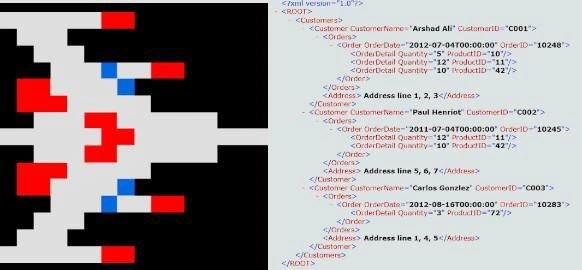
XML Data Structure Visualization
DataFormats Post #761, on Oct 30, 2019 in TG

XML Data Structure Visualization

Why is this DataFormats meme funny?

Level 1: Shapes in the Clouds

Sometimes when you look at a complicated picture or pattern for a long time, your imagination turns it into something familiar. In this meme, a programmer was looking at a very complicated piece of code and suddenly it started to look like a little spaceship from an old video game. It’s just like staring at clouds: after a while, one cloud might remind you of a dragon or a bunny. Here, all the brackets and words in the code lined up in such a funny way that the person saw a pixelated space-invader spaceship in it! The joke is that the code was so dense and tiring to read that the developer’s brain decided to see a toy-like image instead. It’s funny because code is supposed to be serious, but our minds can play tricks – turning a messy block of text into a retro video game graphic, just like finding shapes in fluffy clouds.

Level 2: XML Invaders

What we see here is an XML document on the right and a pixel-art spaceship on the left, and the joke is that the XML’s structure looks like a Space Invader. XML (which stands for Extensible Markup Language) stores data using tagged elements inside angle brackets < ... >. It’s very hierarchical – one element can contain other elements, which contain others, and so on (we call that nested tags). Developers often indent each level with spaces or tabs, so you can visually see the structure. In the code shown, for example, there’s a <ROOT> element, and inside it several <Customer> entries. Each <Customer> has child elements like <Order> and <Address>. Because of indentation, the <OrderDetail> tag inside <Order> is pushed further right, then <Address> is back out a level, etc. All these indent spaces and angle brackets line up in a symmetrical shape. If you tilt your head (or happen to be a bored programmer), those grey < and > symbols along the left and right edges of the code start to look like the outline of a little ship or alien. The syntax highlighting colors make it even funnier: the code editor colored tag names in blue and attribute names in red, so the code isn’t just grey text. In the black-and-grey pixel art on the left, you can spot the same color pattern – blue and red pixels arranged just like the code’s layout – now resembling a classic 8-bit spaceship from old arcade games. Space Invaders and Galaga are examples of those games, with simple pixel graphics; the meme specifically makes the XML code look like one of those enemy aliens or a player’s ship in Galaga. It’s a playful illusion: the code accidentally produces a piece of retro artwork!

The humor also comes from the idea that the developer has been staring at XML data for too long. XML is known to be very verbose (it has a lot of extra markings like < /> for every data field). This can be exhausting compared to a cleaner format like JSON (JavaScript Object Notation), which uses minimal punctuation ({ } and :) and doesn’t repeat closing tags. Many modern devs prefer JSON or other lean formats because they’re easier to read. Here, the XML’s noise is so pronounced that one’s brain starts making silly pictures out of it. (There’s a term “pareidolia” that describes seeing patterns or images in random visuals – like seeing animal shapes in clouds. That’s basically happening with the code.) The meme is poking fun at how over-complicated and nested XML can get. It’s as if the XML is so bloated that instead of reading it, the programmer’s mind drifts and sees a video game. For a junior developer, imagine opening a file and it’s dozens of lines of <Tag> inside <Tag> inside <Tag>… you might lose focus! This contrasts with developer-friendly JSON, where the same data might be just a few lines with curly braces. In fact, the meme caption suggests “deeply-nested XML starts looking like an 8-bit space invader” – meaning the deeper and more indented the XML structure becomes, the more it resembles some pixelated alien sprite. It’s a lighthearted way to say “Wow, this XML is ridiculously detailed and my eyes are getting loopy.” Developers find it funny because we’ve all had moments where a complex piece of code or data made us rub our eyes and laugh at how absurd it looked.

Level 3: Pareidolia in the Tag Tree

At first glance, this meme is a tongue-in-cheek nod to visual pareidolia in code. After wading through a swamp of deeply nested XML tags, a developer’s brain can start seeing familiar shapes — in this case, an 8-bit spaceship hiding in the angle brackets. The image juxtaposes an XML snippet (on the right) with a pixelated Space Invaders-style sprite (on the left). The joke is that the outline of the indented XML markup inadvertently forms a symmetrical, retro gaming graphic. This happens because XML’s hierarchical structure and repetitive syntax (<tags> with matching </tags>) create distinct vertical patterns. The code editor’s syntax highlighting even contributes to the effect: tag names in blue, attribute names in red, angle brackets in grey. All those colored tokens aligned just right produce what looks like the wings and fuselage of a Galaga starfighter. It’s essentially an indentation artifact turned into arcade art!

For seasoned devs, this is hilariously relatable. It satirizes the cognitive load of working with verbose data formats. Back in the early 2000s, XML was everywhere – from configuration files to web services – often leading to “angle bracket soup” on our screens. Reading giant SOAP messages or WSDL files at 3 AM, your tired eyes might indeed start tracing out TIE Fighters or X-Wings in the markup. The humor here leans on that shared memory of XML’s visual noise. Compared to leaner data formats (like JSON or binary Protobuf), XML demands extra mental parsing; there’s so much overhead with closing tags and nested <Customer><Order><OrderDetail>… elements that your brain gets spacey. This meme exaggerates that feeling: the XML is so over-the-top that your mind escapes into a classic videogame daydream. It’s also a subtle jab at how far developer preferences have shifted – modern Developer Experience (DX) favors concise formats. After years of JSON’s curly braces, going back to heavy XML can make you feel like you’re deciphering an ancient alien script (quite literally seeing aliens and spaceships in it!). In short, the meme resonates with senior engineers as a comedic reminder of XML’s format fatigue: stare at deeply-nested tags long enough and you might start seeing 1970s arcade aliens in the dev console.

Description

A two-panel image contrasting a visual abstraction with a block of code. On the left is a piece of abstract pixel art with a chaotic, branching structure made of red, blue, white, and black squares. On the right is a screenshot of a deeply nested and verbose XML file. The XML defines a list of customers with their orders and addresses, showcasing multiple levels of indentation. The underlying joke is that the messy, convoluted pixel art on the left is a visual representation of the complexity and perceived ugliness of the XML data structure on the right. This is a classic critique of XML's verbosity and structural rigidity, especially when compared to more modern data formats like JSON, a sentiment widely shared by experienced developers who have dealt with legacy systems
Comments

7
Anonymous ★ Top Pick I showed this to my therapist. She said it's a perfect visualization of the trauma caused by years of maintaining SOAP APIs
  1. Anonymous ★ Top Pick

    I showed this to my therapist. She said it's a perfect visualization of the trauma caused by years of maintaining SOAP APIs

  2. Anonymous

    Sure, XML is verbose, but at least the indentation doubles as concept art for your next retro shooter - call it "DTD: Defend The Document."

  3. Anonymous

    "Ah yes, the classic 'let me just visualize this production data real quick' that ends with Legal asking why Archibald All is trending on Twitter and GDPR compliance wants to know your home address."

  4. Anonymous

    The eternal irony of enterprise software: we spend millions on 'customer-centric' platforms and 'personalized experiences,' yet at the database layer, every human becomes just another XML node with a CustomerId attribute. At least the pixel art is honest about the abstraction - though I suspect the real customers would prefer we didn't store their OrderDetail Quantity in a denormalized schema that screams 'legacy migration from 2012.'

  5. Anonymous

    Queried for customer addresses, got back the field completeness report - schema-optional DBs at their finest

  6. Anonymous

    Nothing says “enterprise integration” like XML with attributes everywhere and address_line_1/2/3 - aka the SOAP Space Invader: you fire XSLT at it for a decade and the schema drift keeps respawning

  7. Anonymous

    Attributes vs elements is the real holy war - every extra nesting level spawns an X‑Wing in my head and a namespace takes out Red Leader

Use J and K for navigation