Skip to content
DevMeme
1788 of 7435
Tech Hype vs. Public Health Paranoia
IndustryTrends Hype Post #1995, on Sep 1, 2020 in TG

Tech Hype vs. Public Health Paranoia

Why is this IndustryTrends Hype meme funny?

Level 1: When Cool Beats Scary

Imagine your doctor says, “Here’s a little shot that will keep you healthy.” Suddenly, a rumor starts that this shot secretly has a tiny tracking gadget in it, and you get super scared – “No way, I don’t want a sneaky tracker in me!” Now, a bit later, your favorite famous inventor comes along and says, “I’ve made a awesome gadget that we can put in your head, and it will let you hear music in your mind and do all sorts of neat things!” And you get excited – “Wow, that sounds so cool, I want it!”

See the difference? It’s the same basic idea – putting a tiny electronic chip in your body – but you felt scared in one case and thrilled in the other. Why? Because in the first case it felt sneaky and weird, and you didn’t trust the person giving it. In the second case, it sounded fun and you trust the cool inventor. The meme is joking about how people can be afraid of something when it seems forced or hidden, but totally okay with (even happy about) a similar thing when it’s sold as the next cool toy. It’s like refusing to eat a plain cookie because you think there’s something bad hidden inside, then happily eating a fancy cookie from a famous chef even though it actually has a crazy surprise ingredient. The funny part is that our feelings can flip from “scary” to “cool” just based on who offers it and how they talk about it.

Level 2: Microchips 101

Let’s break down the key concepts and jokes in this meme in simpler terms, especially for those newer to the tech scene. The meme compares two situations involving microchips (tiny electronic circuits that power our gadgets) and how people react to them.

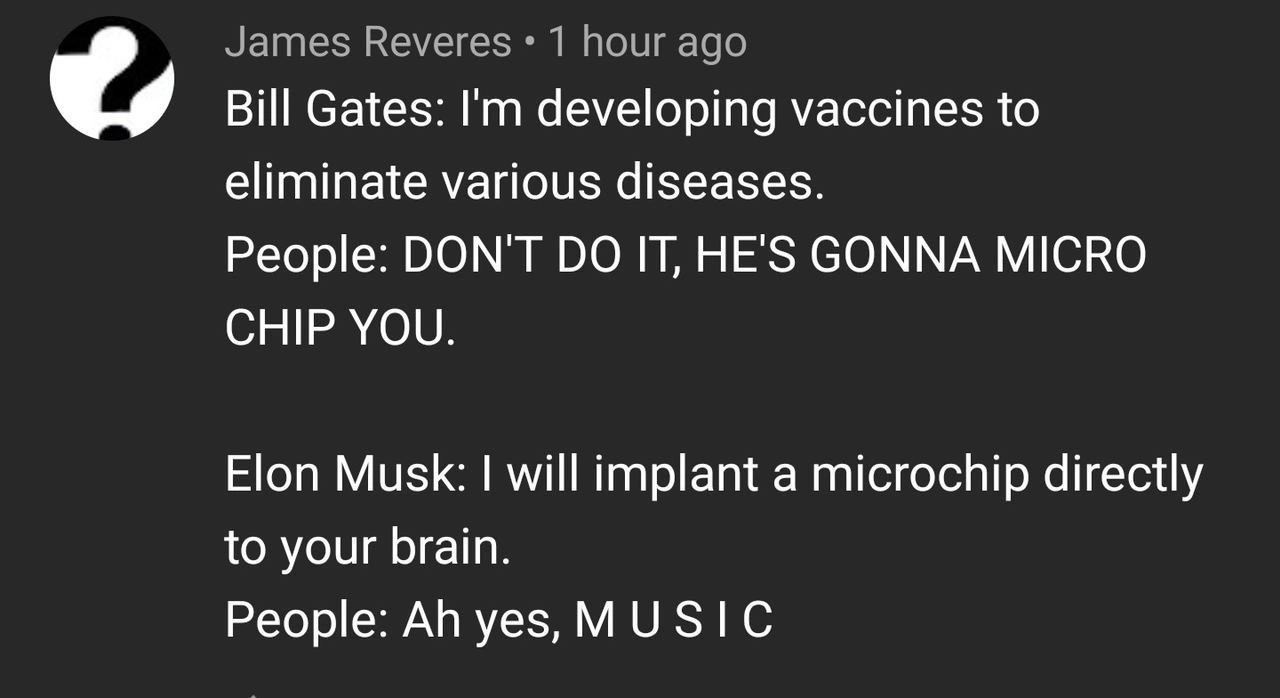
  • Microchip in a vaccine? – First scenario: Bill Gates says he’s developing vaccines to eliminate diseases. Some people (in real life) responded with a conspiracy theory: “Don’t take it, he’s gonna microchip you!” They literally believed (or joked) that Gates would hide a tracking microchip implant in the vaccine injection. This became a popular vaccine_conspiracy_theory around 2020. Now, from a tech standpoint, this idea is pretty far-fetched. Vaccines are just liquids containing weakened viruses or genetic material to trigger immunity – no electronics in there! A microchip is a solid piece of hardware; you can’t invisibly slip one into a tiny vaccine vial without anyone noticing. It would be like claiming there’s a little smartphone in your flu shot – it doesn’t make sense physically. But fear sometimes overrides facts. The conspiracists were basically shouting “He’ll track/control us!” without understanding how hardware or vaccines actually work. This part of the meme highlights how some people can be very paranoid about new medical technology, especially if it involves famous figures like Bill Gates. (For context, Bill Gates, co-founder of Microsoft, has funded a lot of global health initiatives. Somehow he became a boogeyman in certain circles who distrust vaccines and big tech.)

  • Microchip in your brain? – Second scenario: Elon Musk says he will implant a microchip directly into your brain. Elon Musk is the CEO of companies like Tesla and SpaceX, and he started Neuralink, a company working on a direct brain_computer_interface. A brain-computer interface (BCI) means a device that lets your brain communicate with computers, often via a chip with tiny wires implanted in the brain. It’s real tech, primarily aimed at helping people with paralysis or neurological problems, but Elon also talks about cool future uses like listening to music or improving memory. When Musk announced this brain chip idea, a lot of people (especially his fans) reacted like, “Wow, awesome, sign me up!” In the meme, they write it humorously as “Ah yes, M U S I C” – implying people are excited about being able to stream music in their head. The spacing “M U S I C” gives it a playful, drawn-out tone, as if someone is dreamily imagining the feature. The public here seems totally fine with a microchip implant when it’s presented as a fun, voluntary, high-tech gadget.

The meme’s joke is pointing out the public_double_standard: The same type of technology (microchips inside humans) is treated very differently depending on the context. With the vaccine, it’s seen as a sneaky, threatening thing – people yell about privacy and control. With Neuralink, it’s seen as a cool innovation – people get hyped about potential benefits (like streaming music or curing diseases). It’s ironic, and that irony is basically the humor here.

For engineers and tech industry folks, this is a familiar kind of irony. There’s a term SecurityVsUsability that often comes up: it means there’s usually a trade-off between making something very secure/private and making it very convenient/fun. In the vaccine vs Neuralink case, we see a twist on that idea. People were worried about security/privacy (being tracked by a chip) in the context of a vaccine which was meant to protect them. Yet, those same worries vanished when a cutting-edge hardware device promised an amazing new usability feature (like listening to music mentally). It’s like people forgot about the “being tracked or controlled” fear as soon as the microchip was attached to a famous innovator with a shiny consumer angle.

Let’s clarify a few terms and context elements:

  • Neuralink: This is Elon Musk’s brain-chip company. The goal is to create implants that can read and maybe even stimulate brain activity. Early demos involved pigs and monkeys, showing that signals from the brain could be recorded and interpreted. For example, they demonstrated a pig whose Neuralink implant could detect when its snout touched food. The ambitious future claims include helping quadriplegic people control computers or phones directly with thoughts, or even melding human intelligence with AI. It’s very emerging hardware and quite experimental. When the meme says “M U S I C,” it’s referencing one of Musk’s tweets or statements that the chip could stream music in your head – something that got a lot of media attention because it sounded straight out of science fiction.

  • Brain-computer interface (BCI): As mentioned, this is the field of connecting brains and computers. This can be non-invasive (like EEG headsets you wear) or invasive (implants like Neuralink that go under the skull). It’s a complex intersection of neuroscience, electrical engineering, and software. People have been working on BCIs for decades, especially to help paralyzed patients (e.g., allowing someone to move a robotic arm by thinking about it). Neuralink is just a high-profile entrant into this field with new techniques.

  • Microchip implant: Generally means any small electronic device inserted into the body. We already have some simpler versions of this in use: for example, pet microchips (that help identify lost pets when scanned) or human RFID chips that some enthusiasts put under their skin to unlock doors or store medical info. Those are usually very passive devices – they don’t have batteries and only work when a scanner is near. Then there are medical implants like pacemakers or cochlear implants (for hearing) which are more complex microelectronics in the body but serve specific medical purposes. Neuralink’s implant is like a next-level microchip implant because it’s interacting directly with the brain’s signals.

  • Vaccine conspiracy theory (microchip edition): During the COVID-19 crisis, and even a bit before, there was a lot of misinformation floating around. One popular false claim was that any forthcoming COVID vaccine (which Bill Gates was helping fund) would secretly implant a microchip to track people. This was thoroughly debunked – no, vaccines don’t have microchips – but it gained traction among anti-vaccine groups. It probably caught on because it combined fears of government/big tech surveillance with the new pandemic anxiety. Think of it as an evolution of earlier conspiracy theories (like claims that 5G cell towers were causing COVID, or that barcodes, credit card chips, etc., are tools of evil). None of these are true, but they spread in certain communities.

  • Public perception and hype: The meme is also a commentary on hype in the tech industry (IndustryTrends_Hype). Elon Musk is known for generating a lot of hype – when he announces something, tons of people on social media get excited, and the press covers it extensively. Sometimes the excitement outpaces the reality (it might take many years for Neuralink to actually deliver on big promises, or it might never do exactly what sci-fi fans hope, but the idea is thrilling). Bill Gates, in contrast, in 2020 was more of a steady, behind-the-scenes figure focusing on public health. He wasn’t hyping some cool gadget for consumers; he was talking about disease eradication – important, but not “sexy” tech for the average person. So public perception diverged: Musk’s project felt like personal tech empowerment (exciting!), while Gates’s work was reframed by some as potential personal risk (scary!).

To a junior developer or someone early in tech, the takeaway is: the way technology is presented really affects how people accept it. Technically, both situations involve sticking a chip in a human body. But notice:

  • Bill Gates never even proposed to put chips in anyone; it was a wild rumor. It shows how a lack of understanding can breed fear. As an engineer, you’ll encounter folks who have misconceptions about technology (like “Is my phone listening to me?” or “Does this software have hidden spyware?”). Sometimes the concerns are valid, but other times they spiral into unfounded theories.
  • Elon Musk’s proposal is real, but people didn’t express the same fear. Many even volunteered to be test subjects! This shows the power of a popular narrative – “this will make your life cooler/better” – to override concerns. As a developer, you might work on something with potentially serious privacy/security implications, yet users might flock to it because it’s cool, without reading the fine print. It’s a bit of a cautionary tale: don’t assume end-users or the public will logically weigh pros and cons of tech. Often, emotion and trust in the tech figurehead play a big role.

Finally, the meme is posted in an engineering humor context, so the audience (tech-savvy people) find it funny because they see how illogical the contrast is. It’s tagged as TechHumor, TechIndustryIrony, etc., because it’s ironically highlighting a tech industry phenomenon: hype can overshadow privacy fears, and conversely, conspiracies can overshadow facts. It encourages a bit of a chuckle but also a nod of understanding. We’re laughing at how absurd it is that someone would refuse a life-saving vaccine due to a fake microchip rumor, yet possibly sign up to have an actual chip put in their brain because a trendy innovator offers it. It’s a form of gallows humor for those of us who care about both technological potential and public education – we laugh, otherwise we might cry 😅.

Level 3: Selective Paranoia

From a senior engineer’s standpoint, this meme nails a classic tech double standard that we’ve seen play out in various forms over the years. It’s shining a light (with a dark comedic hue) on how public perception can flip 180 degrees based on who is pushing the tech and how they frame it. On one hand, we have Bill Gates – a household name in computing, turned global health philanthropist – saying in essence, “We want to use advanced science to save lives”. The public response (at least a loud, conspiracy-prone subset of it) is depicted as: “DON’T DO IT, HE’S GONNA MICROCHIP YOU.” It’s an all-caps, paranoia-fueled outcry. On the other hand, Elon Musk – a celebrity tech CEO known for flashy projects – openly declares, “I will implant a microchip directly in your brain.” And the crowd goes: “Ah yes, M U S I C.” The spaced-out lettering of “M U S I C” oozes sarcasm: it’s as if people are in a trance of admiration, drooling at the cool factor (“I can have music in my head, neat!”) while overlooking what was just stated – a microchip… in your brain.

The humor here hits home for tech folks because it highlights cognitive dissonance in how people evaluate technology. We’re essentially seeing the same core concept – a microchip implant – met with outrage in one context and applause in another. Why? Because of branding, narrative, and a hefty dose of hype. It’s a prime case of selective paranoia: the source and spin determine if people freak out or sign up. In code, it’s almost like:

def public_reaction(proposer, idea):
    if "microchip" in idea.lower() and proposer == "Bill Gates":
        return "FEAR! SHUN!"
    elif "microchip" in idea.lower() and proposer == "Elon Musk":
        return "Hype and Excitement"
    else:
        return "Meh"

Replace "Bill Gates" with “establishment philanthropist working on public health” and "Elon Musk" with “charismatic entrepreneur promising sci-fi perks,” and the logic still holds. Engineers often shake their heads at this, because we prefer decisions driven by technical merit and actual risk, not personality cults or misinformation. The meme captures that exasperation in a nutshell.

Let’s unpack the two scenarios in human terms. Bill Gates has been vocal about developing vaccines to eliminate diseases (for example, funding efforts to eradicate polio and researching new vaccines – this was big news especially during the 2020 COVID-19 pandemic). Somehow, this altruistic goal got twisted by fringe groups into a vaccine_conspiracy_theory claiming that he’d use vaccines as a vehicle to secretly implant tracking microchips into the population. It’s patently absurd if you have any technical background (as we explored above), but the fear took hold in some corners of the internet. It plays on a classic Big Brother fear – the idea that “the powers that be” want to track or control you. Never mind that most of these people are voluntarily carrying around actual tracking devices (hello, smartphones!) 24/7; the notion of a hidden chip in a syringe lit up the paranoia circuits. For those of us in tech, it was a facepalm moment of “user error” in the societal sense. We’ve seen similar dynamics before: for instance, back when RFID tags first started being used in credit cards and passports, conspiracy theorists had a field day claiming these chips would be used for sinister purposes. And long before that, early “brain chip” ideas in sci-fi and government programs (like Cold War-era experiments) sparked public fear. So there’s a historical pattern of new hardware that touches the body or privacy being met with alarm – sometimes warranted, often wildly exaggerated by speculation. The TechIndustryIrony is that by 2020, actual microchip implants had existed for years (people have gotten RFID chips in their hand to unlock doors or store medical info), but those facts don’t go viral as much as “Bill Gates is gonna microchip you!” did.

Now look at Elon Musk’s Neuralink announcement around the same time. In August 2020, Musk did a live demo showing a pig named Gertrude with a coin-sized Neuralink implant, reading signals from the pig’s snout as it foraged. He hyped that this device could someday help paralyzed people type with their thoughts, treat brain injuries, and yes, even stream music directly into the brain. The public reaction? A wave of awe, curiosity, and techno-optimistic glee — “Sign me up for the future!” became the vibe in many comment sections. Here’s a guy literally saying, “We’re going to put a chip in your skull,” and people responded like he’d announced a new iPhone. Part of that is Musk’s celebrity branding: he’s built a reputation as a visionary who makes science fiction real (electric cars, reusable rockets, etc.), so his fanbase gives him the benefit of the doubt. There’s also the voluntary framing: he’s not saying he’ll chip everyone by force, he’s saying “we have this cool high-tech implant, who wants to try it?” That sounds like an upgrade rather than a violation, tapping into transhumanist dreams of enhanced cognition and direct brain-to-computer links. It’s packaged as personal empowerment (listen to music in your head! cure diseases! become a cyborg Jedi!) rather than an external control. That difference in narrative — enhancement vs. control — is key to why the second scenario gets cheers instead of jeers.

Engineers and industry veterans find this amusingly frustrating. We spend our days balancing security vs usability in technology. We know that public trust can be a fickle thing. This meme is essentially pointing out: public trust isn’t always rational. It’s often a product of hype cycles and who tells the story. For example, think about privacy and data security: users might refuse a well-vetted app from a known company because of a scary news headline, yet they’ll happily dump personal data into a sketchy viral app because all their friends are doing it. Or a company will reject a secure open-source solution citing security concerns, then go buy an expensive proprietary system because a slick salesperson convinced them it’s safe — even if it’s a black box. The IndustryTrends_Hype factor is huge: a charismatic figure or trending technology can overshadow very real concerns. In the meme, public_double_standard is laid bare: a microchip associated with vaccines (a life-saving medical advancement) triggers alarm about privacy and safety, whereas a microchip associated with a tech celebrity triggers almost no privacy concern at all, only excitement for new features. The reality is both raise legitimate questions – data security, health risks, ethical use – but the focus of the crowd is completely skewed by perception. It’s the same tech (tiny implanted chips) with reversed emotional reactions.

There’s also a subtle nod here to how effective marketing and communication are in tech adoption. Bill Gates, despite his geek cred, stepped into a role as a global health advocate – which oddly made him a bigger target for mistrust among conspiracy groups. Elon Musk, by contrast, leans fully into the flashy tech messiah persona, tweeting bold promises in all caps himself at times. One sells his idea with calm, altruistic rationality; the other sells it with showmanship and a promise of personal coolness. And the public (at least the vocal part depicted in the meme) responds accordingly: skepticism vs. enthusiasm. It’s not too far-fetched for senior devs to connect this to workplace experiences: e.g., how a recommendation from a quiet engineer can be ignored, then the same idea repackaged by a loud outside consultant is suddenly gospel. The who and the pitch often matter more than the content – an unfortunate truth in tech and beyond.

For engineers concerned with security, privacy, and ethics, the meme’s scenario is almost a grim joke. We tirelessly implement encryption, authentication, and safeguards expecting users to care, but many users will throw caution aside if something is shiny enough. Neuralink raises very real security and privacy issues – if your brain signals are being transmitted, you’d better be sure they’re protected from eavesdropping or misuse. If someday we can write to the brain, imagine the malware possibilities! 😅 (Brain ransomware, anyone? “Pay 1 BTC or we play Baby Shark in your head on repeat.”) Conversely, vaccines have decades of rigorous research behind them and are designed to help your body, not log your Spotify playlist. Yet that’s what got framed as a Trojan horse. The meme is winking at us: the world sometimes gets it exactly backwards.

In essence, “Public double-standard on microchips” is an apt title. The developer community loves this kind of irony because it underscores why purely technical solutions aren’t enough — human factors rule the day. You can have the most secure, well-intentioned hardware and still face backlash due to rumor and fear. Or you can have an experimental, slightly scary technology get a free pass because it’s riding a hype train. It’s both funny and a little exasperating. As a final historical aside, one might recall how back in the day, people feared things like the telegraph or telephone (“It could steal your voice!”) until they became commonplace. Today’s wild conspiracies about chips and the equally wild enthusiasm for brain tech might just be another chapter in that endless saga of tech hype vs. fear. We laugh, but we also recognize the pattern.

Level 4: Silicon Synapses

At the deepest technical level, this meme contrasts a fantastical microchip injection with a bleeding-edge brain implant. In one corner, we have the imagined scenario of a vaccine secretly delivering a microchip into your body. In the other, we have Elon Musk’s very real Neuralink — a surgically implanted brain-computer interface (BCI). The humor emerges from the wild mismatch in hardware feasibility between these two ideas. Let’s break down the circuitry of each:

On the vaccine side, injecting a functioning microchip is practically science fiction. A microchip is a tiny piece of silicon packed with microscopic electronic components (transistors, capacitors, antennae, etc.). But even “tiny” has limits: the smallest RFID identity chips (like those used to tag pets) are about the size of a grain of rice (~12mm long, 2mm wide) and require a specialized thick needle to implant. Cramming a complex, remotely readable tracking chip into a standard vaccine syringe (often with a needle bore under 1mm) pushes the boundaries of physics and manufacturing. For a chip to actively transmit data (say, to the 5G network of conspiracy lore), it would need an antenna of a certain minimum length (governed by good old Maxwell’s equations for electromagnetic waves) and some power source. Passive chips like RFID can be smaller, but they only work when a scanner is very close to energize them – hardly useful for covert global surveillance. In short, engineering a covert, injectable micro-tracker is orders of magnitude harder than conspiracy Facebook posts would have you believe. It’s as if someone worried a nano-scale Arduino could hide in their flu shot – a notion that makes hardware engineers chuckle and cringe simultaneously. To actually build such a stealthy injectable device, you’d need Nobel-level breakthroughs in micro-fabrication, wireless power transfer, and bio-embedded antennas. (If Gates’s team secretly achieved that, every hardware nerd would be clamoring to read their research paper, not running from vaccines!)

Now enter Neuralink – a real-world attempt to wire silicon directly into the brain’s synaptic symphony. Technically, Neuralink’s device is an array of ultra-fine polymer threads, each studded with multiple electrodes. These threads are carefully inserted into the cortex using a precision robot (think of a sewing machine stitching connections into jelly – that’s the level of delicacy). The implanted chip (a custom ASIC package) sits in a sealed module in the skull and acts like a high-density recorder and transmitter. It can pick up electrical spikes from neurons (on the order of millivolts) and digitize them via analog-to-digital converters, potentially sampling thousands of channels at kilohertz frequencies. In their 2020 demo, Neuralink touted around 1024 electrodes – an impressive number, but still tiny compared to the brain’s billions of neurons. The implant then uses a low-power wireless link (likely Bluetooth or a proprietary radio) to send this neural data to an external computer. This is serious hardware: we’re talking about solving issues of signal-to-noise ratio, heat dissipation in a fan-less implanted chip, and biocompatibility so the body doesn’t reject the circuitry. It’s like building a miniature, wireless EEG machine that fits inside your head and can survive the salty, humid environment of the human body. And here’s the kicker: Neuralink not only wants to read the brain’s signals but eventually write to them too. “Streaming music directly to your brain,” as Musk mused, would mean generating precise electrical pulses that stimulate auditory regions so that you perceive music without using your ears. That’s an even more daunting engineering (and neuroscience) challenge – it’s one thing to intercept neuron firing, quite another to code information into neural patterns in a meaningful way (imagine trying to play a piano by directly vibrating the strings in exact patterns; doable in theory but incredibly complex to get right). The implication is enormous: a high-bandwidth neural interface could potentially treat neurological disorders, allow direct mental control of devices, or yes, let you jam to your playlist silently. But it has to obey the Nyquist-Shannon sampling theorem for brain signals, deal with latency and throughput limits of wireless communication, and ensure safety so that a software bug doesn’t send your neurons into chaos. All that requires rigorous science – published papers, FDA approvals, the whole gamut – nothing that happens by secretly slipping a chip in your soda.

The meme’s irony is that from a hardcore tech perspective, the scenario people fear (a tiny all-powerful tracker in a vaccine) would be a technological marvel well beyond today’s capabilities, whereas the scenario people eagerly embrace (a music-streaming brain implant) is an actual ongoing engineering project grappling with known limits. Essentially, the joke highlights a comical inversion of realism: the public panics about an implausible, near-impossible microchip implant scheme, yet cheers for a far more invasive but openly developed brain chip that truly exists. It’s a bit like fearing a hacker has quantum computers in their garage, while signing up to test the actual quantum computer at the lab – a juxtaposition that hardware geeks find both amusing and telling. The silicon reality (physics, biology, and code) ultimately doesn’t care about hype, but here we see hype and fear wildly out of sync with what Silicon and Synapses can actually do.

Description

This image is a screenshot of a text-based comment on a dark background, likely from a social media platform. The comment contrasts public reactions to technological initiatives from two major tech figures. The first part describes Bill Gates developing vaccines to eliminate diseases, with the public's reaction being fear of being microchipped. The second part describes Elon Musk's explicit goal to implant a microchip directly into the brain, to which the public's reaction is excitement, summarized as 'Ah yes, M U S I C'. The humor stems from the ironic double standard in public perception. It highlights how the narrative and the personality behind a technology can drastically alter its reception, even when the latter's proposal is far more invasive than the conspiracy theory about the former. For experienced tech professionals, this resonates with observations about hype cycles, marketing, and the cult of personality that can often dictate a technology's public acceptance over its actual implications

Comments

7
Anonymous ★ Top Pick One founder ships a critical patch for humanity and gets accused of embedding spyware. The other announces a plan to literally root the human brain and gets lauded for revolutionizing the personal audio experience. It's all about the commit message
  1. Anonymous ★ Top Pick

    One founder ships a critical patch for humanity and gets accused of embedding spyware. The other announces a plan to literally root the human brain and gets lauded for revolutionizing the personal audio experience. It's all about the commit message

  2. Anonymous

    Amazing how folks scream “5G mind control” at a sterile syringe, then camp overnight for a beta brain implant that ships with over-the-air firmware updates and no rollback plan - turns out slick launch decks outrank any threat model

  3. Anonymous

    The real irony is that we trust the guy whose cars occasionally autopilot into barriers more than the guy whose operating system has been blue-screening for 30 years - yet somehow Windows Update is still the most invasive thing either of them has deployed to production

  4. Anonymous

    The real engineering challenge isn't building the brain-computer interface - it's the API documentation explaining why users need to sign a 47-page EULA before their neurons can POST to Spotify. At least with Neuralink, when your code crashes, you can legitimately claim it's a hardware problem

  5. Anonymous

    Gates ships a non-breaking health patch: 'Breaking change!' Musk drops a full nervous-system rewrite: 'LGTM, merge to prod.'

  6. Anonymous

    People panic that Gates will slip telemetry into a syringe, then cheer when Musk ships a v0.1 brain implant to prod because the changelog says “MUSIC” - refusing cookies while running sudo on the cortex

  7. Anonymous

    Call it “telemetry” and legal demands a DPIA; call it a “low-latency cranial audio interface” and the board wants it GA in Q3 - dopamine outvotes STRIDE every time

Use J and K for navigation