
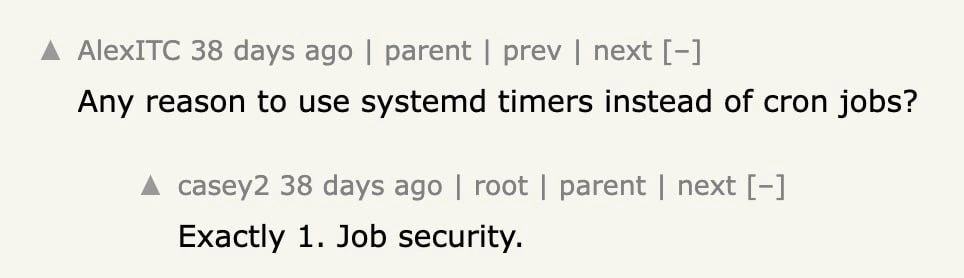
Systemd Timers vs. Cron: A Job Security Play
Description
A screenshot of a comment thread from a minimalist, text-based forum, likely Hacker News. The first comment, posted by user 'AlexITC', asks a question: 'Any reason to use systemd timers instead of cron jobs?'. A nested reply from user 'casey2' delivers the punchline: 'Exactly 1. Job security.'. The visual is simple, focusing entirely on the text exchange, which is displayed in a clean, proportional font against a light-colored background. This meme captures a common debate in the Linux and DevOps communities. Cron is the traditional, universally understood tool for scheduling tasks, while systemd timers are a more modern, integrated, but often more complex alternative. The joke is a cynical take on engineering choices, suggesting that opting for a more complex or less-known technology can make an engineer's role more indispensable, thereby creating job security. It's a humorous critique of over-engineering and the motivations behind technology selection

Comments
45Comment deleted
The best part about replacing all the cron jobs with a complex web of systemd timers is that the next person who has to maintain it will probably be you, five years from now, with no memory of how it works
I replaced five cron lines with a .service, a .timer, and a 12-page runbook - now management thinks we invented a proprietary scheduling platform, so I’m safe until the next reorg
The real systemd timer advantage is that when your 3am cron job fails, you can blame it on a transient unit dependency failure in the journal instead of admitting you forgot to escape a percent sign
The real reason to use systemd timers? So you can spend three hours writing unit files, service dependencies, and debugging 'Failed to start timer: Unit not found' errors - all to accomplish what a single line in crontab does. But hey, at least you'll have plenty of job security explaining to the next engineer why a simple scheduled task now requires understanding socket activation, target dependencies, and the systemd journal. Cron: boring, reliable, and dangerously easy to understand
If your 2am backup needs a unit, a target, a Wants= graph, and journald archaeology, congratulations - you’ve turned ‘crontab -e’ into an employee retention program
Cron is for 03:00; systemd timers are for being the only person who can explain why it didn’t run at 03:00 after DST - WantedBy=job-security.target
Systemd timers: because 'you can't fire me, I know WTF this unit file does' beats cron every time
well it's true, systemd timers is more reliable than cron and they have kinda better security because of systemd's features Comment deleted
We can also check the status of systemd task, right? Comment deleted
Let's start some flamewar about systemd Comment deleted
Not until some explains what is wrong with cron jobs with regard to security, and how exactly systemd is better in this aspect. Comment deleted
It seems like there's nothing wrong with Cron regarding security, just systemd looks to be better as you can use its built in security features like these https://www.ctrl.blog/entry/systemd-service-hardening.html or at least that's what someone pointed out on Reddit Comment deleted
Anything systemd does there can be done with discrete tool too. Comment deleted
Anything that ${tool} does, can be done with another tool, too. 😁 Comment deleted
And yet the entire argumentation for using systemd seems to be "but systemd has feature X built-in" as if "write programs to work together" wasn't one of the guiding principles of design of Unix systems from the early days. Often using false comparisons like these. Cron doesn't do security sanboxing? Duh! You know what it does? Runs arbitrary program including over a dozen of sandboxing solutions, each with it's advantages and disadvantages. Comment deleted
the reason I use systemd is because I know how to use it. I don't know how to make cron do its job. Comment deleted
Nothing against people choosing the tools they want. Personally I'm not fan of the traditional cron design, hence I'm mostly using snooze I linked above. Comment deleted
Does at least one init give you the same ease of creating your own service files as systemd, that it's enough for you to write a toml file and everything works? Comment deleted
as someone who's written several systemd service files over the years: they suck, are awful, and complete utter garbage. But once they work, they do work. Comment deleted
Have you ever written services for other inits? Comment deleted
no, but it can't be worse than the unintuitive shit systemd does Comment deleted
Most of them are not even declarative Comment deleted
what does that mean again? Comment deleted
You're just writing a bash script using the init API Comment deleted
sounds not that bad tbh Comment deleted
https://wiki.gentoo.org/wiki/OpenRC/User_services Comment deleted
I have better things to do than read that tbh, sorry if you wanted an informed discussion Comment deleted
The main advantage of OpenRC or SysVinit is that it gives you the power of shell scripting. The main disdvantage of OpenRC or SysVinit is that it gives you the power of shell scripting. That is, you can do whatever you want and however you want, but you have to implement it yourself, even the most basic tasks; and you have to do it each time you write a new service script. So, SystemD is much like C#, and OpenRC / SysVinit is like C++ or even plain C. Comment deleted
the two things often needed in systemd services are simply starting the service and restarting the service if it crashes. I've literally never needed more than that and I don't even know what else systemd could theoretically offer me. Comment deleted
First, you should distinguish between SysV init and SysV rc system. (Conflating these was actually part of the disinformation campaign during the Debian vote on systemd support) Init is the PID1 and on both the old SysV and BSD systems it didn't do much besides running the rc system, reaping children and making sure gettys stay up. And rc system is what actually starts your services. I believe the closest match to old-style SysV rc is the system you'd find on Slackware (unless they decided to change it since I last saw it) where it just executes a bunch of (shell) scripts from a directory in alphabetical order and it's users responsibility to order them correctly and all that. There was a plenty of incompatible iterations on those. RedHat's was common among rpm distros, Debian's insserv and finally Gentoo's baselayout later split up into separate OpenRC package. Feature of all these rc systems is that they are init independent since they background tasks without any supervision or any other feature that would hook into init. And you can even use several of them in parallel unless you need automatic dependency resolution across services in different rc systems. In parallel to rc systems there was evolution of supervisors, mostly stemming from DJB's daemontools. The rationale for those was extreme focus on reliability. Signalling a PID stored in a file is racy and any system with memory overcommit enabled is prone to killing processes under memory pressure even if there are no bugs in the daemon - so restarts are necessity. To accomplish this you generally want "rooted" supervision tree, meaning parent of the supervisor is also supervised and so forth up to PID 1 which can't be killed without the system itself going down. Daemontools was usually run from inittab on sysv-init systems (same for daemontools-encore fork and perp), while runit ships it's own maybe too minimalist init implementation and s6 provides hooks for the few features needed of init that are needed of init on Linux that aren't part of supervisor's task already (specifically special signal handling and shutdown chainloading) and provides s6-linux-init-maker to generate that configuration. There are several rc systems built specifically to run above a supervisor and launch supervised services. My favourite is s6-rc but you may also be interested in anopa or the system in VoidLinux. Unlike sytemd that tries to be everything and kitchen sink the daemontools-derived supervisors tend to have very well defined scope and implement it very well. They run executables, keep them up and allow you to send signals to them reliably; all in very straightforward fashion. Comment deleted
TL;DR Comment deleted
my god I'm going to read all that… tomorrow. Comment deleted
> it just executes a bunch of (shell) scripts from a directory in alphabetical order and it's users responsibility to order them correctly and all that Thats why systemd rocks Comment deleted
You're comparing it to rc system literally from 1980s. Of course proper dependencies have been a feature of every major reimplementation. Comment deleted
It's enough that these are fucking shell scripts Comment deleted
Well, in the Linux distro I'm currently using (home-brew LFS), init, service and other relevant utilities provided by sysvinit package, and /etc/init.d and /etc/rc.d base scripts are provided by lfs-bootscripts package. How would you call that? Comment deleted
> reaping children 👀 that's one letter away from disaster Comment deleted
it is job security. Having an expertise in a field that makes you unique, so you won't get fired. Comment deleted
i read it like "everybody can do cronjobs, systemd will keep me relevant" Comment deleted
You can deploy systemd timers as part of a debian package Comment deleted
I mean, systemd gives you logging for free Comment deleted
systemd-list-timers brings clarity that cron never had Plus, you can test without having to mess with your config Comment deleted
And disable from the command-line Comment deleted
I prefer running https://git.vuxu.org/snooze/about/ under s6. Comment deleted
I still don't get it Comment deleted