Skip to content
DevMeme
1654 of 7435
A Programmer's Definition of a String Instrument
Languages Post #1850, on Aug 4, 2020 in TG

A Programmer's Definition of a String Instrument

Why is this Languages meme funny?

Level 1: Wrapping Doesn’t Change The Thing

Imagine you have a carrot and you wrap it in a shiny candy wrapper. Then you claim, “Look, it’s candy now!” 😛 Everyone who sees that will giggle, because we all know it’s still just a carrot – putting a candy wrapper around it doesn’t magically turn it into chocolate. That’s exactly what’s happening in this meme. The programmer guy doesn’t know much about musical instruments, so he put a trumpet between two bar symbols (kind of like wrapping it in a special coat) and said “It’s a string instrument.” But a trumpet isn’t a string instrument at all, no matter what wrapper or symbols you put around it. It would be like calling an elephant a fish because you drew a fish bowl around it – clearly silly! We find it funny because the developer used the wrong clue to identify the object, and we can see how obviously wrong it is. He’s basically saying a thing belongs to a group that it absolutely doesn’t (a trumpet has no strings, so it can’t be a string instrument, just like a carrot in candy foil is not suddenly candy). The humor is in that goofy mistake and the little peek into how a coder’s brain, when out of its depth, might apply code logic to real life in a totally wrong way.

Level 2: Vertical Bars ≠ Strings

Let’s break down why calling a trumpet a “string instrument” here is a goofy mix-up. In the world of programming (one of the core CS fundamentals), a string is a data type that represents text. You typically write a string by putting characters between quotes, like "trumpet". In code, that would literally mean the word trumpet as text, not an actual trumpet object. On the other hand, in the world of music, a string instrument is any musical instrument that produces sound from vibrating strings – think guitar, violin, or cello. A trumpet is not in that family at all: it’s a brass instrument (you buzz your lips into it and sound comes out of that shiny horn, with no strings attached!).

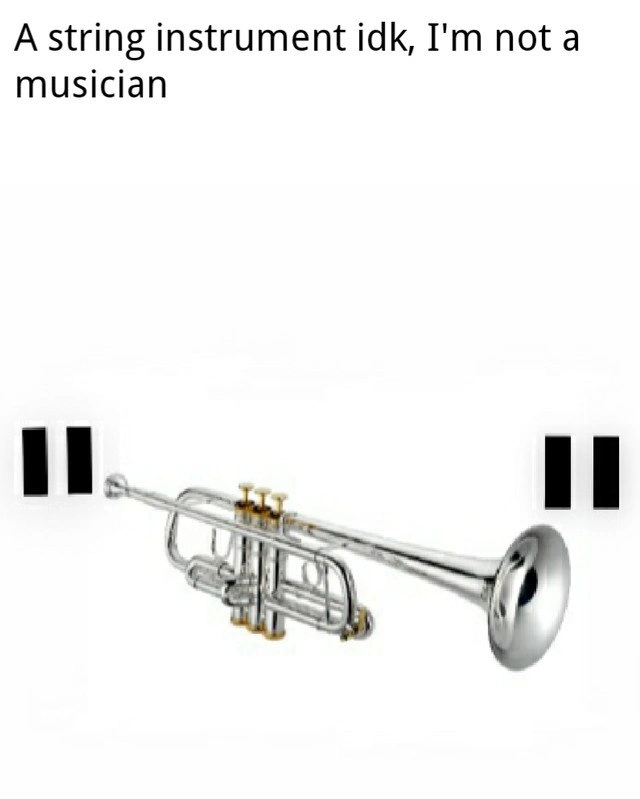
Now, the meme shows an image of a silver trumpet with two thick vertical black bars on each side. Those bars together form the symbol ||. In programming, || is well-known as the logical OR operator – it’s used in many languages (like C, Java, JavaScript) to mean “this OR that” in a Boolean expression. For example, if(isWeekend || isHoliday) { sleepIn(); } uses || to combine two conditions. Important here: || is NOT used to make strings in code. Strings are usually wrapped in quotes ("..." or '...') or maybe backticks (`...` in JavaScript for templates), but not in vertical bars. So if a new coder saw ||trumpet|| in a program, that would actually be a syntax error in most languages – the computer doesn’t interpret that as a string literal at all. It would be confused: “Are you trying to OR something with trumpet? That doesn’t make sense!” In other contexts, those vertical bars have other meanings: for instance, some online chat or forum markdown uses ||like this|| to denote a spoiler, hiding the text in between. In fact, the black rectangles in the image look exactly like the black spoiler censor bars you’d see covering a spoiler. So the meme’s visual is playing on that too – it’s as if the word “trumpet” or the trumpet image is being “spoiler-tagged”. But here it’s not hiding the instrument; it’s highlighting the programmer’s confusion by visually putting the trumpet between bars as if that somehow categorizes it as a string.

The caption text at the top says: “A string instrument idk, I’m not a musician.” Translated from developer-slang, that “idk” means “I don’t know.” This is the developer admitting they have no clue about musical instrument categories. It’s a bit like a programmer who hasn’t learned much about a topic awkwardly guessing. In coding terms, this person sees something between two matching delimiters and assumes, “Oh, if it’s between a pair of symbols, maybe that means it’s a string literal.” This is obviously wrong because only specific delimiters make something a string (usually quotes). It’s as if they thought the vertical bar characters are interchangeable with quotation marks. It would be akin to a newbie mistake of using the wrong syntax for a string, like trying to do:

std::string instrument = |trumpet|; // This is invalid C++ syntax, not how you denote a string!

A seasoned coder would instantly flag that as a mistake – we use " double-quotes, not | pipes. The meme humorously shows that concept: the dev literally put the trumpet between || bars, so they went, “welp, looks string-y enough to me!”

This highlights a concept of type safety and data types: In programming, every piece of data has a type (kind) – e.g., an integer vs. a string vs. a boolean. Type safety means you shouldn’t, say, treat a number as if it were text or vice versa without an explicit conversion, because that can cause errors. For example, if you have a function expecting a string (text) and you accidentally pass a number, a type-safe language (like Java or C#) will give you a compile error – it’s protecting you from mixing up apples and oranges. In a loosely typed language (like JavaScript or Python), the program might try to coerce the type implicitly: for instance, in JavaScript "5" + 3 will coerce the number 3 into text and give the string "53" as a result (concatenating as text), which might not be what you intended if you thought it would do math. These kind of surprises are what type safety is meant to prevent.

In our meme’s scenario, calling a trumpet a string instrument is like a type error in real life. It’s the same as labeling data with the wrong type. In a program, if a developer mislabeled a brass instrument as a string, the logic that decides what sound to play or which group to seat the instrument in would go haywire (imagine an orchestra program that tries to put the trumpet in the violin section because it got a instrumentType = "string" input – the result would sound pretty odd!). In fact, developers have a joking term “stringly-typed” to describe systems where everything is shoved into loosely typed strings rather than proper specific types – it’s usually a recipe for bugs. This meme is basically a stringly-typed classification of a trumpet! The developer is using an extremely flimsy logic: if it’s between two bar characters, it must be a string. They misunderstand the technology of how we denote strings in code and also the actual meaning of string in the musical context.

For a junior dev or a non-coder, the key humor elements are: (1) the confusion between a programming term and a real-world term (the word “string”), and (2) the use of the || symbols which a programmer would recognize as something that normally has a totally different purpose (logical OR or spoiler tag, but definitely not naming instrument types!). Developer communities love this kind of joke because it’s both nerdy and accessible – you have the programming reference (which insiders get) and the obvious real-world mistake (which even non-devs can find silly: calling a trumpet a string instrument is clearly wrong). It’s a familiar scenario of a techie person messing up an everyday category because they’re too deep in their tech world. And we’ve all been there or seen that: like a programmer friend calling a guitar “that user interface for music output” or saying something has a “bug” when it’s just a broken appliance – mixing jargons to comedic effect.

Level 3: Brass Cast to String

At its core, this meme riffs on a type mismatch error in real life. It’s treating a musical trumpet (a brass wind instrument) as if it were a “string” just because it’s enclosed between two || symbols – mimicking the way a programmer might put text between quotes or delimiters to make a string literal. In programming, a string is a sequence of text characters (like "trumpet"), which is totally unrelated to a string instrument in music (like a violin or guitar, which physically have strings). The developer in the meme has conflated these meanings, essentially performing a bogus type cast: they've taken an object of type BrassInstrument and tried to cast it to a String type simply by wrapping it with || bars. In a strictly typed language, the compiler would blow up at you for doing something so absurd – imagine a compile-time error screaming something like TypeMismatchException: Cannot convert Trumpet (Brass) to String. But our hapless dev doesn’t know better, so they confidently label the trumpet as a “string instrument” and even shrug it off with “idk, I’m not a musician”.

This mix-up is hilarious to seasoned developers because it parodies a classic programming blunder: using the wrong delimiter or the wrong type and ending up with a nonsense result. We’ve all seen code where someone intended to do one thing but used the wrong symbol or concept, leading to a bug. Here the || symbol serves double duty in the humor. In many languages || is the logical OR operator (for example, in C, C++, Java, JavaScript, conditionA || conditionB means either A or B is true). Placing a trumpet between || doesn’t make any semantic sense in code – you can’t OR an instrument with anything! – which hints that the developer has no idea what those bars really do in a program. It’s like writing:

// Developer's flawed logic in code form:
const instrumentName = "Trumpet";
const instrumentType = "String";  // oops, treating a trumpet as a string instrument
console.log(`${instrumentName} is a ${instrumentType} instrument.`);
// -> Output: "Trumpet is a String instrument." (a clearly incorrect statement!)

If this were a real program, a senior engineer would facepalm: the code would output a wrong classification because the developer provided the wrong data type or category. The meme’s joke is essentially the same mistake in human form: the dev sees something between two bars and thinks “oh, that must be a string (text)”, then treats the trumpet as a string-type instrument. It’s a nerdy form of syntax humor – abusing programming notation outside its valid context. Seasoned devs find this funny because it satirizes the way inexperienced coders (or those out-of-depth in a domain) can grab the wrong tool or concept and apply it blindly. It’s relatable humor in the software world: who hasn’t seen a newbie confuse one concept for another, or misuse an operator thinking it does something else? This is basically a type-safety joke: in a robust system of categories, calling a trumpet a string would be impossible (or caught as a bug), just like a good type system prevents assigning a "Trumpet" object to a variable of type Guitar. But in the wild world of loosely-typed thinking (or sloppy code), these mistakes slip through. Experienced devs have chased down bugs caused by values being mislabeled or type-coerced incorrectly (like a number handled as text, leading to "2" + 2 = "22" kinds of surprises). So seeing a trumpet labeled as a string instrument triggers that “ugh, somebody didn’t do the type-checking” reflex – but in a harmless, comical scenario. It’s the kind of absurd classification error that reminds us of times we’ve debugged an app only to find some data was put in the wrong category (like an enum value out of place or a JSON field with the wrong type). And the caption, “idk, I’m not a musician”, is the icing on the cake: it sounds just like a dev excuse in a commit message or comment (“Fixed the thing. Issue with musical taxonomy – idk, not my department”). It pokes fun at how developers sometimes confidently implement something they don’t fully understand, with funny (or disastrous) results. This all lands well with developer communities because it’s relatable humor about misunderstanding technology (and music): a lighthearted nod to both our tendency to see everything through a coding lens and the importance of knowing your domain before you label things. (Bonus chuckle: those chunky black || bars also look like a “pause” button ⏸️ – as if the universe itself is saying, “hold on there, code cowboy, think about this!”)

Description

This meme presents a developer-centric pun. The top section contains the text 'A string instrument idk, I'm not a musician'. Below, on a white background, is a picture of a silver trumpet. On either side of the trumpet are large, black double quotation marks. The joke lies in the double meaning of 'string'. While a musician would think of a guitar or violin, a programmer sees a literal 'string' data type, which is text enclosed in quotes. The image humorously depicts an 'instrument' (the trumpet) being turned into a programming 'string' by wrapping it in quotation marks. This is a classic example of technical humor that reinterprets common language through the lens of coding

Comments

7
Anonymous ★ Top Pick My first senior dev told me to 'put strings on everything' for logging. I think this is what he meant
  1. Anonymous ★ Top Pick

    My first senior dev told me to 'put strings on everything' for logging. I think this is what he meant

  2. Anonymous

    Our legacy DSL treats anything between || as a literal, so yes - the trumpet compiles as a string; and people still wonder why the audio pipeline keeps throwing UnhandledBrassException in prod

  3. Anonymous

    This is like when the PM confidently tells the client we're using 'blockchain' for our PostgreSQL database, or when executives insist the monolith needs 'more microservices' to fix a simple caching issue - sometimes the fundamental category error is so profound, you just nod and add another abstraction layer to the requirements translator service

  4. Anonymous

    When your junior dev takes 'everything is a string' too literally and starts wrapping musical instruments in quotes. At least they're thinking about type safety - though I'm pretty sure this trumpet would fail any reasonable schema validation, and good luck serializing that to JSON without some serious buffer overflow issues

  5. Anonymous

    Spec says "string", mockup wraps it in ||, backend ships value || 'default' - enjoy the 2am brass section

  6. Anonymous

    Expected String, got Brass: the TypeError that haunts every prod deploy from a PM spec

  7. Anonymous

    “String instrument” is exactly how our enterprise schemas work: everything’s VARCHAR, the ETL pipes (||) ship it to prod, and we only realize it’s brass when the alerts start blaring

Use J and K for navigation