Skip to content
DevMeme
6173 of 7435
The Embedded Engineer's Edition of Monopoly
EmbeddedSystems Post #6770, on May 20, 2025 in TG

The Embedded Engineer's Edition of Monopoly

Why is this EmbeddedSystems meme funny?

Level 1: Circuit Board Game

Imagine you have a tiny computer chip with a bunch of little metal legs, and each leg does something different – one could turn on a light, another could read a button, another gives the chip power. Normally, a picture showing all these legs and what they do looks super complicated, like a dense technical map. Now, think of the board game Monopoly, with its colorful properties around the edges of the board. This meme basically turns the chip’s map into a Monopoly board. It’s as if someone took a very serious diagram and said, “let’s make it a fun game!” All the chip’s connection points are drawn as if they are properties you can land on in a game. There’s even a spot that acts like the “Go to Jail” square – in this case it’s the chip’s reset pin (if you hit that, the chip restarts, kind of like going back to the start in a game). The joke is funny because it’s mixing something really technical (a microcontroller pinout diagram) with something really familiar and playful (a classic board game). Even though wiring a chip has nothing to do with collecting rent or passing Go, the picture makes it look that way. It makes engineers smile because it’s so unexpected – it’s like seeing your boring office spreadsheet turned into a level of Super Mario. You don’t need to know the technical details to get the giggle: basically, a complicated electronics chart was redrawn to look like a fun game board. It highlights how even nerdy engineers love to play and joke around. They took an electronics schematic (which is usually serious business) and made it look like a game, poking fun at how managing all those chip connections can feel like playing a really high-stakes round of Monopoly. In simple terms, it’s funny for the same reason the idea of a “circuit board game” sounds funny – it’s two worlds colliding in a silly, creative way. So, anyone looking at it can chuckle thinking, “Ha, if Monopoly were about engineering, this is what it’d look like!”

Level 2: Pinout Playground

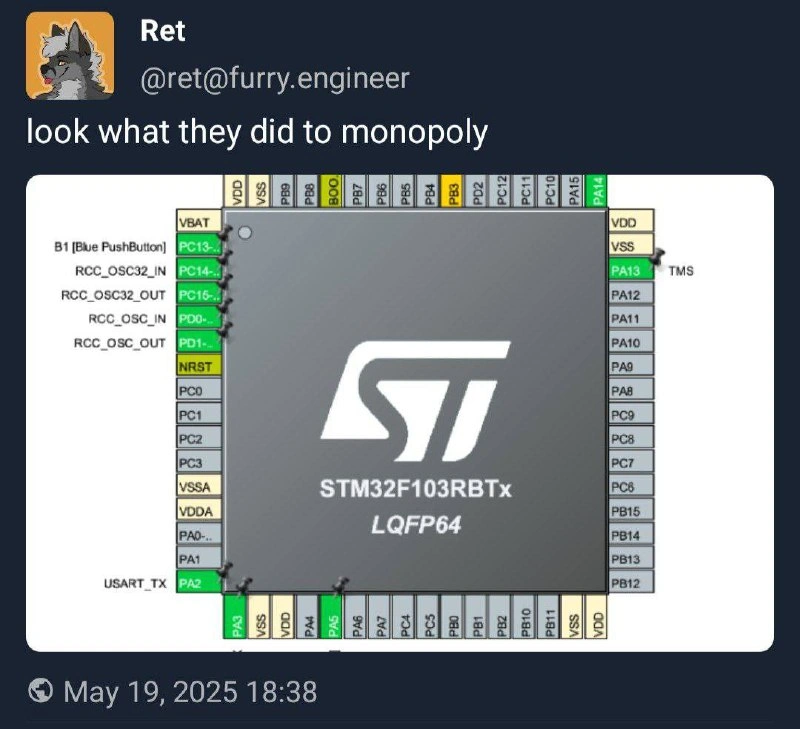
Let’s break down what’s going on here. The picture shows a pinout diagram of a microcontroller (the STM32F103RBTx) that has been stylized to look like a Monopoly game board. A pinout diagram is basically a map of all the pins (the metal legs) on an integrated circuit, showing what each pin is called and what it does. In the real world of Embedded Systems, engineers use such diagrams to know how to connect the chip to other parts (sensors, buttons, power, etc.). The particular chip here, STM32F103RBTx, is a small computer-on-a-chip made by STMicroelectronics (that’s what ST stands for on the chip). It belongs to the STM32 family of microcontrollers which are very popular in hobby and industry projects alike. The code-like names PA13, PB10, PC13, etc., are the pin names. They consist of a letter (the port, like A, B, C) and a number (the pin number on that port). So PA13 means Port A, Pin 13. Think of ports as groups of 16 pins each that can be controlled via software. For example, Port A on this chip has pins PA0 through PA15. Each pin can act as an input or output and often has special functions. For instance, in the diagram you see USART_TX next to PA2 – that indicates Pin 2 of Port A doubles as a UART transmit line (UART/USART is a serial communication interface, basically how the chip can send text/data to a PC or another device).

Now, usually a pinout diagram in the datasheet is just plain rows of labels around a chip outline, often black and white. But here it’s been jazzed up: color-coded blocks around the chip resemble Monopoly properties. Monopoly, the board game, has a square board with each property colored by its “neighborhood” (blue, green, yellow, etc.). The meme uses alternating colors like yellow, green, gray, teal for the pin blocks, immediately evoking that familiar board game look. For example, on the left side of the image, you see a vertical column of green blocks (with labels like PC13, PC14, PC15, PD0, PD1) and a yellow block labeled NRST. In Monopoly terms, that looks like a colored property group ending at a special square. And indeed, NRST is a special pin: it’s the reset pin. Pulling NRST low will reset the microcontroller (like pressing a reset button to reboot it). The image even draws a tiny arrow next to NRST, making it look like an action square (Monopoly’s corner squares like “Go to Jail” often have arrows). On the right side, there’s another arrow by PA13 labeled TMS – that stands for Test Mode Select, a part of the chip’s programming/debug interface (specifically, PA13 is used for the SWDIO signal in Serial Wire Debug, which lets you load code onto the microcontroller or debug it). Again, not a normal property but a special function square in terms of our board game analogy. In a standard pinout, these arrows are just indicating the pin connects to internal modules (NRST connects to the reset circuit, PA13 to the debug module), but styled like this they remind us of Monopoly’s Chance or Community Chest cards that redirect your gameplay.

Let’s decode a few more labels you see: VBAT is a pin used to supply battery backup power to the chip’s real-time clock (so that if the main power is off, the clock and a small portion of memory can stay powered by a battery – useful for keeping time). VDD is the main positive power supply pin (voltage drain, typically +3.3V for this STM32). VSS is the ground pin (0V, reference point for the circuits, usually you have multiple VSS pins on a larger chip). In the image, VSS and VDD appear on multiple sides, colored likely in grey or yellow, similar to how Monopoly has “Tax” or “Go” spaces that are not part of property sets. VDDA and VSSA (with the extra “A”) are the analog power and analog ground – used by the chip’s analog-to-digital converters and such to keep analog circuits clean from digital noise. Meanwhile, B1 [Blue PushButton] is annotated next to PC13. This suggests that on the particular development board that diagram came from (perhaps an ST Nucleo or discovery board or the famous “Blue Pill” board often used with STM32F103), there is a user button (labeled “B1” and colored blue) connected to pin PC13. They included this note on the pinout so you know that pressing the blue onboard button will pull PC13 high or low. Little details like that ground the pinout in a real use-case. So, for a junior developer or an electronics student, this image actually packs a lot of genuine info: it shows which pins are power pins, which are special function pins (like NRST, VBAT, or pins for the external oscillator labeled as RCC_OSC_IN/OUT for the clock crystal on PD0/PD1 or PC14/PC15), and which are general I/O pins like PA0, PA1, … PC15 that you can use for your circuits.

By turning it into a board game layout, the meme makes studying this intimidating diagram more fun. The phrase “the most cutthroat Monopoly board ever” is kind of a tongue-in-cheek jab: in hardware engineering, if you misuse one of these pins or connect something wrong, the consequence isn’t just paying a fine in play money – you might destroy the chip or spend hours troubleshooting! It’s “cutthroat” indeed. But seeing familiar Monopoly-style colors and thinking of each pin as a “property” you manage can make the learning process a bit less dry. It’s a form of TechHumor that says: hey, we know reading pinouts can be a slog, so let’s imagine it as a game to lighten the mood. And for anyone in EmbeddedSystemsAndIoT who has spent nights debugging a board, it’s a welcome chuckle to imagine perhaps Mr. Moneybags (the Monopoly mascot) trying to handle an STM32: “Do I get to collect $200 or do I connect VDD?!”.

Level 3: Game of Ports

For experienced embedded developers, this meme elicits a knowing grin. It takes the pinout diagram – that dense, eye-straining map of pin labels from the microcontroller’s datasheet – and turns it into something whimsically familiar. The image literally arranges the pins of an STM32 microcontroller as if they were properties on a Monopoly board. Each side of the chip (with its 16 pins) becomes a side of the game board. The normally dry labels like PA8, PB10, or PC13 are color-coded in yellow, green, teal, and gray, just like Monopoly properties are grouped by color families. To an EmbeddedSystems engineer, seeing hardware pins laid out this way is hilarious because it clashes two very different worlds: the high-stakes seriousness of hardware design and the supposedly lighthearted realm of a board game. Why “supposedly”? Well, anyone who’s played Monopoly knows it can be cutthroat – much like debugging hardware at 3 AM can be! The tweet caption "look what they did to monopoly" underscores this mashup: someone has imaginatively skinned the pin diagram to look like the iconic property loop. The humor comes from how absurdly well it fits. Each pin is like a property you might land on: for instance, landing on NRST (the reset pin, highlighted in bold yellow with a tiny arrow in the image) would metaphorically send you back to Start (just as pressing reset sends the chip back to its initial state). And notice PA13 on the right side, tagged with TMS (part of the JTAG/SWD debug interface) and drawn with an arrow – this special pin is a corner square of sorts. It’s akin to those unique Monopoly corners (Go, Jail, etc.): you don’t “buy” TMS; it’s a given utility for programming the chip, just as “Go to Jail” is a given event rather than a purchasable property. By marking it with an arrow, the diagram is playfully saying “pay attention, special rule here!” — maybe a nod to the Monopoly card that sends you to jail, or in this case, into debug mode.

This HardwareHumor resonates because every engineer who’s routed a PCB or wired up a microcontroller has battled the pinout. We squint at these diagrams (often literally under a magnifying glass or zoomed-in PDF) trying to find the one pin that is UART_TX or the one labeled VBAT among dozens of cryptic codes. It’s a universal nerd experience: you have the board on your desk, the chip’s in front of you with tiny leg labels, and the datasheet’s pin chart starts to look like a Byzantine game board in your sleep-deprived state. By remixing it as a Monopoly board, the meme nails that feeling. Monopoly is famously a game of strategy, chance, and occasionally backstabbing trades — and if you think about it, hardware design often involves all three. Strategy: planning which pins to use for which function (e.g., “Should I use PA9/PA10 for USART1, or sacrifice those for additional ADC channels?”). Chance: sometimes, despite planning, a miswiring or manufacturing variance throws you a curveball (like drawing an unlucky Chance card). And backstabbing trades? Oh, ask a senior engineer about the time two features conflicted and one had to be cut or rerouted late in development: “Fine, I’ll give up using PB3 for the sensor if I can take PA15 for the debug line.” It’s office-politics-meets-circuit-design, an EngineeringAbsurdity but a real one.

By turning the pinout_boardgame crossover into a visual joke, the meme also hints at how learning hardware feels like learning game rules. Newcomers memorize the rules of Monopoly; junior developers memorize the functions of each pin (PC13 is an LED on many boards, PA13/PA14 are for programming, VBAT keeps the clock running, etc.). Seniors recall the countless hours spent poring over pin tables like these. This image says, “Wouldn’t it be nice if figuring out the pin assignments was as fun as a game?” – all while acknowledging that, in reality, getting pin assignments wrong can cost you real “monopoly money” in the form of fried components or respin costs! In the EmbeddedSystemsAndIoT community, where we deal with hardware quirks daily, this sort of mashup is cathartic. It’s a gentle jab at how HardwareEngineering can feel like a never-ending game where the stakes are high, the rules are plentiful, and sometimes it feels like the house (or datasheet) always wins. In essence, the meme takes a slice of frustrating reality and makes us laugh at it by framing it as a familiar childhood game. Every seasoned dev recognizes that blend of nostalgia and tech inside the joke – and maybe wishes that debugging a tricky pin configuration really was as straightforward as paying 50 Monopoly dollars to get out of jail!

Level 4: Alternate Function Auction

At the deepest technical level, this meme highlights the resource allocation puzzle inside a microcontroller. The STM32F103RBTx is a 32-bit ARM Cortex-M3 microcontroller where each physical pin isn’t just a simple connector — it’s a multiplexed gateway to multiple internal peripherals. In other words, one pin might serve as a general-purpose I/O today, or tomorrow it could be reassigned as a USART TX line, an SPI clock, an ADC input, or a dozen other roles. Deciding which function each pin will perform is like conducting an auction with the chip’s internal peripherals bidding for “prime real estate” on the package. Chip designers have to negotiate which signals get brought out to those limited 64 pins of the LQFP-64 package. Not every internal feature gets a pin, and those that do often have to share. This engineering trade-off is a serious combinatorial challenge – essentially a constraint satisfaction problem where the prize is a proper working design and the penalty for a bad mapping is a peripheral you can’t use. Seasoned engineers know this dance well: assigning pins can feel like solving a Sudoku or coloring a graph, making sure no two features conflict. In fact, tools like ST’s CubeMX function a bit like autonomous game masters, checking your chosen pin configuration against all the rules to ensure no illegal moves (like two functions on one pin) occur.

On the hardware architecture side, the layout of these pins around the chip is far from random – it’s constrained by silicon die layout and physics. The microcontroller’s silicon die has tiny bond wires that connect internal modules to the external pins. Grouping related pins (like port pins PA0–PA7 on one side) can shorten internal routing and minimize interference. Notice terms like VDDA and VSSA: these designate the analog power supply and analog ground pins. They’re separated from the digital power (VDD) and ground (VSS) pins to prevent noisy digital switching from disturbing delicate analog measurements – a design born from electromagnetic theory and chip fabrication practices. This separation is an example of how hardware design is as ruthless as Monopoly’s economy: there are strict rules and limits dictated by physics (you must isolate analog domains, just like you must pay rent on Park Place). The pins are precious: each one is a hard-won negotiation between silicon real estate, functionality, and signal integrity. The joke here plays on that reality – internally, using an STM32’s full capabilities really is like playing a cutthroat game where every pin (property) must be bargained for. Even the chip’s designers had to play this game: deciding, for example, if the debug interface gets to take over PA13 and PA14 (for SWDIO and SWCLK aka the debug/test pins TMS and TCK) instead of leaving those for general I/O. They granted it, because debugging is vital – a decision akin to awarding Boardwalk to the debugger because without it, the development “economy” collapses. In short, beneath the humor is a shadow of truth: configuring a microcontroller is a high-stakes strategy exercise, constrained by both computational complexity and physical laws, not unlike an intense game of Monopoly being played on the silicon “board.”

Description

A screenshot of a tweet by user 'Ret' (@[email protected]) with the caption, "look what they did to monopoly". The image displays a technical pinout diagram for an STMicroelectronics STM32F103RBTx microcontroller, which is a popular chip used in embedded systems. The diagram shows the square chip package (LQFP64) with its 64 pins arranged neatly around the perimeter, complete with labels like 'PC13', 'PA10', 'VDD', and 'VSS'. Some of the pins are highlighted with colors like green and yellow. The humor is derived from the striking visual resemblance between this square pinout diagram and the layout of a classic Monopoly game board. The arrangement of pins around the edge mimics the properties, railroads, and other spaces on the board, making it a niche joke for those in the electronics and embedded systems fields

Comments

48
Anonymous ★ Top Pick In this version of Monopoly, landing on VDD and VSS simultaneously doesn't send you to jail, it just releases the magic smoke
  1. Anonymous ★ Top Pick

    In this version of Monopoly, landing on VDD and VSS simultaneously doesn't send you to jail, it just releases the magic smoke

  2. Anonymous

    Free Parking is just VBAT pulled high - land on PA13 and you owe four SWD cycles plus a solder bridge

  3. Anonymous

    After 20 years of debugging race conditions in embedded systems, you realize the real monopoly isn't the board game - it's STMicroelectronics owning your entire BOM because their HAL libraries are the only thing keeping your legacy codebase from complete entropy

  4. Anonymous

    When your embedded systems project has so many GPIO conflicts and pin multiplexing issues that the datasheet starts looking like a property trading game - except instead of Boardwalk and Park Place, you're fighting over USART_TX and trying to figure out which alternate function won't bankrupt your entire peripheral budget. At least with Monopoly you could mortgage properties; with STM32, you just get to read 1,000+ page reference manuals and pray your pin assignments don't land you in 'hardware revision jail.'

  5. Anonymous

    In STM32 Monopoly, land on PA13 and go directly to Debug - do not pass GO, do not collect 200 mA; every property’s an alternate function the bank can remap mid‑game

  6. Anonymous

    STM32 Monopoly: where 'Chance' is AFIO remapping roulette, and landing on VDD means you've finally got power - until the peripherals fight over it

  7. Anonymous

    In STM32 Monopoly, PA13 is already zoned for SWD, NRST is Jail, and the rent is paid in rework and errata

  8. @ZgGPuo8dZef58K6hxxGVj3Z2 1y

    I dont get it

    1. @nwordtech 1y

      stm32cubeide pin allocation

      1. dev_meme 1y

        You think in devmeme someone would get lost at stm32? This must be more likely that someone just doesn't know monopoly 😄

        1. @nwordtech 1y

          You never know the amount of ignorance web niqqas might have

          1. @Art3m_1502 1y

            You just envy that they don't have to know what processor is

            1. @deadgnom32 1y

              well. depends on quality of software you need to provide. I'm a web guy, who comes after other web guys produce shit, and turn in into well functioning a fast web software. at some point you kinda need to know, what's inside the engine and even how processors optimize things.

              1. @ZgGPuo8dZef58K6hxxGVj3Z2 1y

                Bro is optimizing JavaScript for processor architecture 😂🗿

                1. @deadgnom32 1y

                  there are cases when hand-optimization will only confuse the processor and it runs slower than its straightforward unoptimized counterpart

                  1. @ZgGPuo8dZef58K6hxxGVj3Z2 1y

                    Exactly and every single optimization does this if you let the code age

                  2. @ZgGPuo8dZef58K6hxxGVj3Z2 1y

                    Let the hw do what its supposed to do and thats it. Obviously dont encode shit in base 64 but you dont need to optimize much. Either your compiler or your CPU already tries to optimize. If you will do something too then the CPU will have to do something stupid to unravel your mess. Unless we are talking about live service games. Then you must write the plain code and the optimized code and make it a warning after every 6 months so people can review and disable it if the assumption the optimization relies on is not true anymore. Then you use the unoptimized code or optimize it again with up to date knowledge

                2. dev_meme 1y

                  Should I repost this meme about ARM instruction specifically for JS? 🌚

                  1. @ZgGPuo8dZef58K6hxxGVj3Z2 1y

                    Pls😭💀😂

                    1. dev_meme 1y

                      FJCVTZS, god forbid!

                      1. @ZgGPuo8dZef58K6hxxGVj3Z2 1y

                        NOOOOOOOO NOT THE 48 bit float😭💀

                        1. @nwordtech 1y

                          Afaik it's for using double's 52 bit mantissa as an integer, not for 48 bit float

                  2. @ZgGPuo8dZef58K6hxxGVj3Z2 1y

                    Can you do something like __asm("mov rax 0") in js? Hell naw or?

                    1. dev_meme 1y

                      Wasm to the rescue

                    2. @deadgnom32 1y

                      you don't need it. you just need to write code that is well understood by processors, so it can optimize it by itself. like. making branched loops — is much slower, than running with a clear defined set of operations over the whole dataset multiple times in pipelines. it looks like you do more operations, you do indeed, but they are well optimized on processor level with branch prediction. and if there are no branches at all, it just speculated the results without dropping them afterwards. which is way faster.

                      1. @ZgGPuo8dZef58K6hxxGVj3Z2 1y

                        Yesn't. Write plain straightforward code. NOT specifically for any CPU

                        1. @deadgnom32 1y

                          I haven't been saying I'm opting for specific cpus. it was your assumption out of nowhere

                          1. @ZgGPuo8dZef58K6hxxGVj3Z2 1y

                            Yeah. It wasnt clear. You iust write what is pretty in the language. If its a common pattern there may even be hand written optimizations for it

                            1. @ZgGPuo8dZef58K6hxxGVj3Z2 1y

                              In your compiler

                            2. @deadgnom32 1y

                              anyways. oftentimes unoptimizing hand-micro-optimizations often results in faster execution and cleaner code. I better focus on architecture optimizations. this brings way more performance than optimizing loops

                              1. @ZgGPuo8dZef58K6hxxGVj3Z2 1y

                                Yes

                              2. @ZgGPuo8dZef58K6hxxGVj3Z2 1y

                                Architecture as of your app? Not CPU architecture?🤨

                                1. @deadgnom32 1y

                                  yes

                                2. @deadgnom32 1y

                                  imagine fpga cpu that you reprogram for your needs on every webpage 😂

                      2. @ZgGPuo8dZef58K6hxxGVj3Z2 1y

                        Actually thats what the (JIT) compiler does. Speculative execution is meant for reducing cache misses. By preloading pages from RAM that might be needed later

                      3. dev_meme 1y

                        Wdym processor? 🌚

                        1. @deadgnom32 1y

                          I may be wrong and it appears on some other level. at some point knowledge becomes less specific on details.

                        2. @Art3m_1502 1y

                          Exactly

          2. @RiedleroD 1y

            there's an unfortunate trend of squarespace monkeys calling themselves web devs. it makes the rest of us look bad

            1. @RiedleroD 1y

              "trend" since like 2005 I would really like the field to stop being stuck in this shitassery of incompetence being celebrated

            2. @TERASKULL 1y

              and they explain their incompetence with imposter syndrome, which further makes people in IT look like retarded monkeys pressing buttons by guess

              1. @RiedleroD 1y

                mmh well impostor syndrome is an actual issue people have, but some peoples' intuition about being incompetent is 100% correct

                1. @TERASKULL 1y

                  yea that's what i mean, they use it to cope, while invalidating the actual syndrome and making others look like they're pretending

            3. @ZgGPuo8dZef58K6hxxGVj3Z2 1y

              Dont try to differentiate yourself from them /s

        2. @ZgGPuo8dZef58K6hxxGVj3Z2 1y

          Yes

  9. @ZgGPuo8dZef58K6hxxGVj3Z2 1y

    Ah😭💀😂🗿

    1. dev_meme 1y

      @nwordtech thats what I'm talking about 😂

      1. @ZgGPuo8dZef58K6hxxGVj3Z2 1y

        NWORDTECH💀🤌

Use J and K for navigation