Startups Skip Scrum Roles
Why is this Agile meme funny?
Level 1: Everyone Does Everything
This is like asking a tiny lemonade stand, "Who is the manager, who is the accountant, and who is the customer-service department?" and the kids at the stand answer, "We do not have that here. We just sell lemonade." The joke is that big teams give special names to jobs, while startups often make the same few people do all the jobs at once.
Level 2: Who Owns What?
Agile is a broad approach to building software in small, adaptable steps. Scrum is one specific Agile framework with defined events, artifacts, and roles.
In Scrum, the Product Owner decides what work is most valuable. They manage the product backlog and help the team understand priorities. The Scrum Master helps the team use Scrum well. They do not boss everyone around; they remove blockers, improve process, and keep the team from turning Agile into random meetings.
The meme says startup companies reject that separation. In many startups, one person may handle product questions in the morning, write code after lunch, test the release at night, and explain the roadmap to a customer the next day. That can feel efficient because there are fewer handoffs. It can also create confusion because nobody knows who has final say.
This is why the image is tagged with StartupCulture, AgilePainPoints, and ManagementVsEngineering. It is not only mocking Scrum. It is mocking the gap between textbook process and small-company survival mode. Startups often move fast by keeping structure minimal, but missing structure does not make the underlying work disappear.
Level 3: Ceremony Not Found
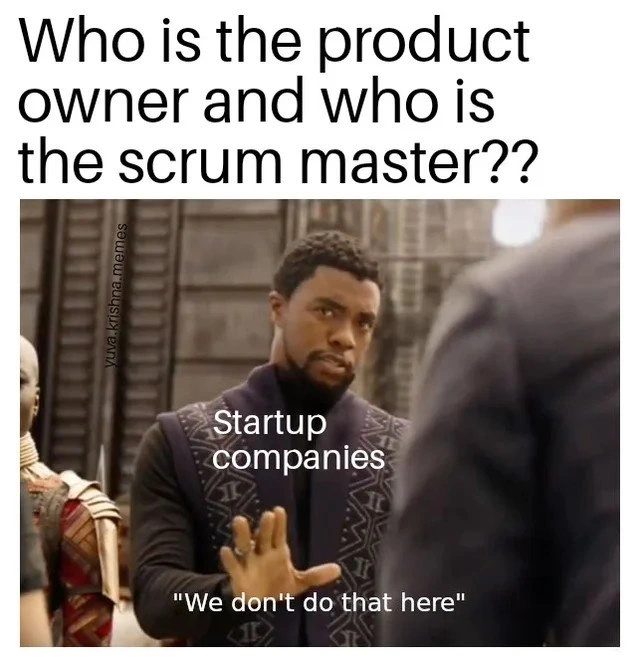
The meme asks:
Who is the product owner and who is the scrum master??
The reaction frame labels the person holding up a hand as:
Startup companies
and answers:
"We don't do that here"
That is the whole startup-process argument in one image. Formal Scrum separates responsibilities: the Product Owner owns product value, priorities, backlog ordering, and stakeholder alignment; the Scrum Master coaches the team, protects the process, removes impediments, and helps Scrum actually function instead of becoming calendar cosplay. Startups often look at those role boundaries, glance at the runway, and assign all of it to the same three people who are also writing code, answering support tickets, configuring Stripe, and fixing the office Wi-Fi.
The humor works because both sides have a point. Scrum roles exist because product direction, delivery process, and engineering execution are different jobs with different failure modes. If nobody owns the product, the backlog becomes a junk drawer of customer requests, founder impulses, half-promised enterprise features, and "quick wins" that take six weeks. If nobody owns process health, standups become status theater, retros become group therapy without follow-through, and sprint planning becomes a negotiation with optimism as the only currency.
But early-stage startup reality is not a certification workshop. A company with six people cannot always afford a dedicated product owner and scrum master. The founder may be the product owner because they are closest to customers and investors. The tech lead may become the process person because they know where the engineering bottlenecks are. The same developer who estimates the ticket may also design the feature, deploy it, watch the metrics, and apologize in Slack when the metrics are on fire.
That is why the caption, "We just develop the software...", adds a second layer. It is not just anti-process bravado. It is the startup belief that shipping matters more than ceremony. Sometimes that is healthy: lightweight process can preserve speed and reduce performative meetings. Sometimes it is just technical debt wearing a hoodie: no prioritization discipline, no explicit acceptance criteria, no shared definition of done, and no one empowered to say "this is not the work that matters."
The real pain point is role invisibility. Startups may not have titles for product ownership or Scrum facilitation, but the work still exists. Someone is deciding what gets built. Someone is mediating scope. Someone is translating customer pain into requirements. Someone is protecting focus or failing to. The meme is funny because "we don't do that here" usually means "we do that informally, inconsistently, and then act surprised when context lives entirely in one person's head."
Description
The meme asks in large text, "Who is the product owner and who is the scrum master??" Below it is a reaction still of T'Challa from Black Panther holding up a hand, with "Startup companies" overlaid on his chest and the subtitle-style quote "We don't do that here." The joke is that early-stage startups often ignore formal Scrum role definitions and collapse product ownership, delivery coordination, and engineering execution into whoever is available. It contrasts Agile process orthodoxy with the informal, resource-constrained operating style common in startups.
Comments
3Comment deleted
In a startup, the product owner is whoever got the customer call, and the scrum master is whoever still remembers the standup link.
And I think it's beautiful. Comment deleted
I have yet to encounter firsthand a single _company_, let alone a _team_ doing Scrum proper! Every single team or company "doing Scrum" that I have have encountered so far is doing some badly disfigured form that could be best described as "Scrum" (emphasis on the quotes) or Bastardized Scrum™ 😁. Once you inquire more closely about the aspects from The Scrum Guide they'll usually just tell you why this or that part didn't work for them. And so in essence they aren't doing Scrum, even though they claim so. I heard a credible oral account from a trusted dev that he did _actual_ Scrum at a previous company, though. But to this day in several years and peeking into a number of different companies and teams I have not found a single one where Scrum proper is practiced. So maybe it's not a bad thing that they aren't doing that in those stereotypical startups? Certainly this wouldn't be the one aspect that would prevent me from working for a startup company. There are others that weigh heavier. And _if_ the timeboxing of Scrum would be taken seriously, then that'd be a good thing in my book. Usually startup atmosphere means something along the lines of overtime without end etc. So timeboxing would be a good thing, if it were used in the spirit of The Scrum Guide. Comment deleted