Skip to content
DevMeme
6495 of 7435
Founding Engineers: MIT Dropouts vs Eastern European Homelab Wizards
Startup Post #7120, on Sep 12, 2025 in TG

Founding Engineers: MIT Dropouts vs Eastern European Homelab Wizards

Why is this Startup meme funny?

Level 1: One-Upping at Recess

Imagine two kids on a playground trying to top each other’s brag. The first kid says, “My big brother is so smart, he even quit the famous school Harvard because he’s creating something cool!” That’s pretty impressive, right? But the second kid isn’t impressed and fires back: “Oh yeah? Well, my uncle is this super funky inventor. He’s kind of a mess – his house is full of gadgets, he’s got a bunch of weird satellite antennas on his roof, and he’s spent more money on computers in his basement than on his whole house! He even makes my dad pay him in special pirate coins instead of dollars.”

The other children giggle because the second kid’s claim is wild and over-the-top. It’s a silly exaggeration, like a tall tale. The humor comes from how ridiculously he tries to one-up the first brag. It’s basically a funny game of “my team is crazier and cooler than yours.” Even if you don’t get the tech details, you can laugh because it’s clearly boasting gone wild. One person brags about something big, and the other person responds with something so absurd (a basement full of machines and being paid in secret coins!) that it flips bragging into a joke. It’s like saying, “You think that’s cool? Hold my juice box, I’ve got an even crazier story!”

Level 2: Homelabs & Monero 101

Let’s break down the tech and culture references in simpler terms. This meme is essentially a joke tweet comparing two startup teams: one fairly typical (engineers from a top school) and one totally wild (engineers with crazy personal setups). To understand why it’s funny, we need to know what each of those buzzwords and references mean:

  • Founding engineers: The first engineers hired at a startup, often the ones building the core product from scratch. They’re like the startup’s original tech heroes. When someone says their founding engineers are MIT dropouts, they’re implying these folks were smart enough to go to MIT (a world-famous tech university) but bold enough to leave before graduating. In startup lore, being a dropout from a top school can be a bragging point – think of tech icons like Bill Gates or Mark Zuckerberg who dropped out of Harvard to start companies. It suggests the person is brilliant but non-conformist, willing to take risks.

  • Divorced Eastern Europeans with drinking problems: This describes the other startup’s engineers in a shockingly frank way. Instead of polished college kids, they’re older, possibly grizzled engineers from Eastern Europe (countries like Russia, Poland, Ukraine, etc., known in tech for strong programmers). “Divorced with drinking problems” is an exaggeration to emphasize these individuals have had a rough personal life, maybe lots of life experience (and perhaps a stereotypical vodka habit). It’s intentionally unflattering and thus funny, because normally you’d never boast about that. The joke here is that despite those personal issues, these engineers are apparently so good that the founder brags about them anyway. It flips the idea of “ideal employee” on its head – from a slick MIT prodigy to a brilliant but troubled genius. In developer communities, there’s an archetype of the super-talented programmer who might be a bit eccentric or have a messy life but can code circles around everyone. This tweet leans into that stereotype for humor.

  • 6 satellite dishes on their roof: A satellite dish is that bowl-shaped antenna you see on roofs or in yards, used to receive signals from satellites (for TV, internet, etc.). Having even one on a house is pretty uncommon these days (unless you’re in a remote area using satellite internet or you’re a hobbyist picking up satellite data). Six dishes on one roof is practically a mini earth station! This detail tells us these engineers are serious hardware tinkerers. Maybe they set up their own satellite communication links or are doing something extreme like tracking satellites across different orbital positions. It paints a cartoonish picture: imagine a house with a forest of satellite dishes on top – it screams “electronics geek lives here.” For techies, it’s a known flex that some folks build elaborate antenna setups for fun projects (like contacting the International Space Station, getting free broadband, or receiving weather images directly from orbit). In simpler terms, it’s like saying “my engineers are so intense, they literally have NASA-level gear at home.” Most startups would brag about using the latest cloud servers; these guys apparently skip the cloud and beam data straight from space to their basement.

  • 400 subscribers on YouTube: This refers to their YouTube channel’s follower count. Four hundred is a small number on YouTube (big channels have hundreds of thousands or millions of subscribers). By mentioning this, the tweet is tongue-in-cheek: it suggests these engineers have a YouTube channel where they presumably share tech videos (maybe showcasing their homelab or satellite projects), but only a few hundred people find it interesting enough to subscribe. To a general audience, 400 subs is almost nothing to brag about. And that’s exactly why it’s funny in context – it’s an anti-flex. The typical startup brag might be “our CTO has spoken at TED and has 100k Twitter followers.” Here it’s “my guys post niche tech content that only a handful of hardcore fans care about.” It implies these engineers are not doing it for fame; they’re genuine enthusiasts. It’s a playful jab at the kind of TechTwitter influencer culture: instead of being social media famous, these experts quietly have their small corner of internet fame. If you’re new to developer humor, just know that being authentic and geeky often earns more respect in dev communities than just having big follower numbers. So 400 YouTube subs, while objectively small, signals a kind of underground credibility among fellow geeks – a real “in-crowd” vibe.

  • Homelab in their basement worth more than their house: A homelab is a home laboratory for tech – basically a bunch of computers, servers, networking equipment, and other gadgets all set up at someone’s home. Enthusiasts build homelabs to learn, experiment, or run projects (like hosting websites, running game servers, practicing system administration, or mining crypto). When they say it’s worth more than their house, picture tens of thousands of dollars of gear crammed into a basement or spare room. That might include server racks (those tall frames you see in data centers), professional-grade switches and routers, high-end processors, and tons of blinking lights and cables everywhere. It’s probably an exaggeration (hopefully the house isn’t literally cheaper than the gear!), but it emphasizes how extreme these folks are about tech. They’d rather buy GPUs, hard drives, and CPUs than new furniture or a vacation. For someone new to this idea: imagine your friend’s gaming PC setup, then multiply it by 50 – that’s a homelab. It often looks like a mini version of what big companies have in their data centers, but squeezed into a home. Some developers really do this; there are entire forums and subreddits where people show off basement datacenters. It’s both a hobby and a point of pride – they control all their own infrastructure. In startup terms, most companies would use cloud computing (renting servers from AWS, Google Cloud, etc.), but these engineers self-host everything at home. The meme is having fun with that contrast: corporate tech vs. DIY tech. If you’ve ever built your own PC, a homelab is like that hobby taken to the max.

  • “And I have to pay them in Monero.”: Monero is a type of cryptocurrency (like Bitcoin, but with a focus on privacy). Paying someone in Monero means giving them digital coins through the Monero blockchain network rather than regular money via a bank. Monero is known for being very private – transactions are encrypted in a way that outsiders can’t easily trace who paid whom or how much. When the tweet says the founder has to pay them in Monero, it implies these engineers won’t accept normal payment (like a paycheck or bank transfer). Perhaps they’re paranoid about banks/governments, or maybe it’s a legal thing (could they be working off the books or from a country with sanctions?). Either way, being paid in Monero is highly unusual. For one, companies usually pay salaries in a stable currency. Crypto like Monero can swing in value, and it’s not commonly used for everyday expenses (you can’t easily buy groceries or pay rent with Monero). This detail also pokes fun at startup trends: during crypto craze times (BlockchainHype era), some startups tried paying overseas contractors or employees in Bitcoin or other crypto to be hip or to avoid transfer fees. But Monero is an especially niche choice – it’s almost like saying “My team is so hardcore, even their money is hacker-level stuff.”

For someone newer to the tech world, the overall scenario is ridiculous on purpose. The tweet’s author (SPEC on Twitter) is basically making up a crazier brag to out-do another startup bro. It’s written in the style of a tweet because TechTwitter is where a lot of these humorous or boastful conversations happen publicly. The metrics (5,267 likes, etc.) show that many people found this joke relatable and funny. Why? Because it combines StartupHumor (mocking how startups brag about their teams) with DeveloperHumor (references to niche tech hobbies like homelabs and crypto).

In essence, the joke contrasts two types of “impressive” tech workers:

  1. The conventional impressive – young hotshots from a famous school (MIT) who dropped out to chase a dream.
  2. The unconventional impressive – older, self-taught geniuses with odd habits and extreme home setups.

Neither is a bad thing in reality, but the second is far less glamorous, which is why bragging about it is funny. It’s as if someone said, “Oh you have fancy thoroughbreds? Well, I have wild stallions that eat nails for breakfast.” One is polished, the other is scrappy and feral – and the speaker is proud of that scrappiness.

Finally, consider startup culture context: Startup founders often show off to investors, peers, and on social media about how great their team is. Usually you’d highlight degrees, past job titles, things that sound impressive to the layperson. By instead highlighting weird personal life details and an obsession with hardware, SPEC’s tweet is satirizing that entire practice. It hints that what really might make a team amazing isn’t the shiny résumé or pedigree, but passion and hardcore skills – even if it comes with quirks. The fact that it’s framed humorously means it’s not literally suggesting every startup should hire Monero-loving basement dwellers; it’s exaggeration to make us laugh and maybe think twice about conventional definitions of “top talent.”

All the tags like StartupLife and TechHumor fit because this is exactly the kind of joke you’d see shared among devs who are tired of hearing the same braggy stories. It’s a way of saying: “Let’s not take these startup pissing contests too seriously – I’ll raise you one absurd scenario!” If you’ve just started in tech, don’t worry if not every reference lands immediately. Now you know:

  • Monero = privacy crypto coin.
  • Homelab = personal mini data center at home.
  • MIT dropout = someone who left a top college, often seen as an innovator.
  • Tech Twitter = where devs joke and brag in tweet form.

And you’ve seen how mixing those in an exaggerated way makes for prime TwitterHumor among developers.

Level 3: Basement Datacenter Bravado

At the highest level, this meme skewers startup culture by taking the usual bragging wars to absurd heights. It’s a perfect example of founder one-upmanship on tech Twitter. The first boast is pretty standard: “Our founding engineers are MIT dropouts.” In the startup world, having ex-MIT (Massachusetts Institute of Technology) folks, especially dropouts, is classic clout – it implies they're brilliant and bold enough to ditch a premier program for a big idea. But the reply cranks the dial way past eleven, essentially saying: “Cute, but check out my crew.”

This second founder’s flex is a laundry list of eccentric infrastructure and hardcore credentials that flips the script on what “impressive” means:

  • Divorced Eastern Europeans with drinking problems – Instead of blue-blood Silicon Valley types, the team is made of gritty, world-weary hackers from Eastern Europe. It’s poking fun at the stereotype of the genius programmer from, say, Russia or Ukraine who has insane skills but also some personal chaos. Seasoned devs know many open-source legends and low-level wizards hail from Eastern Europe. By bragging they’re divorced and have drinking problems, the tweet hyperbolically implies these engineers sacrificed normal life for tech (and possibly vodka 🥃). It’s a darkly funny contrast to idyllic Ivy League dropouts; these folks sound like battle-hardened coding veterans. A cynical senior dev might even chuckle, recalling brilliant colleagues who fit this profile – the type who can rewrite a kernel module at 2 AM but might show up to stand-up meeting hungover.

  • 6 satellite dishes on their roof – This is an outrageous satellite_dish_flex. Having one satellite dish is unusual enough for an engineer’s house; six is pure overkill. For context, multiple dishes could mean they’re pulling data from different satellites or running a DIY global communications hub. Perhaps they’re streaming downlinks of weather data, intercepting satellite signals for fun, or ensuring redundant internet connectivity by literally tapping into space. It’s the ultimate hardware hacker brag: who needs fiber or cable when you’ve got a personal satellite array? This element screams “my engineers are so hardcore, they built their own ISP out of spare parts.” Tech veterans recognize the humor: we’ve all met that one infra guru who rigs up crazy antennas or a mesh network at home just because they can. This is that, dialed up to cartoonish level. It satirizes how startups often boast about cutting-edge tech – here, the tech is so cutting-edge it involves aerospace hardware bolted to a suburban roof.

  • 400 subscribers on YouTube – In tech circles, having a YouTube channel signals you tinker and share your projects, but 400 subscribers is adorably modest. This line parodies the “social media influencer” flex. Instead of a famous tech evangelist with a million followers, these geniuses have a tiny niche following. And yet it’s being bragged about as if it’s a big deal, which makes it funny. To seasoned eyes, 400 subs implies they’re probably uploading super niche content (like tutorials on homemade supercomputers or cryptography hacks) that only a small community cares about. It’s a humblebrag: they’re not mainstream famous, but the right 400 people (likely other serious geeks) know them. This resonates with dev communities because influence in tech isn’t always measured by huge numbers—sometimes a few hundred dedicated followers means you’re a guru in a very specialized corner of tech. So the brag here is, “my guys are underground legends, not showy rockstars – they’re in it for the craft, not clout.” It’s an inside joke for DevCommunities that value deep knowledge over vanity metrics.

  • A homelab in their basement worth more than their house – Ah, the homelab_engineers flex. A homelab is essentially a personal data center: racks of servers, networking gear, maybe a cluster for running VMs or crypto miners, all jammed into a basement or spare room. Saying it’s worth more than their house is likely exaggerated, but not by much for some die-hards. Many senior devs know someone (or are someone) who spent tens of thousands on enterprise-grade hardware for “home use.” This is both hilarious and weirdly impressive: it implies these engineers value computing power over creature comforts. Instead of buying a better house or car, they’ve invested in RAID arrays, high-end GPUs, and maybe a custom cooling system that could rival a small basement_datacenter. In industry terms, they’re basically running AWS a private AWS in their cellar. This detail lampoons the notion of “startup with cutting-edge infrastructure” by showing a DIY version: like a scrappy basement datacenter that’s probably louder and hotter than any office server room. It’s a nod to how some brilliant engineers prefer on-premises hardware they can touch and tweak, rather than cloud VMs – even if that means voiding their home insurance with a wall of servers. Seasoned devs laugh because they’ve experienced the nitty-gritty of maintaining hardware: the power bills, the failed disks at 3 AM, the spouse or roommate complaining about that constant 50 dB fan noise next to the laundry. It’s the absurd extreme of “passionate engineer” syndrome.

And then, as if all that wasn’t enough, SPEC (the poster) adds the kicker in a reply: “And I have to pay them in Monero.” This is the cherry on top that slays tech folks with its specificity. Monero (XMR) is a cryptocurrency known for its focus on privacy and anonymity – unlike Bitcoin, Monero transactions are very hard to trace. Paying employees in Monero is wild. For one, it’s not exactly legal tender for salaries in most places (good luck explaining that to the IRS or your accounting department!). For another, it implies these engineers either don’t want to be on the books (perhaps due to those messy personal lives or visa issues) or they’re such cypherpunk enthusiasts that they insist on crypto compensation. It satirizes the whole BlockchainHype era when startups tried to do everything with crypto. Remember when companies were adding “Blockchain” to their names to raise investor eyebrows? Here we’ve got a startup literally doing payroll via crypto, and not even a mainstream one like Bitcoin or Ethereum, but Monero – the choice of privacy purists and, frankly, some shady operators.

To an experienced developer, this nails several jokes at once: - It mocks tech_twitter_bragging culture: founders often humblebrag about how unique their team or tech is. Usually it’s “we have PhDs from Stanford” or “we use a revolutionary AI-driven stack.” Here it’s “we hired off-grid basement hackers and pay them under the table in crypto.” It’s so over-the-top you can’t help but laugh. - It highlights the absurdity of crypto_compensation: Paying in Monero suggests maybe these wizards live somewhere with sanctions or they just refuse banks. It’s a flex about being rebellious – as if normal HR rules don’t apply. A senior dev might chuckle and think, “Try running payroll with Monero – hope you enjoy doing quarterly taxes by hand,” or recall job offers during crypto booms where companies offered tokens instead of money. Usually, that ends in confusion or tax nightmares, which makes the brag even more ridiculously brazen. - It celebrates the myth of the 10x engineer in a tongue-in-cheek way. These “homelab wizards” are basically portrayed as those mythical super-engineers who live and breathe tech to the exclusion of all else. The meme is essentially saying: our startup’s secret weapons are these unsung 10x engineers hidden in a basement lab. It’s poking fun at the idea that a ragtag team of unconventional geniuses can outgun the typical shiny startup team. Silicon Valley loves the legend of the garage startup; this takes it to the basement, literally.

Overall, the humor works on multiple levels for seasoned developers. It lampoons StartupHumor tropes (elite founders vs. real-world mad scientists), mixes in Blockchain absurdity, and relies on insider knowledge of dev subcultures (homelab enthusiasts, crypto-anarchists, Eastern European tech savants). It’s both a parody of the bragging seen in StartupLife and a cheeky nod to the fact that innovation sometimes comes from the fringes. As a grizzled engineer, you laugh because you’ve met characters like this and because you’ve seen how ridiculous startup flexing can get. The next time someone brags “My team is all ex-Google,” you might deadpan: “Oh yeah? Mine prefer Monero and have more servers in their basement than servers at Google’s data center.” 😅

Description

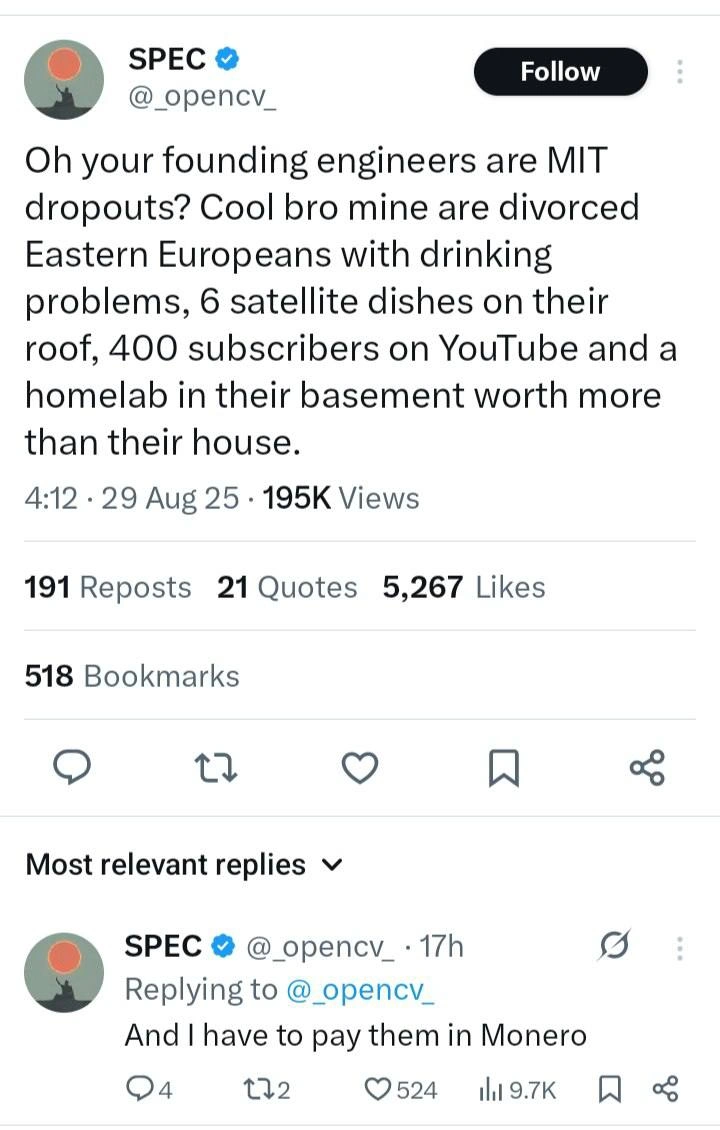
A tweet from SPEC (@_opencv_) reads: 'Oh your founding engineers are MIT dropouts? Cool bro mine are divorced Eastern Europeans with drinking problems, 6 satellite dishes on their roof, 400 subscribers on YouTube and a homelab in their basement worth more than their house.' 195K views, 191 reposts, 21 quotes, 5,267 likes, 518 bookmarks. A self-reply adds: 'And I have to pay them in Monero' (524 likes). The post celebrates the archetypal Eastern European hacker/engineer stereotype - technically brilliant but unconventional individuals who are the backbone of many startups

Comments

10
Anonymous ★ Top Pick The real 10x engineer doesn't have a LinkedIn - they have a Tor hidden service resume and you pay them in Monero to a wallet address taped to a satellite dish
  1. Anonymous ★ Top Pick

    The real 10x engineer doesn't have a LinkedIn - they have a Tor hidden service resume and you pay them in Monero to a wallet address taped to a satellite dish

  2. Anonymous

    On the bright side, paying ops in Monero means finance, payroll, and laundering compliance all live in the same Terraform module

  3. Anonymous

    The best engineers aren't the ones with Stanford CS degrees and equity vesting schedules - they're the ones who've been running BGP on their home network since 2003 and can explain why they need seven different VLANs for their smart toaster collection

  4. Anonymous

    When your founding engineer's homelab has better uptime than AWS and their threat model includes three-letter agencies, you know you've found someone who actually reads RFCs for fun. Sure, they demand payment in Monero and their Kubernetes cluster runs on decommissioned server hardware worth more than their mortgage, but at least they won't pivot to blockchain without understanding Byzantine fault tolerance first

  5. Anonymous

    Pedigree doesn’t move packets; six dishes, a basement BGP lab, and invoices in Monero do - right up until the SOC2 auditor asks where payroll sits in your DFD

  6. Anonymous

    Monero salaries for OpenCV wizards: untraceable patches from untraceable geniuses hoarding more GPUs than ethics

  7. Anonymous

    We picked the team whose homelab has a lower RTO than prod - only drawback is the payroll microservice speaks Monero, not Workday

  8. @advanced_name_1 10mo

    😀

  9. Max 10mo

    Sounds solid, I’d invest blindly

  10. @neekoisthebestdecision 10mo

    oh that’s me

Use J and K for navigation