The Startup Founder's Agony at the Family Dinner Table
Why is this Startup meme funny?
Level 1: Lemonade Stand at Dinner
Imagine you spent your whole summer working on a little lemonade stand in your front yard. You painted the sign, squeezed lemons every day, and hoped to become the next big thing in the neighborhood. By the end of the summer, you earned just $20. Now picture sitting at a big family dinner, and your parents proudly say, “There’s our little business owner! Come tell everyone how much money you made from your lemonade stand!” You feel a bit proud but also a bit shy, right? You stand at the top of the stairs feeling almost invisible, like a ghost, because you know $20 isn’t a lot to grown-ups. All your relatives are smiling and waiting to hear your story. It’s kind of funny and awkward at the same time. They’re not trying to be mean – in fact, they think it’s cute – but you can tell they expected a bigger tale. This meme is just like that: it’s poking fun at a big dream with a small start. Everyone is happy you tried something on your own, but $20 is such a tiny result that it makes the situation a little silly. It’s funny because it’s true: even a little success can feel huge to you, but to your family it might just be an adorable story to tease you about at dinner.
Level 2: Ramen Profitable? Not Yet
If you’re newer to startup culture, this meme highlights the very early-stage struggles of starting a tech business. Let’s break down the concepts and why this scenario is funny (and a little painful).
Startup Founder: This is the person who created a new company, often with a big dream but very limited resources. In our meme, the founder is literally hiding in an attic – which suggests they might be working from home (possibly a parent’s house) to save money instead of renting an office. Early founders often live cheaply (ramen noodles for dinner, anyone?) because their project isn’t making money yet.
$20 Revenue: Revenue means the money you bring in from customers. So making $20 implies the startup has maybe one or two sales, or a handful of users who paid a tiny fee. It’s an actual accomplishment – the product made some money – but it’s very small. It’s the kind of tiny win that founders still get excited about (“Someone paid for what I built!”) but outsiders might not see as significant. Imagine spending months building an app or service and the first money you earn from it is just $20. It’s both exciting (it’s real!) and humbling (bills are much more than $20).
Burn Rate: Burn rate is startup-speak for how fast you’re spending money without making enough back. It’s basically negative cash flow. For example, if our founder spends $1000 a month on cloud servers, software, and living expenses, but only earns $20 in that month, the burn rate is $980 per month (that’s how much cash “burns away”). A high burn rate with low revenue means the startup is losing money every month. This is common in early startup phases – you invest time and money upfront hoping to grow, but initially you’re in the red.
Runway: Runway is how long you have until the money runs out, if things stay as they are. Think of it like the distance a plane has to take off – if you don’t get the business off the ground before the runway ends, you crash (i.e., you have to quit or find more money). If the founder had, say, $2000 in savings, with a $980/month burn rate, their runway is only about 2 months before they’re broke. Family members often worry about this: “How long can you keep doing this startup thing?” In the meme, implicitly, the family sees $20 coming in and probably knows the founder has been at it for a while – they’re concerned or amused that this “business” might not last.
Pre-Revenue Struggles: Pre-revenue means the startup hasn’t really started making money yet. Many startups operate for months (or even years) building a product, attracting users, or growing their service before they charge anything. During this time they rely on savings or investor funds. It’s normal in the tech industry, but to an outside observer it looks risky or even foolish. The meme captures this by showing the social pressure the founder faces: the family wants to see proof that this idea is working. “You made $20” is their way of saying, “After all this effort, is that it?” It’s both a tease and a genuine question.
“Ramen Profitable”: This is a tongue-in-cheek term in startups meaning the company makes just enough money for the founders to afford basic food and living – essentially surviving on cheap ramen noodles. It’s a very low bar for profitability, but hitting ramen profitability means at least you’re not losing money each month. At $20 total revenue, our attic-dwelling founder is not there yet by a long shot. The joke is that he can’t even buy a week’s worth of ramen with that money. Founders often aim to be ramen profitable so they can sustain themselves and keep working, but early on, many are far from it.
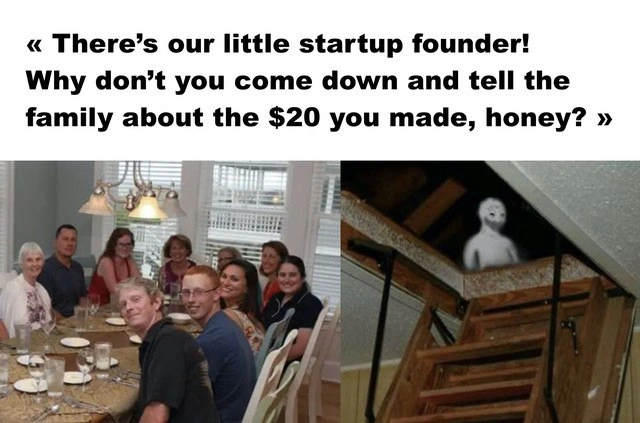
Now, consider the family dinner context. The image on the left shows a family gathered around the table, all looking expectantly at someone – that’s presumably our founder’s family, eager (or nosy) to hear how the startup is going. Family gatherings (especially around holidays) are notorious in startup circles: well-meaning relatives ask things like “How’s your little app?” or “Are you making any money yet, dear?” These questions can feel uncomfortable when the honest answer is “um, barely.” Here the caption has the family say, “Why don’t you come down and tell the family about the $20 you made, honey?” in a sweet but teasing way. They’re treating the founder’s business somewhat like a child’s school project (“Aw, our little entrepreneur!”) rather than a serious company – because from their viewpoint, $20 isn’t a serious income.
The right panel showing the pale ghost-like founder in the attic is a funny exaggeration. It’s as if the founder has been hiding upstairs, maybe working 24/7 in that dark space (hence the pale, spooky look from lack of sunlight and social contact). The founder peeking down the attic ladder looks hesitant and awkward – which is exactly how one feels when you don’t have much to show and everyone’s waiting. In real life, a newbie entrepreneur might literally dread coming downstairs to face curious relatives if things are going slowly. The “attic ghost” visual makes the situation absurd and thus humorous. It implies the founder is almost like a mythical creature living in the house, rarely seen, and now being lured out by the mention of his tiny treasure ($20).
For a junior developer or anyone early in their career, the big takeaway is: startups are hard. Early success is often very small, and that can clash with non-tech folks’ expectations. The meme is popular in tech humor circles because it’s relatable – many developers dream of starting their own app or company, and when they do, they encounter exactly this: tiny wins and a lot of explaining to family and friends who just don’t get why it’s taking so long to “make it big.” It’s a mix of pride (hey, we earned something!) and embarrassment (yeah… only $20). The scene is funny because we sympathize with the founder’s predicament while also recognizing the family’s point of view. In StartupLife, you celebrate any progress, but in the real world outside that bubble, $20 is practically laughable. The meme finds humor in that disconnect, making it a piece of industry satire that newcomers can understand once they know the terms.
Level 3: Burn Rate Blues
This meme drags into daylight a classic startup nightmare scenario: proudly hacking away in an attic on your “billion-dollar idea,” only to get called downstairs at a family dinner to explain why you’ve made just $20 so far. It’s poking fun at the brutal math of early startup life. The founder, shown as a ghostly pale figure lurking at the attic entrance, personifies how transparent your results become when faced with pragmatic family members. In tech circles, founders often speak in terms of user growth, traction, and future unicorn dreams (a unicorn is a startup valued over $1B). But all that venture jargon evaporates at the dinner table, where the only number that matters is actual cash in hand. The caption “There’s our little startup founder… tell the family about the $20 you made” drips with that sarcastic, understanding tone only relatives can pull off. It’s a reminder that outside the startup bubble, revenue is king – and in this case, the crown’s pretty tiny.
From a seasoned engineer-turned-founder perspective, the humor cuts deep. We recognize the subtext about burn rate and runway. The founder’s burn rate is likely hundreds or thousands of dollars a month (servers, software subscriptions, ramen noodles – it adds up) while actual income is literally twenty bucks. That means their venture is underwater financially, hemorrhaging cash to keep the dream alive. Runway is the time before that cash runs out; at this rate, our ghostly friend might have only months left before needing a miracle or a day job. This relatable pain hits home for anyone who’s stretched personal savings or a small seed fund while waiting for revenue to ramp up. The meme exaggerates it perfectly: imagine burning through VC funding personal credit cards at a rate that makes $20 look like a rounding error, yet you’re expected to smile and make it sound like progress over turkey and pie. 😅
There’s also an element of industry satire here. The tech world often glamorizes “sleeping in the office” or hustling in a garage, but in reality many founders end up as attic- or basement-dwelling hermits when money is tight. That ghostly image in the attic isn’t just for laughs – it’s how a startup founder can feel when facing skeptical relatives. Pale from late-night coding marathons and haunted by the opportunity cost of not holding a normal job, the founder peeking out is both comical and painfully accurate. It’s as if he’s thinking, “If I stay up here like a ghost, maybe they’ll forget I exist and not ask about my startup’s performance.” But nope – the family sees right through him (pun intended). They drag him out, shining a light on the contrast between startup hype and reality.
The brilliance of this meme is how it condenses that entire dynamic – StartupCulture optimism vs. cold financial reality – into one scene. At tech meetups, this founder might boast about MVP launches or how their app “is in beta with 500 users in our pipeline.” Yet at home, Grandma or Uncle Bob doesn’t care about “beta users” or “disrupting industries” – they care if you can pay rent. The line “tell the family about the $20 you made” is hilariously blunt. It undercuts all the grand vision with a single data point. Every experienced developer or entrepreneur chuckles (perhaps nervously) because we’ve either lived this or seen it happen: that sobering moment when actual earnings speak louder than any pitch deck. It’s a universal TechIndustryHumor truth that making money is much harder than talking about making money. And the meme captures that with a mix of secondhand embarrassment and affectionate ribbing.
In short, “Burn Rate Blues” is the senior engineer’s wink and nod. It recognizes the absurdity of early-stage startup finances and the social friction it causes. The humor lands so well because it’s founded (no pun intended) on reality: big dreams + small income = an awkward conversation waiting to happen. This is career humor drawn from real life. Seasoned folks in tech have seen promising ideas fizzle, savings evaporate, and founders sheepishly explain to family why they’re working 80-hour weeks for the equivalent of lunch money. The attic-dwelling founder’s $20 isn’t just a random small number – it represents that first trickle of hope, blown out under the spotlight of family expectations. The meme’s dark, knowing chuckle comes from recognizing that gap between “We’re changing the world!” and “I made enough to buy gas for the week.” It’s funny, it’s cringey, and it’s oh-so-real in the startup world.
Description
This is a two-panel meme that contrasts a cheerful family gathering with the isolation of an entrepreneur. The top of the image has text that reads, '« There's our little startup founder! Why don't you come down and tell the family about the $20 you made, honey? »'. The left panel shows a large, happy family sitting around a dinner table, smiling for the camera. The right panel shows a starkly different scene: a pale, ghostly, alien-like figure (a Wojak variant) hiding in a dark attic, peering down a wooden ladder. The meme humorously and painfully captures the social isolation and misunderstanding that many startup founders face. The family's comment, though perhaps well-intentioned, is deeply patronizing, trivializing the immense effort and risk involved in building a business for what is initially very little financial reward. The founder is depicted as a recluse, literally and figuratively above the normal family life, struggling in the dark while their family celebrates conventional success

Comments
7Comment deleted
They don't get it. That $20 isn't just revenue; it's a 100% month-over-month growth in our MRR, which technically makes us the fastest-growing company in this house
Explaining to the family that the $20 is MRR - therefore totally validating an $8 M post-money - is harder than teaching eventual consistency over turkey
After burning through three AWS free tiers, pivoting twice, and achieving a perfect 100 Lighthouse score, you've finally reached profitability... technically. Now if only you could explain to your family why your $20 MRR is actually a 'hockey stick growth trajectory' when viewed on a logarithmic scale with the right time window
When your family asks about your startup's revenue and you realize your AWS bill is still 10x higher than your MRR, but explaining the difference between revenue and burn rate would require a Series A pitch deck and they still think 'the cloud' is just weather
Pre-seed traction update: ARR $240, TAM = 'extended family', CAC = two Thanksgivings, and the attic is rebranded as 'stealth‑mode data center'
Thanksgiving board meeting: founder descends from stealth mode (aka the attic) to report MRR $20, ARR $240, CAC a guilt trip, runway = leftovers - claiming PMF in the “family” vertical
When your SaaS MVP hits $20 MRR and family asks if it's time to 'get a real job' - classic seed-stage validation