Skip to content
DevMeme
4615 of 7435
The Crypto Justice Paradox: Jailed for Code, Free While Under Investigation
Blockchain Post #5063, on Dec 6, 2022 in TG

The Crypto Justice Paradox: Jailed for Code, Free While Under Investigation

Why is this Blockchain meme funny?

Level 1: So Unfair

Imagine two kids on a playground. One kid spent a long time building a really cool new game for everyone to play. Unfortunately, a bully later used that game to do something bad. Now the teacher punishes the kid who invented the game, locking them in time-out. But the bully – who actually hurt others – is still outside, running around free and even laughing. That doesn’t feel right, does it? It feels really unfair. In the cartoon picture, Squidward (inside and sad) is like the kid in time-out – he’s the one who made something. SpongeBob and Patrick (outside having fun) are like the bully who did something wrong but isn’t punished immediately. The meme is funny in a kind of “this shouldn’t happen” way. It makes us laugh a little because it’s a cartoon, but it also makes us think, “Hey, that’s not fair!” The person who only created a tool is the one behind the window, while the person who caused big trouble is playing outside. Even a kid can see something’s not right about that!

Level 2: Privacy Dev vs Crypto CEO

Let’s break down the basics. Tornado Cash is a tool on the Ethereum blockchain known as a “mixing service.” What that means is it lets people mix up their cryptocurrency coins with others to hide the trail – kind of like shuffling cards. If Alice sends 1 ETH into Tornado Cash and Bob sends 1 ETH as well, later they can each withdraw 1 ETH to new addresses, and outsiders can’t easily tell which withdrew coin came from whom. This provides privacy on a public blockchain (where normally every transaction is visible). Such privacy tools are popular in the cryptocurrency world for people who care about anonymity. However, they can also be misused by criminals: for example, if someone hacks or steals crypto, they might put it through Tornado Cash to make it hard for authorities to trace the stolen funds. The “Tornado Cash Dev” in the meme refers to one of the developers (programmers) who wrote and maintained this mixing service’s code.

Now, SBF stands for Sam Bankman-Fried, who was the CEO of a big cryptocurrency exchange called FTX. FTX wasn’t decentralized or on a blockchain; it was a company (kind of like a bank or stock exchange for crypto) where people deposited their Bitcoin, Ether, and other assets to trade. In 2022, FTX famously collapsed in a scandal: it turned out they didn’t have the money they were supposed to have. Billions of dollars of customer funds were missing because, allegedly, SBF’s team had been using customer deposits for risky investments without telling anyone – essentially a huge fraud. This event is often referred to as the FTX collapse. It was one of the biggest failures in crypto industry history (akin to a massive bank failure in traditional finance). Suddenly, a lot of people couldn’t withdraw their money from FTX, and the company went bankrupt. SBF went from being a young billionaire and crypto celebrity to being under serious investigation.

The meme jokes about how these two people were treated. The Tornado Cash developer was arrested by authorities (in the Netherlands) because Tornado Cash was used for money laundering by some bad actors (including, notably, North Korean hackers who stole crypto from a game and laundered it through Tornado Cash). Essentially, the dev is accused of helping criminals, even if indirectly, by providing them a tool to hide their tracks. On the other hand, at the time this meme was made, Sam Bankman-Fried had caused a ton of harm with FTX’s collapse – many regular people and investors lost money – but he hadn’t been arrested yet. He was actually still free, giving interviews and wandering around in public. People in the crypto community felt this was unfair: how come the guy who built a privacy tool is behind bars, while the guy who possibly stole or lost everyone’s money is out in the world?

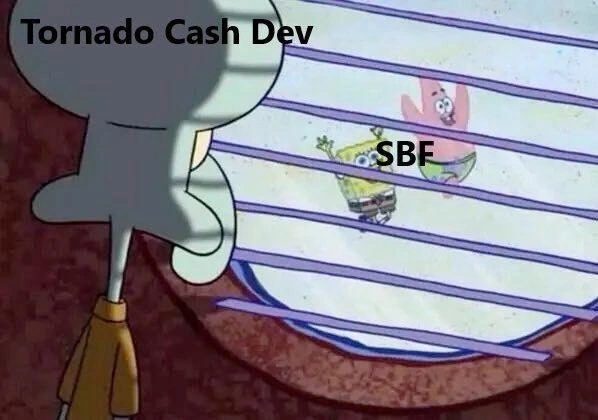
This image uses a SpongeBob SquarePants cartoon scene to illustrate that feeling. In the scene, the character Squidward (the sour-faced squid neighbor) is indoors, peering out sadly from his window. Outside, his two neighbors SpongeBob and Patrick are playing happily. It’s a famous meme format to show someone feeling left out or stuck while others enjoy freedom. Here:

  • Squidward represents the Tornado Cash developer, who is stuck inside (like being in jail or otherwise constrained).
  • SpongeBob and Patrick represent SBF, who is outside and free, having a good time (or in reality, going about life without immediate consequences).

In the text on the image, “Tornado Cash Dev” is over Squidward, and “SBF” is over SpongeBob/Patrick, to make it clear who is who. It’s a simple visual way to say: “The Tornado Cash dev is watching SBF run free.” This comparison highlights a regulatory double standard (meaning two people are being treated very differently by regulators/law enforcement). The meme is both funny and pointed: anyone new to this will recognize the “hey, that’s not fair!” feeling.

For someone early in their tech or finance career, a few key things to know:

  • Blockchain is basically a public ledger (like a database) that records transactions; privacy isn’t built-in, so tools like Tornado Cash add privacy by mixing transactions.
  • Decentralized Finance (DeFi) refers to financial services run by software (smart contracts) on blockchain without central authorities. Tornado Cash is part of DeFi since it’s just code running on Ethereum.
  • FTX was part of the more traditional side of crypto (a centralized exchange) – you had to trust the company and its management (like SBF) to keep your funds safe, and there was supposed to be regulation and oversight similar to a bank or broker, though in practice it failed spectacularly.
  • In many countries, there’s ongoing debate and development of crypto regulation – how to enforce laws on an industry built on decentralized, global software. It’s not always consistent.

So, in summary, this meme is using a SpongeBob cartoon to explain a real-world crypto drama: a developer who made a privacy tool got in big trouble, while a CEO who lost a fortune was, for a time, not in jail. The picture and labels get this point across instantly even to those who just know the basics of what Tornado Cash and SBF are. It’s a stark lesson that in the world of FinTech and crypto, things can be a bit upside-down: sometimes the techies face harsher immediate scrutiny than the finance moguls, which is exactly the opposite of what a newcomer might expect.

Level 3: Double Spend vs Double Standard

This meme hits home for many in tech and crypto because it highlights an industry irony: a glaring regulatory double standard. The image labels Squidward (alone, behind a window) as “Tornado Cash Dev,” and SpongeBob and Patrick (frolicking outside) as “SBF.” In the crypto world, this refers to the contrast between the fate of the Tornado Cash developer and Sam Bankman-Fried (often known by his initials SBF). Tornado Cash is a privacy tool (a mixing service) that lets users obscure crypto transactions for anonymity. Its developer wrote open-source code to enable privacy in decentralized finance (DeFi) – essentially software that anyone could use, good or bad. SBF, on the other hand, was the high-flying CEO of FTX, a huge centralized crypto exchange, and is tied to the infamous FTX collapse where billions in user funds went missing. The humor (tinged with frustration) comes from seeing the developer stuck “inside” (like being jailed), watching the alleged fraudster happily “outside” (still free at the time). It’s a classic case of “the wrong person is punished” that resonates in tech and fintech circles.

To put it plainly: the Tornado Cash dev was arrested (in August 2022, by Dutch authorities) basically for writing privacy-enabling code that others misused for money laundering. Meanwhile, after FTX imploded in November 2022, SBF – who actively mishandled customers’ money – was still roaming free for weeks, doing media interviews and tweeting as if nothing happened. This felt absurdly unjust to the community. It’s the DeFi coder versus the CeFi (centralized finance) CEO. One built a neutral tool (which even has legitimate uses, like financial privacy for law-abiding users), the other built a house of cards that collapsed and hurt millions of people. Yet initially, the law came down harder on the coder.

Why does this happen? The meme hints at systemic issues in crypto regulation. Regulators sometimes act swiftly against things they think facilitate crime directly – like anonymizing tools (hence Tornado Cash got sanctions and its dev jailed) – but can be slower and more cautious in handling high-profile, big-money fraud cases, especially when the person involved had political connections or was a major industry figure. SBF was famous, rubbed shoulders with lawmakers, and donated to campaigns; he wasn’t the kind of guy who typically flees – and indeed, eventually he was arrested, but only after significant delay. The Tornado Cash dev, by contrast, was an easier target: a developer with no powerful allies, implicated in “money laundering tech.” The community saw this as punishing code instead of the criminals who used the code. It’s reminiscent of earlier tech history moments, like when encryption tools were targeted in the 90s (Phil Zimmermann, who created PGP encryption, was investigated for arms export violations because encryption was treated like a weapon). The ethos in tech is that code is speech and tools should not be outlawed just because bad actors exploit them, just as a car manufacturer isn’t jailed because someone used a car in a bank robbery. This meme encapsulates that outrage with a SpongeBob cartoon: a perfect Trope where Squidward is the sour onlooker and SpongeBob/Patrick are obliviously having fun.

Everyone familiar with the SpongeBob “Squidward watching from the window” meme format instantly gets the emotion: Squidward (the Tornado dev) is both jealous and disheartened watching SpongeBob and Patrick (SBF) enjoy freedom. The developer community feels the Tornado Cash dev’s pain – that could be any of us who write code that someone misuses. It raises a chilling question: if you create a blockchain tool that works exactly as intended, are you liable for the way people use it? Meanwhile, someone who blatantly broke trust and possibly laws (like commingling funds in the FTX scandal) might be out there partying or, in SBF’s real case, speaking at a New York Times event. Talk about a “crypto double standard.”

To illustrate the parody of justice, imagine writing it as pseudocode:

def legal_action(person):
    if person.role == "PrivacyDev" and person.code_used_by_criminals:
        return "Arrest immediately"
    elif person.role == "CryptoCEO" and person.lost_billions:
        return "Wait and see"
    else:
        return "No action"

This tongue-in-cheek code reflects how the situation felt to crypto folks: an open-source developer gets the harshest outcome, while a high-flying executive who lost customers’ money initially gets a wait-and-see approach. The meme’s humor is dark: it’s funny because it’s true, in that cynical “of course the little guy gets shafted” way. Within the Blockchain and FinTech community, this image sparked discussions about fairness, legal overreach, and how decentralized tools are treated versus centralized fiascos. It’s a modern tech takedown of the old adage "No good deed goes unpunished": here the “good deed” was improving privacy for users. And the meme format – a beloved cartoon scene used for envy or FOMO – makes the serious message more digestible, even as it underscores real frustration. In short, Tornado Cash’s dev vs. SBF became a meme-able example of perceived injustice: a privacy geek in jail watching a suspected finance villain at liberty.

Level 4: The Elliptic Curveball

On a deep technical level, Tornado Cash is powered by some serious cryptography – specifically zero-knowledge proofs on top of Ethereum. Tornado Cash’s smart contracts use zk-SNARKs (Zero-Knowledge Succinct Non-Interactive Arguments of Knowledge) so that when you deposit some Ether into the mixer, you get a secret note, and later you (or anyone with that note) can withdraw the same amount without anyone being able to mathematically prove the deposit and withdrawal are linked. This is essentially cryptographic anonymization: an application of Merkle trees, hash functions, and elliptic curve math to break the on-chain transaction trail. The meme’s core injustice stems from this math-meets-law intersection. Here, advanced cryptography enables financial privacy (and unfortunately, also money laundering) in a decentralized finance tool, which spooks regulators. The curveball is that writing such code – which by itself is neutral, even elegant – landed the developer in jail. Meanwhile, on the other side, Sam Bankman-Fried’s realm (FTX) wasn’t about fancy math on-chain; it was a classic centralized database of customer accounts, which he allegedly fiddled with. Ironically, the complexity in Tornado’s algorithmic anonymity is not what failed – that math did its job – but it’s what drew regulatory ire. The fundamental computer science notion that “code is law” in blockchain (smart contracts executing exactly as written) ran smack into real-world law, where authorities decided that enabling untraceable transactions was a crime facilitator. This touches on decades-old debates from the Cypherpunk era: can writing an algorithm (like encryption software or a coin mixer) be illegal if bad actors use it? The meme wryly points out that the zero-knowledge magic protecting privacy offered its developer zero leniency from the law, while a centralized actor who simply misused entrusted funds initially got a pass. It’s a clash of algorithmic trust vs. human trust: the Tornado Cash dev trusted math to ensure fairness (no one can cheat the mixer’s rules due to cryptography), whereas SBF asked everyone to trust him and then broke that trust. Yet, paradoxically, the legal system immediately grabbed the math guy and only slowly moved on the human culprit. In theoretical terms, the meme exposes a kind of double standard anomaly: you might call it a “Proof-of-Privacy penalty” versus a “Proof-of-Fraud delay.” It’s as if in the consensus algorithm of society, we reached agreement to punish an open-source protocol implementer faster than a multi-billion-dollar fraud perpetuator. The deep irony tickles those who know the cryptographic underpinnings here: We have impeccably secure algorithms on one side and very insecure business ledgers on the other – and it’s the secure algorithm author behind bars. When math and law collide, the outcome can defy logic, much like dividing by zero in the justice system.

Description

This meme uses the 'Squidward Looking Through Blinds' format from Spongebob Squarepants. Squidward, labeled 'Tornado Cash Dev', is shown indoors, looking sadly and longingly through a window with blinds. Outside, in the bright sunshine, Spongebob and Patrick, labeled 'SBF' (Sam Bankman-Fried), are playing happily and freely. The meme critiques a perceived injustice within the cryptocurrency world. The Tornado Cash developer was arrested and jailed for writing open-source privacy software that was later used by illicit actors. Meanwhile, at the time the meme was likely created, Sam Bankman-Fried, the founder of the collapsed FTX exchange, was under investigation for massive financial fraud but remained free. The humor is dark and cynical, highlighting the irony that a developer who wrote code was treated more harshly by the legal system than the individual at the center of a multi-billion dollar financial scandal
Comments

9
Anonymous ★ Top Pick One guy implements a zero-knowledge proof and gets a subpoena. The other guy implements a zero-knowledge of accounting and gets a book deal. The legal system clearly hasn't updated its dependencies
  1. Anonymous ★ Top Pick

    One guy implements a zero-knowledge proof and gets a subpoena. The other guy implements a zero-knowledge of accounting and gets a book deal. The legal system clearly hasn't updated its dependencies

  2. Anonymous

    Turns out the real compliance nightmare isn’t losing $8B in user funds - it’s committing an open-source mixer to GitHub without a lobbyist.yml

  3. Anonymous

    The real crime was thinking that writing immutable smart contracts for privacy would be treated the same as running a centralized exchange with a backdoor labeled 'definitely_not_customer_funds.py'

  4. Anonymous

    When you realize writing privacy-preserving smart contracts gets you harsher treatment than running a $8 billion fraud - turns out the real crime wasn't losing customer funds, it was making transactions too private. At least SBF got house arrest at his parents' place; the Tornado Cash devs got to experience the ultimate 'deployment to production' - a Dutch prison cell. Nothing says 'decentralization' quite like centralized prosecution of protocol developers while the guy who commingled billions gets to write substack posts from his couch

  5. Anonymous

    Architecture lesson: ship an immutable zk mixer with no admin keys and you own the blast radius; ship a custodial exchange and the blast radius owns everyone - apparently accountability isn’t composable

  6. Anonymous

    Tornado Cash devs: delivering zero-knowledge privacy until the feds demand full disclosure in court

  7. Anonymous

    Apparently the only thing more decentralized than Tornado Cash is accountability - SBF gets a podcast tour; the dev who shipped the zk mixer gets handcuffs

  8. @SamsonovAnton 3y

    Yet another bitcoin meme completely opaque to bystanders?

    1. @neizvestnyi 3y

      Tornado Cash dev was arrested. SBF (FTX exchange main man) wasn't. Tornado Cash did no (afaik) damage. FTX lost shitton of customers' money plus turned the whole market to red.

Use J and K for navigation